IN PROGRESS - NOT FOR PUBLICATION
Lieutenant Harrington Astley TREVELYAN - 11th Hussars
"The Unfortunate Mrs Trevelyan"
According to EJB, Harrington Astley Trevelyan married Henrietta Louisa Harison, daughter of Ambrose Harison, Esq., of Brighton, on the 20th of February 1858. There were two daughters of the marriage, Louisa Trevelyan Harison and Alice Mary.
[PB: This date seems to be wrong.]
One online source, thepeerage.com, says they married 20 May 1858, citing "[S37] BP2003 volume 3, page 3933" i.e. Burke's Peerage, 2003.
However, other sources suggest May 1859.
If so, and since their first child, Louisa, was born early in 1859 and baptised in August 1859, Henrietta gave birth before they married.
Marriage
27th May 1859, Hove, Harington [sic] Astley Trevelyan married Henrietta Louisa Harison. His father's name is shown as Willoughby, and hers as Frederick.
[Source: "England Marriages 1538-1973 Transcription" (findmypast.com). Where is the original?]
Marriage registered
Harington Astley Trevelyan and Henrietta Louisa Harison, Steyning, Sussex, April Quarter 1859. [PB]
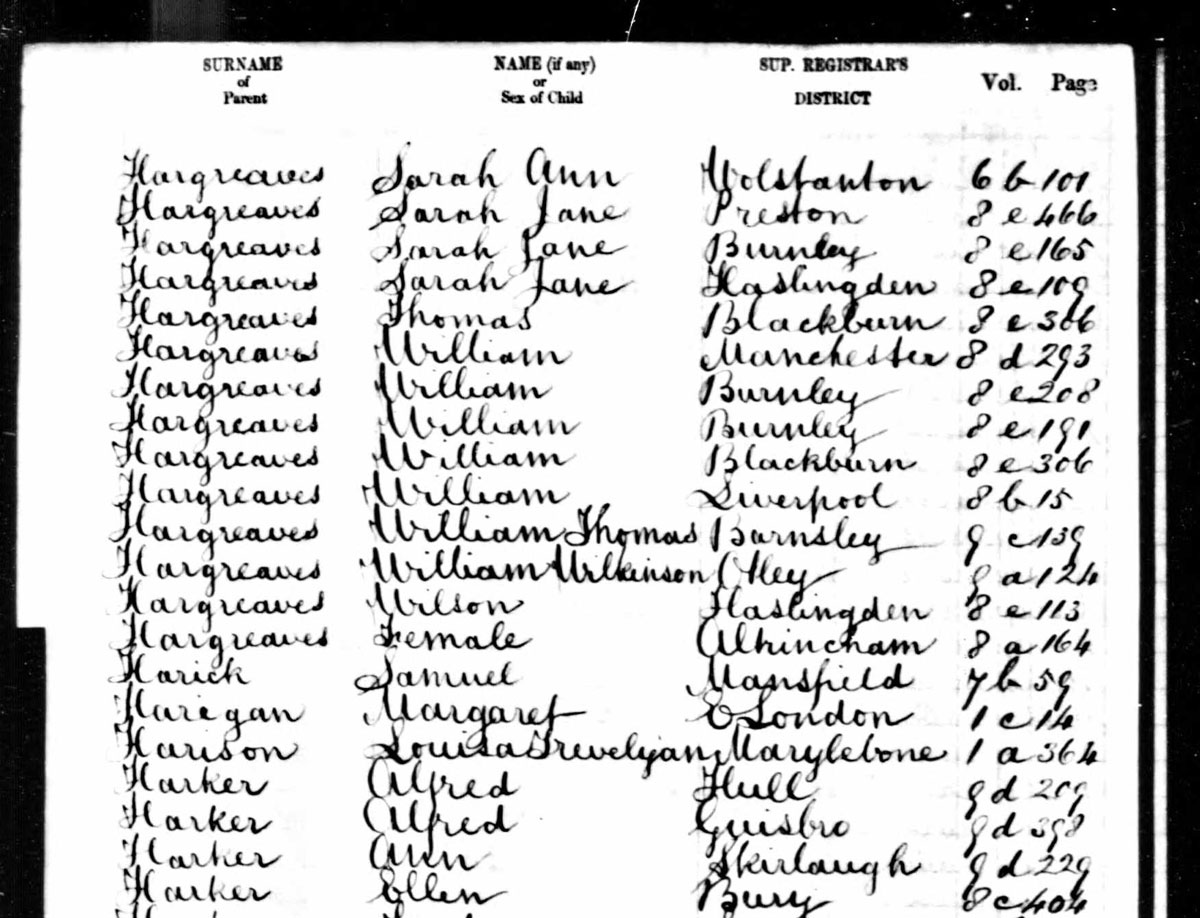
Registration of the birth of Louisa Trevelyan Harison [sic], January Quarter 1859 [FreeBMD Birth Index, 1837-1915]
(Click on image to enlarge)
By the time of her baptism in August 1859, Louisa's parents had married - hence the repetition of "Trevelyan" in Louisa Trevelyan Harison Trevelyan.
Baptism
Louisa Trevelyan Harison Trevelyan [daughter], 19th August 1859, Holy Trinity, Guildford.
Father: Harrington Ashley Trevelyan. Mother: Henrietta Louisa Trevelyan.
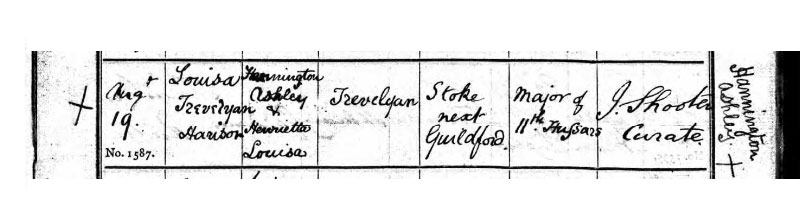
Baptism of Louisa Trevelyan, 19th August 1859, in Stoke next Guildford, Surrey.
Notice her name is given as "Louisa Trevelyan Harison". Also the marginal clarification that the father's given names, smudged in the 3rd column, are "Hannington Ashley", which is of course wrong. Her father is described as "Major 11th Hussars".
(Click on image to enlarge)
[PB - Clarify this note, which I can't find my source for: "Their first child, Louisa Trevelyan, was baptised in Middlesex, in 1859, to Henrietta Louisa Harison, age 19, and Harrington Astley Trevelyan, age 25."]
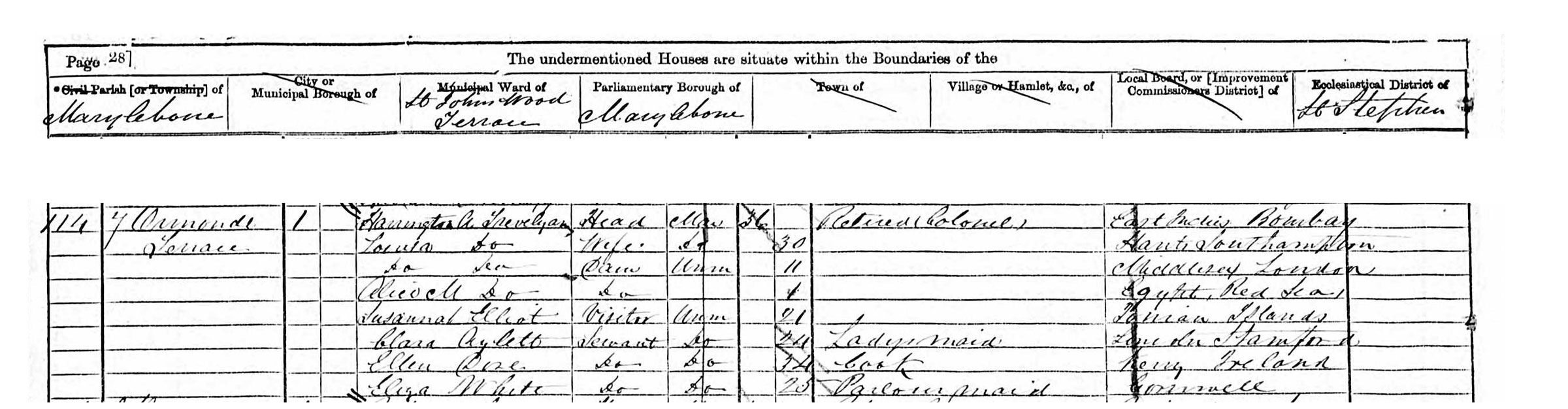
1871 Census: the Trevelyans are together at 7, Ormonde Terrace, St Marylebone (near Regent's Park, facing Primrose Hill). Harrington Trevelyan is described as a "Retired Colonel".
(Click on image to enlarge)
1871 Census
7, Ormonde Terrace, St Marylebone, London.
Harrington A. Trevelyan, Head, Married, 36, Retired Colonel, born Bombay. East Indies.
Louisa Trevelyan, Wife, 30, Southampton, Hampshire.
Louisa Trevelyan,11, London, Middlesex
Alice M. Trevelyan, 1, Red Sea, Egypt.
Susannah Elliot, 21, Visitor, Ionian Islands.
Clara Aylett, 24, Lady's Maid, Stamford, London [?].
Ellen Dose, 34, Cook, Kerry, Ireland
Eliza White, 25, Parlour Maid, Cornwall.
[PB: According to the 1871 Census, a second daughter, Alice Maud Trevelyan, was born about 1870, in the Red Sea, Egypt. She appears to have married Harry Finley Morrier on 10 April 1891.
At some time in the next decade, the Trevelyans' marriage fell apart in a rather dramatic way, leading in the mid-1880s to a numerous court cases, scandalous articles in the nation's press, a couple of terms in prison, and, for Henrietta, mockery, penury and many years spent in London workhouses.
The earliest newspaper report I have come across is from August 1883. Having separated some years previously (probably before 1880), Trevelyan has promised to pay Henrietta £300 a year, to be given to her via Lord Marcus Beresford. Beresford is suing Trevelyan for failing to provide that money. Trevelyan is counter-claiming that he wants the original terms of the separation changed. Clearly Henrietta is demanding that Beresford should provide her with funds anyway, and retrieve them from Trevelyan. She becomes a nuisance, and things get worse.
From The Times, the Globe, and Vanity Fair, 1884:
[PB: good, if poss, to add refs, dates etc. Does this help to explain why Trevelyan removed himself to California? Do the dates match?]
Action brought by Lord Marcus Beresford against Colonel Trevelyan, August 1883:
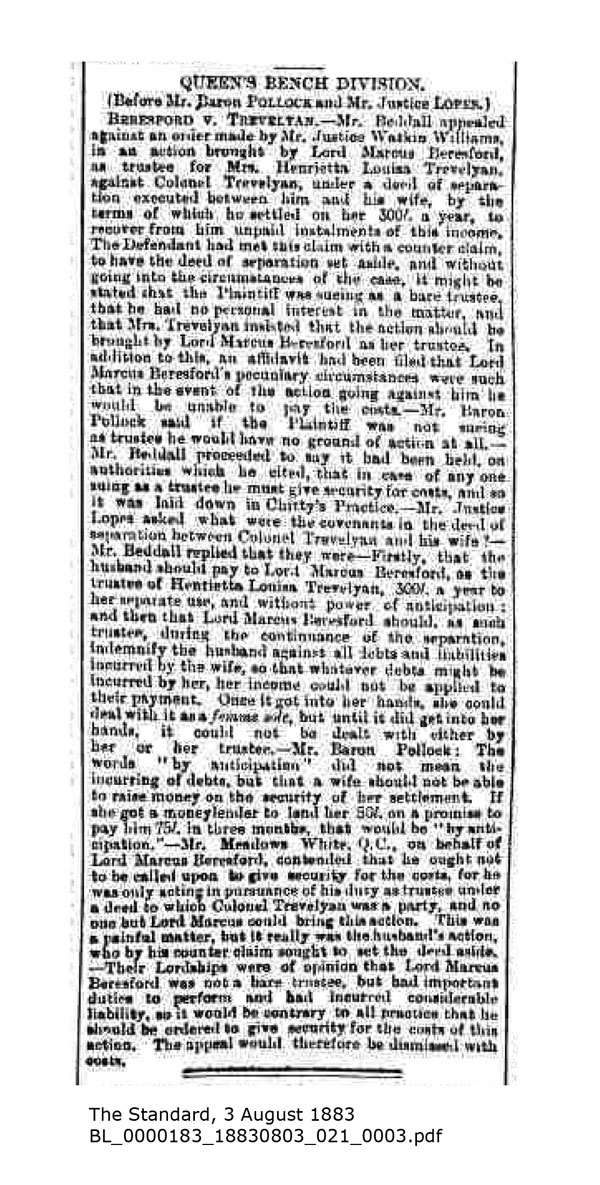
Beresford v Trevelyan, The Standard, 3 August 1883
(Click on image to enlarge)
QUEEN'S BENCH DIVISION.
(Before Mr. Baron Pollock and Mr. Justice Lopen.)
BERESFORD V. TREVELYAN. - Mr. Beddall appealed against an order made by Mr. Justice Watkin Williams, in an action brought by Lord Marcus Beresford, as trustee for Mrs. Henrietta Louisa Trevelyan, against Colonel Trevelyan, under a deed of separation executed between him and his wife, by the terms of which he settled on her £300 a year, to recover from him unpaid instalments of this income.
The Defendant had met this claim with a counter claim, to have the deed of separation set aside, and without going into the circumstances of the case, it might be stated chat the Plaintiff was sueing as a bare trustee, that he had no personal interest in the matter, and that Mrs. Trevelyan insisted that the action should be brought by Lord Marcus Beresford as her trustee. In addition to this, an affidavit had been filed that Lord Marcus Beresford's pecuniary circumstances were such that in the event of the action going against him he would be unable to pay the costs.
- Mr. Baron Pollock said if the Plaintiff was not sueing as trustee he would have no ground of action at all.
- Mr. Beddall proceeded to say it had been held, on authorities which he cited, that in case of any one suing as a trustee he must give security for costs, and so it was laid down in Chitty's Practice.
- Mr. Justice Lopes asked what were the covenants io the deed of separation between Colonel Trevelyan and his wife?
- Mr. Beddall replied that they were - Firstly, that the husband should pay to Lord Marcus Beresford, as the trustee of Henrietta Louisa Trevelyan, £300 a year to her separate use, and without power of anticipation: and then that Lord Marcus Beresford should, as such trustee, during the continuance of the separation, indemnify the husband against all debts and liabilities incurred by the wife, so that whatever debts might be incurred by her, her income could not be applied to their payment. Once it got into her hands, she could deal with it as a femme sole [?], but until it did get into her hands, it could not be dealt with either by her or her trustee.
- Mr. Baron Pollock: The words "by anticipation" did not mean the incurring of debts, but that a wife should not be able to raise money on the security of her settlement. If she got a moneylender to lend her £50 on a promise to pay him £75 in three months, that would be "by anticipation." - Mr. Meadows White, Q.C., on behalf of Lord Marcus Beresford, contended that he ought not to be called upon to give security for the costs, for he was only acting in pursuance of his duty as trustee under a deed to which Colonel Trevelyan was a party, and no one but Lord Marcus could bring this action. This was a painful matter, but it really was the husband's action, who by his counter claim sought to set the deed aside.
- Their Lordships were of opinion that Lord Marcus Beresford was not a bare trustee, but had important I duties to perform and had incurred considerable liability, so it would be contrary to all practice that he should be ordered to give security for the costs of this action. The appeal would therefore be dismissed with costs
[Source: The Standard, 3 August 1883, British Newspaper Archive. [PB]]
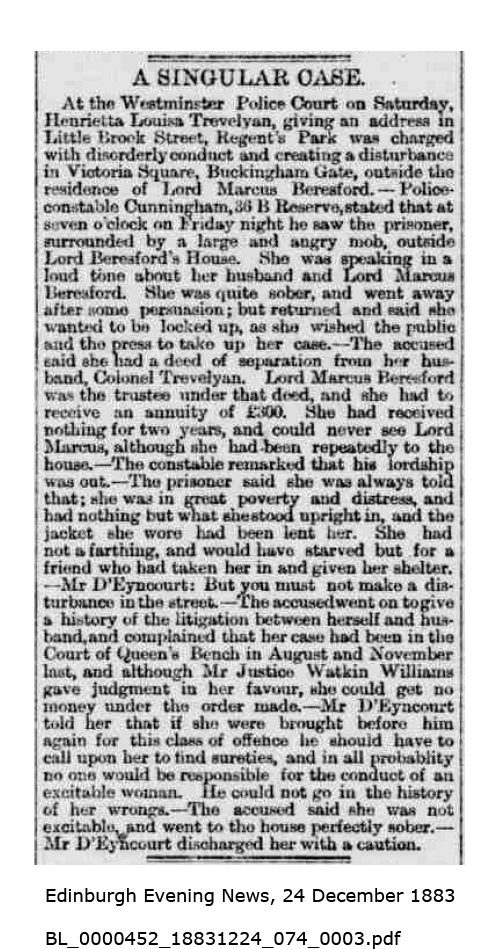
"Scene Outside A Nobleman's House". This is the version that appeared in The Herald, 29th December 1883, but a similar article had appeared in the Edinburgh Evening News, and Freeman's Journal, 24th December 1883.
(BL_0000484_18831229_023_0006.pdf)
(Click on image to enlarge)
"Scene Outside A Nobleman's House . . . Henrietta Louisa Trevelyan . . . was charged with disorderly conduct, and with creating a disturbance, at Victoria square, Buckingham Gate, the residence of Lord Marcus Beresford"
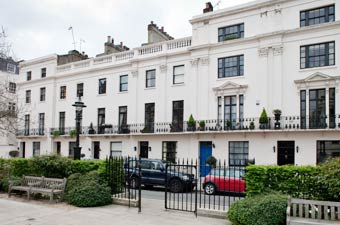
Victoria Square, photographed c.2010. [PB: substitute a better photograph, when one is available.]
Victoria Square, where Lord Beresford lived, is a curious enclave near Victoria Station, and only a few yards from Buckingham Palace. It was built to commemorate the coronation of Queen Victoria in 1837.
(Click on image to enlarge)
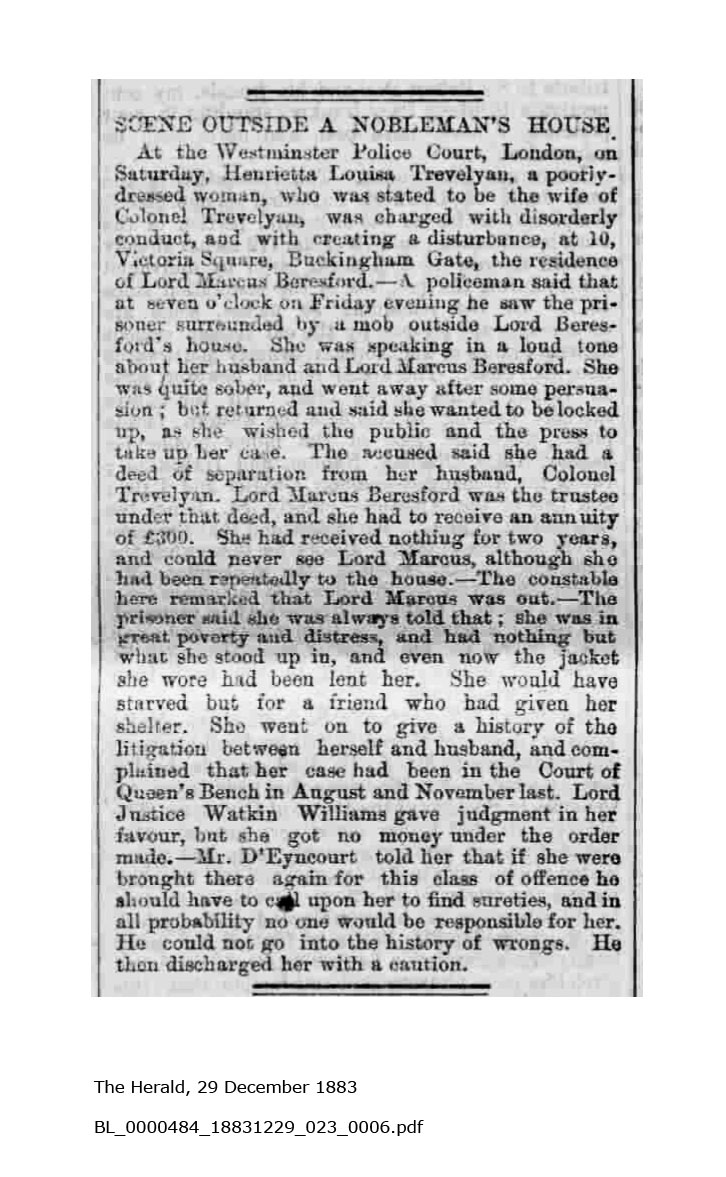
"Scene Outside A Nobleman's House". This is the version that appeared in The Herald, 29th December 1883, but a similar article had appeared in Freeman's Journal, 24th December 1883.
(BL_0000484_18831229_023_0006.pdf)
(Click on image to enlarge)
The following day, which was Christmas, Lord Beresford responded through his solicitors, in London Evening Standard:
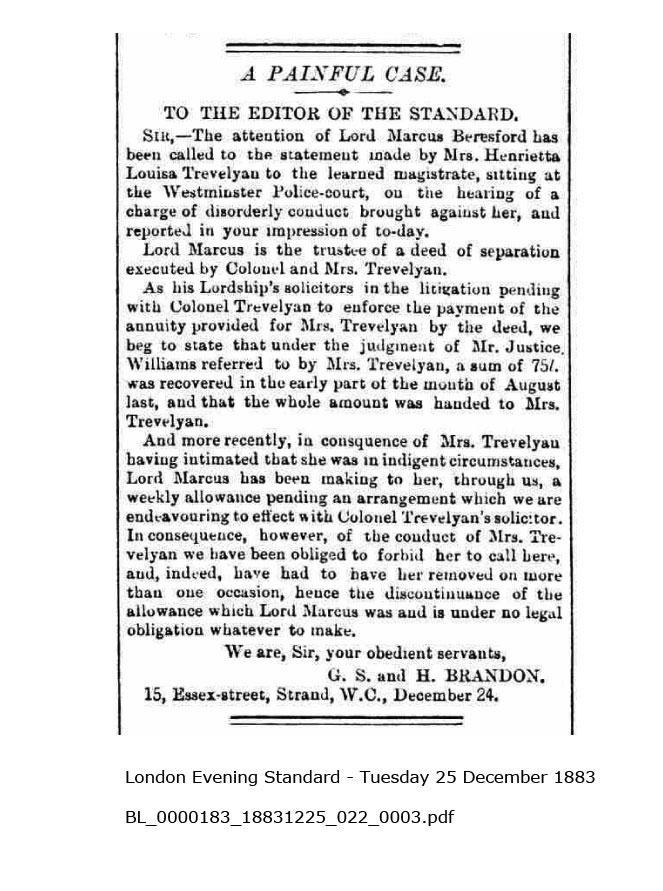
"A Painful Case", 25th December 1883.
(BL_0000183_18831225_022_0003.pdf)
(Click on image to enlarge)
A PAINFUL CASE.
TO THE EDITOR OF THE STANDARD.
Sir, - The attention of Lord Marcus Beresford has been called to the statement made by Mrs. Henrietta Louisa Trevelyan to the learned magistrate, sitting at the Westminster Police-court, on the hearing of a charge of disorderly conduct brought against her, and reported in your impression of to-day.
Lord Marcus is the trustee of a deed of separation executed by Colonel and Mrs. Trevelyan. As his Lordship's solicitors in the litigation pending with Colonel Trevelyan to enforce the payment of the annuity provided for Mrs. Trevelyan by the deed, we beg to state that under the judgment of Mr. Justice Williams referred to by Mrs. Trevelyan, a sum of £75 was recovered in the early part of the month of August last, and that the whole amount was handed to Mrs. Trevelyan.
And more recently, in consquence of Mrs. Trevelyan having intimated that she was in indigent circumstances, Lord Marcus has been making to her, through us, a weekly allowance pending au arrangement which we are endeavouring to effect with Colonel Trevelyan's solicitor.
In consequence, however, of the conduct of Mrs. Trevelyan we have been obliged to forbid her to call here, aud, indeed, have had to have her removed on more than one occasion, hence the discontinuance of the allowance which Lord Marcus was and is under no legal obligation whatever to make.
We are, Sir, your obedient servants,
G. S. and H. BRANDON.
15, Essex-street, Strand, W.C, December 24.
[Source: London Evening Standard, Tuesday 25 December, 1883_BL_0000183_18831225_022_0003.pdf. NEEDS EDIT.]
"She had always acted like a lady when not under the influence of drink"
At Marylebone Court, Louisa Trevelyan, 43, who gave an address at No. 15 Stephen Street, Tottenham Court Road, was charged with stealing on the 28th of February, from No. 10 Little Brook Street, Munster Square, a lady's jacket, value 4/-, being the property of Charles Brown, a master chimney-sweep.
The prosecutor said that about midnight on Tuesday of last week the prisoner came to his house and aroused him by knocking on his door. When he opened it she asked him if he would kindly allow to lodge there for the night, as she had nowhere else to go. The night being very cold, he took her in: but the room she had previously occupied when she lodged with him before was engaged, so he therefore gave her permission to spend the night in his parlour.
He then went to bed, but could not sleep owing to the noise she made. He got up again and went down to her, and found her pulling down the window curtain, destroying other things and behaving in such a disorderly manner that he told her she had better be quiet, or leave the house at once.
She had refused to go, and he was forced to send for a policeman and have her turned out. The next morning he missed the jacket from behind the parlour door. On Thursday evening last he met the prisoner wearing the jacket, and he gave her into custody.
He had been obliged to take these proceedings for his own protection, as the prisoner had become such a source of annoyance to him. For two months she had lodged at this house, and had received many kindnesses at his hands. On the night she came to him she was evidently under the influence of drink.
At Marylebone Court, Louise Trevelyan, of No. 15 Stephen Street, Tottenham Court Road, was charged on remand of stealing a lady's jacket, valued at 4/-, the property of Charles Browne, a master chimney-sweep, living at No. 10 Little Brook Street, Munster Square. At the recent examination of the prisoner it was said that she was the wife of Colonel Trevelyan.
On the night of the 28th February last, she was accommodated with a room at the prosecutor's house, but her conduct was so strange that she was requested to leave, and it was alleged that she then took the jacket away.
The defence was that the prisoner asked for a cloak that she had left in the prosecutor's house, and that in reply, the coat was thrown out to her. P.C. Connell now said that when he was called to the house to eject the prisoner she was talking to the prosecutor in the passage, about a book, and walked out of the house with the jacket on her arm.
She appeared to be perfectly sober, and asked him to direct her to Victoria Station. It was then 3 o'clock in the morning. She was not disorderly, and behaved in a perfectly lady-like manner.
The prosecutor was recalled, and expressed the opinion that when the prisoner came to his house on the night of the 28th ult. she was not sober.
The cloak she was now wearing was left at his house for some time, and she was supposed to have given it to his wife.
She did not ask for that, but for a dictionary. She had always acted like a lady when not under the influence of drink. Mr Cooke said that there was no doubt in his mind that when the prisoner went to the prosecutor's house she was under the influence of drink.
He thought it was also quite possible that the prisoner, whilst in that state, had taken the jacket under the impression that it was hers. He would not agree, however, that the jury should convict her of theft, and he would therefore discharge her.
[Source: ? Dated 15th of March 1884. [EJB] ]
Source? 21st of April 1884
"The lady in the workhouse was the wife of Colonel Trevelyan"
At Marylebone Police Court, Harrington Astley Trevelyan, of No. 1 Clement's Inn, The Strand, was summoned by William Parsons, Relieving Officer of the Marylebone Parish, to show cause why an order should not be made upon him to contribute towards the support of his wife, Henrietta, who became chargeable to the parish from the 28th inst.
Mr Douglas appeared for the Guardians, and Mr Gray defended.
The defendant did not appear in person, and Edward Carden, one of the warrant officers of the Court, proved that he had duly served the summons at No. 18 Montague Street, the last-known address of the defendant.
Mr Cooke asked why the defendant was not there.
Mr Gray said that at present he was abroad, and he represented him.
Mr Parsons deposed that a person named Henrietta Trevelyan had become chargeable to the parish, and at present was an inmate of the workhouse.
Mr Douglas said that he believed Mr Gray was quite ready to assent to an order being made.
There were many reasons why the case should not be gone into at length. It was said that this case had been brought with a view of annoying the defendant.
Mr Cooke then observed that it had not been shown she was the wife of anyone. It must be proved that she was the wife of Colonel Trevelyan.
Mr Gray said he was ready to admit that and on Mr Cooke asking if Mrs. Trevelyan was present.
Mr Chapman said she was not, and Mr Cooke then observed that she ought to be.
Mr Douglas then said that if the case was adjourned for a short time he would have her brought to the Court.
Mr Gray then said that he would admit she was the defendant's wife and on being asked by Mr Cooke if he would go on oath and admit it, was duly sworn. He deposed that he was a solicitor in the offices of the solicitors for Colonel Trevelyan.
The lady in the workhouse was the wife of Colonel Trevelyan.
Mr Cooke said that was sufficient and asked what the sum was.
Mr Parsons said that 7/- per week was the sum; and he could not ask for more.
Mr Cooke then made the order, with £1/7/6d. costs.
[Source: ? Dated 21st of April 1884. [EJB] ]
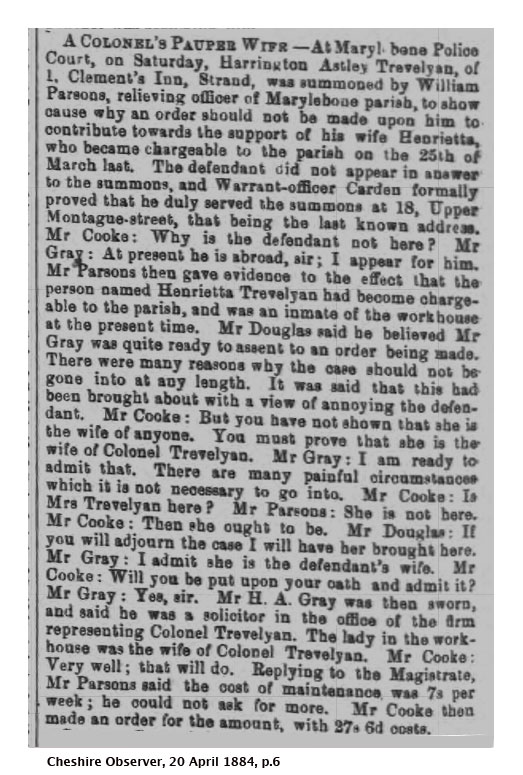
"A Colonel's Pauper Wife", The Cheshire Observer, 26 April 1884
(Click on image to enlarge)
A COLONEL'S PAUPER WIFE
At Marylebone Police Court, on Saturday, Harrington Astley Trevelyan, of 1, Clement's Inn, Strand, was summoned by William Parsons relieving officer of Marylebone parish, to show cause why an order should not be made upon him to contribute towards the support of his wife Henrietta. who became chargeable to the parish on the 25th of March last. The defendant did not appear in answer to the summons, and Warrant-officer Carden formally proved that he duly served the summons at 18 Upper Montague-street, that being the last known address.
Mr Cooke: Why is the defendant not here?
Mr Gray: At present he is abroad, sir; I appear for him.
Mr Parsons then gave evidence to the effect that the person named Henrietta Trevelyan had become chargeable to the parish, and was an inmate of the workhouse at the present time.
Mr Douglas said he believed Mr Gray was quite ready to assent to an order being made. There were many reasons why the case should not be gone into at any length. It was said that this had been brought about with a view of annoying the defendant.
Mr Cooke: But you have not shown she is the wife of anyone. You must prove that she is the wife of Colonel Trevelyan.
Mr Gray: I am ready to admit that. There are many painful circumstances which it is not necessary to go into.
Mr Cooke: Is Mrs Trevelyan here?
Mr Parsons: She is not here.
Mr Cooke : Then she ought to be.
Mr Douglas: If you will adjourn the case I will have her brought here.
Mr Gray: I admit he is the defendant's wife.
Mr Douglas: Will you be put upon your oath and admit it?
Mr Gray: yes sir.
Mr H. A. Gray was then sworn, and said he was a solicitor in the firm representing Colonel Trevelyan. The lady in the work-house was the wife of Colonel Trevelyan.
Mr Cooke: Very well; that will do.
Replying to the Magistrate, Mr Parsons said the cost of maintenance was 7s per week; he could not ask for more.
Mr Cooke then made an order for the amount, with 27s 6d costs.
"He advised her to go away, but she would not, and commenced dancing on the pavement"
Henrietta Louisa Trevelyan, aged 44, who described herself as the wife of Colonel Harrington Astley Trevelyan, was charged at Westminster Police Court with disorderly conduct and creating a disturbance outside of Lord Marcus Beresford's house at No. 10 Victoria Square, Victoria Palace Road.
A policeman called to the house said that he found the prisoner violently ringing the bell and behaving in a very disorderly manner. He advised her to go away, but she would not, and commenced dancing on the pavement.
In her defence she said that she was suffering great deprivation and had been in the workhouse for the past few weeks.
Lord Marcus was her trustee under a deed of separation, but she could get no money.
'I am entitled to £300 a year, but I cannot get it. I have not been to this house for nearly a year and can get no reply to my letters. I have had no money for four years . . . '
She was remanded on bail, and an order was made for Lord Beresford to attend the Court.
[Source: ? 28th of May 1884.[EJB] ]
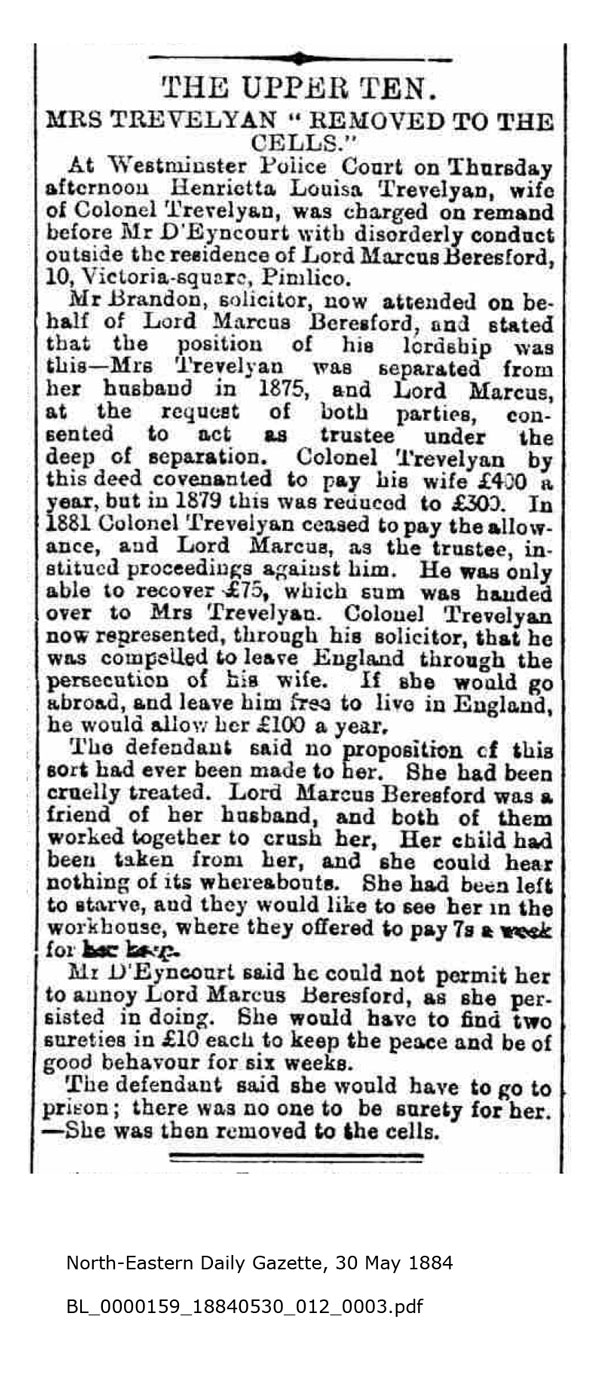
"The Upper Ten: Mrs Trevelyan removed 'to the cells'", 30th May 1884, North-Eastern Daily Gazette (Middlesbrough).
" 'Upper Ten Thousand', or simply, 'The Upper Ten', is a phrase coined in 1852 by American poet Nathaniel Parker Willis to describe the upper circles of New York, and hence of other major cities . . . In 1875, both Adam Bissett Thom and Kelly's Directory published books entitled The Upper Ten Thousand, which listed members of the aristocracy, the gentry, officers in the British Army and Navy, members of Parliament, Colonial administrators, and members of the Church of England." [Source: wikipedia.org/wiki/Upper_ten_thousand (accessed 16 December 2015)]
Source? 30th of May 1884
"Defendant said she was a pauper, and had no friends. No one would be responsible for her, and she was being sent to prison because she asked for justice . . . "
At Westminster Police Court, Henrietta Louisa Trevelyan, wife of Colonel Trevelyan was charged on remand before Mr d'Eyncourt, with unlawfully ringing the bell at Lord Marcus Beresford's house, No. 10 Victoria Square, Pimlico, and with disorderly conduct in the street.
Mrs. Trevelyan stated on Wednesday that Lord M. Beresford was her trustee under a deed of separation, and she could get no money from him for her maintenance.
Mr Brandon, solicitor, now attended on behalf of Lord Beresford and asked that the prisoner really should be restrained from continuing a system of annoyance. His Lordship was a trustee under a deed of separation and up the end of 1881 he had paid Mrs. Trevelyan the allowance made to her.
Lord Marcus actually took proceedings against Colonel Trevelyan to enforce the terms of the agreement, and the only sum received, £75, had been handed over to the wife.
Colonel Trevelyan represented that he had been compelled to leave England in consequence of his wife's persecution; he would however, offer her £100 a year, if she would live abroad.
The defendant said this offer had never been made to her.
Mr d'Eyncourt said her conduct was becoming quite a scandal, and it must be stopped. He had no alternative but to call upon her to find two sureties - two of £10 - to keep the peace, or six weeks in prison. If the offence was ever repeated, than she would have to find bail for a far longer period.
Defendant said she was a pauper, and had no friends. No one would be responsible for her, and she was being sent to prison because she asked for justice . . . She was removed in custody.
[Source: ? 30th of May 1884. [EJB] ]
Vanity Fair, 4th of October 1884
" . . . this poor creature, the wife of a Colonel in the Queen's Army, the niece of a member of the English aristocracy, emerges again from the workhouse only to be clapped into prison"
The unfortunate Mrs. Trevelyan is once again before the public.
Judging her case simply by the newspaper reports, the lady is deserving of very considerable sympathy. Mrs Trevelyan is the wife of Colonel Trevelyan, who lately commanded a crack cavalry corps, and when this gentleman decided to separate from her he did not adopt the usual course of providing for her maintenance through the medium of some discreet solicitor, but executed instead some sort of document settling upon her the sum of £300 a year and appointing Lord Marcus Beresford her trustee.
Why he should have done this is not clear, unless he had intended to provide a moral scourge for his own back in his failing to do that duty by his wife required by the law of the country of him. Yet this is exactly what Mrs. Trevelyan stated has come to pass.
She asserts that her allowance has not been paid to her for some time and that appeals to Lord Marcus have been in vain; in fact, she has been taken into custody on one occasion and sent to prison for creating a disturbance outside of the house of her trustee in Victoria Square, London.
Little by little she has sunk into the most abject poverty; her wretched story has been told in faltering accents whenever she found her way to the Bench; and at length this poor creature, the wife of a Colonel in the Queen's Army, the niece of a member of the English aristocracy, emerges again from the workhouse only to be clapped into prison for an offence she did not commit and is eventually discharged by the magistrates with the remark that "she has suffered enough, and that starvation was the root cause of her misdemeanours."
Enough, indeed. It is high time for the interference of some person armed with legal or social authority. If, as the lady in question asserts, Lord Beresford is her trustee - and it has never been denied - why does he not force Colonel Trevelyan to keep his wife from starvation.
Or, if he feels her powers are not sufficiently ample, why not provide Mrs. Trevelyan with such legal assistance that will enable her to demand and obtain the maintenance which is her right.
[Source: ? 4th October 1884 [EJB]]
[PB: Is the next bit part of a quote? Presumably not.]
Following the article published in Vanity Fair concerning these proceedings, a letter was published in the subsequent issue of the magazine, written much along the same lines, and simply signed 'E.O.P.'
Lord Marcus Beresford took great offence at both, and meeting Mr Bowles (owner and editor of Vanity Fair) outside of his office, demanded to know who was the author.
Bowles refused, and on Lord Beresford striking him in the face with his fist, strongly retaliated and knocking him down.
The latter was later charged with assault, and at the hearing much of what had gone on before in the various police-courts was repeated.
The Earl of Egremont on being called said that he was a relative of Mrs. Trevelyan and after reading the article in Vanity Fair had instructed his solicitor to find her and offer her some help. It was he who had written the letter, enclosing his card, with the intention of getting up some sort of public subscription for her.
Lord Beresford was bound over to "keep the peace."
[Source: ? NEEDS EDIT.]
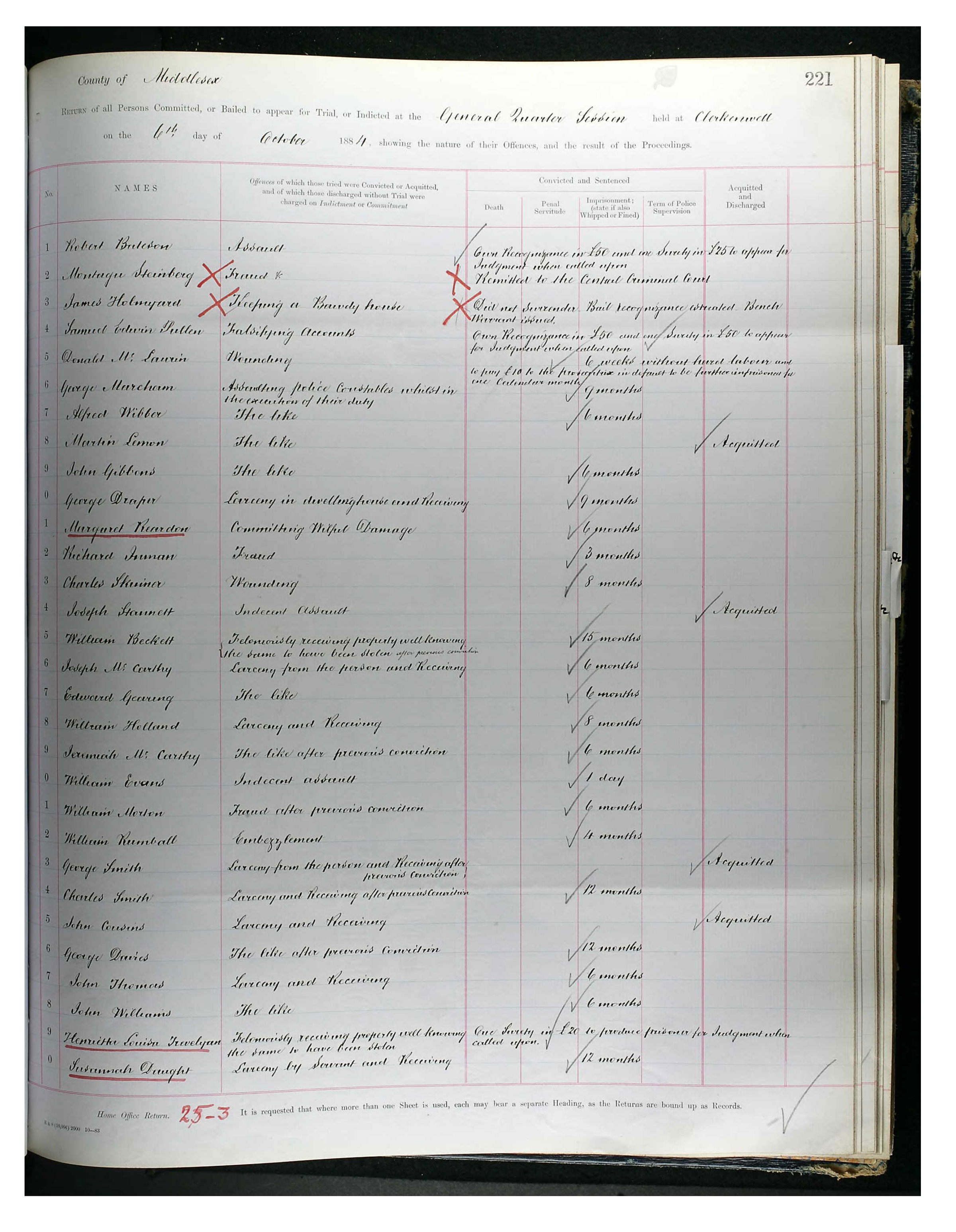
Henrietta Louisa Trevelyan's appearance at the Quarter Sessions, Clerkenwell, 6th October 1884, charged with "Feloniously receiving property well knowing the same to have been stolen." "[One? Own?] Surety in £20 to produce prisoner for Judgement when called upon."
(Click on image to enlarge)
Lloyd's Weekly Newspaper, Sunday 12 July 1885
HAMMERSMITH
Henrietta Louisa Trevelyan was charged with being drunk and disorderly. The Magistrate was informed that there was a summons pending against the Prisoner taken out by her landlady for an assault.
Serjeant Searle deposed that on Thursday evening he was called to a house in Shepherd's-bush-road, where he found the Prisoner down in the area. Mrs. West, the occupant, wished him to remove her, and complained of her having been annoying her for some time by ringing the bell. He requested her to leave and not to return. She did so after using bad language. Half an hour later he found her at the door. She went into the road and defied him, saying she would not go away.
- Mr. Sheil: Was she drunk?
- The Sergeant: Yes, sir, very drunk.
- The Prisoner commenced by stating that the landlade told a falsehood.
- Mr. Sheil (interposing): Were you drunk?
- The Prisoner: I was not; I was sober.
- Mr. Sheil: Perfectly?
- The Prisoner: Yes, I had no money.
- Mr Shiel said the Prisoner had been locked up before for being drunk and disorderly, but not at that court.
The Officer said that was so.
Mr Shiel then sentenced her to be imprisoned for 21 days.[Source: London Evening Standard, Saturday 4th July 1885.]
A slightly abbreviated version appeared nearly a fortnight later in Lloyd's Weekly Newspaper, Sunday 12 July 1885
TREVELYAN SENT TO PRISON
At Hammersmith, on Friday, Henrietta Louisa Trevelyan was charged with being drunk and disorderly. The magistrate was informed that there was a summons pending against the prisoner taken out by her landlady for an assault. Serjeant Searle deposed that on Thursday evening he was called to a house in Shepherd's-bush-road, where he found the prisoner down in the area. Mrs. West, the occupant, wished him to remove her, and complained of her having been annoying her for some time by ringing the bell.
Mr. Sheil (interposing): Were you drunk?
The Prisoner: I was not. I was sober.
Mr. Sheil sentenced her to be imprisoned for 21 days.
[Source: Lloyd's Weekly Newspaper, Sunday 12 July 1885.]
After so many appearances in court and press, it is not surprising that a number of newspapers in 1885 headed their articles "Mrs Trevelyan Again", some adding an exclamation mark:
MRS. TREVELYAN AGAIN!
At the Marylebone Police Court, London, yesterday, Mrs Henrietta Louisa Trevelyan, wife of Colonel Trevelyan, and an inmate of the Marylebone Workhouse, was charged with being drunk and disorderly. A constable said the defendant went to the police station while in a state of drunkenness, and made a rambling statement in regard to the Marylebone workhouse, which could not be understood. The defendant was told to leave the station, but she refused to go away and said she preferred being locked up.
In reply to the charge the defendant said she left the workhouse to see her husband's solicitors. When she returned she could not gain admission. It was quite true that she told the constable she preferred being in custody to being in the workhouse, where she had been an inmate since the 18th August.
She was willing to take a situation as governess if anyone would take her by the hand. She was quite destitute. She had thought it very hard, when her husband was living in Constantinople, that she should have to be in such a place. She thought the constable must have mistaken her condition, as all she had had was a sponge cake and a glass of sherry.
She could not endure being an inmate of the workhouse, for besides the rebuffs she got and the company she had to mix with, she had to put up with gruel for tea, as she was under the age of 60. She often prayed that she might die.
She had been a good wife to Colonel Trevelyan, and did not deserve what she was now enduring. Mr. Slade (the magistrate) reminded the defendant that she had been before the court on previous occasions, sentenced her to one day's imprisonment.
[Source: Bristol Mercury, 14th November 1885.]
MRS. TREVELYAN AGAIN
At the Marylebone Police-court, on Friday, Mrs. Henrietta Louisa Trevelyan, forty-five, described as an inmate of the Marylebone-Workhouse, was charged with being drunk and riotous. Constable Blunt, of the D Division, said the defendant went to the: Marylebone Police-station while in a state of drunkenness, at twenty minutes to ten o'clock on the previous night, and made a rambling statement in regard to the workhouse. As she would not go away she was locked up.
In reply to the charge the defendant said she left the workhouse to see her husband's solicitors, and when she returned she could not gain admission. She told the constable she preferred being in custody to being in the workhouse, where she had been an inmate since August 18th. She was quite willing to take a situation as governess, and thought it hard that she should be destitute and her husband living at Constantinople. The constable was mistaken as to her condition, as she had only had a sponge cake and a glass of sherry.
Besides having to put up with the rebuffs from the company she had to mix with, she had to take gruel for tea, as she was under the age of sixty. She often prayed that she might die. She had been a good wife to Colonel Trevelyan, and did not deserve what she was now enduring. She wished someone would take her by the hand. Mr. Slade having reminded the defendant that she had been before that court on previous occasions, sentenced her to one day's imprisonment.
[Source: Illustrated Police News, Saturday 21 November 1885 (BL_0000072_18851121_015_0003.pdf)]
In the workhouse
From at least 1883, Henrietta Trevelyan was forced to enter a workhouse, chiefly the St Marylebone Workhouse in Northumberland Street. I have found her in workhouse records from 1900 to 1920, but not as yet between 1883 and 1900. I have not yet confirmed the date of her death, but it seems likely she lived in the workhouse for more than 30 years, never leaving except to visit the associated Infirmary, the "Hospital for the Sick Poor" in Rackham Street, Ladbroke Grove.
See Peter Higginbotham's remarkable website, workhouses.org.uk, for detailed information about St Marylebone Workhouse and the Infirmary. It also includes many maps, plans and images.
Christmas in the Workhouse, 1900
In late December 1900 (shortly after her estranged husband's death in California), Henrietta Trevelyan was admitted to Fulham Road Workhouse. (See also Ste George's Poor Law Union.)
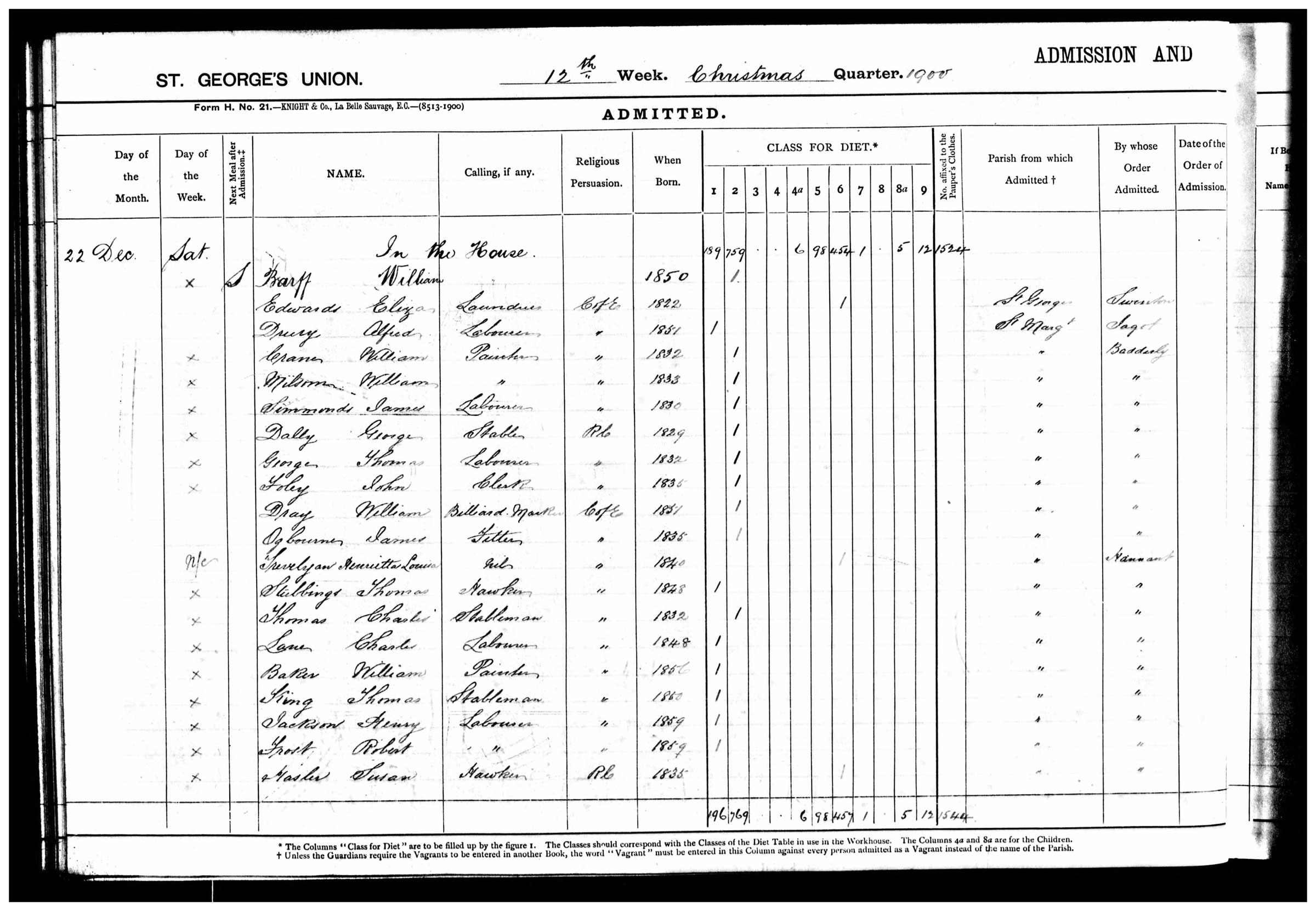
Henrietta Trevelyan admitted to Fulham Workhouse, Christmas 1900
Henrietta Trevelyan is one of 3 women and 17 men listed on this page, and the only person defined as having no prior occupation: "Calling, if any, Nil". The other two women are described as "Laundress", and "Hawker".
(Click on image to enlarge)
Saturday 22nd December 1900, Fulham Road Workhouse, Westminster. Henrietta Louisa Trevelyan, born 1840 [sic], CofE, from St Margaret parish.
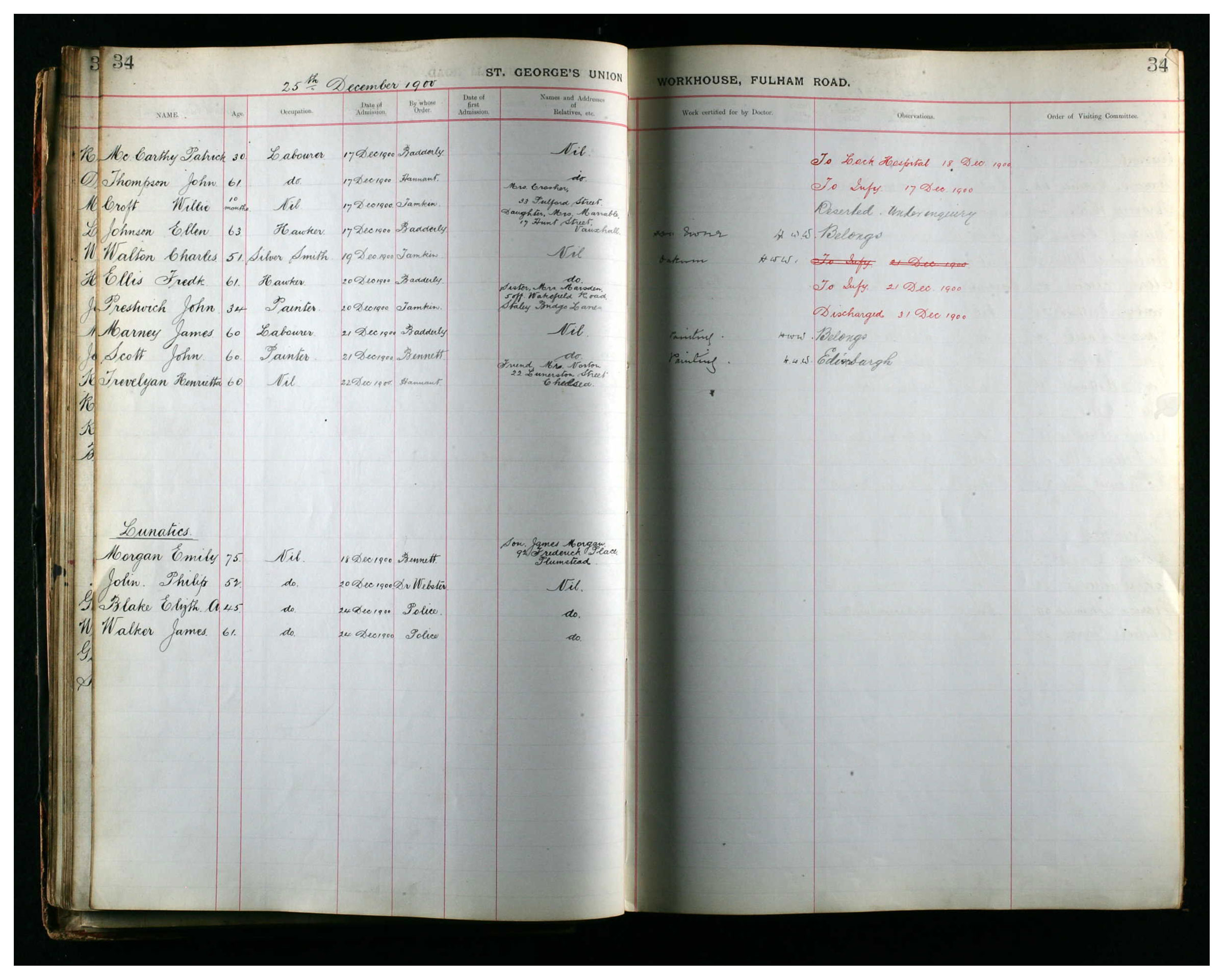
Henrietta Trevelyan in Fulham Workhouse, Christmas 1900
No work is specified ("certified for her by Doctor") for her, e.g. cleaning or oakum-picking. Is this because she is over 60?
(Click on image to enlarge)
St George's Union Workhouse, Fulham Road, 25th December 1900
Trevelyan Henrietta, 60 [sic], Occupation "Nil", 22 Dec 1900, by order of Hannant, Relatives "Friend, Mrs Norton, 22 Limerston Street, Chelsea" [this road runs parallel to Edith Grove between Brompton Road and Kings Road, near World's End], no work is certified for her.
Having spent Christmas in the Fulham Road Workhouse, on 2nd January 1901 Henrietta Trevelyan was discharged at "own request", but was soon back in the Marylebone Workhouse.
1901 Census
Workhouse, Rectory, St Marylebone, London
Henrietta Trevelyan, Widow, 62, Occupation "Nil", born Southampton, Hants. [PB]

"In a woman's ward", 1901 (source?)
[check date and find source = there is a cropped version in St Marylebone Workhouse. ]
(Click on image to enlarge)
[PB: At some time before March/April 1901, she was living in another workhouse, St Marylebone. It seems likely she never left, except to go periodically to the associated Infirmary, the "Hospital for the Sick Poor" in Rackham Street, Ladbroke Grove.]
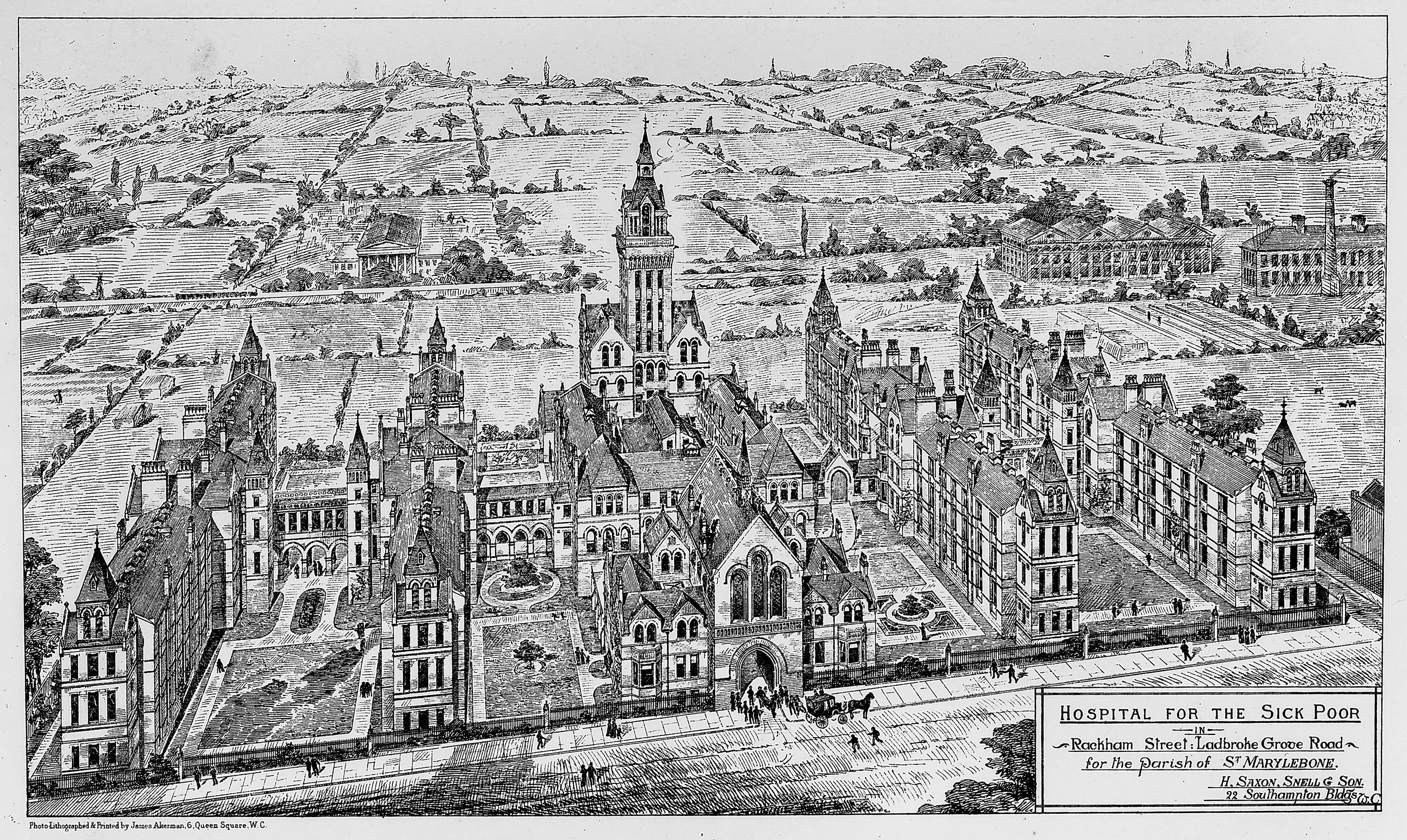
The Hospital for the Sick Poor, Marylebone Workhouse, Rackham Street, Ladbroke Grove, 1881, designed by Henry Saxon Snell and son (photo: Wellcome Library, M0013550)
(Click on image to enlarge)
Follow up
Ladbroke Grove Infirmary (Later St. Charles Hospital) Admission and Discharge Register, 1908-1908: Henrietta or Harriet Trevelyan, age 64, CE, admitted from Workhouse to Infirmary, 17 August 1908 ["No friends"]
Follow up
Ladbroke Grove Infirmary (Later St. Charles Hospital) Admission and Discharge Register, 1909-1910: Henrietta Louise Trevelyan, age 70, discharged to Workhouse, 16 August 1910 ["by cab, with an attendant"]
Monday 20th May 1912, Henrietta L. Trevelyan, born 1843, discharged to the Infirmary from the Marylebone Workhouse, Northumberland Street.
Wednesday 3rd December 1913, Henrietta Louisa Trevelyan discharged to the Infirmary from the Marylebone Workhouse, Northumberland Street.
Wednesday 3rd March 1914, Henrietta Louisa Trevelyan discharged to the Infirmary from the Marylebone Workhouse, Northumberland Street.
22nd January 1915, Henrietta L. Trevelyan, 72, [??], Northumberland Street Workhouse
18th October 1915, Henrietta L. Trevelyan, born 1843, discharged to Infirmary from Northumberland Street Workhouse.
5th December 1917, Henrietta L. Trevelyan, age?, [??], Northumberland Street Workhouse
10th March 1920, Louisa Trevelyan, 74, to Infirmary from Northumberland Street Workhouse.
[PB: The death of a Louisa Trevelyan, aged 73, is recorded in the Kensington District of London, April Quarter, 1923. The age is wrong (Henrietta Louisa, born about 1840, would have been 10 years older), but I suppose this could be her. ]
Further information
Tony Margrave's summary, 2012:
By 1884 he was separated from his wife under a deed of separation by which she was supposed to have been paid £300 p.a. For reasons not known, his wife was admitted to the poor house on March 25, 1884 and in April he was summoned to appear before the Marylebone Magistrates Court to show cause why he should not meet the costs of the local workhouse for the support of his wife. He was out of the country at the time but was ordered to reimburse the costs at the rate of seven shillings a week, back dated.
The case was reported in the Cheshire Observer (Chester, England), Saturday, April 26, 1884. p.6, Issue 1655; The Dundee Courier & Argus (Dundee, Scotland), Thursday, April 24, 1884, Issue 9603; and Western Mail (Cardiff, Wales), Tuesday, April 22, 1884, Issue 4662.
A month later she appeared in the Westminster Police Court (May 28, 1884) for causing a disturbance outside the home of Lord Marcus Beresford. She said she had been in the work house for 6 weeks, denied money under a deed of separation, of which Beresford was a trustee.
The case was reported in The Huddersfield Chronicle and West Yorkshire Advertiser (West Yorkshire, England), Wednesday, May 31, 1884, p. 3, Issue 5250; Manchester Times (Manchester, England), Saturday, May 31, 1884, Issue 1377; Cheshire Observer (Chester, England), Wednesday, May 31, 1884, p. 5, Issue 1660; The Huddersfield Daily Chronicle (West Yorkshire, England), Wednesday, May 29, 1884, p.3, 3; Issue 5248; and The North-Eastern Daily Gazette (Middlesbrough, England), Wednesday, May 29, 1884, Issue 5278.
[Source: Tony Margrave, Newsletter, 33, February 2012. Some of these references have already been included above, but it would be good to check the rest. Although they may simply be recycling news, some may contain fresh information.]
ODD NOTES TO INSERT ABOVE OR DELETE
[PB: If they did indeed marry in 1858 (and not 1859), why are neither marriage nor child recorded in WO25/278? It looks likely that the bride was pregnant at the time of the marriage. Might this have influenced his move from the 11th to the 7th Hussars?]
[PB: Alice Mary born during return to England from India, after HAT left [retired from? transferred to?] his regiment.]
Marriage registered
Harington Astley Trevelyan and Henrietta Louisa Harison, Steyning, Sussex, April Quarter 1859. [PB]
Their first child, Louisa Trevelyan, was born in 1859 [CHECK], in Middlesex, to Henrietta Louisa Harison, age 19, and Harrington Astley Trevelyan, age 25. [More info?]
Baptism
Louisa Trevelyan Harison Trevelyan [daughter], 19th August 1859, Holy Trinity, Guildford.
Marriage
He married, on the 20th of February 1858, Henrietta Louisa, daughter of [John?] Ambrose Harison, Esq., of Brighton. There were two daughters of the marriage, Louisa Hamilton and Alice Mary. The former married Wellington Dale in 1880.
Marriage registered
Harrington Astley Trevelyan and Henrietta Louisa Harison, Steyning, Sussex, April Quarter 1859. [PB]
Marriage
Louisa Harison Trevelyan, 20, of 80 Finchley Road, married Wellington Dale, 28, Solicitor, living in Halston, at the Parish Church, St Mark, St Marylebone, on 31st July 1880. His father is shown as John Dale, Solicitor, and hers as Harington Astley Trevelyan, Colonel. [PB]
[PB: The marriage fell apart rather dramatically, and Henrietta Louisa Trevelyan found herself in court (and in the newspapers) a number of times 1883-1885. Being the "Colonel's Lady" did not protect her: after a number of short terms of imprisonment, she appears to have spent the rest of her life in the Marylebone workhouse.]
"The unfortunate Mrs Trevelyan"
[PB: In one of her court appearances, on 21 November 1885, Henrietta Trevelyan told the court her husband was currently in Constantinople. I wonder why he was there?]
1882: 80 Finchley Road, NW, Harrington Astley Trevelyan was listed as the "occupier of house".
1891: Embarked for New York from Liverpool.
Trevelyan was for some years the manager of the Barton Vineyard Company, Fresno, California, which he managed on behalf of an English syndicate.
[PB: When did he go out to California? One newspaper says 1890. Does it coincide with court cases involving his wife?]
At the Barton Vineyard, California
Tony Margrave:
Lieutenant Harrington Astley Trevelyan, 11th Hussars, was with his regiment in the "Charge of the Light Brigade" in which he was shot in the left leg. Of the "600" men engaged, few of the officers and men present in the Crimea that day can be shown conclusively to have participated but Trevelyan is one of them.
He was commissioned into the regiment on October 17, 1851. He passed to the 8th Hussars in March 1859 and to the 7th Hussars in August of that year. He retired on July 7, 1880 having been breveted a Colonel as early as April 1869.
[Passage about his marriage removed to separate page.]
By 1884 he was separated from his wife under a deed of separation by which she was supposed to have been paid £300 p.a. For reasons not known, his wife was admitted to the poor house on March 25, 1884 and in April he was summoned to appear before the Marylebone Magistrates Court to show cause why he should not meet the costs of the local workhouse for the support of his wife. He was out of the country at the time but was ordered to reimburse the costs at the rate of seven shillings a week, back dated.
The case was reported in the Cheshire Observer (Chester, England), Saturday, April 26, 1884. p.6, Issue 1655; The Dundee Courier & Argus (Dundee, Scotland), Thursday, April 24, 1884, Issue 9603; and Western Mail (Cardiff, Wales), Tuesday, April 22, 1884, Issue 4662.
A month later she appeared in the Westminster Police Court (May 28, 1884) for causing a disturbance outside the home of Lord Marcus Beresford. She said she had been in the work house for 6 weeks, denied money under a deed of separation, of which Beresford was a trustee.
The case was reported in The Huddersfield Chronicle and West Yorkshire Advertiser (West Yorkshire, England), Wednesday, May 31, 1884, p. 3, Issue 5250; Manchester Times (Manchester, England), Saturday, May 31, 1884, Issue 1377; Cheshire Observer (Chester, England), Wednesday, May 31, 1884, p. 5, Issue 1660; The Huddersfield Daily Chronicle (West Yorkshire, England), Wednesday, May 29, 1884, p.3, 3; Issue 5248; and The North-Eastern Daily Gazette (Middlesbrough, England), Wednesday, May 29, 1884, Issue 5278.
Trevelyan became the manager, Barton Vineyard Co, Fresno, California, having been sent out to California in 1887 by the Barton Estate Co Ltd of London which had just bought the Fresno company for $1 million.
A very brief obituary appeared in The Royal Cornwall Gazette, etc., Nov 1, 1900, which records that he was decorated with the Turkish Order of the Medjidie (5th Class) as well as with the Crimean Medal (bars Alma, Balaclava & Sevastopol), as well as with the Turkish Crimean Medal.
[Source: Tony Margrave, Newsletter, 33, February 2012. It would be good to check these newspapers. Although most may simply be recycling news, some may contain fresh information.]
— Harrington Astley Trevelyan, 11th Hussars
— India with the 7th Lancers
— Marriage to Henrietta Louisa Harison
— Barton Winery [to be augmented, edited and possibly combined into one page - perhaps make a separate page of his death in California?]