IN PROGRESS - NOT FOR PUBLICATION
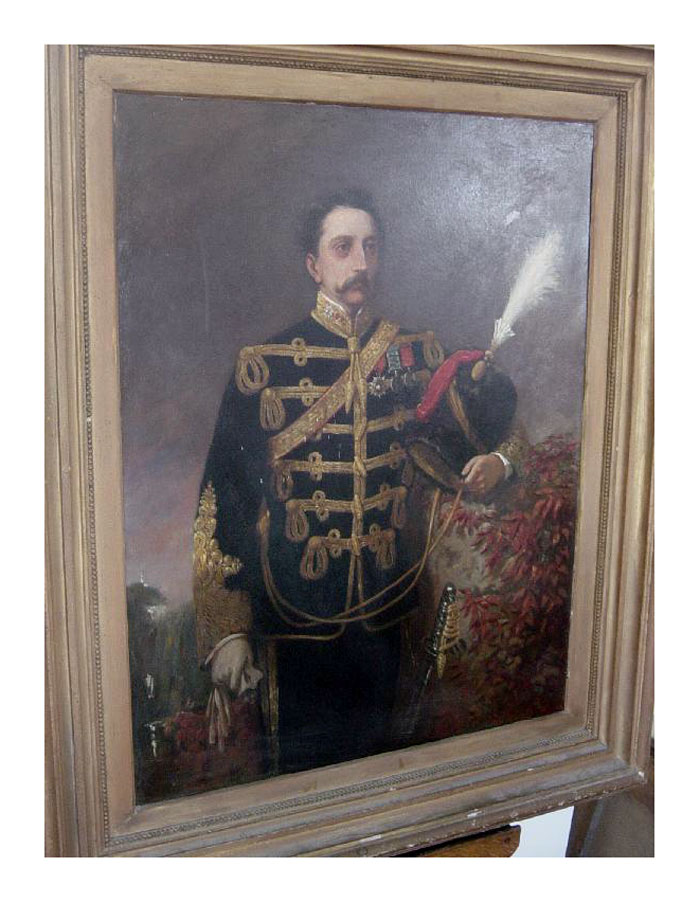
Lieutenant Harrington Astley TREVELYAN - 11th Hussars
The Barton Winery, Fresno, California
Trevelyan was for some years (1890?-1900) the manager or factor of the Barton Vineyard Company, Fresno, California. It appears from contemporary images that the environment roughly resembled the Crimea (which had been a major centre of Russian wine production until the War flattened vineyards). The Central Valley was hot and arid, but major landscaping and irrigation projects - in this case funded by British investors - "seemed to release a magic fertility".
As Thomas Pinney, historian of the US wine industry, has put it:
Agriculture in the Central Valley was never an affair for the small proprietor. Only irrigated farming was possible, and the costs of preparation for that were too great for most individuals: the main irrigation works had first to be provided; then the ground had to be levelled, ditches dug, dikes and levees built, hedges planted, roads made - all before any planting went on . . . .

The bareness of the scene and the large scale of the operations that characterized Central Valley winegrowing are both clearly evident here. (From Jerome D. Laval, As "Pop" Saw It [1975])
(Click on image to enlarge)
The large-scale example set by the pioneer firm of Eisen was followed by a number of other Fresno vineyards and wineries. Among the most notable of these were the Eggers Vineyard, the St. George Vineyard, the Barton Vineyard, and the Fresno Vineyard Company. They may be dealt with briefly.
The Barton Vineyard, founded in 1879, was the showplace of the region, splendid on a level of display that put it high among California attractions. Robert Barton, a former mining engineer, spared no expense to make his new property elegant and handsome in every detail: his fences, his hedges, his pleasure grounds, his winery, his barns, his mansion, his vineyards - all moved the admiration of the journalists who wrote about it: "a princely domain," one called it; "a paradise," said another. Barton had five hundred acres of bearing vineyard by 1884, from which he made both dry and sweet wines from standard varieties such as Zinfandel and Burger; he also had a mixture of other, more exotic varieties for trial, especially for sweet wines.
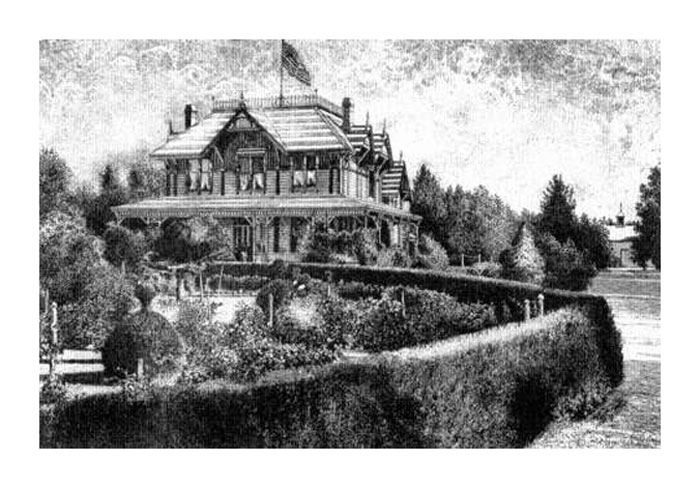
The Barton Estate Vineyard at Fresno, the unchallenged showplace of the Central Valley in the pioneer days; founded in 1879, it was sold only eight years later to a syndicate of English investors for $1 million. To contemporaries, the Barton Estate was "a princely domain" by contrast to the bare flats of the valley around it. (From Frona Eunice Wait, Wines and Vines of California [1889])
(Click on image to enlarge)
In 1887, at the high point of English interest in California vineyard property, Barton sold his estate to a syndicate of English investors for a million dollars - a sensational transaction for Fresno, where winemaking was barely more than a decade old. Unlike the Sunny Slope Winery of L.J. Rose, which was sold to English investors at about the same time, the Barton Vineyard continued to grow; by 1896, as the Barton Estate Company Ltd., it had a capacity of half a million gallons, supplied by over 700 acres of vineyard. Its manager, installed by the English owners, was a Colonel Trevelyan, a survivor of the Charge of the Light Brigade.
[Source: Pinney, Thomas. A History of Wine in America: From the Beginnings to Prohibition. Berkeley: University of California Press, 1989. Available online here (accessed 8.12.15)]

Trevelyan not to be bunkoed: Barton Vineyard Manager Declares War
(Click on image to enlarge)
TREVELYAN NOT TO BE BUNKOED
Barton Vineyard Manager Declares War on Huntington.
Will Have His Freight Hauled by Team to the Valley Railway.
Rates on a Southern Pacific Branch Increased 272 Per Cent Without Notice.
FRESNO, Cal., Sept 21. - Colonel Trevelyan, a survivor of Balaklava, who is managing the big Barton vineyard of 640 acres, near this city, for English capitalists, is now an avowed enemy of the Southern Pacific Company. He announces that hereafter he will turn all of the large amount of freight to the Valley road, and that he will fight Collis P. Huntington on every turn.
When the Southern Pacific employed Marcus Pollasky to act as its secret agent, a few years ago, to build the branch extending from this city to Pollasky on the San Joaquin River, it successfully deceived the people, and Pollasky, representing that it was a private enterprise, obtained liberal concessions from the residents as well as from the Barton estate vineyard company. Then as soon as the rights of way had been procured free of charge, and the people of Fresno had paid a bonus of several thousund dollars, the uisnonest Pollasky turned the road over to the big corporation, he having performed the services for which he was hired.
To show his kind regard for the vineyard company Pollasky had a switch laid from his line to the winery. An arrangement was afterward made to haul freight from the winery into town at the rate of $3 per carload. While this was a convenience to the Barton estate it was a convenience to the neighborhood as well, as local shippers used the line and tho traffic was considerable.
Several days ago Colonel Trevelyan had occasion to ship a car of raisins in to Griffin & Skelley's packing-house, and when he came to pay the freight he was presented a bill of $8 18 instead of $3 - and then the music began. The freight rate had been raissd on him over 272 per cent without notice, either by letter or publication.
While the colonel is a most amiable gentleman and a model of restraint under most trying circumstances this made him "hot." The result is that he means to have the raisins - about 250 tons - hauled to this city by team, and, as the distance is not over three miles, it can be done for about the old rate paid the railroad, with the advantage of having his boxes hauled back.
It is evident that the Southern Pacific thought it had a "cinch" on the freight business of the winery, because the Valley road does noi connect with it. Rates have been raised all along the Pollasky line. This is probably due to the heavy loss in business the Southern Pacific has sustained because of the competing road that the people of the San Joaquin Valley are patronizing so liberally. On the Pollasky branch there is no competition and it seems that the people dependent upon it are to be "squeezed" a little more to make up for the alarming general deficiency.
The arbitrary manner in which the company treated Colonel Trevelyan in raising the rate without notifying him and simply presenting an increased bill has aroused much indignation here.
S.F. Booth, the district agent for the Southern Pacific, was seen to-day. He would make no statement and boldly denied that the rate had been increased.
"I do not see," he said, "why Colonel Trevelyan should have permitted this story to get to reporters. It is not a matter of news and should not be treated as such."
[Source: San Francisco Call, 22 September 1897 (accessed 18.12.2015).]
Yesterdays: Forty Years Ago
Colonel Trevelyan returned from European trip with twenty Anatolian dogs, obtained in Asia Minor, which he placed on the Barton Vineyard to serve as watchdogs. At anyone's approach to an entrance one of the dogs would bark, setting off the whole twenty in a swelling chorus of yelping.
[Source: The Fresno Bee, 29 June 1936, http://www.newspapers.com/newspage/25802843/ (accessed 5.12.2015)]
H. A. Trevelyan - "Colonel" as he was known
H. A. Trevelyan - "Colonel" as he was known - died at sixty-six; was the factor for the British syndicate operating the Barton vineyard and was one of "the noble 600" of Balaclava of the poem. Trevelyan was in fact at the time an ensign carrying dispatches and did not participate in the poetically immortalized charge.
[Source: Paul E. Vandor, History of Fresno County, California, with biographical sketches of the leading men and women of the county who have been identified with its growth and development from the early days to the present (Volume 1). Available online here (accessed 5.12.2015).]