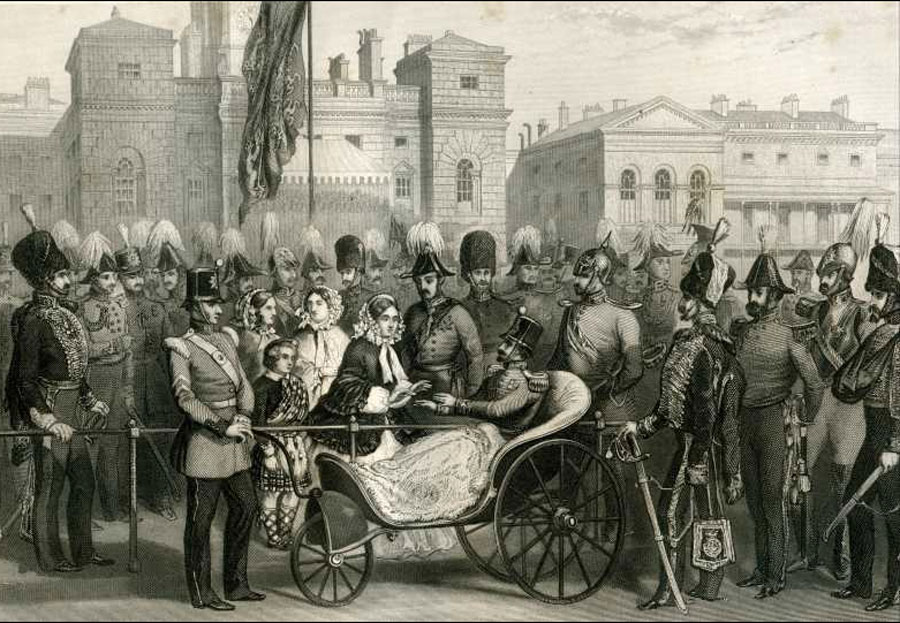
(Click on image to enlarge)
To follow up...
- John Hayward, Diana Birch, John Bishop, British Battles and Medals, Spink (7th edition 2006) [Standard reference, most complete source, excellent photographs]
- Diane Oldman, Crimean War Veterans in Western Australia: Medals awarded for service in the Crimean War etc [probably the best summary]
- CWRS: Illustrated Identification Guide to Crimean War Medals [very brief]
- Wikipedia: Crimea Medal
- Michael Hargreave Mawson, The Crimean War Medal [brief. MHM has written on Crimea medals at greater length, hasn't he?]
- The London Gazette
- North-east Medals:
- Crimea medals at the Fitzwilliam Museum, Cambridge [part of the Lester Watson Collection of campaign and gallantry medals, displayed in a major exhibition on "The Imagery of War" held in 2006.]
- Tony Martin, William Pickering, Arthur Satterley, 'By Order Of Her Majesty', The Crimea Medal, OMRS, December 2017. Can be ordered from OMRS/Lulu Books From publisher's blurb:
The Crimea Medal radically changed the entire process of both the manufacture and distribution of campaign medals forever. Awarding such medals in bulk was a relatively new concept anyway, but pressure from Queen Victoria to issue this one while the campaign in the Crimea was still being fought placed huge strains on those responsible for ensuring that soldiers and sailors received recognition. In the process this created problems for collectors which continue to this day because so many medals were issued unnamed. This fascinating study by a team of three authors looks at the institution of the medal and its clasps, the monarch's influence, the manufacturing process and includes a detailed look at the naming - both official and unofficial - of the medal. It is the most comprehensive study of its kind ever undertaken and is a must for medal collectors and for anyone who is interested in the Crimean War.
- A.F. Flatow, "The British Crimea Medal", Journal of the Orders and Medals Society of America [sic?], June 1955, pp.31-33 (download pdf [cut short?])
- Imagery
- Clasps
- Entitlements
- Naming styles (official, impressed, engraved etc)
- Forgeries and fakes
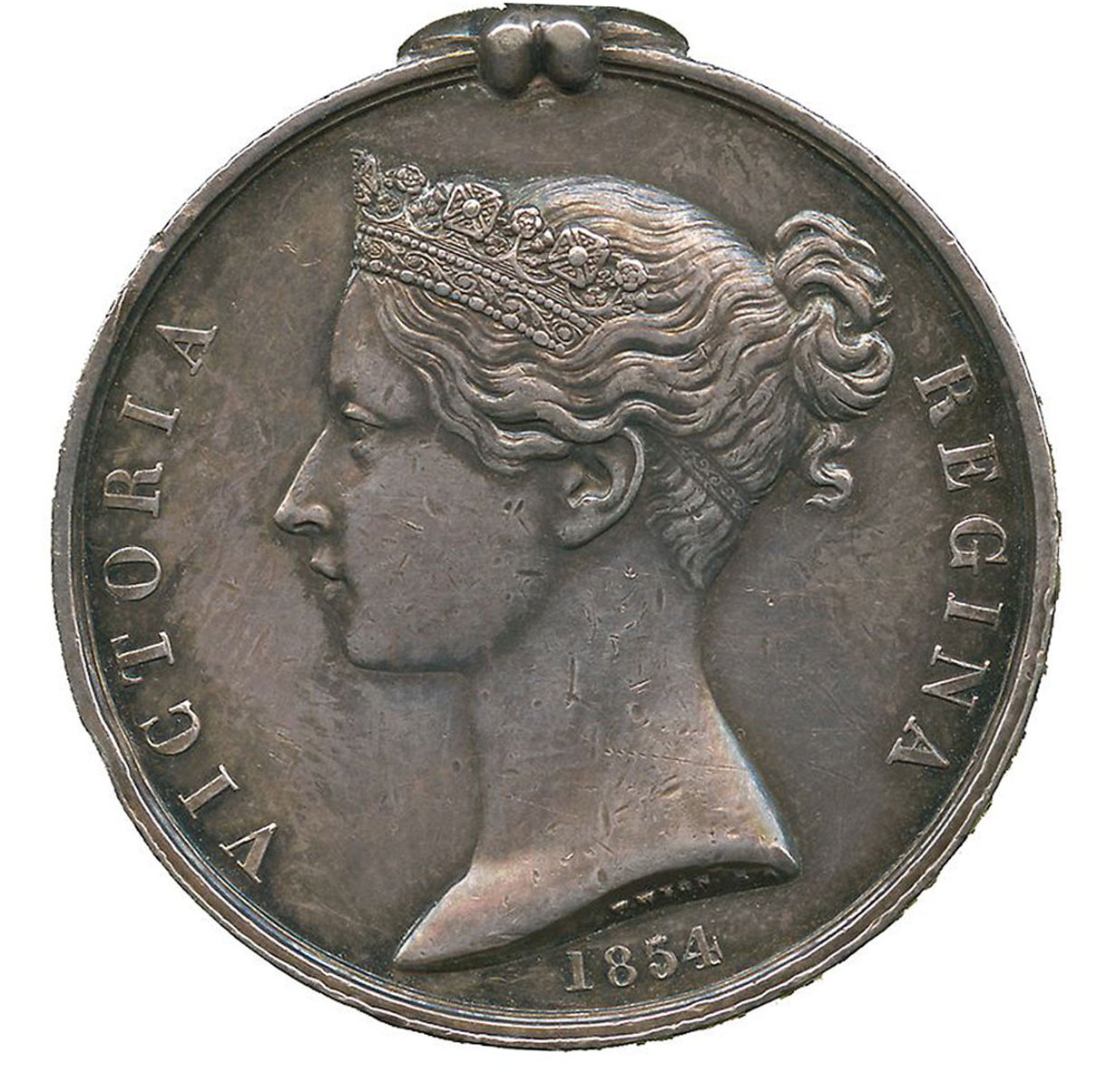
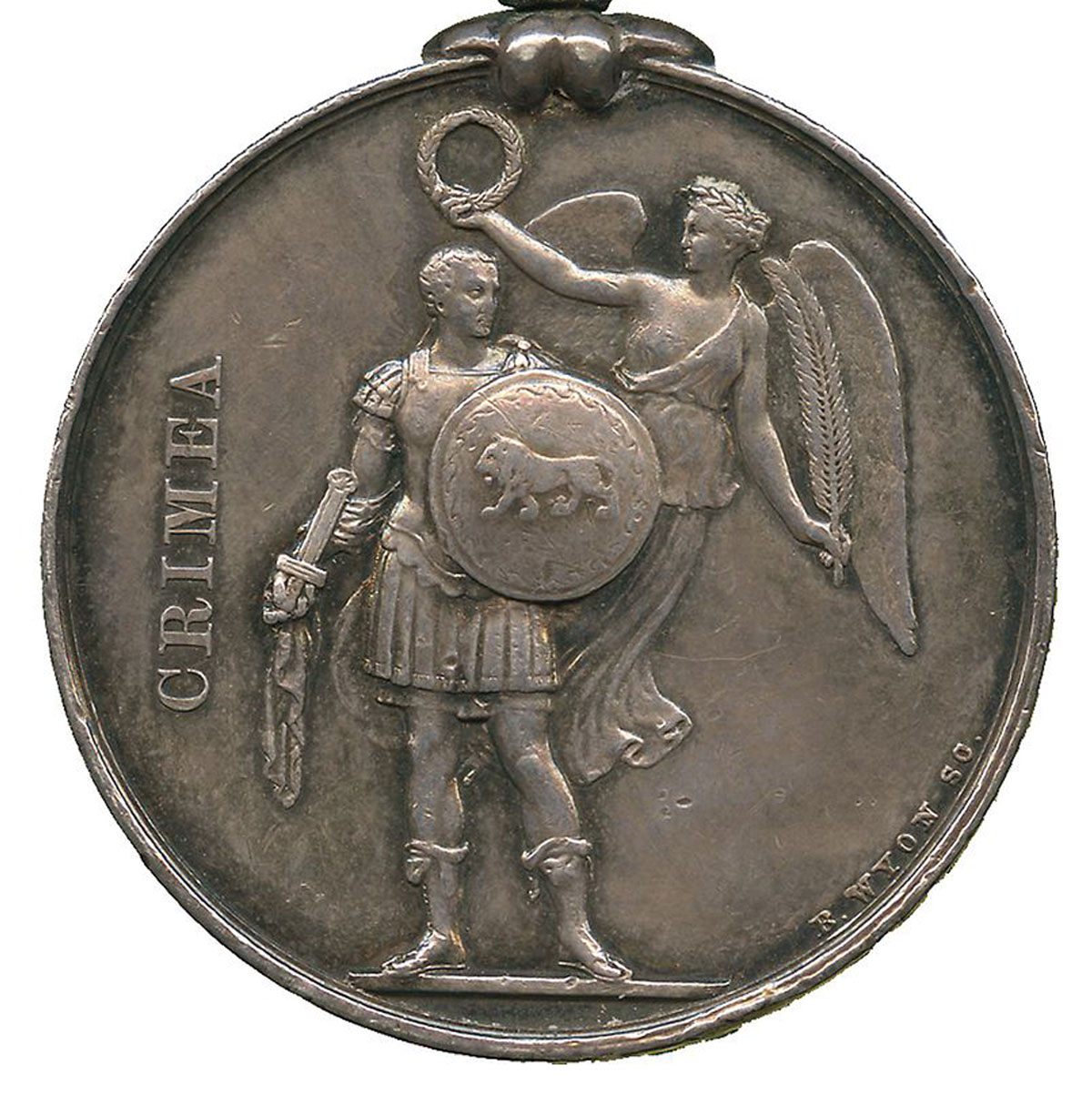
(Click on image to enlarge)
Add notes about imagery
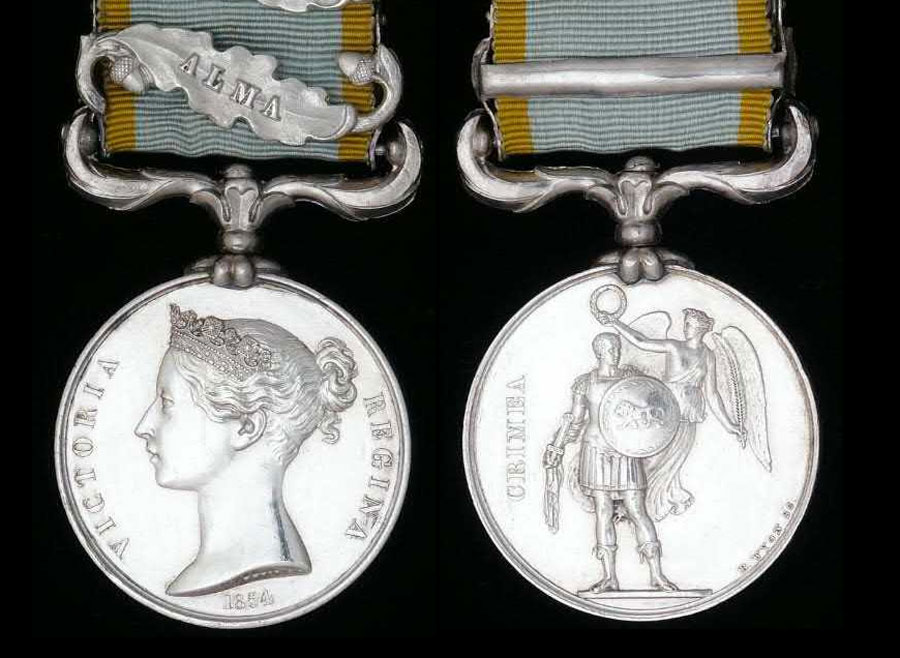
Obverse [head]
Imagery...Victoria Regina [in Latin, of course]...1854... a young [image from when?] Victoria's head...a diadem [mng?]... hair tied with a simple fabric band /ribbon...behind in a loose chignon [?...a knot or coil of hair arranged on the back of a woman's head...her hair is drawn back from her face into a chignon du cou... or is it not a chignon because it's so high off her neck?...[Victoria changed to a bun-in-a-net when she was mourning Albert's death in 1861]
Hairdo: see e.g. https://en.wikipedia.org/wiki/Chignon_(hairstyle)
The chignon can be traced back to ancient Greece, where Athenian women commonly wore the style with gold or ivory handcrafted hairpins. Athenian men wore the style as well, but they fastened their chignons with a clasp of "golden grasshoppers", according to The History of the Peloponnesian War, by Thucydides.[2] The chignon was specific to Athens, as other city states, such as Sparta and Cyprus, had their own style of hairdressing.
Male writers of the Victorian era, like Anthony Trollope e.g. He Knew He was Right [], were fond of poking fun at the absurdity of the fashion, which was much in vogue in England in the 1860s.
(Click on image to enlarge)
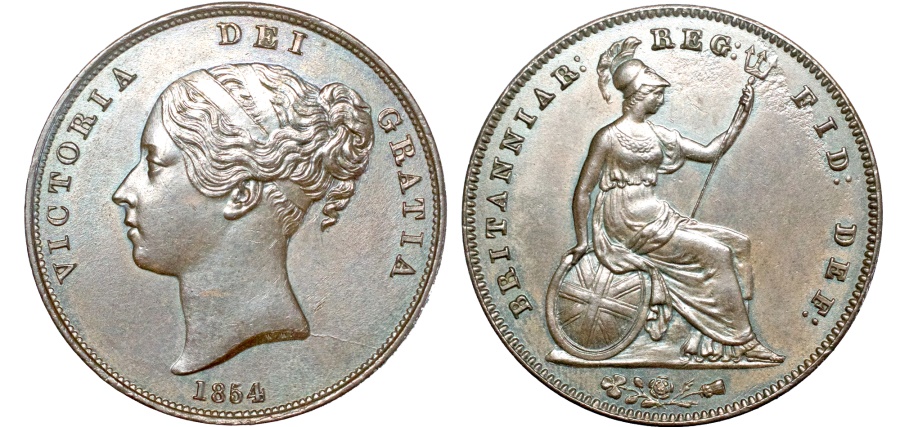
Is the front of the medal in effect a big silver penny? Also akin to postage stamp... NB the ubiquity of the "young Victoria" image...what branding!