Added 15.9.11. Minor edits 28.11.11, 5.4.14. Information added 20.4.14.
Build 5 — 15 September 2026
IN PROGRESS — NOT FOR PUBLICATION
1120, Private Benjamin SOLEY — 17th Lancers
Birth & early life
Born in Ealing on the 18th of April 1831.
The Parish Records of St. Mary's, Ealing, show Benjamin Soley was baptised there on the 12th of May 1833 by the Revd. W. Peart, Curate. He was the son of Benjamin Soley, a labourer, and his wife Harriet. No date of birth is recorded (this was usual at this period). He was one of five known children born into the family (three boys and two girls), he being the second son.
[CP, April 2014: thanks to the recent greater availability of census data, it now seems there were 8 children: 3 girls and 5 boys.]
[PB: What might explain the fact that his family was living in the barracks, but his father was employed as an agricultural labourer?]
Death registered
Harriett Soley [sister], December Quarter 1842, aged 3, Brentford.
1851 Census
Caroline Place, Ealing.
Benjamin Soley, 48, Farm Labourer, born Datchett, Bucks.
Harriett Soley, 45, born Ealing.
Charlotte Soley, 20, Out of Service, born Ealing.
Benjamin Soley, 18, Labourer, born Ealing.
Robert Soley, 16, Labourer, born Ealing.
William Soley, 14, Bird Boy [i.e. employed scaring birds from crops], born Ealing.
Henry Soley, 7, Bird Boy, born Ealing.
James Soley, 3, born Ealing.
Enlistment
Enlisted at the old Regimental Depot in Mount Avenue on the 11th of May 1852.
Age: 19.
Height: 5' 9".
Trade: Labourer.
Service
"Absent" on the 19th/20th of March 1853, as a result of which he forfeited 2 days' pay, and was "In cells" from the 21st to the 27th of March.
Severely wounded in action at Balaclava, 25th of October 1854.
At Scutari General Depot from the 10th of May and sent to rejoin the regiment on the 24th of May 1855.
Embarked for India from Cork aboard the S.S. "Great Britain" on the 8th of October 1857.
The musters for July-September 1858 show him as being "On Field Service" from September of the period
Discharge & pension
Discharged, "time expired, and on the completion of his limited engagement", from Colchester on the 27th of May 1865.
Served 13 years 17 days.
In Turkey and the Crimea: 2 years. In India: 7 years 1 month, although his documents credit him with an additional six months service there.
Conduct: "Good — and temperate".
In possession of two Good Conduct badges (awarded in January of 1861 and 1863). Never tried by Court-martial.
Intending to live at Ealing, Middlesex on discharge.
Medals
Entitled to the Crimean medal with clasps for Alma, Balaclava, Inkerman, and Sebastopol, and the Turkish medal.
Can find no trace on the Mutiny medal roll, although his documents credit him with it.
Commemorations
Member of the Balaclava Commemoration Society in 1877 and 1879.
Signed the Loyal Address to the Queen in 1887.
Attended the Annual Dinners in 1890, 1892, 1893, 1895, 1897 and 1899.
He appears on a photograph taken after the Dinner in 1890 at Alexandra Palace. (There is a copy in the 17th Lancer files. This will eventually be scanned and uploaded.)
He was known as "Any Old Iron", from his habit of singing this song at the Annual Dinners.
Any old iron?
Any old iron?
Any, any, any old iron?
You look sweet, talk about a treat,
You look dapper from your napper to your feet.
Dressed in style, brand new tile,
With your father's old green tie on.
But I wouldn't give you tuppence for your old watch chain,
Old iron, old iron.
[Did Benjamin Soley really sing this song, which appears to have been written some years after the Annual Dinners he attended? It would be good to know the source of the claim. For background research on the song itself (songwriters, actual recording date) see my Notes - Any Old Iron.]
He was a pensioner of the Roberts Fund, from which he received a total of £49/17/6d.
In 1890, he received £20 from the Light Brigade Relief Fund. [CP]
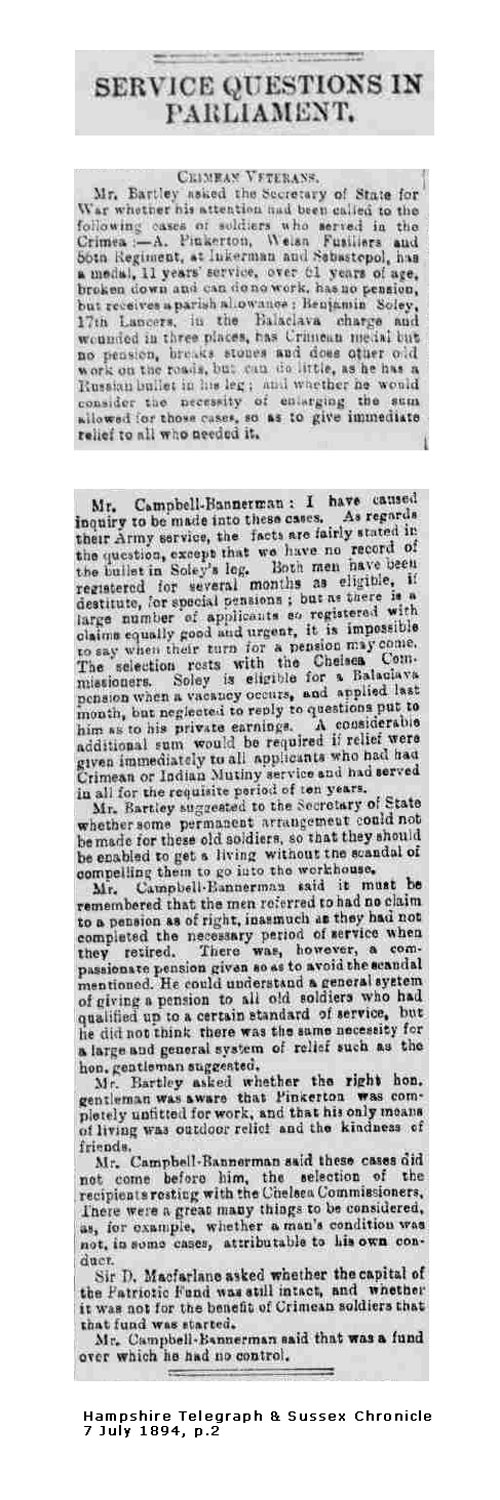
In 1894 Soley's decline, and absence of an army pension, was raised in the House of Commons, as reported in the Hampshire Telegraph & Sussex Chronicle, 7th of July 1894, p.2:
Benjamin Soley, 17th Lancers, Parliamentary Question 1894.
“Service Questions in Parliament”
Crimean Veterans. Mr. Bartley asked the Secretary of State for War whether his attention had been called to the following cases of soldiers who served in the Crimea:—A. Pinkerton, Welsh Fusiliers and 56th Regiment, at Inkerman and Sebastopol, has a medal, 11 years' service, over 61 years of age, broken down and can do no work, has no pension, but receives a parish allowance; Benjamin Soley, 17th Lancers, in the Balaclava charge and wounded in three places, has Crimean medal but no pension, breaks stones and does other odd work on the roads, but can do little as he has a Russian bullet in his leg; and whether he would consider the necessity of enlarging the sum allowed for those cases, so as to give immediate relief to all who needed it.
Mr. Campbell-Bannerman: I have caused inquiry to be made into these cases. As regards their Army service, the facts had been fairly stated in the question, except that we have no record of the bullet in Soley's leg. Both men have been registered for several months as eligible, if destitute, for special pensions; but as there is a large number of applicants so registered with claims equally good and urgent, it is impossible to say when their turn for a pension may come. The selection rests with the Chelsea Commissioners.
Soley is eligible for a Balaclava pension when a vacancy occurs, and applied last month, but neglected to reply to questions put to him as to his private earnings. A considerable additional sum would be required if relief were given immediately to all applicants who had had Crimean or Indian Mutiny service and had served in all for the requisite period of ten years.
Mr. Bartley suggested to the Secretary of State whether some permanent arrangement could not be made for these old soldiers, so that they should be enabled to get a living without the scandal of compelling them to go into the workhouse.
Mr. Campbell-Bannerman said it must be remembered that the men referred to had no claim to a pension as of right, inasmuch as they had not completed the necessary period of service when they retired. There was, however, a compassionate pension given so as to avoid the scandal mentioned. He could understand a general system of giving a pension to all old soldiers who had qualified up to a certain standard of service, but he did not think there was the same necessity for a large and general system of relief such as the hon. gentleman suggested.
Mr. Bartley asked whether the right hon. gentleman was aware that Pinkerton was completely unfitted for work, and that his only means of living was outdoor relief and the kindness of friends.
Mr. Campbell-Bannerman said these cases did not come before him, the selection of the recipients resting with the Chelsea Commissioners. There were a great many things to be considered, as, for example, whether a man's condition was not, in some cases, attributable to his own conduct.
Sir D. Macfarlane asked whether the capital of the Patriotic Fund was still intact, and whether it was not for the benefit of Crimean soldiers that that fund was started.
Mr. Campbell-Bannerman said that was a fund over which he had no control.
He is shown as having been awarded a "Special Campaign Pension" (no date given, but probably in the early 1890s). The comment on his being "wounded in three places" is borne out by an entry in the Casualty Lists as being "Wounded severely", but doubts must arise as to their severity, as he was present at the battle of Inkermann only eleven days later, and there is no entry in the muster rolls as to his having been sent to Scutari after Balaclava.
Further detailed medal information archived.
Life after service
Marriage registered
Benjamin Soley to Matilda Nicholls, December Quarter 1865, Brentford.
He married Matilda Nicholls at Christ Church, Ealing, on the 26th of November 1865. He is shown on the marriage certificate as 30 years of age, a bachelor, a Labourer and former Soldier. His father was named as Benjamin Soley, a Labourer. His wife was then aged 25, a spinster and Servant. Her father is named as James Nicholls, a Gardener. (There is a copy of this in the "Certificates" file. This will eventually be scanned and uploaded.)
Births registered
Charles Soley, September Quarter 1870, Wandsworth.
[PB: Why Wandsworth and not Battersea?]
Louisa Soley, March Quarter 1875, Brentford.
Nellie Soley, 1877, Brentford.
Emma Soley, December Quarter 1880, Brentford.
Phillis Soley, March Quarter 1883, Brentford.
1871 Census
22, Everett Street, Battersea.
Benjamin Soley, 37, Labourer, born Ealing.
Matilda Soley, 30, Southall.
Charles Soley, 10 months, Battersea.
One visiting relative was also included.
[PB, April 2014. These notes need to be tidied up:
We can see from the 1871 Census and the ages and birthplaces of his children that Soley moved to Nine Elms, Battersea, a few years soon after his discharge in 1869. Why?
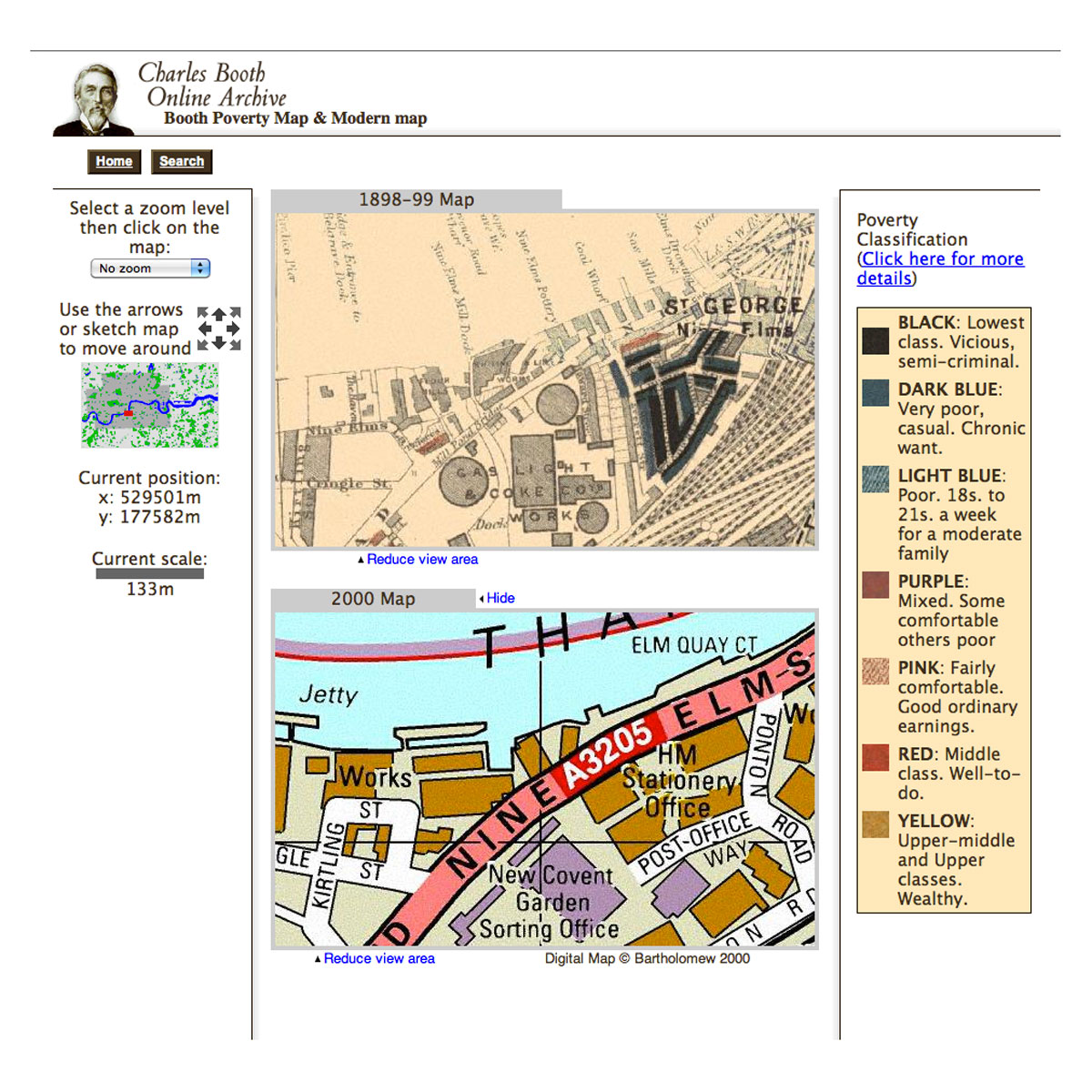
Everett Street was one of small enclave of poorly built back-to-back houses surrounded by the Thames, the Nine Elms Brewery, the notorious London Gas Light Works (where a number of men had been killed in an explosion in 18[??]), and the London & South Western Railway. Everett Street itself backed onto the [?]-foot wall that surrounded the works.
It was locally described as an "island", an impenetrable area spiralling into slumdom, bounded to the north by the Thames, to the east by the immense gasworks (17 acres? high wall? and to the south and east by the railway.
[A] warren of streets was sandwiched from 1862 between the London Gas Light Works, the Nine Elms Brewery. This impenetrable warren of streets spiralled into slumdom, earning the nickname of the 'island' and the scrutiny of reformers.]
As Charles Booth put it in 1902, quoting the notes taken a few years earlier by one of his researchers who had toured the area with a local policeman:
"The houses are two storey and flush with the pavement . . . The streets . . . all show the usual signs of squalor in an exaggerated form: broken windows, filthy cracked plaster, dirty ragged children, and drink-sodden women. Several of the children were without shoes and stockings, one girl of about five with nothing on but a shirt (it was summer), and the police say that it is quite common to see the small children running about stark naked.
The original notes add:
"In hot weather the people, especially in Everett St and in the Gas Works will often bring Mattresses out and sleep in the street "
"[I]n spite of the dirt the children as [?] looked well fed and healthy . . . Many if not most of the inhabitants of them streets earn good wages as gas workers, coal porters, cotiers?, etc, and almost the sole cause of their destitution is drink."
So perhaps the explanation is to be found in the cheapness of the rents and the abundance of work available in the area, even to unskilled men such as Soley:
Soley himself, as his discharge papers show, was temperate, which may have protected him and his family to some extent.]
Everett Street, in which Soley lived, as shown on Booth's map of 1889-91. Most of the "island" is coloured blue and black, for high levels of poverty.See the LSE's superb online Charles Booth's Poverty Map and Notebooks
In the early 20th century Battersea Council was keen to raze and rehouse the island site, but its scale was believed too large for the Borough to manage and it was left to the Luftwaffe to administer the coup de grace.
He must have returned to Ealing at some time in the 1870s, where he was employed for a time as Farm Labourer.
A little later, he was employed by the Ealing Council as a Roadman [i.e. he kept local roads in good repair], a job he is said to have kept for 24 years.
1881 Census
4, Cottage, Brent Side, Ealing.
Benjamin Soley, 47, Farm Labourer, born Ealing.
Matilda Soley, 40, Southall.
Charles Soley, 10, Scholar, Battersea.
Louisa Soley, 6, Scholar, Ealing.
Nelli [sic] Soley, 4, Ealing.
Emma Soley, 6 months, Ealing.
1891 Census
19, Castlebar Mews, Ealing.
Benjamin Soley, 57, Labourer, born Ealing.
Matilda Soley, 50, Laundress, Southall.
Louisa Soley, 16, servant, Ealing.
Emma Soley, 10, Scholar, Ealing.
Phyllis Soley, 8, Scholar, Ealing.
Marriage registered
Louisa Soley [daughter] to William Pearce, December Quarter 1898, Brentford.
1901 Census
19, Castlebar Mews, Ealing.
Benjamin Soley, 67, Roadman, born Ealing.
Matilda Soley, 60, born Southall.
Emma Soley, 21, Laundrywoman, born Ealing.
[N.B. St Stephen's Almshouses were literally a few doors away.]
__________
Flat 60, Carlyle Road, Ealing.
Louisa Pearce [daughter], 26, married, living on own means, born Ealing.
Including 1 visitor.
Birth registered
Ethel May Pearce [granddaughter], June Quarter 1907, Brentford.
A Membership List of the Balaclava Society kept by James Wightman when he was the Secretary shows Benjamin Soley's address as being "Near the School, Ofenir Road [sic], Ealing, Middlesex [date?].
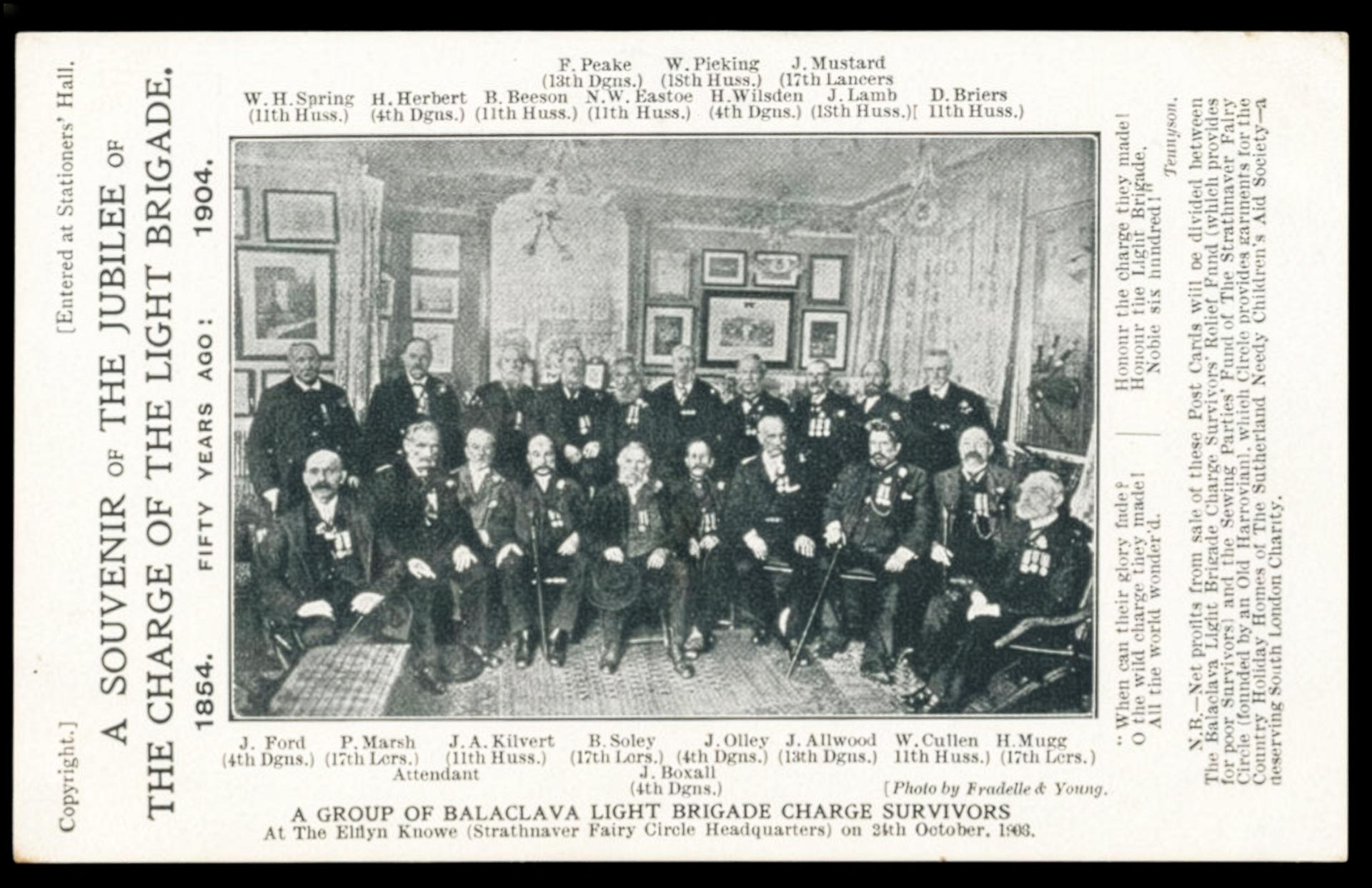
A Group of Balaclava Light Brigade Charge Survivors at the Elflyn Knowe (Strathnaver Fairy Circle Headquarters) on 24th October 1903.
Matilda Soley, age 64, March Quarter 1906, Brentford.
Benjamin Soley, June Quarter 1906, aged 75, Brentford.
Died on 18th of April 1906 at 50 Carlyle Road, South Ealing, London.
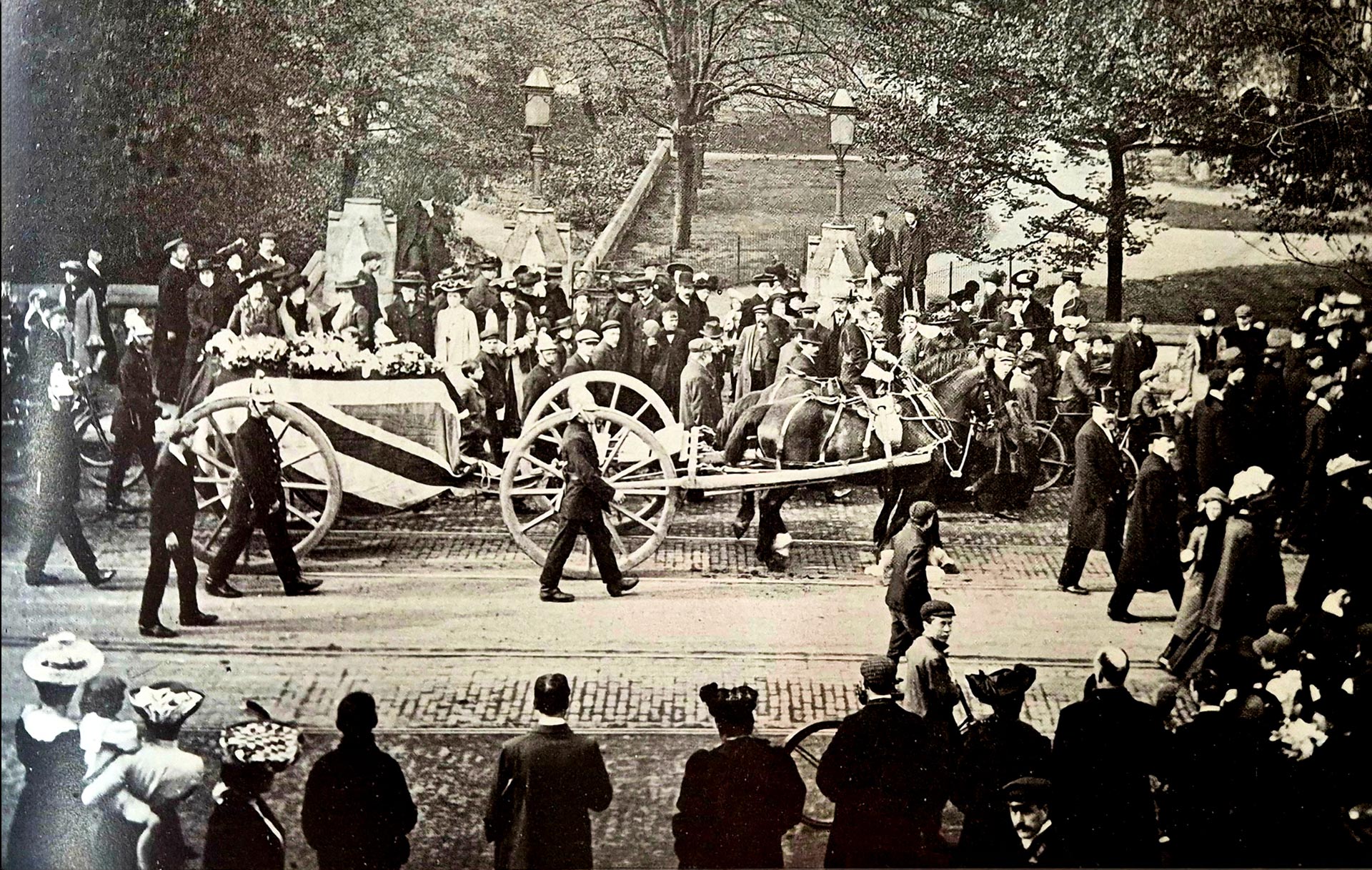
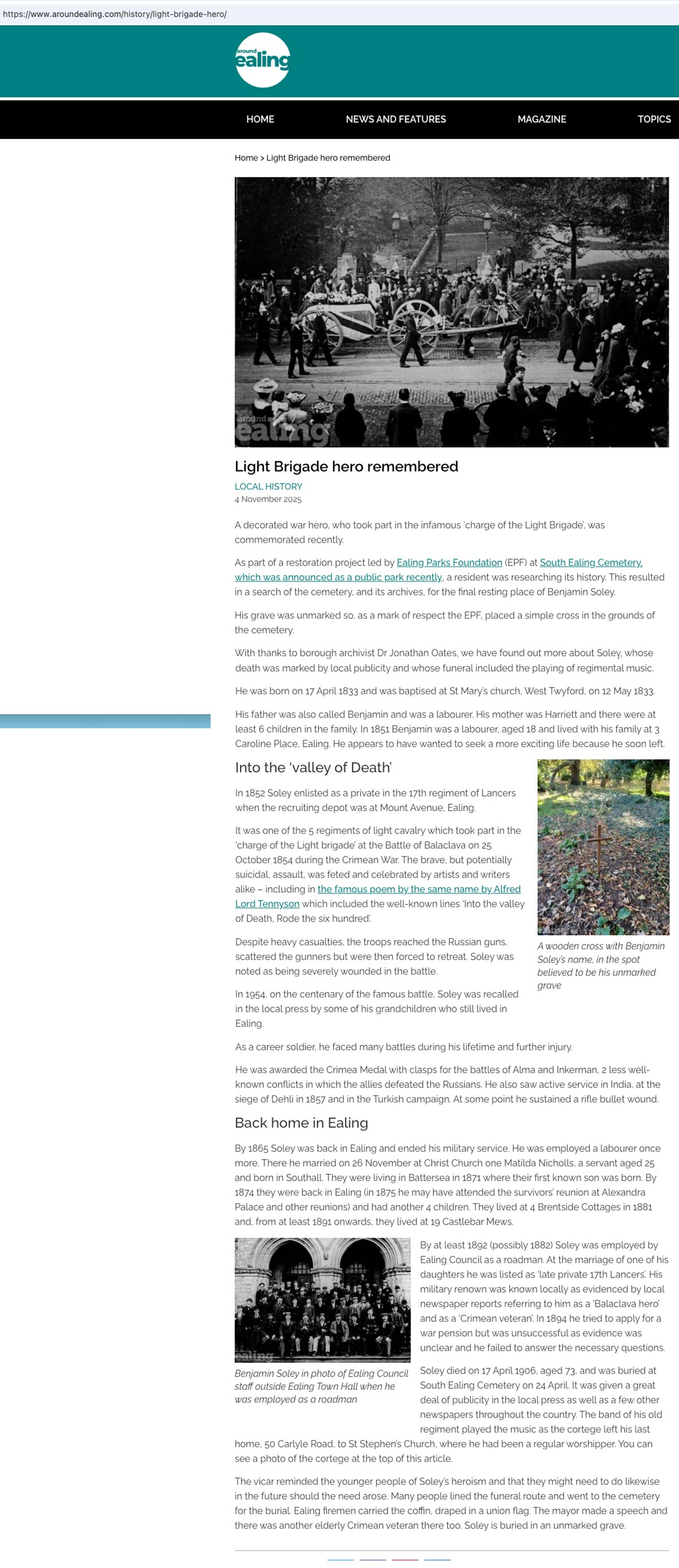
The funeral procession of Balaclava veteran, Benjamin Soley, on 24th April 1906 is seen here passing Christ Church. The procession formed up in Carlyle Road and included local firemen and the band of the 21st Lancers. The memorial service took place at St. Stephen's Church, West Ealing.
His obituary notice in the Middlesex County Times for the 28th of April 1906 states:
"SOLEY. On the 18th of April, at 50 Carlyle Road, South Ealing (the residence of his daughter, Mrs. Pearce), Benjamin Soley, late 17th Lancers, on his 75th birthday. — Also Matilda Soley, wife of the above, who died on January 30th, aged 64 years."
Extract from the Middlesex and County Times, 21st of April 1906:
"Death of a Crimean Veteran"
"One of the last survivors of the famous charge of the Light Brigade at Balaclava, named Benjamin Soley, died at 50, Carlyle Road, Ealing, on Tuesday, on his seventy-fifth birthday.
As a trooper in the 17th Lancers he served through the whole of the war in the Crimea, and besides being one of the "Noble Six Hundred" fought at the battles of the Alma, Inkermann and Sevastopol, gaining the Crimean medal with four clasps. Another of his medals was won in the Turkish campaign and he also saw service during the Indian Mutiny and was present at the siege of Delhi [sic].
He joined the Army at the age of nineteen, enlisting at the old regimental depot which was at one time in Mount Avenue. Born and bred in Ealing, he returned to the town after leaving the colours, and was later employed as a roadman by the Town Council, being in the employ of the local authority for twenty-four years.
He was well-known to many of the older residents in the district. His wife died soon after Christmas and Soley never fully recovered from the shock her death caused him, and had been ailing ever since.
The funeral will take place at the Cemetery on Tuesday, and full military honours will be paid to the memory of the deceased soldier."
Extracts from the Ealing and Hanwell Post, Saturday 28th of April 1906:
"The Death of Trooper Soley — Military Funeral"
"Amid signs of general respect and sympathy the funeral took place on Tuesday of Benjamin Soley, who was one of the last survivors of the Light Brigade, which had so gloriously distinguished itself in the famous charge at Balaclava. The funeral aroused much patriotic feeling and respect amongst the inhabitants of Ealing, and persons of all classes, young and old, rich and poor, feeble and active, turned out in their thousands to pay homage to the mortal remains of the Balaclava hero.
The funeral procession was headed by Inspector Andrews (chief officer of the Ealing sub-division of police) and was composed of the band of the 21st Lancers, a contingent of local fireman, a gun-carriage, on which rested the body of the deceased soldier, and at the rear three carriages containing the family mourners.
The cortege was accompanied by a crowd numbering several hundreds and everywhere en-route keen interest was manifested by numerous spectators, who eagerly craned their necks from open windows or gathered in knots on the footpaths. Heads were respectfully bared by men and boys of all classes as the procession pursued its mournful way, and the utmost order prevailed.
A crowd of considerable dimensions had gathered outside of St. Stephens Church and on the arrival of the procession the police very wisely restrained many people from entering the church, a precaution which prevented it from being dangerously overcrowded.
The brief service was then conducted by the Revd. Dr. B.S. Tupholme, the coffin, covered by a Union Jack, surmounted by many floral wreaths in which red geraniums, arum lilies and narcissi predominated being placed before the chancel. It was significant of the sense of loyalty and respect which was aroused by the occasion that the congregation was of such an unusually mixed nature. There must have been many amongst its rougher element to whom the interior of a church was such a revelation.
At the completion of the service, the coffin, carried by four firemen, was again placed on the gun-carriage outside, and the procession, now swelled to over a thousand, commenced the journey to the Ealing Cemetery, where the deceased was to be interred. Here, to the strains of the 'Dead March', impressively rendered by the band, the coffin, again borne aloft on the shoulders of the fireman, was carried to the graveside."
See also the copy of his funeral report taken from the Ealing Gazette, 28th of April 1906, in the 17th Lancer file. In time this will be scanned and uploaded.
Both he and his wife, Matilda (who died on the 30th of January 1906), were buried in Grave Plot No. 23DC in the Ealing and Old Brentford Cemetery. No headstone was erected over the grave. (There is copy of a photograph of him in later life, of his funeral procession, and also photographs of the gravesite, grave-area and of the Cemetery entrance, in the 17th Lancer file. These will eventually be scanned and uploaded.)
In 1954 an article on the Centenary of the Charge a report of his funeral was reprinted in a local newspaper. Two of his grand-children were reported to be still living in Ealing. (See copy in the 17th Lancer file.)
Further information
1911 Census
50, Carlyle Road, South Ealing.
William Pearce, 38, Carman, Ealing Borough Council, born Perivale.
Louisa Pearce [daughter], 36, born Ealing.
Ethel May Pearce, 3, born Ealing.
The editors are very pleased to note that number of members of the Soley clan have contacted the EJBA over the years.
In 1990 a great-great-granddaughter of Soley's, living in Wiltshire, wrote to say she possessed several items of interest. These included a copy of his marriage certificate, newspaper reports of his death and funeral other than those already known, the form advising him how to fill in the claim form for the Light Brigade Relief Fund, dated the 26th of March 1892 (which had just been taken over by the Patriotic Fund), the menu of the Jubilee Commemoration Dinner held at St. James's Hall, London, on the 25th October 1897, an invitation card for the Annual Dinner of the Survivors held at the same venue in October of 1902, and a page from a magazine showing the list of those attending the Jubilee celebrations given by T.H. Roberts at his Fleet Street offices in June of 1897, as well as copies of some of the letters written to Mr. Roberts from the men named, on accepting the invitation.
In 1994, another member of the Soley family, living in Windsor, came into possession of papers left by his deceased father and claiming Benjamin Soley as his great-uncle. (His ancestor was William Soley, born on the 19th of August and baptised in St. Mary's Church, Ealing, on the 10th of September 1837.)
Also in 1994, a correspondent living in New Zealand wrote to say he was a direct descendant (as a great-great grandson) of Benjamin Soley through a son, Charles Soley, and his daughter, Florence, who had originally emigrated to New Zealand circa 1968, with her second son, and who died in 1976. This branch of the family possessed a very comprehensive family tree and an original pawn-ticket that Charles Soley had been given when pawning his father's medals about a month after his father's death (said by the family to pay for the funeral), which was never redeemed.
In November 2011 two of Soley's great-great-granddaughters separately contacted the Archive seeking further information about their ancestor. It transpired that they were cousins, sharing a grandmother in Soley's granddaughter Phyllis. Benjamin Soley's daughter Emma married William Webber in the December Quarter of 1902. By 1911 there were 3 children: Alma, Frederick and Lilly. The birth of another daughter, Phyllis A., was registered in Hackney in the March Quarter of 1912. [Genealogical information kindly provided by Chris Poole 28/11/11.]
Around Ealing: Light Brigade hero remembered, 4 November 2025
Facebook: Ealing History, 13 September 2026.
Facebook, 13 September 2026: Memorial ceremony to be held for Benjamin Soley, Crimean War veteran.
Betsy Spangles: "Memorial ceremony for Benjamin Soley, Crimean War veteran | London, England.
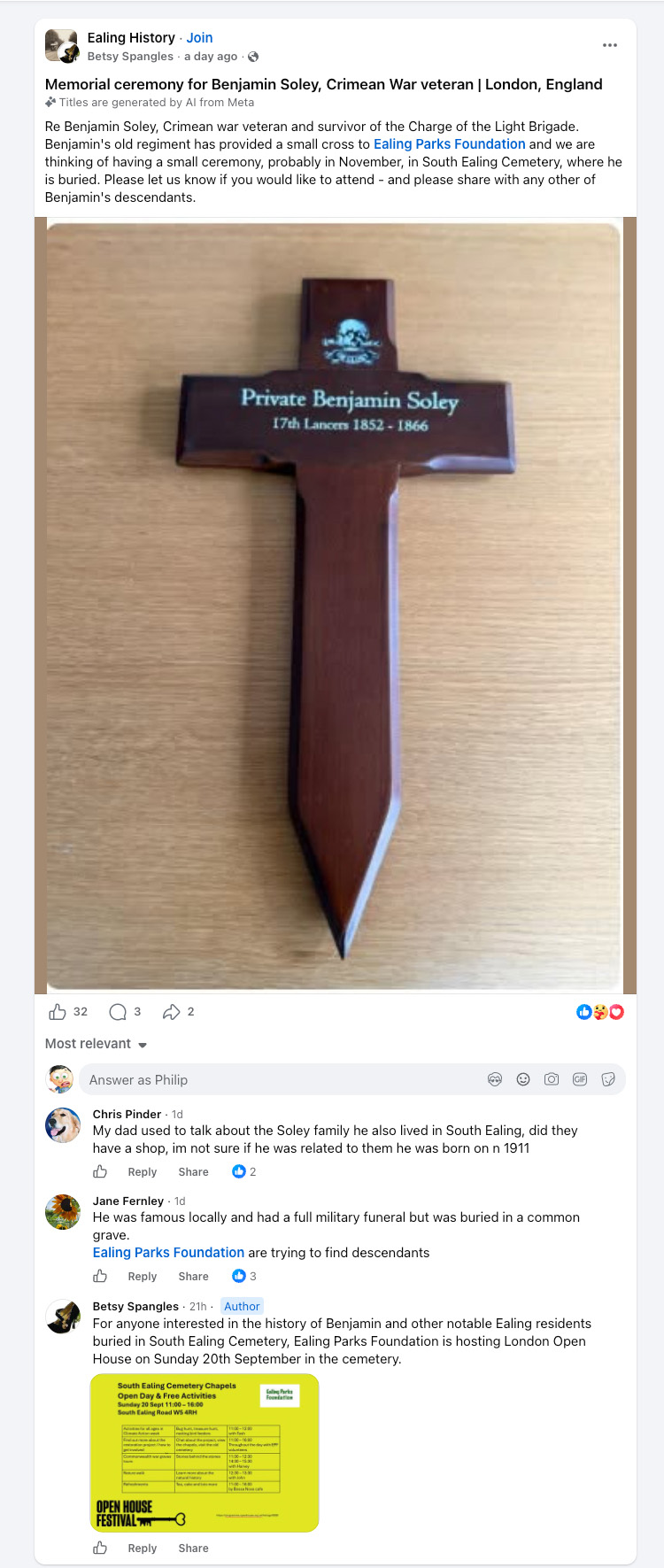
Re Benjamin Soley, Crimean war veteran and survivor of the Charge of the Light Brigade. Benjamin's old regiment has provided a small cross to Ealing Parks Foundation and we are thinking of having a small ceremony, probably in November, in South Ealing Cemetery, where he is buried. Please let us know if you would like to attend - and please share with any other of Benjamin's descendants.
Chris Pinder: My dad used to talk about the Soley family he also lived in South Ealing, did they have a shop? I'm not sure if he was related to them; he was born in 1911.
Jane Fernley: He was famous locally and had a full military funeral but was buried in a common grave. Ealing Parks Foundation are trying to find descendants.
Betsy Spangles: For anyone interested in the history of Benjamin and other notable Ealing residents buried in South Ealing Cemetery, Ealing Parks Foundation is hosting London Open House on Sunday 20th September in the cemetery.
Find a Grave: Transcription of an obituary in The Hanwell Gazette and Brentford Observer, 28 April 1906
FUNERAL OF A CRIMEAN VETERAN AN IMPRESSIVE SPECTACLE.
FUNERAL OF A CRIMEAN VETERAN. | AN IMPRESSIVE SPECTACLE.
There was a huge crowd at the Ealing and Old Brentford Cemetery on Tuesday afternoon, so large that the gates had to be closed and admittance refused some. The occasion was the funeral of one of the last survivors of the famous charge of the Light Brigade at Balaclava, named Benjamin Soley, who died at 50, Carlyle-road, Ealing, last week on his 75th birthday.
As a trooper in the 17th Lancers, he served through the whole of the war in the Crimea, and besides being one of the "Noble Six Hundred," fought at the battles of Alma, Inkerman, and Sevastopol, gaining the Crimean medal with four clasps. Another of his medals was won in the Turkish campaign, and he also saw service during the Indian mutiny, and was present at the siege of Delhi.
He joined the army at the age of nineteen, enlisting at the old regimental depot which at one time was in Mount-avenue. Born and bred in Ealing, he returned to the town after leaving the colours, and later was employed as a roadman by the Town Council, being in the employ of the local authority for twenty-four years. He was well known to many of the older residents in the district. His wife died soon after Christmas, and Soley never really recovered from the shock her death caused him, and had been ailing ever since.
Deceased's funeral was accorded military honours. The cortege left the house in Carlyle-road, at two o'clock. It was headed by the band of the 21st Lancers, who are stationed at Hounslow Barracks, and who played the Funeral March. A gun carriage followed on which was placed the coffin, covered with a Union Jack, and guarded by members of the Ealing Fire Brigade, then came the mourners in coaches, and on foot. The procession proceeded by way of Northfield-lane, Drayton Green-road and the Avenue to St. Stephen's Church, where Soley had been a regular worshipper, and where the first part of the funeral service was conducted.
An immense crowd fore-gathered at St. Stephen's. The coffin was borne into the church by Lancers and an impressive service was conducted by the Rev. Dr. B. S. Tupholme, assisted by the Rev. Eyton Jones. Afterwards the coffin was borne back to the gun carriage by the firemen and the march to the cemetery resumed, the route taken being St. Stephen's-road, Castlebar-road, Longfield-road, Gordon-road, Longfield-avenue, Uxbridge-road, High-street and St. Mary's-road. A huge crowd followed all the way and seemed to increase in density at every step. Nearing the cemetery the band played the Dead March in "Saul."
The coffin was borne to the graveside by the firemen and the Rev. Dr. Tupholme officiated at the service, afterwards addressing some brief remarks to the younger portion of the assembly in which he instanced the deceased soldier who had been laid to rest that day as one of a gallant band only two hundred out of six hundred of whom survived a fateful charge. Were the call to duty to come to these young people in the days to come, he hoped they would remember the example of Benjamin Soley.
The mourners were: —1st. carriage: Mr. C. Soley, Mrs. Woolner, Mr. and Mrs. Peace, Mrs. Harrison and Miss Soley. —2nd. carriage: Mr. J. Soley, Mrs. Tomkins, Mrs. Ayling, Mr. Harrison, Mrs. C. Soley and Mrs. Bird. —3rd. carriage: Mr. J. Tomkins, Mr. Barnard, Mr. Woolner, Mrs. Schollar, Mrs. J. Soley, Mr. J. Pearce and Master Woolner.
The floral tributes were as follows:
Cross, In loving remembrance of our dear Father, from Phyllis and Walter.
With heartfelt sympathy from his loving Son and Wife.
A token of respect from the Officers and Men of the Metropolitan Police (Ealing Station).
With deepest sympathy from Mr. and Mrs. Ayling, to the Balaclava Hero.
A token of sympathy and respect from his fellow workmen of the Ealing Town Council.
Wreath, In loving memory of our dear Father, from Emmie and Will.
Wreath, In loving memory of our dear Father, from Nellie and Sam.
Wreath, In ever loving remembrance from his son and daughter, Lily and Robert.
Cross, In loving remembrance from his brother James and Wife.
Cross, With love from three little children visiting Ealing.
In loving memory of our dear Father, from Louie and Will—"Not dead but sleepeth."
Many thanks to Tom DeNardo for sharing the photo and to Tracey Roberts for sharing the plot location.
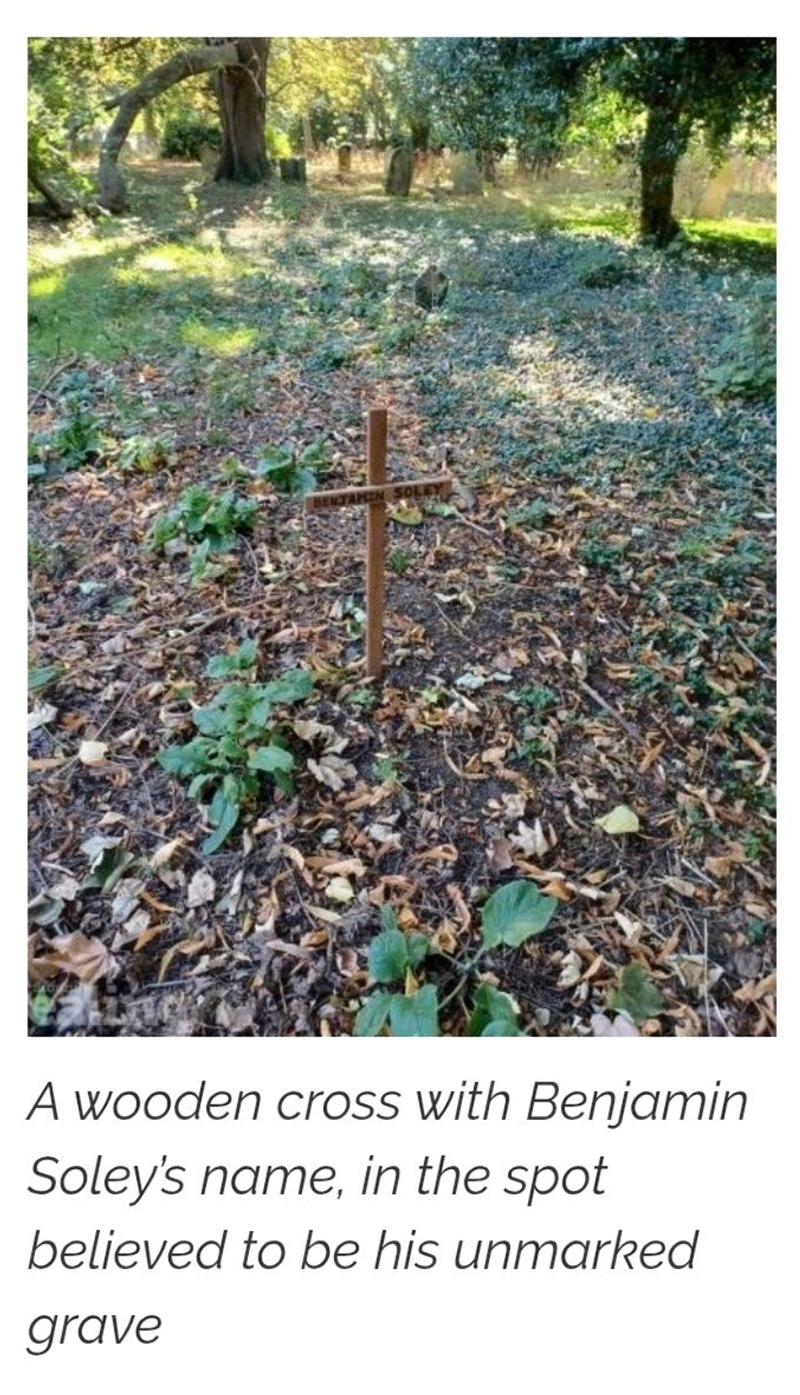
Wooden cross marking Benjamin Soley’s unmarked grave, photograph by Tom DeNardo/Tracey Roberts.
References & acknowledgements
Marriage, birth and death registrations, and additional Census information for 1841, 1851, 1871, 1881, 1891, 1901 and 1911 kindly provided by Chris Poole.
For further information, or to express an interest in the project, please email the editors, Philip Boys & Roy Mills, via info@chargeofthelightbrigade.com