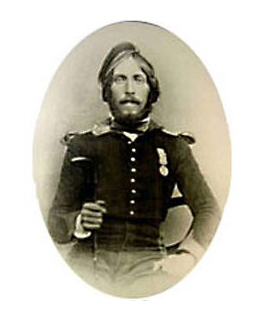
[PB: Show image of Pearson medals?]
1353, Private William PEARSON - 4th Light Dragoons
WP's medals / Penrith Museum etc
Penrith Museum
Over many years the Penrith Museum has acquired a variety of items relating to William Pearson, including photographs and medals.
From a letter from a Mr. H. Hayworth, late Clerk to the Penrith Council, in September 1974:
"About two years ago I acted for the Penrith Council in the purchase from Sotheby's of Pearson's medals and they are now in the Penrith Museum. His portrait is also there. After the Council's purchase, his 83 year old grand-daughter living in Preston, presented to the town his paybook, discharge papers, and a letter bearing his signature sent from the Crimea."
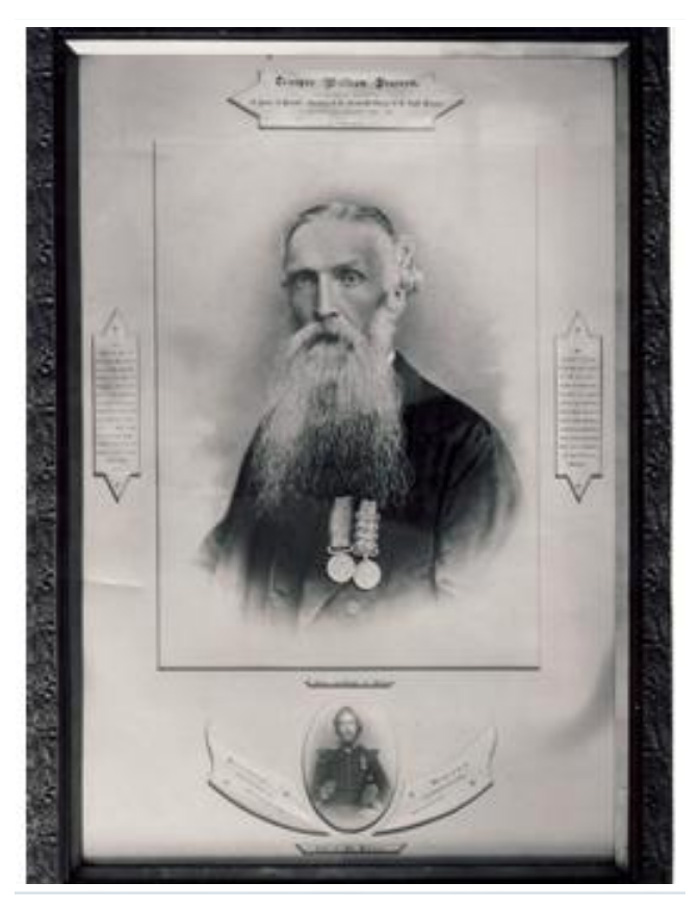
Also included was a photograph, said to be of the recipient (copy in the 4th Hussar file). The small plaque on the front shows him as he was on his discharge in 1855 and the larger as he was about 1894. The plaques on the side record his military service.
The medals sold at Sotheby's in October 1971 were the Crimean, with four clasps, and impressed naming to "W. Pearson. 4th Lt. Drgns.", and the Turkish medal (as Private), engraved naming. (No mention is made of the "Un-official" suspension of this medal. See picture in the 4th Hussar file. Both were with ornate silver suspension brooches.) Also included was a photograph of the recipient wearing his medals. This portrait was a copy of that hanging in Penrith Library and was the work of Mr. R. Fowler Richards, a well-known local photographer and was originally commissioned by a Mr. T.D. Graham. No question as to their being perfectly genuine was raised, the auctioneers also adding in the "write-up" an extract of his services taken from the book, "Honour the Light Brigade", by Lummis and Wynn.
This pair of medals have now [1994] been independently examined and the conclusion reached that the description given at the time of the auction was correct, the naming being impressed on the Crimean medal to "W. Pearson, 4th Lt. Drgns." and the Turkish Crimean medal (engraved) named to "1282 W. Pearson. 4th Lt. Drgns." However, the Crimean medal is badly edge knocked, the portion presumably showing any rank being obliterated. The suspension (and number of clasps) has obviously been changed at some time, and does not now swivel. Even more noticeable is the fact that the Turkish medal is in a far better condition (although the suspension is nothing more than a piece of twisted wire,) than the Crimean medal and is numbered as No. 1282.
So, on the face of things, it would appear that either the medal was "as worn" by William Pearson or the opportunity was taken at some later date to try to convince a possible buyer that this was a genuine "Charger" Crimean medal, yet with the Turkish medal numbered to a different man. It would also appear that the "Sotheby" Pearson medals had been offered to the Penrith Council on several occasions by dealers since 1961. None of these had made any attempt to confirm or deny their authenticity although they were on one occasion described as "original issue".
It would appear, too, that there are now two groups of medals to a "William Pearson of the 4th Light Dragoons" known to be in existence.
In the mid-1970s a group of medals was "found" in the loft of a house at Kendal by a man said to be his grand-son. The naming on this pair is engraved and the medals are in V.F. condition. With the group were World War One medals awarded to No. 131 Maurice John Pearson and No. 81 Private William Douglas Pearson. Both were awarded the War and Victory medals, the former serving in the R.A.M.C and the latter in the 12th Bn. London Regt.
Also found was a copy of the 1877 list of members of the Balaclava Commemoration Society with several annotations in a hand-writing similar to that of 1353 William Pearson when signing the testimonial given to Mr. Roberts in 1897. It also compares with that of the 1353 William Pearson who signed the Loyal Address in 1887.

1353 William Pearson's signature on the 1897 Roberts Address.
(Click on image to enlarge)
From then on this group has rather a chequered history.
First purchased from the family by a dealer (who thought at first he was buying an impressed naming pair which he claimed to have previously owned), they were handed over with a certificate that "they had never left the family". (The dealer was later convicted of falsifying previously unnamed Crimean medals by "naming" them with an impressing machine to known participants in the Charge, but the whereabouts of whose original medals was unknown. From known police evidence however, there appears to be nothing to involve either group with this case.)
Sold to a collector, they progressed via two more medal dealers to a London dealer where they were eventually sold for a very considerable sum, the original purchase price having increased greatly. Although representation was made to the firm by several interested parties as to their authenticity, or otherwise, that appeared to be the end of the matter. Such was not the case, however. They had been returned down the chain of previous owners and are now (1977) back in the hands of the first "collector" owner. At this point in time the original "dealer purchaser" was in prison for his offence.
Whether this group are the medals originally issued to 1353 William Pearson is a moot point. Those in the family group could well be the medals issued to him. He had left the Army before their issue and could well have had the naming done himself. The suspender fitted to the Turkish medal is said to correspond with that he is pictured as wearing in the paragraph forming part of an original newspaper cutting offered with the group. The granddaughter had read in the local paper about the purchase of the medals and made the donation of the pay-book, etc. The Crimean relics had been divided amongst the two sons and this family knew nothing about the other lady at this time. What connection there is between her and the other family is not known.
In a letter regarding the medals the finder said that his name was Peter Pearson and he was the grandson of R.J. Pearson. The medals and documents had lain in the attic for over forty years - until his grand-mother's death. This fact would account for the mould on the documents when found. One point here is said that if the family medals were a re-issue they would have been engraved in the Boer War style of naming. This arises from a possible interpretation of the pencilled addenda by the side of his recorded medal entitlement (Authority of the War Office, dated 28/6/01) WO68/4 Huss. AC2.). There is no comment about any re-issue.
The medals which 1353 William Pearson wears in his picture do not have the silver riband buckles of the "Sotheby" medals. The engraving on the "family" medals is to "Private William Pearson. 4th Light Drgns." These medals have also been examined and the story of his not receiving the clasp for Sebastopol until September of 1859 substantiated in that this clasp has been affixed in a position not confirming to the distance between the other clasps. There seems no reason now to doubt that these medals were those originally awarded to 1383 William Pearson.
See photographs of the two Crimean medals in the 4th Hussar file. They would appear to be the medals which were formerly in the Penrith Museum because both have riband suspension brooches, which those he is wearing in his pictures do not, and the suspension of that pictured of the Turkish Crimean medal is not with the bar suspension as on that he is pictured wearing. He is said to have received the Sebastopol clasp on the 14th of September 1859, and to have been one of the veterans seen by Queen Victoria at Brompton Barracks.
Extracts from local newspaper (unknown source), dated 6th of May and 8th of June respectively:
"Forgery Probe Reveals Penrith Medal Muddle"
"Now authentic set will be bought... The shock disclosure that medals bought by Penrith Council in the firm belief that they were those of a town hero, are not authentic, was made this week.
And the unwitting mistake did not come to light until detectives, who were investigating the forgery of Crimean War medals, visited the town to examine the pair purchased seven years ago as mementoes of Penrith-born Trooper William Pearson of the Fourth Light Dragoons, who took part in the Charge of the Light Brigade in 1854.
Now an opportunity has arisen to acquire the correct medals, Eden councillors have been told.
Council Chairman Mr. Jack Varety told a Policy and Resources Committee meeting on Thursday of the "ominous turn" in efforts to honour its hero by creating a Pearson display as a feature of the intended Museum.
He revealed that "The Council had received several confidential visits from C.I.D officers from Lancashire inquiring about the Trooper Person medals which we held and, in fact, they were also taken away for investigation". Now it has been established beyond reasonable doubt that these medals were in fact not our Trooper Pearson's medals but are, in fact, those of a Corporal - later Trooper - Pearson who fought in the Crimea with the Fourth Light Dragoons, but who did not fight at Balaclava and did not take part in the famous Charge.
Forgers Convicted.
"This fact has come to light following intensive investigations into the affairs of certain people who have been convicted of forgery with regard to Crimean medals, although those of our Trooper Pearson and the other Pearson were not the subject of these prosecutions.
The medals have been in Penrith since October of 1971, and were bought at Sotheby's in London for £150.
This followed an outcry by retired businessman Mr. Charles Sakes, of Lane, Penrith, that Pearson's gallantry had received but little recognition in the town.
This was so effective that a street in Penrith was named Pearson Court... personal papers were given to the town by a member of the family.. Penrith branch of the Royal British Legion put a plaque on the trooper's birthplace, the former Mitre Hotel in King Street, now solicitor's offices... and the medals were bought at a public auction.
The Honourable Thing - Expert.
The chance to get the authentic medals comes about because the expert who now owns them, a woman, feels "honour bound" to sell them to the Council at the price she paid, £300.
[PB, Dec 2017: This must be Vivian Stuart, see below.]
Her letter to Eden says: "I am simply trying to do the right and honourable thing and preserve the integrity of medal collectors and experts in what is, to say the least, an unfortunate affair."
Mr. Varety, who was also Chairman of the former Penrith Urban Council at the time the first medals were bought, asked the committee meeting, "Does the Council wish to have the authentic medals of a hero of Balaclava?"
He also referred to meeting with the Penrith branch and Club of the Royal British Legion who are prepared to buy the genuine medals and permanently loan them to Eden on certain conditions.
One is that the Council should not sell the medals already in its possession, so that no other Pearson medals can be in circulation. A second is that the Legion should be allowed to put the medals and other mementoes on display at their head-quarters until they can be shown in the museum.
During the discussion which followed Mr. Varety's report to the committee on Thursday, the Secretary (Mr. Douglas Brown) told members that one of the men involved in the medal forgery case was now in prison.
Mr. Varety then suggested that money from the Penrith lottery might be earmarked for the purchase of the true medals.
Out-of-town members were interested to learn more of Trooper Pearson's activities and Mr. Varety told them: "He was slightly wounded in the Charge but got on to a Russian officer's horse and rode off the field of battle to safety." (Not true, he rode out on a 8th Hussar man's horse.) The other Trooper Pearson was apparently ill at the time of the Charge, he added.
Mr Tom Craig, Shape, commented: "I think we should buy these medals on account of his quick thinking in jumping on another horse to get out of the fray!"
Members seemed agreed that the medals should be bought, but differed slightly as whether this should be done by the Council or the Royal British Legion's offer to purchase them should be taken up.
Mr. Don. Appleby, moved that they should take advantage of the British Legion's generosity, and Mr. Ken. Wise seconded.
But Mrs Wilfred Pickles,, favoured the Council being the new owners of the medals. Mr. Peter Day, Kirkby Stephen, seconding, and that was the course eventually decided upon by a substantial majority.
Penrith Medal Muddle Sorted Out For £300 - Plus a Bonus!
Eden councillors and officials breathed a sigh of relief this week when Trooper William Pearson's genuine Crimean medals arrived safely in the town - at last!
A native of Penrith, Private 1353 William Pearson served in the Fourth Light Dragoons at Sebastopol, Inkerman, Alma and, most importantly of all, at Balaclava in the Charge of the Light Brigade.
In 1971 the then Penrith Urban District Council bought what they thought were the local hero's medals at a Sotheby's sale for £150. But recently it was discovered that they belonged to another Private William Pearson, who served in the Crimea but was not in the Charge of the Light Brigade.
Now, thanks to internationally-known medal collector Mrs. Vivienne Stuart of York, Eden Council have been able to buy the real medals for £300, the price she had initially paid for them.
[PB: On VS, see below.]
Almost Identical.
The two medals are almost identical to the Council's earlier buy, with an 1855 Crimean medal on a pink and green ribbon bearing Sebastopol, Inkerman, Balaclava and Alma bars, and a 1854 Balaclava Charge medal, (sic.)
As an added bonus, Mrs Stuart has given Penrith the four First World War medals of Trooper Pearson's sons, Private 5681 W.D. Pearson of the 12th London Regiment and Private 131 M.J. Pearson, of the Royal Army Medical Corps.
All the medals will be displayed in the Penrith Museum when it is eventually re-organised. But at present the elusive medals of Trooper William Pearson are safe and well - locked securely in the Town Hall safe!
It is believed that, because of the controversy surrounding both groups of medals, the first "collector owner" was unable to dispose of them to the trade or other collectors and sold them to the Penrith Museum for a nominal sum.
[PB, December, 2017: I have come across an article from 1979 [?], "The Two William Pearsons - 4th Light Dragoons", by Vivian Stuart, a member of the orders and Medals Research Society. Presumably this is the same person as "Mrs Vivienne Pearson", above?]
THE TWO WILLIAM PEARSONS - 4TH LIGHT DRAGOONS
By VIVIAN STUART, Member O&MRS
On 31st July, 1909, William Pearson, a native of Penrith, Cumbria and a survivor of the famous Charge of the Light Cavalry Brigade at Balaclava, died at his home near Kendal, Cumbria, at the age of 83.
As No. 1353 Private William Pearson, 4th Light Dragoons, he was slightly wounded in the Charge, a member of the Balaclava Commemoration Society, and he signed the Loyal Address in 1887 and attended the 1897 Balaclava Dinner - thus a well proven Charge participant. [we/100/ 24: W0/97 1296 X/L05939: HONOUR THE LIGHT BRIGADE - Lummis & Wynn pp. 58.]
Two Crimea 4-bar medals, paired with Turkish Crimea medals, purported to be his were offered for sale. The first, an impressed medal, with an engraved TC, came up at a well known London Auction on 7th October 1971 and was purchased by the then Penrith Urban District Council, who bought it with the intention of honouring a local hero by putting it on display in the Penrith Library, together with a portrait of William Pearson wearing his medals, presented to the Library in 1894. The Turkish medal was engraved with Pearson's name and a regimental number, of which the two central digits were partially erased - the first and last being clearly legible as "i" and "3".
Unaware, at the time, of the Council's purchase, in October, 1976, I bought, through a trusted agent, an engraved 4-bar Crimea medal, with an unnamed TC, from the veteran's great-grandson, Mr. Peter Pearson. With the medals I also received a signed statement from the vendor to the effect that, to the best of his knowledge, the medals had never left his family's possession (he stated verbally that they had been _lost_ in the attic of his grandmother's house for 40 years, and only found on her death).
I also bought the WWI pairs to William Pearson's two sons, Maurice and William Pearson, and numerous newspaper cuttings (original) photographs and Pearson's Balaclava Commemoration Society membership book. Through a professional researcher, I then obtained photocopies of William Pearson's Discharge documents.
It was then that I was told of the impressed Crimea and engraved Turkish Crimea medals - said to be those awarded to the Charge hero - in the possession of the Penrith Council. Furthermore, the authenticity of my engraved Crimea was called into question - when the whole group, with the sons' medals, was on display in a London dealer's salesroom - by an expert on Charge medals. I was understandably shaken since I had had no reason to doubt the authenticity of my medal or the integrity of its vendor, and the medal had every appearance of being genuine - a contemporary style of engraved naming and no sign of an added bar. I of course at once took the whole group back and set to work to investigate in an attempt to arrive at the truth.
Being a military historian, my first recourse was to the original rolls of the 4th Light Dragoons, of which I had photocopies, and here I made a very relevant discovery! There were two William Pearsons in the Regiment in the Crimea.
In addition to No. 1353 Pearson - the proven Charge participant - there was No. 1283 Corporal William Pearson, who was on the Roll for the Alma, Inkermann and Sebastopol, but not for Balaclava, and whose name is not included by Lummis and Wynn in HONOUR THE LIGHT BRIGADE.
There were other differences, as well as several similarities: No. 1283 Pearson, a native of Preston, Lancs., was attested on 6th July 1846 - his namesake, No. 1353 Pearson on 21st February 1848. No. 1283 Cpl. Pearson subsequently lost his stripes and was discharged as a private in March, 1860, [WO/97 1749 X/LO6106] five years _after_ his Charge participant namesake, who was invalided from the hospital at Brampton, Kent, with frostbite of the toes. The Balaclava hero received his medal from Queen Victoria, whilst he was at Brampton - the medals presented by Her Majesty at this period being unnamed, which, to my mind, offers a valid reason for the medal having been engraved, and not impressed. (To have a medal officially impressed, it had to be returned to the regiment by men who had been discharged there from prior to the award, and very few did return their medals, preferring to have them named by local jewellers or military tailors. Serving soldiers - as No. 1283 Pearson would have been, when he received his Crimea medal - were given impressed medals.)
In all, I amassed ten pages of research details pertaining to the two Pearsons and, convinced that the engraved medal bought from his great-grandson was the Charge Pearson's original medal, I permitted the Bolton Criminal Investigation Department to take my medal for forensic examination. At my request, the Penrith (now the Eden District) Council's medals were also tested. The findings were: My medal, the engraved Crimea, showed no sign of ever having been tampered with or had a bar added. The Council's impressed medal, badly edge-knocked, did not satisfy the experts on this count. The engraved regimental number of the Council's Turkish medal was revealed as "1283" - Cpi. Pearson's number, when the two partially erased central digits were rendered legible.
Through the police and with the Council's permission, I examined their medal and, in my considered opinion, there can be little doubt that the bar for Balaclava was added to the three to which No. 1283 Pearson was entitled.
I am not suggesting that the bar was added with "intent to deceive" - only one William Pearson appears on the Balaclava roll for the 4th LD and it is considered by some collectors and dealers legitimate practice to add a bar, if one is missing from a medal awarded to a man who is on the roll for the action. It should, however, be very carefully checked - in this case, the rolls for the Alma, Inkermann and Sebastopol should have been consulted, since they would have revealed the existence of the second William Pearson.
The partial erasing of the regimental number on the Turkish medal must, however, have been done by a previous owner with the knowledge that two William Pearsons served in the regiment - the numbers left legible were common to both men, the two erased were the Corporal's ...clear evidence of "intent to deceive." The Penrith Council, not being medal experts, obviously did not realize that they had been deceived and, in good faith, purchased the
14 medal they believed was the one awarded to their local Balaclava Charge hero. The Pearson family did not question the medal, since their own was still, in 1971, undiscovered in the grandmother's attic ... and one of 1283 Cpl. Pearson's previous owners (I traced five between 1967-71) must contributed knowingly to the deception.
There is a happy end to this rather sad story - I offered the Council my engraved medal and the sons' WWI pairs at the price I had paid for them two years ago, feeling that the right and only place for them was the Penrith Library. The offer was accepted and Private William Pearson's medals will now be on display in his home town, together with his portrait ... a fitting memorial to a fine old soldier and his two soldier sons.
For medal collectors, already shaken by the recent revelation of another "attempt to deceive" by means of an impressing machine, used to convert unnamed Crimea medals to supposed "Charge" medals, there is, I think, a lesson to be learned. First, that it is advisable to research valuable medals and second that the engraved Crimeas should not, provided the style is contemporary, always be considered less valuable than the impressed medals. In my experience, a great many 100% genuine Crimea medals were engraved - by officers, men wounded and invalided in 1855-56, and those who received their medals from HM Queen Victoria's hands ....
[Source: Vivian Stuart, "The Two William Pearsons - 4th Light Dragoons" (pdf downloaded 8.12.2017).CHECK THIS. OMSA is the Orders and Medals Society of America, NOT the Orders and Medals Research Society (of Britain). VS's article appeared in the OMRS as "Two William Pearsons, 4th Light Dragoons" 17(3) 160 - 2 in 1977. So it also appeared in OMSA?]
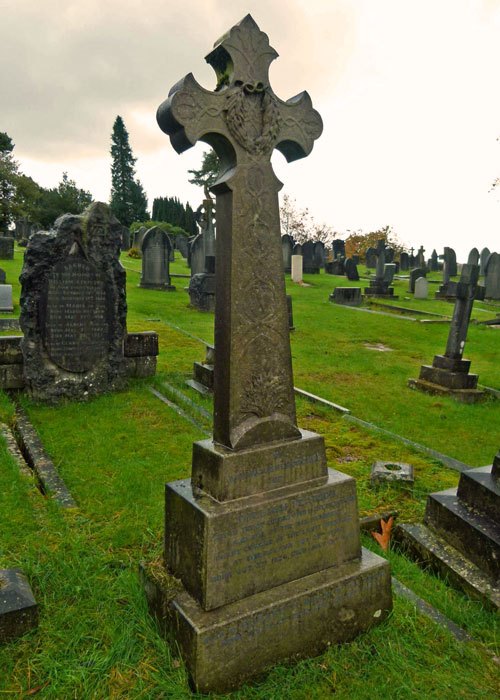
William Pearson's tombstone in Kendal Cemetery
Photo from "A Bit About Britain: Trooper Pearson and the Charge of the Light Brigade" blog (link below).
(Click on image to enlarge)

(Click on images to enlarge)
This life-sized portrait photograph by E Fowler Richards is of William Pearson of Penrith (1826-1909). Pearson was a survivor of the Crimean War and took part in the Charge of the Light Brigade at the Battle of Balaclava on 25 October 1854. The photograph was commissioned in 1894 to commemorate the 40th anniversary of the 'Charge' and to honour Pearson who was then aged 68. It is framed with a smaller vignette of Pearson in uniform after discharge in 1855.
During the 'Charge' Pearson had a hair's-breath escape from death and later suffered severe frostbite. He was nursed by Florence Nightingale at the hospital in Scutari where she pioneered modern nursing practices while caring for the wounded. Pearson served through the whole of the Crimean War and received a medal with clasps for Alma, Balaclava, Inkermann and Sebastopol, and the Turkish medal. The medals, photograph and other memorabilia are all on display in Penrith Museum.
Penrith's Crimea War Hero Trooper William Pearson
Penrith museum owns the medals and other memorabilia of William Pearson (1826-1909), the Crimea War survivor. The town has done much to ensure that the man and his bravery should not be forgotten. As long ago as 1894 townsfolk marked the 40th anniversary of the "Charge of the Light Brigade" by acquiring a life size photograph of Pearson, who was then still alive. Still in its elaborate frame it is now owned by the Museum. He has the distinction of having a corner of the town named after him 'Pearson Court' and a plaque is affixed to the property in King Street formerly the Mitre Hotel where he was born in 1826. He was brought up in North Westmorland and was a leather dresser before running away to enlist in the 4th Light Dragoons in 1848, at Westminster. He was serving in Ireland when the regiment received orders for the Crimea.
During the Charge of the Light Brigade at Balaclava his horse stumbled over another that had fallen and he had to mount a rider-less horse of the 8th Hussars. He had an epaulette shot from his shoulder and returned from the affair with a wound to his forehead. The severe Crimean winter left Pearson with frost-bite and he spent Christmas Eve 1854 having four toes amputated. He was nursed by Florence Nightingale at the hospital in Scutari before being invalided home.
He was presented before Queen Victoria in 1855, and discharged as unfit for further military service, with a pension of 8d a day. This was later increased to 12s a week by the Royal Patriotic Fund. He received the Crimea Medal (with clasps for Alma, Balaclava, Inkerman and Sebastopol), the Turkish Medal, and he also had a Good Conduct Badge.
He met his wife at a ball in honour of the Crimean heroes held at Dover and they returned to Penrith, where Trooper Pearson became Inspecting Officer's Orderly to the Dalemain Troop, Cumberland and Westmorland Imperial Yeomanry. In 1880 he moved to Underbarrow, near Kendal, where he set up a fellmongering and tanning business. He retired in 1906, and died in July 1909, aged 82. He was buried with military honours in Parkside Cemetery, Kendal.
[Source: Eden District Council: Local Personalities (accessed 10.12.2017).]
Feature, BBC News, 3rd February 2010:
"Trooper Pearson's photograph"
Belinda Artingstoll, Special Features producer BBC Radio Cumbria
This is a tale of bravery, disastrous mistakes and Florence Nightingale and it centres on a photograph belonging to one of Cumbria's smallest museums.
The photograph is of Trooper William Pearson who survived the Charge of the Light Brigade during the Crimean War.

William Pearson photographed in later life by E. Fowler Richards.
Born in Penrith he went to London and joined the 4th Light Dragoons, instead of joining a local regiment.
In October 1854 he was one of the 600 who were ordered to ride towards the Russians at Balaclava.
Firing on them
The aim was to stop the Russians moving the British guns they had captured earlier in the campaign. But instructions from commanding officers were confusing and ultimately disastrous.
As a result they rode down the valley towards the wrong guns with the Russians firing on them from three different sides.
More than a third of the men were killed or wounded and around half of those who were left had lost their horses.
The Charge has gone down in history and inspired a famous poem of the same name by Alfred, Lord Tennyson.
Florence Nightingale
In a letter to his parents three weeks after the Charge, Trooper Pearson describes how he had to ride over the bodies of his fallen comrades. He was only slightly injured but he did lose his horse.
Although, in the letter he revealed that when he got back to camp he was delighted to find that his horse had returned safely.
William Pearson photographed as a young man.
Judith Clarke, the curator at Penrith Museum, says he did end up in hospital but not as a result of his battle wounds. They were living and fighting in extremely wintry conditions and he had to have four toes amputated because of frostbite.
While he was recovering in hospital he was nursed by Florence Nightingale. He died in Kendal in 1909 and was buried with full military honours.
Lord Cardigan
Local historian Colin Bardgett says the Crimean War was a wake-up call for the British Army and showed how badly organised it was.
It was the first war that was photographed and war correspondents were able, for the first time, to use the telegraph to get their stories back to the British public much more quickly than before.
The war also brought us the balaclava and the cardigan, which was named after one of the commanders, Lord Cardigan, who wore a small woollen jacket as part of his uniform.
The photograph in Penrith Museum is of Pearson in later life and was commissioned by a local man to mark the 40th anniversary of the Charge. The image hung in the local library for many years.
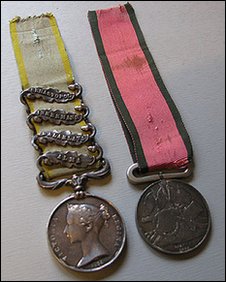
Pearson's medal with clasps for Alma, Balaclava, Inkermann and Sebastopol, and his Turkish medal, on display at the Penrith Museum.
The museum also has his two Crimean War medals and other items that used to belong to him. Interestingly the museum bought the medals in the early 1970s only to find out that there were two Trooper Pearsons with those medals and they had bought the wrong set. But eventually the right set came up for sale and they bought those too!
The museum is closed for refurbishment but you can see the photograph at the town's tourist information centre."
Judith Clarke, Curator at Penrith Museum, and others talk about Trooper Pearson: Listen (4 mins 44 secs).
For further information, or to express an interest in the project, please email the editors, Philip Boys & Roy Mills, via info@chargeofthelightbrigade.com