Reading Mercury, 1 July 1854, p.7
(Click on image to enlarge)
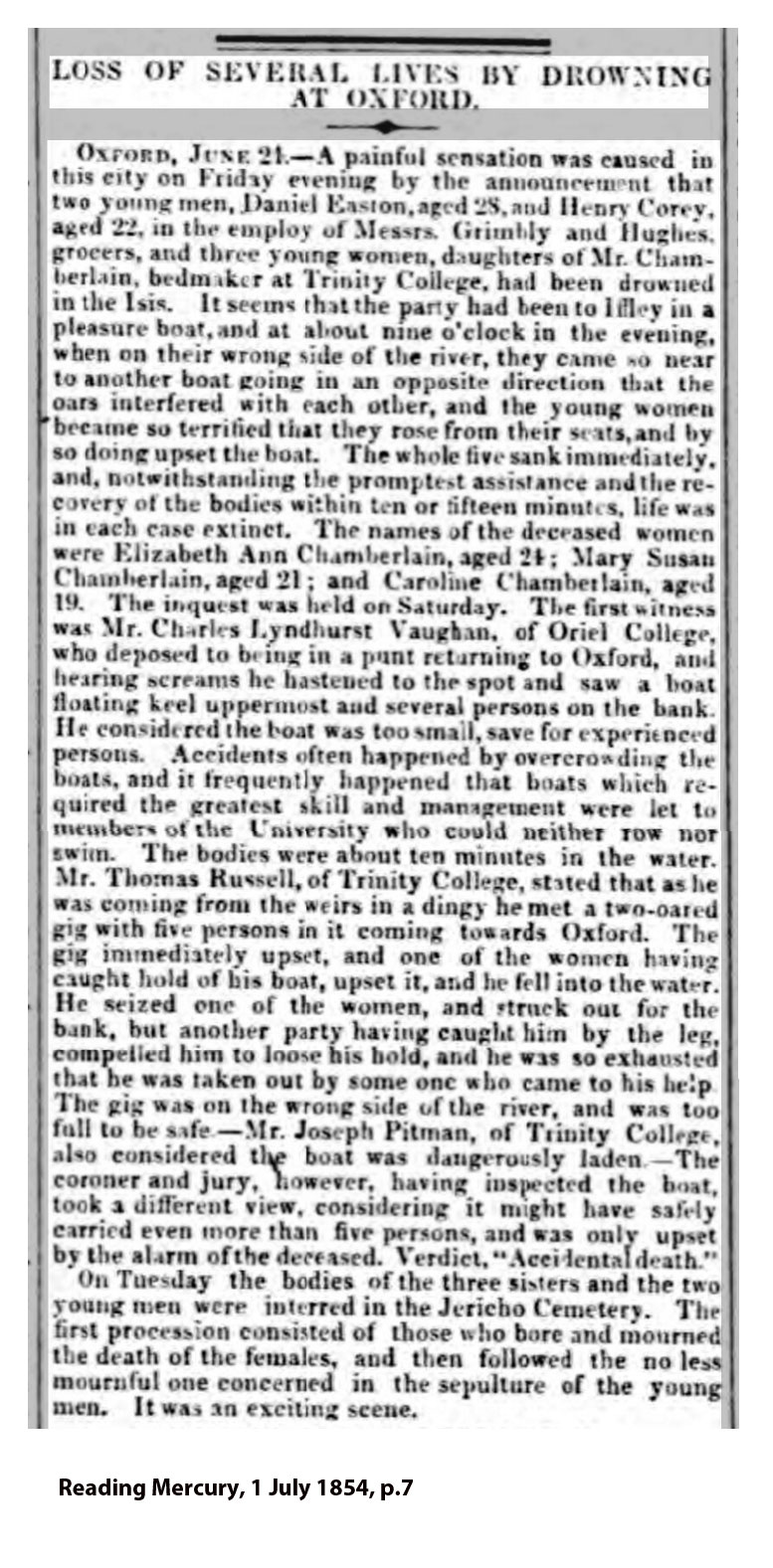
LOSS OF SEVERAL LIVES DROWNING AT OXFORD
OXFORD, JUNE 21 - A painful sensation was caused in this city on Friday evening by the announcement that two young men, Daniel Easton, aged 28, and Henry Corey [sic], aged 22, in the employ of Messrs. Grimbly and Hughes, grocers, and three young women, daughters of Mr. Chamberlain, bedmaker at Trinity College, had been drowned in the Isis.
It seems that the party had been to Iffley in a pleasure boat, and at about nine o'clock in the evening, when on their wrong side of the river, they came so near to another boat going in an opposite direction that the interfered with each other, and the young women became so terrified that they rose from their scats, and by so doing upset the boat. The whole five sank immediately, and, notwithstanding the promptest assistance and the recovery of the bodies within ten or fifteen minutes, life was in each case extinct.
The names of the deceased women were Elizabeth Ann Chamberlain, aged 24; Mary Susan Chamberlain, aged 21; and Caroline Chamberlain, aged 19. The inquest was held on Saturday.
The first witness was Mr. Charles Lyndhurst Vaughan, of Oriel College, who deposed to being in a punt returning Oxford, and hearing screams he hastened to the spot and saw a boat floating keel uppermost and several persons on the bank. He considered the boat was too small, save for experienced persons. Accidents often happened by overcrowding the boats, and it frequently happened that boats which required the greatest skill and management were let to members of the University who could neither row nor swim. The bodies were about ten minutes in the water.
Mr. Thomas Russell, of Trinity College, stated that as was coming from the weirs in a dingy he met a two-oared gig with five persons in it coming towards Oxford. The gig immediately upset, and one of the women having caught hold of his boat, upset it, and fell into the water. He seized one of the women, and struck out for the bank, but another party having caught him by the leg, compelled him to loose his hold, and he was so exhausted that he was taken out by some one who came to his help.
The gig was on the wrong side of the river, and was too full be safe - Mr. Joseph Pitman, of Trinity College, also considered the boat was dangerously laden - The coroner and jury, however, having inspected the boat, took a different view, considering might have safely carried even more than five persons, and was only upset by the alarm of the deceased. Verdict, "Accidental death."
On Tuesday the bodies of the three sisters and the two young men were interred in the Jericho Cemetery. The first procession consisted of those who bore and mourned the death of the females, and then followed the no less mournful one concerned in the sepulture of the young men. It an exciting scene.
[PB: "sepulture" = burial, interment.]
[Source: Reading Mercury, 1 July 1854, p.7 (accessed 1.5.2018).
[PB: "It was an exciting scene"!]

Oxford Chronicle and Reading Gazette, p.2, 1 July 1854
(Click on image to enlarge)
https://www.britishnewspaperarchive.co.uk/search/results/1854-01-01/1854-12-31?basicsearch=cory%20isis%20oxford%20drowned&somesearch=cory%20isis%20oxford%20drowned&exactsearch=true&retrievecountrycounts=false Oxford Chronicle and Reading Gazette - Saturday 01 July 1854
https://www.britishnewspaperarchive.co.uk/viewer/bl/0000989/18540701/020/0002
Distressing Accidents on the Isis.
FIVE YOUNG PERSONS DROWNED, AND A FATAL ACCIDENT TO A MEMBER OF THE UNIVERSITY.
The aspect of gaiety and bustle which this locality usually wears on the eve of Commemoration has this year been clouded by one of the most mournful accidents it has ever been our duty to place record. It is painful fact, that from the experience of many years past it would seem as if there were a dread fatality which associates this annual celebration in Oxford with some af dieting accident suddenly terminating the career of one or more of the residents in the locality, members the University or natives of the City. It is sad to think how many families there are of high and low station in life, to whom the placid stream of the Isis, and the beautiful scenery of the neighbourhood around, even under its brightest aspect of summer verdure and serenity, must bring recollections of fondly-cherished hopes blighted through some such casualty, which persons in the flush of youthful promise have been snatched away in an instant.
The case to which we now refer is peculiarly sad one, from the nature and extent of the bereavement and other attendant circumstances, involving, as it did, the sudden death drowning of five youthful individuals two young men a respectable position of life, and of most meritorious conduct, one of them head shopman with Messrs. Grimbly and Hughes, grocers, Corn Market Street, and the other a clerk in that extensive establishment and also the deaths of three young, most respectable, and we believe accomplished females, sisters, of ages varying from 19 to 24, the daughters of Mr. Chamberlain of St. John Street, servant of many years standing at Trinity College.
The melancholy event happened about nine o'clock on Friday evening last, at a part of the river opposite a solitary hay rick standing close the Berks shore, nearly half a mile above the Isis Tavern, kept Mr. Wm. Wyatt. The sufferers were, Daniel Easton, aged 28; Henry Cory, 22; Elizabeth Anne Chamberlain, 24, or thereabouts; Mary Susan Chamberlain, 21, and Caroline Chamberlain, 19.
The young men, it appears, immediately after the close of the business of the | day at their employers' shop, had met the Misses Chamberlain, probably by appointment, and taken them for sail the river in the cool of the evening. We believe, indeed, that melancholy event derives an interest of more than ordinarily touching character from the fact of Easton and Cory having stood footing of sweet-hearts towards two of the young women, who were all more or less remarkable for their personal attractions and amiability of disposition, qualities which were heightened and rendered more engaging through the medium of good education, designed fit them for situations as governesses or in some similar capacity.
The party had landed at Wyatt's Tavern, where they partook of a tankard of bitter ale, and it was on their return thence that the accident happened. The fact that the young men were tin-! affected by liquor at the time is avouched by their general character conduct, in which respects there is every reason to believe they were persons of even anpe-1 rior stamp for their position life. There is the evi I ! deoce of Mr. Hughes as their uniform steadiness, aud i also to the fact that they had quitted the shop only an hour before the accident occurred.
As generally happens with respect to these accidents in bowling, the immediate cause of the disaster more a matter of conjecture than otherwise; but it appears they were the wrong side of the river, according to the rules of boating ; that they met young gentleman of Trinity College, coming down the river in a boat; and that, though the two boats did not actually run foul of each other, one of the deceased's oars touched the other boat it passed between them | and the shore (on the Oxford side), which caused one or more of the females to start in alarm, thus giving their boat an impulse sufficient to upset it. At the same j moment the edge of the gentleman's boat was grasped by one of the young women in a vain attempt to save herself, from which cause he also was thrown into the water * and exposed to considerable danger.
need not, however, recapitulate the facta at greater length here, they fully appear from subjoined report of the evidence given the inquest, which was held before Edward Cowcher, Esq., Coroner for that portion of Berkshire which is contiguous to Oxford, at the Isis Tavern, on Saturday last, at one o'clock, the bodies having been removed to that house immediately on their being recovered by means of the drags, which appears to have been done remarkably short period of time, seeing that not more than fifteen or twenty minutes elapsed from the occurrence of the accident till all were got out of the water.
Mr. Chamberlain's family, we may bore state, consisted of two sons, besides the three daughters whoso unhappy fate are now recording; and one of the sons, youth of 15, we believe, was in boat on the river the time of the accident, some little distance head of the boat containing the deceased. The sad nature of the case is heightened the circumstance that the body of one of the girls, the first recovered, was not more than seven or eight minutes in the water, and that, when taken out, it felt sensibly warm, according the positive statement of one of the witnesses the inquest.
It only a matter of simple justice to state here, that. Mr. Russell, of Trinity College, the gentleman who was thrown out of his boat above mentioned, together with other members the University who were on the water and near the spot the time, appear to have exerted themselves with the utmost activity and intrepidity for the rescue of the unhappy sufferers. The bodies, however, had sunk and did not rise again until brought up by the drags, and thus all the aid that could rendered the spot was of no avail. Mr. Hester and Mr. Hitchings, surgeons, were sent for and arrived with every possible haste, but too late to exert themselves with success for restoring animation.
The following were the jury on the inquest: William Wole (foreman), John Shorratt, John Bloncowo, W. Gray, James Modcraf, James Leaver, Emanuel Eden, James Bucket, Charles Becsloy, Buckley Daguoll.
The jury having been sworn, the CRONER briefly addressed them, the effect that they were called upon to impure how. an.! what means Daniel Easton and four others came by their deaths. Their first duty would to view the bodies. was a very melancholy business indeed. They would have every opportunity of determining what their verdict should bo. wore five bodies in all, but it would only necessary to take evidence as to the death of one in the first instance, and if that was conclusive, they would not require go over the whole again, though there must separate inquisition to each.
The jury then viewed the bodies as they lay on a table in adjoining room, presenting a very harrowing specta- I do.
The first witness called was Charles Lyndhum Vaughan, of Oriel College, who, being j sworn and examined, said - l in orders, and have lajcn , in Oxford for only few days of late, residing the Mitre j Hotel. At the lime of this accident, I was down hero [at' Wyatt's) standing the shore, the towing path, and saw the deceased persons start in their boat.
It was | few minutes past nine last night. They started from within few yards of this public-house. was pair- j 0 irod gig, to contain five people. I saw in it throe women j and two men. I should have said there was not room in it i fur more - it full. They proceeded towards Ox- i | ford. started with two frlendit in punt within five | minutes afterwards, proceeding the same way they did. I I was punting. had not gone far before heard screams a-bead of us - not one, but continuous screams like those of two women.
One the gentlemen who were with roc said - "l afraid there must lie some one the water," and punted up as fust could. went met people on the l ank, telling make haste. There was great confusion on the bank, and many voices. It was getting dark at that time of evening, and difficult to see one hundred yards distinctly. On hearing ; screams, one of friends took one of the polos and assisted punting them.
When we reached the spot, saw gig lying upset on water, and there were articles floating about upon the water, such hats, the boat's rudder, and the oars. There were three or four boats at the spot crowded together. One was canoe, which could no assistance, or at least of very slight assistance. I saw people punt among those boats. . There were people the shore, but except those in the j punt, I did not any in the boats. inquired what was the matter, and learned that the boat was upset, and !, that nothing was to seen of the people. The first thing ( did was to right the upset boat. We saw no signs j anybody clinging to it. Another punt came up from toward* jtfley very' quickly, and from that and another punt ' the drags were thrown.
It appeared me that at the first cast the drags caught one of the bodies ; it was the body of a woman. It was brought ashore immediately to tlds house. I assisted to carry it here. It was warm when taken out of the water. remained in the room, and the todies wore brought in very quick succession, one after the other. did not see the boat upset. I was punting when heard the screams, and back was turned the direction from whence they proceeded. I have further knowledge of the circumstances.
The Coroner. - You are familiar with boats ? - Oh, yes, err.
Would you say that boat was too small for the party ?Wo ' have sent for the boat; but I should like know your opinion upon that point.
Witness. - l should have said it was not too small if the oars-men were accustomed to l> a ug, but decidedly too small if they were not accustomed to boating. Tb it, I think, is important, because accidents frequently happen from overcrowding of small boats.
It not always the blame of those who let the boats, because it often happens that the crews are changed, or increased in nural*er, when they come down here. But if these parties know that people applying for the boats arc inexperienced in the use of them, tuey should not allow them to go down the water. I think that is very important. It the same with University men ; they allow them in those light boats, by which accidents are risked. It does not matter much if the persons are experienced in boating - the danger of course is not really so great that case.
The Foreman. - Goatley, the owner of the boat, said to and others, that the boat they were in was not upset.
Witness. - l do not know whether the boat I referred to upset was the one they had been in but I know there was a boat lying there upset, for turned over with my own hands.
The Coroner - What time, as nearly possible, was it when the bodies were found? - My impression is, that the great bell of Christ Church was tolling at the time, and I had heard other bells, indicating to mind that it might be ton minutos past nine o'clock, or a little more.
A juror. - How long should you think the bodies had been in the water, when the first was recorered ?
The Coroner. - You have there waa warmth in the first body brought therefore it could not have been many minutes in the water. How long was from the time you heard the screams till you got to the spot ? - I certain it was not ton minutes. think it could not have been over five.
The same juror. - What I wanted ascertain was, how long the bodies had boon in the wator, in order that might soe whcihor means could have for rostering animation with any chance of success.
Witnoss.^ - I saw somo means usod. There was a person here who eudoavoured to inflate the lungs breathing into them.
The Foreman. - That was Mr. Collins, the relieving officer. .
the CORONER. - How far is it from bore the spot whore the accident occurred i should think it is not more than quarter of a mile.
The Coroner observed, with respect the moans which witness said had boon used for restoring animation, namely, blowing into mouth with the view of inflating the lungs, that thought that would rather prevent the expansion of lungs, unless they could introduce tube or pipe into tbo wind-pipe. If any one breathed or blowed into the body, it would bettor to blow into the nose, at the same time pressing down the tongue, as the object was to get air into the wind pipe.
Witness. - I observed that Collins pressed tbo tongue down. There is some machinery about the place, but it is in these cases just as in fires, the machinery is never ready. The drags, however, appeared very quickly the spot, and tbo persons in charge of them appeared to use all the means in their power, so far I could soe.
The Coroner. - There is a difficulty in restoring animation in theso cases, especially in the hands of unskilled persons. persons cannot recovered after being only few minutes the water, and others have been recovered after half hour's immersion. A man is much more easily suffocated if has boon drinking. But with all the good-will in the world, unless man is initiated, and knows how to apply the instrument, may more harm than good. I believe that rubbing the body to maintain warmth, is the best thing that can done till professional man arrives. witness repeated his statement that the first body recovered, and which assisted in carrying to Wyatts, was sensibly warm when taken out ot the water. Henry Thomas Russell, undergraduate of Trinity College, was the next witness. said - l came from the Weirs in boat, intending to row to Iffley, and was coming down when the accident occurred. I was a small, very light dingy. Ido not know exact time, but it was the evening just before nine o'clock. I was the Oxford side of the river. not know at all how they managed to upset. Their l*oat was alongside of mine when it was up set, and it fell over towards mine. one of the persons female) grasped ray boat, which was consequently upset, and I was thrown into the water. The Coroner (to there rule for the boats to the aicio the river they are take ? - Yea, think I was ou the riirht aide.
The Coroner. - How near the shore? - l had just room for mv oar that side. Their boat was coming in the opposite direction, proceeding towards Oxford.
The Coroner. - Did it come foul of you? - No, did not come foul of me. It carao alongside of mo, and think it was from the girls having moved that the accident occurred.
A juror. Did you come collision? did not; never touched. But the whole thing occurred so quickly, that am unable to apeak precisely to what did happen. Their boat came alongside of mo, but did not run foul. think their oar touched my boat.
By the Coroner. - There was a gentleman before mo in another l»out. hoard screaming at all. did not see the females move.
A juror. - How near were you to the other gentleman head of you f think twenty yards. You had not contest ? - No, was rowing quite slowly. One of the women the boat caught hold of boat and upset it.
The Coroner. - Was it dark then? - The evening was approaching, but it was still light.
juror - Did you fall among the rest of them, or on the opposite side, when you were thrown into the water? I fell the sumo side, right among them.
The Coroner. - What did you thou? - l took nold of ouo the women by the dress, and begun to swim ashore with her. But another of the persons caught by the log and held for some lime. I was several times under the water, but last got away. I did not succeed m pulling the female along with mo. because got quite exhausted, and was glad gel the shore, some one pulled me up, but I not know who was.
A juror, - You swam to the towing path, did you ( - %No, to the othor shore. Did you soo any of the bodies? - Not one rose till the drags came.
The CORONER. - How long were they in the water I think the one first recovered was seven minutes in the water. lam not certain - it may have been more. the drags carao immediately. A friend of mine called them. I think they were there the space of from seven ton minutes. Another Oxford man came to the spot in canoe, man of dived for the bodies, but without success. I think they wore sill dead when taken out of the water. . , .
The CORONER - What did you then ? I helped to bring the bodies this house, and I then loft and walked home. , You say you wore on the right side? was the op- j posite side to this. lam told it was the right side, though I not know much of the river. Do you know anything respecting the boat f do not think the Isiat was safe. I do not think that five people ought to have been in it. It might no doubt carry live persons, but certainly, think five persons ought not to go into boat of that sort. the boat was so laden, that the moment it swayed to one side, the water rushed and it filled directly. Homo conversation hero took place with reference the circumstance alluded the witness, of the oar held by one of the young men having touched his boat, accident which is known catching crab, in Itoaliug phrase. the inference seemed be that that circumstance was of little moment, except in so far it caused one or two the females start from their seats. Henry Corey [sic] in the employ of Messrs Grimbly and Hughes, grocers
Joseph Pitman, being sworn and examined, said an undet graduate, a member of Trinity College. was coming down the river yesterday evening, pulling dingy. was by myself. was as near nine o'clock us possible. I was going down to Iffley, and when at a distance of about yards from that place, I saw the accident. I met this boat with party in it, three ladies and two gentlemen. two men were pulling. One of the girls sat on one seal, and the other two behind her. The boat was gig. I did not make any observations when passed them, but I thought the boat was dangerously overloaded. They were going to Oxford, not on the towing-path side of the river, but the other. It was their wrong side in going up to Oxford. I saw them coming, and got out of the way quietly. I saw the two boats approaching each other, but thought they would avoid each other before any collision could take place. had passed them when I heard a scream. was not so dark but that I could see overthing perfectly clear. looked back.
The CORONER. - You must have been looking back when you were rowing down the river. You would have your loco towards the two boats, and your back towards the witness, after recollecting himself for minute or so, said - When scull, always keep my bead in this position (looking over bis shoulder), sco what is coming, and had not done on this occasion. was likely to have into them my friend was. hearing the scream, I turned boat immediately and went back. While I was turning ray boat, that Wadham gentleman who has been mentiono I came up in dingy and passed mo. It took me littlo time to turn. He immediately jumped into the river and dived for them, but could not find them.
the Foreman. - Did you see the two boats come into collision f I did not. I saw them within few yards each other, but I did not shout, because I thought they could not fail to see each other in time to keep clear. the Coroner. - With respect the rules of the nver, have von keep on one side ? No, not continuously, have to change every corner, that is, from point to point. the rule is not like that of turnpike road. \uu have to change every turn. .... i
A Juror. - Are these rules understood by townspeople, as well university men do not know; they ought to Another Juror. - l havo never soon them printed. Witness. - Oh. yes, they are printed, and can bail Messrs. Hpicrs's. Almost all university men have them. The boat having been sent for, the Coroner and Jury went outside and examine I it as it lay the water directly in front the bouse. Mr. Goatley, ts proprietor, was there, and showed anxiety demonstrate the jury that there could reflection duo account of its insutncient capacity for a party of five persons. With that view directed five full grown young men to enter it, and they , it about. can testify from personal observation, that under this experiment, there was part of the boat s aide which was not clear out the water, space from six eight inches least. Mr. Coatley insisted was eight inches by measurement. It was boat of the gig kina, of considerable length and believe that every one who saw it must have been satisfied that with tolerable skill and care in its management, it could carry seven even eight persons in safety. Coroner and Jury returning to inquest-room, it was agreed that further evidence as to cause the accident would required. , rr
Mr. James Hughes, of the firm of Grimbly and Hughes, came before the Coroner to identify bodies of Easton and Cory. He had taken possession of the property found their persons, a list of which bo held in his hand ; and applied for the Coroner's certificate for the removal of those bodies the course of the evening, which that gentleman expressed his readiness grant. In answer to a question juror, Mr. Hughes added - They left at eight o'clock, and were both quite sober at that time. They were two of the , steadiest young men in our employment. One of them (Easton) had been with us for seven or eight years - the | other since February last. ..... , ,
Mr. Thomiis Thame identified toe bodies of the three young woman, and stated their ages, as mentioned above. He applied for permission to remove the bodies, engaging (like Mr. Hughes) to pay all expenses. Mr. Wyatt of Isis Tavern was then called and questioned with respect the box of instruments and the other apparatus provided for cases of this kind. He said the los instruments was kept at the lock-house at Jtfley. They had drags at his house, but no instruments. There was one there who had been taught to use the instruments. Mr. Hester and Mr. Hitchiogs, surgeons, who were there on lb© previous evening, were of one opinion that there should on the Thames at or near that spot some one who bad been taught to use the instruments. The lock-boose (be said) was yards distant from his bouse.
Mr. E. Collins, relieving officer the Oxford Union, who was present on tbo occasion of the accident, as above stated, came forward make a statement which thought should be made for the public benefit. had assisted in carrying to that house the first body got out of the water, and had used his best endeavours restore animation, but without success. What particularly desired to say was, that thought the Coroner and jury should strongly recommend that Mr. Wyatt liave spirit license, instead of having only the beer license. the house itself, from its situation, was great benefit in such cases, but not nearly beneficial as it might if spirits could procured for application to the bodies taken out of the river. Even if spirits were not required for the dead, they ought to accessible ou account of the living, who were apt to suffer from great exhaustion through their exertions, had done. Lately, a poor fellow lost his way there ;bo had been capsized twice, and came through ditches to that house, but could got no brandy, although would have given anything for it. He (Mr. Collins) really thought that the Coroner and jury should give some attention to that point. Tho Foreman said, that point and any other requiring notice would no doubt brought undor the attention of authorities through the press, reporters of local papers were present. Henry Corey [sic] in the employ of Messrs Grimbly and Hughes, grocers
The Coroner (to the jury) - I think, for part, there is no reason to find fault with that boat. the Foreman said, believed they wore satisfied upon that point. the Coroner. - l say, one of ladies stood up the boat when sho saw the oar touch other boat, and that this caused their boat to upset. the first question for your consideration is, whether this was a case of accidental drowning, or whether, from any act of imprudence, any could held culpable ; but I think you have evidence to show that the bout was upsot otherwisj than through their own unfortunate exertions savo themselves, being frightened.
It was mentioned to the Coroner and jury, that Edward Wyatt (Mr. Wyatt's brother), a person named Danby, son of man appointed University to watch river with the drags for such accidents, and one or two other persons, who had assisted in taking the bodies out the river, wore attendance, but it was not deemed necessary take their evidence.
The jury agreed to verdict of "Accidental Death Drowning and after brief consultation with his fellow jurors, the Foreman said, it was their wish add to their verdict recommendation tint box of instrument* should l>c kept at Mr. Wyatt's house, and they desired also strongly to recommend that there should bo a spirit licence for the house. inquisitions on the other bodies wore thou taken in duo form, with the same result above, and the proceedjut's terminated. The five bodies were removed in the course of Saturday evening from Wyatt's Tavern ; the females the house of Mr. Chamberlain, the father of the three deceased girls, in Oxford, and the young men to the establishment of Messrs. Grimbly and Hughes. It need scarcely said that the affliction of both parents of the girls, on the event being communicated to them, was great in proportion to the overwhelmingly sudden and unusual character of their bereavement.
The deceased Daniel Easton was native of Richmond, and Cory a native of Croydon; consequently their parents are not resident Oxford.
The funeral of the five took place in Jericho Cemetery Tuesday last at 11 o'clock. the bodies wore conveyed thither in several hearses, followed by mourning coaches containing the relatives friends of the deceased.
The intense interest and sympathy which the event has excited in Oxford was manifested the attendance at the funeral of vast crowd of both sexes, numbering, wo believe, from two to three thousand ; whose conduct while the funeral rites wore being porformod was very orderly and decorous. The service was road by the Rev. Jacob Ley, vicar of Magdalen parish, and the Rev. R. C. Halos, rector of St. Martin's, females having been resident in former parish, and the young men in latter. Two graves received the bodies, the three one sex being buried in one, and the two young men in another closely adjoining. Thus terminates the story occurrence which for painful interest is not exceeded by anything known in our local annals, and which seems have produced very profound impression public mind.
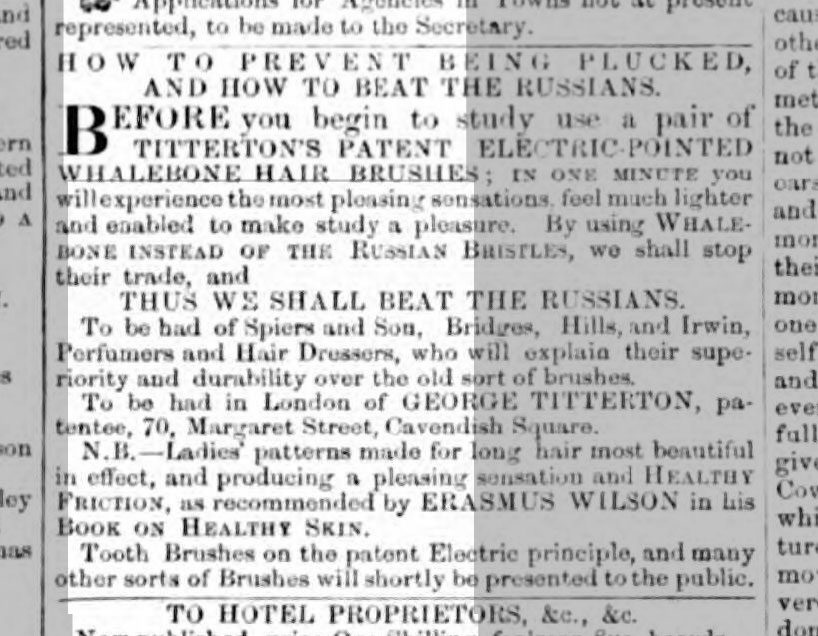
[PB: I must draw attention to a ludicrous advert to the immediate left of this article:
"HOW TO PREVENT BEING PLUCKED AND HOW TO BEAT THE RUSSIANS.
BEFORE you begin to study use a pair of TITTERTON'S PATENT ELECTRIC POINTED WHALEBONE HAIR BRUSHES; IN ONE MINUTE you will experience the most pleasing sensations, feel much lighter and enabled to make study a pleasure. By using WHALEBONE INSTEAD OF THE RUSSIAN BRISTLES, we shall stop their trade, and
THUS WE SHALL BEAT THE RUSSIANS..."]
Oxford Chronicle and Reading Gazette, p.2, 1 July 1854
(Click on image to enlarge)
Short derivative articles appeared elsewhere in the country e.g.
- BNA: Search: "Cory" "Isis" "drowned" "1854". (accessed 1.5.2018).
- www.britishnewspaperarchive.co.uk/viewer/bl/0001523/18540629/042/0003 (accessed 1.5.2018).
- www.britishnewspaperarchive.co.uk/viewer/bl/0000312/18540627/011/0002 (accessed 1.5.2018).
- www.britishnewspaperarchive.co.uk/viewer/bl/0000498/18540701/057/0010 (accessed 1.5.2018).
- www.britishnewspaperarchive.co.uk/viewer/bl/0000183/18540626/026/0003 (accessed 1.5.2018).
- https://www.britishnewspaperarchive.co.uk/viewer/bl/0000071/18540701/014/0004 (accessed 1.5.2018).
- (accessed).