Back to Prisoners of the Russians | John Bevin’s page
Private John Bevin (1060), 8th Hussars, was badly wounded and taken prisoner in the Charge on 25 October 1854. A month later he wrote to his mother from hospital at Simferopol. Someone signing himself “G.” sent an “exact copy” to the Times on 9 February 1855, to show that ordinary soldiers taken prisoner were being treated kindly. It was then reprinted in local papers. The writer’s blanks (“——”) for the names of family and friends are in the printed text.
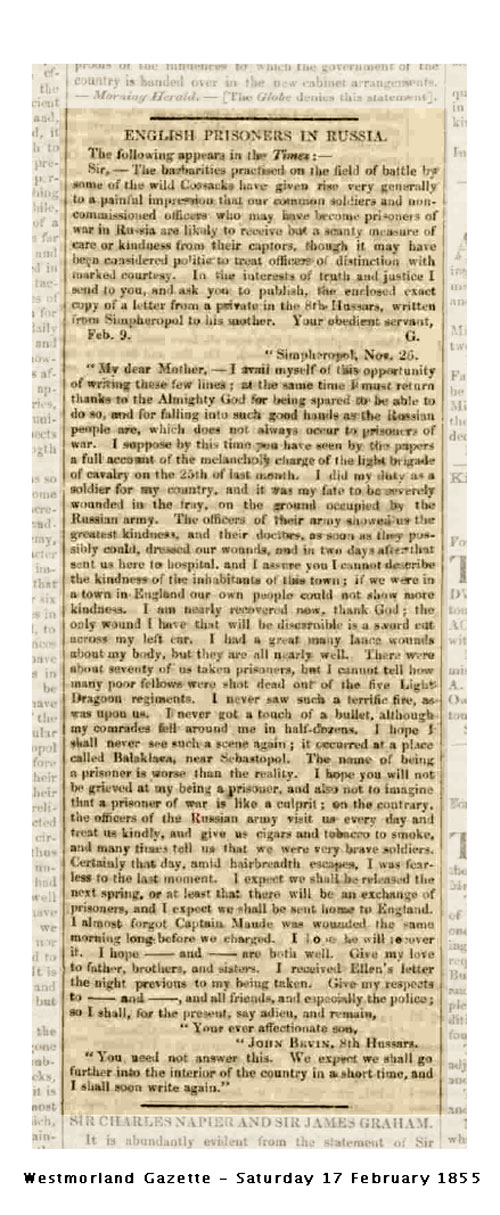
Source of this transcription: Westmorland Gazette, Saturday 17 February 1855, “English Prisoners in Russia”, reprinted from the Times. Scan: bevin_j_1060_8H_prisoner_westmoreland_gazette_1855.jpg. Compared with the Notts Guardian, 15 February 1855 (scan); differences are listed below the letter. The date of the Times printing and the original manuscript have not been traced.
Spelling and punctuation of the newspaper are kept. The newspaper prints the letter as one paragraph; it is broken into paragraphs here for ease of reading.
[Newspaper heading:] ENGLISH PRISONERS IN RUSSIA.
The following appears in the Times:—
Sir,—The barbarities practised on the field of battle by some of the wild Cossacks have given rise very generally to a painful impression that our common soldiers and non-commissioned officers who may have become prisoners of war in Russia are likely to receive but a scanty measure of care or kindness from their captors, though it may have been considered politic to treat officers of distinction with marked courtesy. In the interests of truth and justice I send to you, and ask you to publish, the enclosed exact copy of a letter from a private in the 8th Hussars, written from Simpheropol to his mother. Your obedient servant,
Feb. 9. G.
“Simpheropol, Nov. 26.
“My dear Mother,—I avail myself of this opportunity of writing these few lines; at the same time I must return thanks to the Almighty God for being spared to be able to do so, and for falling into such good hands as the Russian people are, which does not always occur to prisoners of war.
I suppose by this time you have seen by the papers a full account of the melancholy charge of the light brigade of cavalry on the 25th of last month. I did my duty as a soldier for my country, and it was my fate to be severely wounded in the fray, on the ground occupied by the Russian army. The officers of their army showed us the greatest kindness, and their doctors, as soon as they possibly could, dressed our wounds, and in two days after that sent us here to hospital, and I assure you I cannot describe the kindness of the inhabitants of this town; if we were in a town in England our own people could not show more kindness.
I am nearly recovered now, thank God; the only wound I have that will be discernible is a sword cut across my left ear. I had a great many lance wounds about my body, but they are all nearly well.
There were about seventy of us taken prisoners, but I cannot tell how many poor fellows were shot dead out of the five Light Dragoon regiments. I never saw such a terrific fire, as was upon us. I never got a touch of a bullet, although my comrades fell around me in half-dozens. I hope I shall never see such a scene again; it occurred at a place called Balaklava, near Sebastopol.
The name of being a prisoner is worse than the reality. I hope you will not be grieved at my being a prisoner, and also not to imagine that a prisoner of war is like a culprit; on the contrary, the officers of the Russian army visit us every day and treat us kindly, and give us cigars and tobacco to smoke, and many times tell us that we were very brave soldiers. Certainly that day, amid hairbreadth escapes, I was fearless to the last moment.
I expect we shall be released the next spring, or at least that there will be an exchange of prisoners, and I expect we shall be sent home to England.
I almost forgot Captain Maude was wounded the same morning long before we charged. I hope he will recover it.
I hope —— and —— are both well. Give my love to father, brothers, and sisters. I received Ellen’s letter the night previous to my being taken. Give my respects to —— and ——, and all friends, and especially the police; so I shall, for the present, say adieu, and remain,
“Your ever affectionate son,
“John Bevin, 8th Hussars.“You need not answer this. We expect we shall go further into the interior of the country in a short time, and I shall soon write again.”
Introduced only as “The following letter, describing the treatment of English prisoners in Russia, is from a soldier of the 8th Hussars:—”, with no mention of the Times or “G.”. It is dated “Simpheropol, November 26th, 1854” (the year confirms 1854). Otherwise the same letter, except:
Both appeared within a week of “G.”’s covering letter of 9 February, so both probably come from the Times, the Notts Guardian perhaps from a different reprint.
Captain Maude: Captain George Ashley Maude, Royal Horse Artillery (I Troop), badly wounded in the morning’s action at Balaklava. [to check]
“Especially the police”: who Bevin meant is not known. [PB had asked on Bevin’s page whether this is ironic.]
Bevin’s sword cut to the left ear also appears in James Wightman’s memoir: in hospital, a Russian cavalryman Bevin had cut about recognised him, and Bevin pointed to “the fragment of his own left ear”.