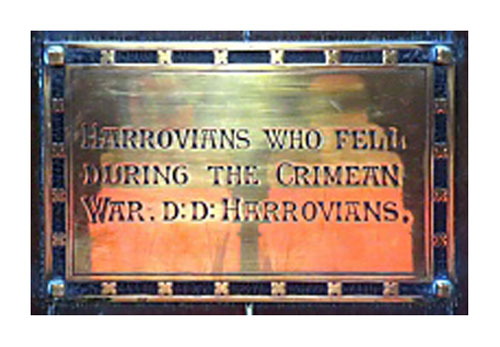
There is a Plaque in the Royal Garrison Church, Portsmouth, dedicated to Old Harrovians who died in the Crimean War. Of the 22 names commemorated, three were of officers in the Light Brigade (two killed in the Charge).
LIEUTENANT THE HON. ROBERT ANNESLEY, 11th Hussars, died of cholera in the Black Sea on the 28th September, 1854, aged 20 years.
CORNET HUGH MONTGOMERY, 13th Light Dragoons, fell in the Light Cavalry Charge at Balaklava on the 25th October, 1854, aged 24 years.
CAPTAIN GEORGE LOCKWOOD, 8th Hussars, Aide-de-Camp to the Earl of Cardigan, fell in the Light Cavalry Charge at Balaklava on the 25th October 1854, aged 36 years.
Other members of the Light Brigade recorded in the EJBA as having been educated at Harrow School include:
Arthur Lyttleton ANNESLEY.
James Thomas BRUDENELL.
Alexander Roberts DUNN.
Hugh MONTGOMERY.
Two more are referenced but I have not found them in the Harrow School Register:
Somerset John Gough-CALTHORPE.
Robert MACNEILL.
Incidentally, Winston CHURCHILL was also a pupil at Harrow (from 1888). His academic career there was famously undistinguished, and he went on to join (much against his parents' wishes) what he called the "awfully smart" 4th Light Dragoons in 1894. [See e.g. Douglas Russell, Winston Churchill: Soldier: The Military Life of a Gentleman at War, 2005.]
HARROVIANS WHO FELL
DURING THE CRIMEAN
WAR DD: HARROVIANSThere are two references to Old Harrovians who died during the Crimean War in the church, but the only record of who they were is in the 1873 Guide to the Church. How the author came by these names is unknown - the entries are of uniform content but differ in a few respects from other available records...
MAJOR-GENERAL JAMES BUCKNALL ESTCOURT, Adjutant General of the Army in the East, died of cholera in the Crimea on the 24th June 1855, aged 53 years.
LIEUT-COLONEL THE HON. THOMAS VESEY DAWSON, Coldstream Guards, fell at the battle of Inkerman on the 5th November, 1854, aged 35 years.
[Memorial: Royal Military Chapel, Wellington Barracks, London - "In memory of the late Lieut-Col. The Hon. T. Vesey Dawson, Coldstream Guards, born September 3rd 1819, who entered the Regiment August 11th 1837, and proceeded with the 1st Battalion to Turkey in 1854, serving during the campaign in the Crimea, including the Alma, till the Battle of Inkerman, where he died a soldier's death, on the 5th November 1854, aged 35 years. Placed by his brother, Richard Earl of Dartrey, K.P. and his two sons, Vesey John Dawson, and Douglas F. Rawdon Dawson, Coldstream Guards."]
LIEUT-COLONEL JAMES BRODIE C.B. [sic], 30th Regiment. Fell mortally wounded on the attack on the Redan, on the 8th September 1855, aged 32 years.
[Buried on Cathcart's Hill - "Sacred to the memory of Lieutenant Colonel James Brodie Patullo, CB 30th Regiment." Harrow School records give his name as James Brodie Pattullo]
CAPTAIN HYLTON JOLLIFFE, Coldstream Guards, died of cholera in the Crimea, on the 3rd October 1854, aged 28 years.
[The 'Redcoats' site has the date of death as 4th October.]
CAPTAIN GEORGE LOCKWOOD, 8th Hussars, Aide-de-Camp to the Earl of Cardigan, fell in the Light Cavalry Charge at Balaklava on the 25th October 1854, aged 36 years.
CAPTAIN WILLIAM KENT ALLIX, 1st Royal Regiment, Aide-de-camp to General Sir de Lacy Evans, fell at the battle of Inkerman, 5th November 1854, aged 32 years.
CAPTAIN THE HON. CHARLES WELBORE HERBERT AGAR, 44th Regiment, fell at the assault upon Sebastopol on the 18th June, 1855, aged 31 years.
CAPTAIN WILLIAM HENRY CECIL GEORGE PECHELL, 77th Regiment, fell in the trenches before sebastopol, on the 3rd September, 1855, aged 21 years.
[Harrow School records show his surname as PECHALL and his age as 24 years.]
CAPTAIN JAMES AUGUSTUS LOCKHART, 41st Regiment, fell in the advanced trenches before the Redan on the 8th of September, 1855, aged 21 years.
CAPTAIN JAMES ERNEST KNIGHT, 77th Regiment, died of fever before Sebastopol on the 2nd October, 1855, aged 19 years.
LIEUTENANT HENRY ANSTRUTHER, 23rd Regiment, fell in the battle of the Alma, on the 20th September, 1854, aged 18 years.
LIEUTENANT THE HON. ROBERT ANNESLEY, 11th Hussars, died of cholera in the Black Sea on the 28th September, 1854, aged 20 years.
LIEUTENANT HENRY CHARLES DAWSON, Enniskillen Dragoons, died of fever in Balaklava Bay on the 5th November, 1854, aged 19 years.
LIEUTENANT CAVENDISH HUBERT GREVILLE, Coldstream Guards, fell at the battle of Inkerman, 1854, aged 19 years.
[He entered the regiment on the 10th June 1853 and joined the 1st Battalion in the Crimea, in October 1854; he was killed at the battle of Inkerman, on the 5th November 1854.]
LIEUTENANT PERCIVAL HART DULKE, Rifle Brigade, died of fever in Balaklava Harbour, on the 9th April, 1855, aged 18 years.
[Harrow School Archive give his name as Percyval Hart Dyke.]
LIEUTENANT ROBERT JOHN BROWN CLAYTON, 34th Regiment, died in camp on the 12th July, 1855, of wounds received at the assault on the Redan, on the 18th June 1855, aged 20 years.
[The 'Redcoat' site has Clayton's rank recorded as Ensign.]
LIEUTENANT HENRY CHARLES EVANS, 55th Regiment, fell mortally wounded in the trenches before Sebastopol on the 4th of August, 1855, aged 18 years.
LIEUTENANT HENRY STEWART RYDER, Rifle Brigade, fell within the Redan in the assault on the 8th September, 1855, aged 20 years.
LIEUTENANT EDWARD SHUTTLEWORTH HOLDEN, 23rd Welsh Fusiliers, fell mortally wounded at the assault on the Redan on the 8th of September, 1855, aged 18 years.
CORNET HUGH MONTGOMERY, 13th Light Dragoons, fell in the Light Cavalry Charge at Balaklava on the 25th October, 1854, aged 24 years.
ENSIGN JAMES HULTON CLUTTERBUCK, 63rd Regiment, fell at the battle of Inkerman, on 5th November 1854, aged 19 years.
[In addition to the names recorded in the 1873 Guide, the Harrow School records also include the name of Captain Sir Robert Lydston Newman, Bart. Genadier Guards fell at the battle of Inkerman, on the 5th November 1854, aged 33 years.]
[Source: memorialsinportsmouth.co.uk/churches/royal_garrison/harrovians.htm (accessed 6.3.2016). Comments in square brackets are included in this list.]
[PB: The impressive Harrow School Chapel itself was substantially enlarged and re-modelled by Sir George Gilbert Scott to celebrate the role of Harrow boys in the Crimean War.]
1856. On the 26th of June, 1856, the Foundation Stone was laid for a new South Aisle, designed as a Memorial to those Officers educated at Harrow who fell in the Crimean War.
1857. The whole building having been in the interval completed, the Chapel was re-consecrated by the Lord Bishop of London, on All Saints' Day, the 1st of November, 1857...
A chapel had been talked of as far back as 1818, but nothing effective had been done for its erection; in 1839, twenty years after the building of the east wing of the old schools, the first school chapel, Dr. Wordsworth's chapel, was built. It was not a beautiful building, it has completely disappeared. But the erection was characteristic of the time when the modern idea of a public school as an independent community began first consciously to be grasped.
For a time the School divided its worship between the chapel and the parish church; then in Dr. Vaughan's time the old chapel was gradually replaced by the present building, which was consecrated in 1857. The new chapel is the work of Sir Gilbert Scott. As to the architectural merits of the outside, opinions may differ, but inside the proportions are perfectly true and simple, and the columns that separate the nave and the aisles are excellent examples of the style of the architect. The west window has some beautiful glass.
But Harrow School Chapel is not to be judged by its architecture.
The most beautiful and incomparably the most significant of the material ornaments of the chapel are the memorials to those whose lives or deaths have entitled them to a permanent place in the history of the School. There is hardly a stone without a memory. The south aisle was built in memory of Harrovians who fell in the Crimea; their names are written on a brass scroll running under the windows. They begin, as you enter the chapel, with the name of a boy of nineteen, who left the school to die at Balaclava.
[Source: J. Fischer Williams, Harrow, London, 1901. Available online from the Internet Archive: archive.org/stream/harrowwill00willuoft/harrowwill00willuoft_djvu.txt and archive.org/stream/harrowschoolregi00harruoft.pdf (accessed 7.3.2016).]
[Are there any photographs of this scroll?.]
Dale Vargas has listed memorials for the Crimean War as follows:
George Lockwood, Balaklava, killed returning to rescue his General, Lord Cardigan (OH) following the charge of the Light Brigade, 1854, aged 39.
Hylton Jolliffe, of cholera, 1854, aged 28.
James Bucknall Estcourt, of cholera, 1854, aged 33 [should be 53].
Sir Robert Lydston Newman Bt, Inkerman, 1854, aged 33 .
William Kent Allix, Inkerman, 1854, aged 32.
Henry Stewart Ryder, Redan, 1855, aged 20.
Edward Shuttleworth Holden, Redan, 1855, aged 18.
The Hon Charles Welbore Herbert Agar, fell in the assault on Sebastopol, 1855, aged 24.
William Henry Cecil George Pechell, Sebastopol, 1855, aged 31.
James Augustus Lockhart, Redan, 1855, aged 21.
The Hon Thomas Vesey Dawson, Inkerman, 1854, aged 35.
Charles Ernest Knight, of fever, 1855, aged 19.
Henry Anstruther, Alma, 1854, aged 18.
The Hon Robert Annesley, of cholera, 1854, aged 20.
James Brodie Pattullo, Redan, 1855, aged 32.
Henry Charles Dawson, of fever, 1854, aged 19.
Cavendish Hubert Greville, Inkerman, 1854, aged 19.
Percyval Hart Dyke, of fever, 1855, aged 18.
Robert John Browne Clayton, Redan, 1855, aged 20.
Charles Henry Evans, Sebastopol, 1855, aged 18.
Hugh Montgomery, killed in the charge of the Light Brigade at Balaklava, 1854, aged 24.
James Hulton Clutterbuck, Inkerman, 1854, aged 19.
[Source: Dale Vargas, The Timeline History of Harrow School, Appendix 16, 2010 (accessed 6.3.2016).]