A number of men of the Light Brigade were associated with Millbank Prison (either as warders or convicts), curiously all of them from the 11th Hussars.
1680 William Thistle and 1802 Charles Wilson were prisoners there in 1856, prior to transportation.
According to an obituary, 1128 Thomas Alliston was "for many years" a warder here.
Some years later, in 1874, 1355 Edward Woodham, an assistant warder, transferred here from Portland Prison.
[PB: As EJB remarks, while there are often good records for convicts and warders at Portland Prison, no such records exist for Millbank.]
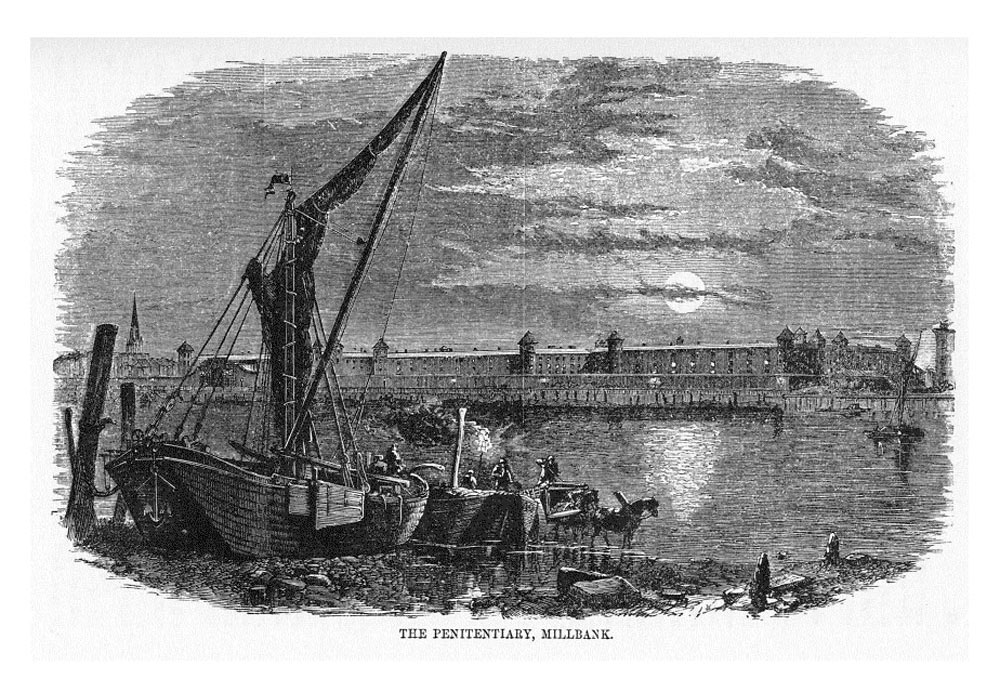
Millbank was opened in 1816 as a National Penitentiary for men and women, but its scandalous rates of disease, suicide and mental illness, and high running costs, led eventually to a downgrade. After 1843 Millbank became a holding depot for convicts prior to transportation to Australia. Prisoners were held for three months before their final destination was decided.
By 1850, around 4,000 people convicted of crimes were being transported annually from the UK. Prisoners awaiting transportation were kept in solitary confinement and restricted to silence for the first half of their sentence. Large-scale transportation ended in 1853, but the practice continued on a reduced scale until 1867 (to Western Australia). Millbank then became an ordinary local prison, and from 1870 a military prison.
By 1886 it had ceased to hold inmates, and it closed in 1890. Tate Britain now occupies the site.