THE BATTLE OF BALAKLAVA
Tom Taylor, Punch, or the London Charivari, vol. XXVII, 2 December 1854, p.219.
[Published anonymously, but according to Patrick Waddington, "The author's identity is established by the Punch office ledger for 1848-55" (Theirs but to do and die", p.29".
Date? I have seen various earlier dates, including 2 November and 25 November? Taylor's was not the first Balaclava poem to be published (there was one by "R." in the Manchester Guardian, 22 November 1854. See Waddington p.28). But it precedes Tennyson's Charge, first published in the Examiner, 9 December 1854, p.780 (Waddington p.13).
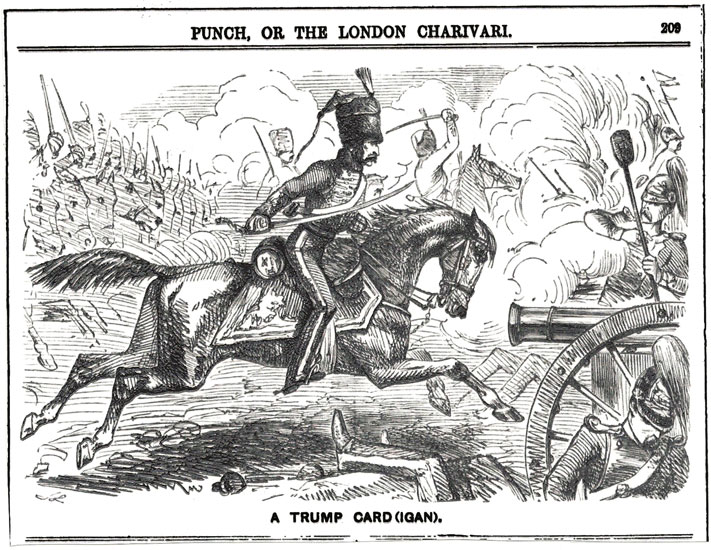
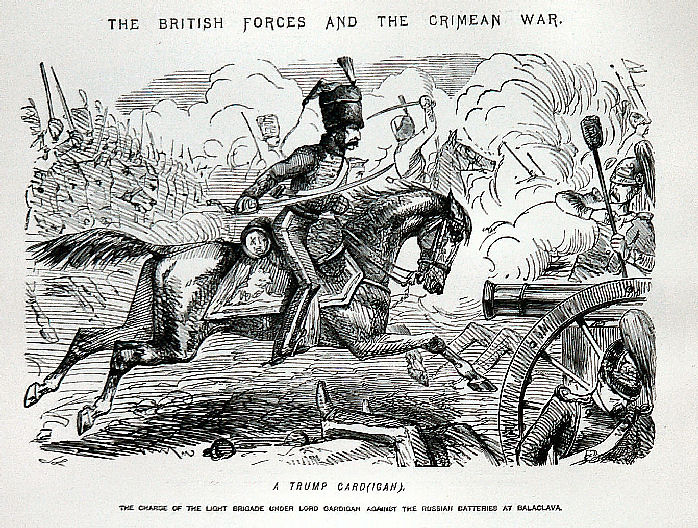
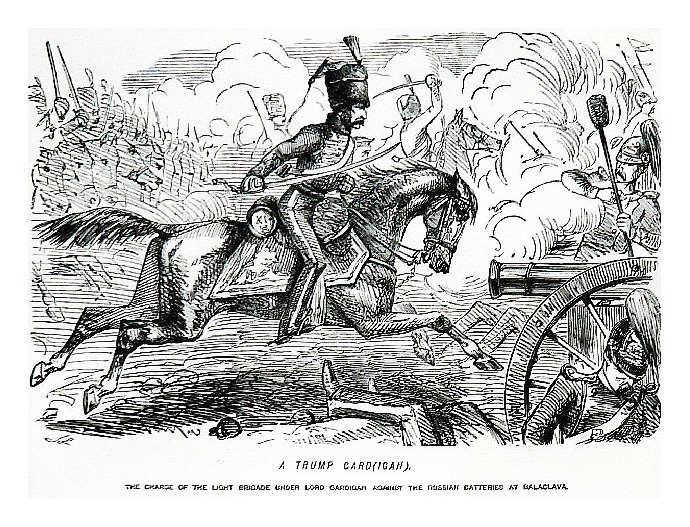
Was it accompanied by John Leech's "Trump Card(igan)" cartoon? No but there was another Charge-related image on the same page.
(Click on image to enlarge)
THE wind of dawn is breathing, the mists of night are wreathing
Up from the valley, in white swathes the mountain ranges sheathing;
Watch-fires are burning dimly; hill-batteries frowning grimly:
Troop-horses in the plain below at the picquets tethered trimly:
And the Turks in the redoubts, and the sailors on the hill,
And the Highlanders, within their tents, in the gray dawn, sleeping still
When in with hot haste riding our out-picquets bring tiding,
That the Russians in force within the Eastern gorge are hiding.
"Boot and saddle," and "reveillé," in the cool clear air ring gaily.
And horse and foot are forming, all eager for the melée;
Marine and sailor batteries are alive With fuse and match;
Every English heart's a-fire, — every English eye's a-watch.
Manned by our Turkish ally five redoubts command the valley;
From a gorge, a short mile distant, the Russian vanguard sally:
Tirailleurs and Cossacks dashing o'er the plain, with lance-points flashing —
Now they open! Two field-batteries their showers of grape send crashing;
And as the smoke blows over, six squares of Russian horse,
Three on each flank, en echelon, proclaim the foe in force.
The redoubts with shell they're plying. By Heaven, the Turks are flying!
Under Cossack lance and sabre, by scores, like cowards dying!
Curse the slaves, and never mind them; there are British hearts behind them,
With British bayonets sharp and sure — and so the foe shall find them.
Two deep the gallant Ninety-third are formed to bear the brunt;
And the Russian horse come thundering on that unshaken front!
They're at six hundred paces — wait till you see their faces —
Down go the rlfles, wlth a fire, that empties scores of places;
But on their line still dashes, when a second volley flashes,
And as lightning cleaves a cloud, through the Russian squadron crashes;
Down, rear and van, go horse and man, the wounded with the slain —
That mounted host will count the cost, ere they charge our Scots again!
Meanwhile their chargers reining, and their own hot hearts restraining,
Our heavy horse upon the right inactive are remaining —
The hill their squadrons hiding, when o'er its summit riding,
All a blaze with blue and silver, and in their strength confiding,
The Russian horse, in triple force, to what our line can show,
With loosened rein, upon the plain dash, shouting as they go.
In spurs, and out sabres! Now bend to our labours, Enniskillen, and gallant Scots Gray!
Full oft in the fight you've aforetime stood neighbours,
But ne'er in more desperate fray.
The First Royal Irish are hard on your track,
With the Fourth Dragoon Guards at their side,
And the gallant First Royals, that never showed back,
Nor found foe that their onset defied.
On they dash, boot to boot, bended brow and bare blade —
What care they for the numbers against them arrayed?
In pele mele on the foe like a bolt from a bow,
With a cheer, loud and clear as a trumpet, they go.
Through a line, twice their length, and three deep for their one
They have past, like a blast — but their work is not done.
Fresh squadrons close round them: 'tis one man to three!
Out-flanked and out-numbered, what rescue may be?
Hurrah! the Dragoons and the Royals so true, —
They'll finish what work you have left them to do!
Soon they clear all the rear, with the sweep of their blades,
And that shout tells the rout of the Russian brigades.
Oh, would to God that gallant charge had closed the bloody day!
Then clear of blame had shone the fame of Balaklava's fray;
But who is there with patient tongue the sorry tale to tell,
How our Light Brigade, true martyrs to the point of honour, fell!
"'Twas sublime, but 'twas not warfare," that charge of woe and wrack,
That led six hundred to the guns, and brought two hundred back!
Enough! the order came to charge, and charge they did did — like men:
While shot and shell and rifle-ball played on them down the glen.
Though thirty guns were ranged in front, not one drew bated breath.
Unfaltering, unquestioning, they rode upon their death!
Nor by five times their number of all arms could they be stayed;
And with two lives for one of ours, e'en then, the Russians paid:
Till torn with shot and rent with shell, a spent and bleeding few, —
Life won against those fearful odds, — from the grapple they withdrew.
But still like wounded lions, their faces to the foe,
More conquerors than conquered, they fall back stern and slow;
With dinted arms and weary steeds - all bruised and soiled and worn —
Is this the wreck of all that rode so bravely out this morn?
Where thirty answered muster at dawn now answer ten,
Oh, woe's me for such officers! — Oh, woe's me for such men!
Whose was the blame? Name not his name, but rather seek to hide.
If he live, leave him to conscience — to God, if he have died:
But for you, true band of heroes, you have done your duty well:
Your country asks not to what end; it knows but how you fell!