Added 16.1.16. Information added 12.7.2017.
IN PROGRESS - NOT FOR PUBLICATION

OH! 'TIS A FAMOUS STORY OF BALACLAVA, Slade Murray (date?)
There is a low resolution version of this image, and a transcription with some explanatory links, on the History Home website here
. The higher resolution image is from the Frank Kidson Collction, accessed here (13 August 2017).A version of this song was collected by Sam Henry and originally published in the Northern Constitution of Coleraine, Northern Ireland, between 1923 and 1939. It was edited with detailed notes by Gale Huntington an Lani Herrmann in 1990 (University of Georgia Press). Parts can be viewed here
.[Add info about typescript and image: Battle of Balaclava, Roud ID: S363763, First Line: Six 'undred standi warriors of England's pride the best Source: Plunkett Collection (Sussex Texts typescript), Performer: Date: 1957 - 1960, Place: England : Sussex, Collector: Plunkett, Mervyn, Roud No: 1443]
Vaughan Williams Memorial Library, search for e.g. "Balaclava", "Balaklava" etc here. They also show a typescript of the song as partially recalled in Sussex [?] 1956-60[?].
The DBOPM (Database of Popular Music) website records this piece as here as copyright 1884.
There is an interesting summary of Slade Murray's early life and appearances as a performer in Australia here (August 2017). (If this link ceases to work, visit the Australian Variety Theatre Archive, at http://ozvta.com/practitioners.)
[WL: See also the British Library entry, which includes the score, here.]
A different song about Balaclava? There is a reference to a collected version, with a sound recording, in the Helen Creighton collection (Nova Scotia Archives) AR 5352 / AC 2297 / 1854 here.
Balaclava (from WILLIAMS, Dennis of Musquodoboit Harbour, Halifax County, Nova Scotia, first line of song: "It was just before that last great fight...") - July 1951 Rec no. 1854, Loc. no. AR 5352, AC 2297, MF no. 289.378, sound recording.
(Click on image to enlarge)
Slade Murray's New Song
OH! 'TIS A FAMOUS STORY OF BALACLAVA
Six hundred stalwart warriors of England's pride the best,
Did grasp the lance and sabre on Balaclava's crest,
And, with their trusty leader, Earl Cardigan the brave,
Dashed through the Russian valley to glory or a grave.
Their foeman stood in thousands, a dark and awful mass,
Beneath their famous strongholds resolved to guard the pass,
Their guns with fierce defiance belched thunders up the vale,
Where sat our English horsemen firm beneath the iron gale.
Oh! 'tis a famous story, proclaim it far and wide,
And let your children's children re-echo it with pride,
How Cardigan the fearless, his name immortal made,
When he crossed that Russian valley with the famous Light Brigade.
Brave Nolan brought the order, good God can it be true,
Cried Cardigan the fearless, and my Brigade so few,
To take those awful cannon from yonder teeming mass.
"Tis madness sir, where shall we charge - what guns bring from the pass?
The messenger with hauteur looked once at the brave Earl,
Then pointing to the enemy, his lip began to curl
There, there, my lord, there are your guns and there your foemen too,
Then turned his charger's head away, and bade the Earl adieu.
And they were but six hundred, 'gainst two score thousand foes,
Hemmed in with furious cannon, and crushed with savage blows.
Yet fought they there like heroes, for our noble England's fame,
Oh glorious charge! heroic deed! what honour crowns thy name.
Four hundred of those soldiers fell, fighting where they stood,
And thus that fatal death vale they enriched with English blood.
Four hundred of those soldiers bequeathed their lives away,
To the England they had fought for on that wild October day.
Notes
London: H.P.SUCH, Machine Printer & Publisher, 177 Union-street, Borough, S.E.
[Source: Add info]
[PB: Waddington refers to it as "John Arthur Elliott, Balaclava. (Oh 'Tis a Famous Story!)", p.159.]
[PB: I wonder if the "private phonograph" recording still exists?]
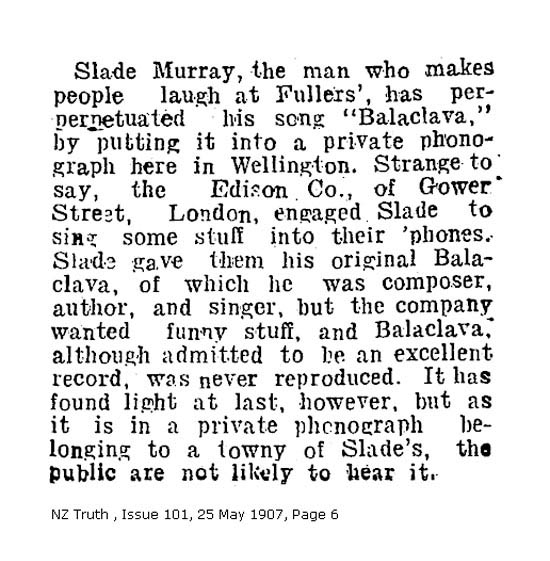
[Source: New Zealand Truth, 25th May 1907. ]
(Click on images to enlarge)
A "folk" song?
The historian of folk music Karl Dallas includes a version in his The Cruel Wars: 100 Soldiers' Songs from Agincourt to Ulster (1972), with a detailed provenance:
Most such songs are composed far from the field of battle, but it was from Robert Farren of Ballymoney, a Crimean veteran, that this song was first heard by a Mr Graham of Coleraine, who taught it to his son George, who sang it to Mr Sam Henry, who also got a similar version from Mr John Love of Limavady."


[Source: Karl Dallas, The Cruel Wars: 100 Soldiers' Songs from Agincourt to Ulster, London: Wolfe, 1972, pp.218-9.]
(Click on images to enlarge)
The two versions are remarkably similar - there are only a handful of word changes - with the exception of the most critical verse, concerning Nolan's disdain for Cardigan, omitted in the Dallas version:
"Tis madness sir, where shall we charge - what guns bring from the pass?
The messenger with hauteur looked once at the brave Earl,
Then pointing to the enemy, his lip began to curl
There, there, my lord, there are your guns and there your foemen too,
Then turned his charger's head away, and bade the Earl adieu.
As KD recognises, "Most such songs are composed far from the field of battle", but by citing a continuous lineage starting with Robert Farren, a Crimean veteran, he suggests he believes this is indeed a "folk" song, rather than one that was professionally composed, performed and printed (in this case for the music hall). Presumably many "folk" songs originate in a similar way, even if they subsequently form part of an "oral tradition". (Of course, I am assuming the song was not already in the public sphere when Slade Murray claimed it was his own work - though such things did, and do, occur.)
[PB, August 2017: I am very grateful to Chris Robinson for bringing this book to my attention.]
Murray, the poor man's Tennyson?
[PB: expand or comment on this...the context is contemporary criticism of Cardigan for ...]

Murray v Tennyson
[Source: Donald Thomas, Charge! Hurrah! Hurrah!: A Life of Cardigan of Balaclava, p.267.]