

Deep in the foeman's mould he lies,
The youthful and the brave;
Without a stone to speak his worth,
Or mark the soldier's grave.
A cry for help came o'er the seas,
The Osmanli to shield;
He heard it, and with maiden sword
He sought the battle-field.
We blessed him as he left his home,
His noble soul to prove;
We loved him for our England's sake,
And he returned our love.
We never doubted once his heart
Was daring to a sin;
We knew his patriotic fire,
And metal of his kin.
And, knowing him, our watchful love
Pursued the path he trod;
And, when his footprints mocked our search,
We left him to his God.
Grim Death, with scythe of pestilence,
Britannia's flower mowed down;
We saw him mourn those hero-sons
Of England's old renown.
And, bending with a wistful gaze
To see his comrades die,
He heard those dying Britons say —
"Our country's loss supply."
With eye upturned to Heaven, he asked
That he in peril's hour,
Remembering how the brave could die,
Might have their share of power.
His prayer was heard, his wish was sealed,
The hour immortal came,
And Balaklava wrote in blood
The Lancer's deathless name!
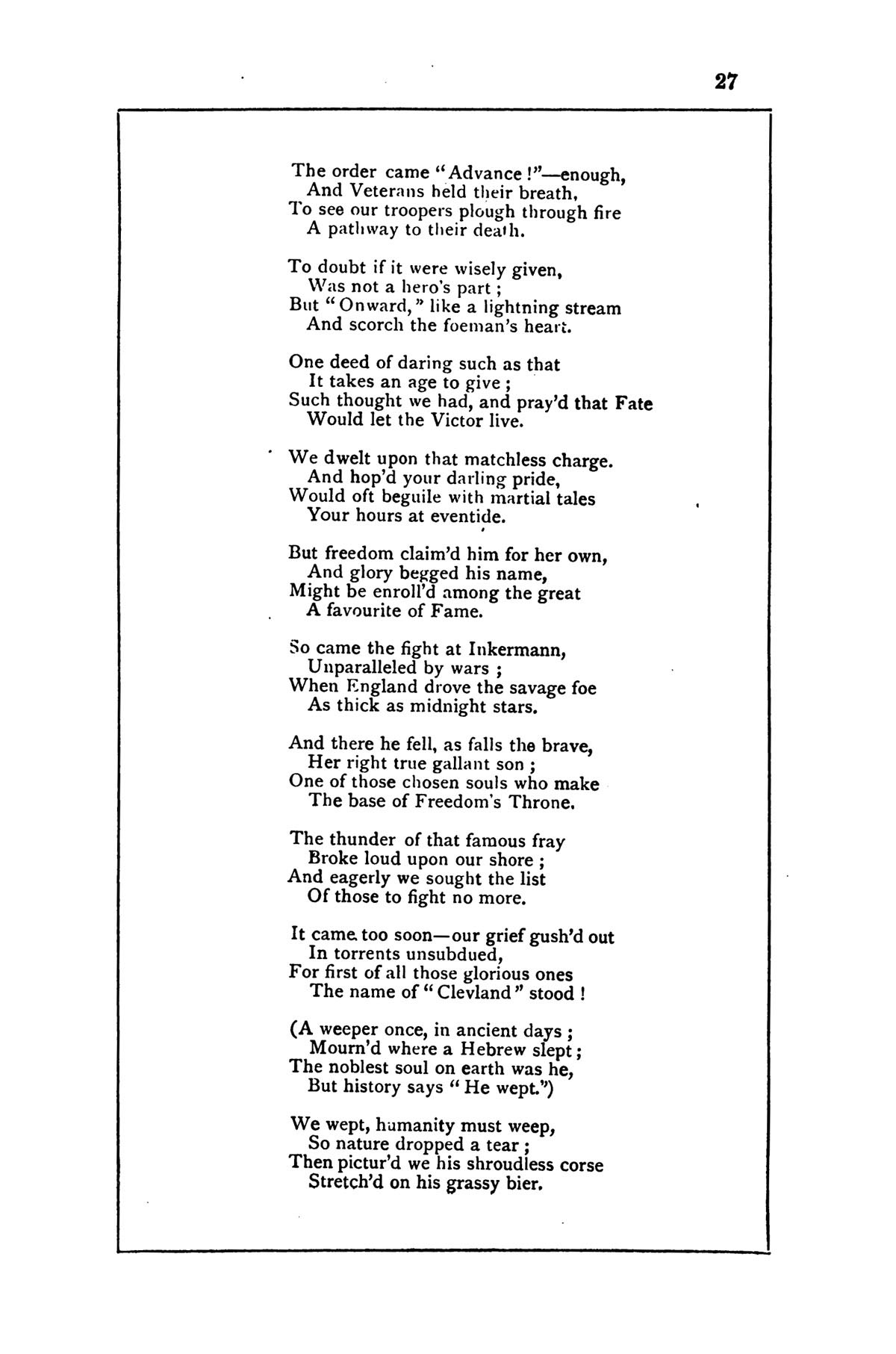
The order came, "Advance!" — enough:
And veterans held their breath
To see our troopers plough through fire
A pathway to their death.
To doubt if it were wisely given
Was not a hero's part;
But "Onward!" like a lightning-stream,
And scorch the foeman's heart.
One deed of daring such as that
It takes an age to give;
Such thought we had, and prayed that Fate
Would let the victor live.
We dwelt upon that matchless charge,
And hope your darling pride
Would oft beguile with martial tales
Your hours at eventide.
But Freedom claimed him for her own,
And Glory begged his name
Might be enrolled among the great —
A favourite of Fame.
So came the fight at Inkermann,
Unparalleled in wars;
When England drove the savage foe
As thick as midnight stars.
And there he fell, as falls the brave,
Her right true gallant son;
One of those chosen souls who make
The base of Freedom's throne.
The thunders of that famous fray
Broke loud upon our shore;
And eagerly we sought the list
Of those to fight no more.
It came too soon — our grief gush'd out
In torrents unsubdued,
For first of all those glorious ones
The name of "CLEVLAND" stood!
(A Weeper once, in ancient days,
Mourned where a Hebrew slept;
The noblest soul on earth was He,
But history says "He wept.")
We wept, Humanity must weep,
So Nature dropped a tear;
Then pictured we his shroudless corse
Stretched on his grassy bier.
We saw a gentle comrade's hand
Press lightly on his head;
Then, with his fellow-soldiers, make
The warrior's narrow bed.
[187]
No manufactured pomp of death
Bedecked his coffin rude;
His mourners were those bleeding hearts
Which heaped the field of blood. [?]
A carriage borrowed from the war
The bearer's office did;
His cap upon the coffin rode.
His sword across the lid.
No muffled drum, no funeral pall,
Salute, nor solemn knell,
Told how they sorrowed o'er their loss,
But tears, and one farewell.
A little mound we saw them raise
Upon that broken slope;
Then weeping went to bind and soothe
Our country's pride and hope.
Full many a kindred deed that day
All piously was done;
Whilst war roared out a requiem
As gun replied to gun.
No flow'ret there may crown their graves
As our sweet daisies do;
But this our Fatherland hath sworn —
To wrench them from the foe.
Peace, Lady, — thou hast done thy part —
A son thou hadst to give:
Now England writes his epitaph —
"He died that I might live."
EDWARD CAPERN
Bideford, December 2nd, 1854.
Edward Capern, "The Fall of the Brave, Addressed to his Bereaved Parent", in Poems by Edward Capern, Rural Postman of Bideford, Devon, London 1855, pp.180-185 [Online at archive.org/details/poemscapern00cape, downloaded as poems01capegoog.pdf (accessed 8.6.2016).
Significantly, the poem is included in the Rules of the Balaclava Commemoration Society [source? year?].
The poem is also included in a brief essay on Archibald Clevland, in George Ryan, Our Heroes of the Crimea: Being biographical sketches of our military officers from the General Commanding-in-Chief to the Subaltern, London, 1855, pp.184-187 (accessed 8.6.2016).
PB: Edward Capern (1819 — 1894), widely known as the "Postman Poet", was born in Tiverton, Devon, and moved to Barnstaple with is family in 1821. From the age of eight, he worked in a local lace factory but his sight became damaged. He became a Post Office messenger between Bideford and Appledore, and elsewhere. Tapley Park, Archibald Clevland's home, is only a few miles from Bideford so he may have delivered mail there and might well have known Clevland's mother. He was certainly very quick to write his poem, which was addressed to her.]
en.wikipedia.org/wiki/Edward_Capern
en.wikisource.org/wiki/1911_Encyclop%C3%A6dia_Britannica/Capern,_Edward
en.wikisource.org/wiki/Capern,_Edward_%28DNB01%29
lerwill-life.org.uk/history/postpoet.htm
Sabine Baring-Gould (author of "Onward Christian Soldiers" and a noted Devon antiquarian) dismissed Edward Capern's abilities as a poet in his Devonshire Characters and Strange Events (1908). It begins:
The Postman Poet, Edward Capern, has been hailed as the Devonshire Burns, but he has no right to be so entitled. Burns, at his best, sang in the tones and intonation of his class and country, and it was at his worst that he affected the style of the period and of culture, such as it was. Now Capern aspired to the artificiality and smoothness of the highly educated and wholly unreal class of verse writers of the Victorian period, of whom John Oxenford may be thrust forward as typical, men who could turn out smooth and finished pieces, rhythm and rhyme correct, but without a genuine poetical idea forming the kernel of the "poem."
He quotes a vivid account of Capern's life
In the summer of 1864, the American literary blacksmith, Elihu Burritt, spent three days with Capern, on his "Walk from London to the Land's End and back," and gave an excellent description of his host. He says: "Edward Capern, of Bideford, is a poet, and he is a postman, and both at once, and good at each. He is as faithful and genial a postman as ever dropped a letter in a cottage door, with an honest and welcome face, itself a living epistle of good will and friendly cheer. I can attest to that most confidently; for I went with him in his pony-cart two days on his rural rounds. That he is a poet who has written songs that will live and have a pleasant place among the productions of genius, I am equally confident, though pretending to be no connoisseur in such matters myself. Better judges have awarded to them a high degree of merit. Already a considerable volume of his songs and ballads has gone to its second edition; and he has sufficient matter on hand to make another of equal size and character.
His postal beat lies between Bideford and Buckland Brewer, a distance of more than six miles. Up to quite a recent date, he walked this distance twice a day in all weathers; starting off on winter mornings while it was yet dark. Having grown somewhat corpulent and short-winded, he has mounted, within a year or two, a pony-cart, that carries him up and down the long, steep hills on his course. It takes him till noon to ascend these to Buckland and distribute letters and papers among the hamlet cottages and roadside farmhouses on the way. Having reached the little town on the summit-hill, and left his bag at the post-office, he has three hours to wait before setting out on his return journey.
These are his writing hours; and he spends them in a little, antique, thatched cottage in one of the village streets. Here, seated at one end of a long deal table, while the cottager's wife and daughters are plying their needles, and doing all their family work at the other, he pens down the thoughts that have passed through the flitting visions of his imagination while alone on the road. Here he wrote most of his first book of ballads, and here he is working up his glowing rollicking songs for a new volume.
Sometimes the poetic inspiration comes in upon him like a flood on his way. He told me that he once brought home with him six sonnets on six different subjects, which he had thought out and penned in one of his daily beats. When the news of the taking of the Redan reached England, the very inner soul of his patriotism was stirred within him to the proudest emotion. As he walked up and down the long hills with his letter-bags strapped to his side, the thoughts of the glory his country had won came into his mind with a half-suffocating rush, and he struggled, nearly drowned by them, to give them forms of speech. The days were short, the road was long, and hard to foot, and the rules of the postal service were rigid. He could not hold fast the thoughts the event stirred within him until he reached the cottage. Some of the best of them would flit out of his memory, if he delayed to pen them as they arose. So he ran with all his might and main for a third of a mile, all panting with the race for time, found he had caught enough of it for pencilling on his knee a whole verse of the song. Thus he ran and wrote, each stanza costing him a race that made the hot perspiration fall upon the soiled and crumpled paper, on which he brought home to a wife prouder than himself of the song, 'The Lion Flag of England.'"
[Source: Devonshire Characters and Strange Events.