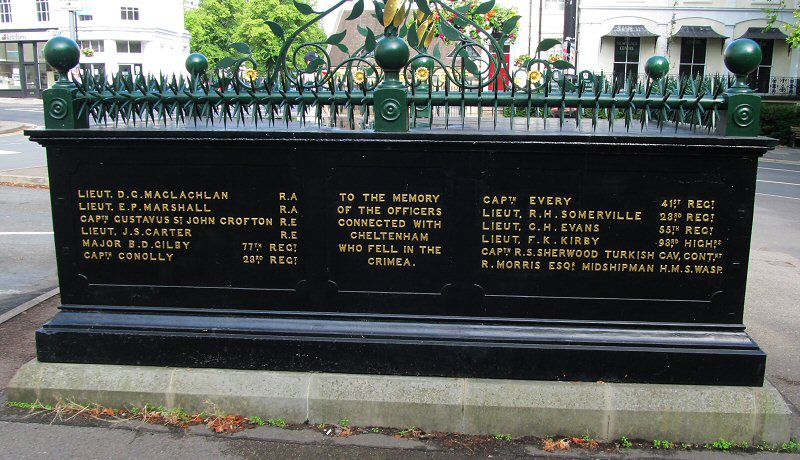
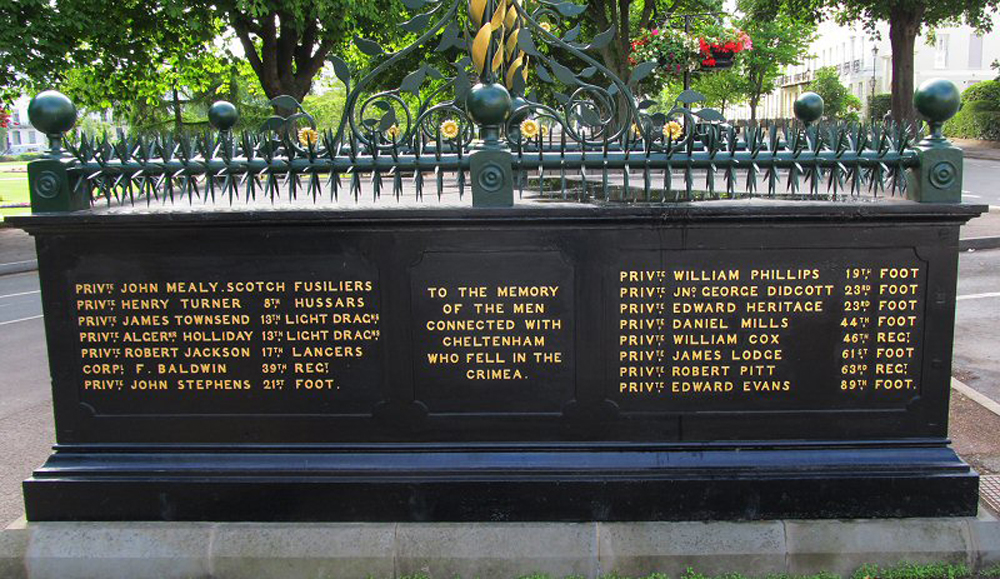
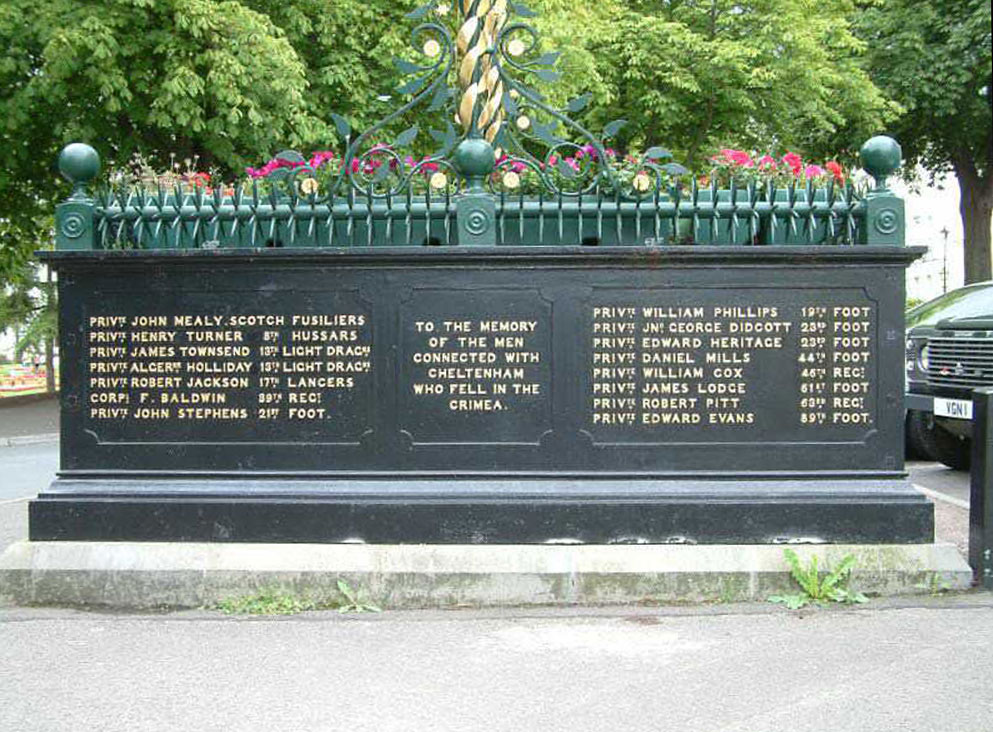
"To the memory of the men connected with Cheltenham who fell in the Crimea."
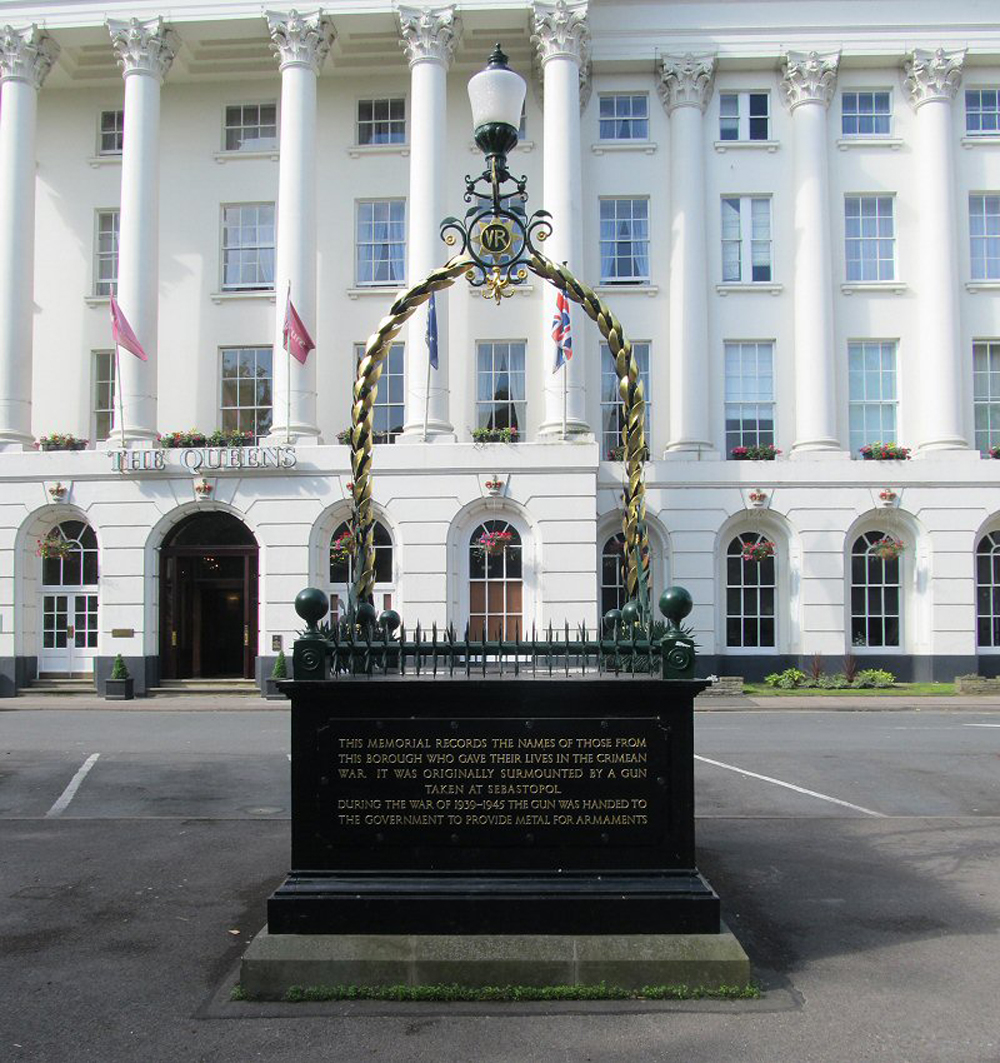
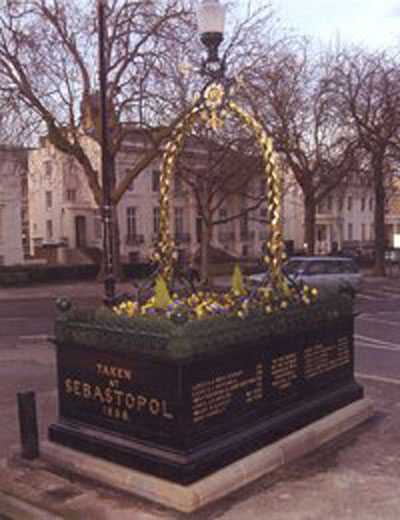
The memorial originally had a Russian gun [PB: two guns?] taken from Sebastopol in 1856 mounted on top, but this was removed at the beginning of World War Two and handed over to the Government for the war effort. Its place has now been filled in with earth and planted with flowers.
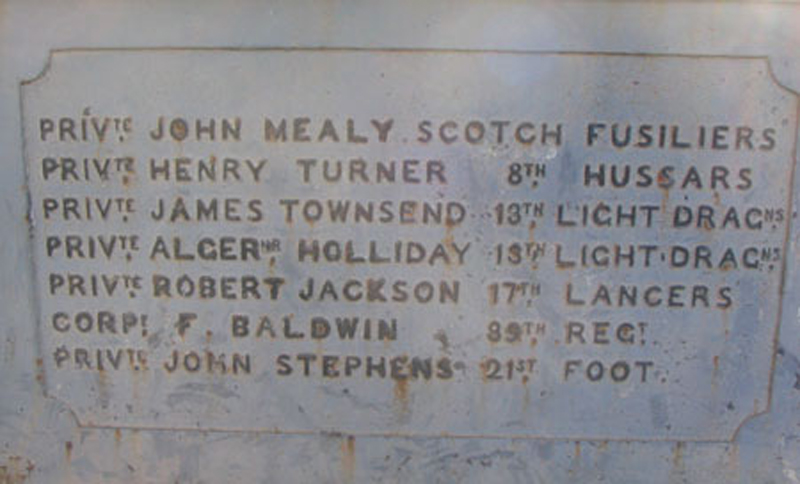
Men of the Light Brigade shown on the memorial:
Cheltenham Crimea Memorial
Town or City: Cheltenham
County: Gloucestershire
Country: England
WMT Reference Number: WM1855
Value of grant: £9030.00
Type of memorial: Freestanding
Type of work: Restoration
Grant scheme: English Heritage/Wolfson Foundation Grants
Year: 2008
UKNIWM reference number: 2070
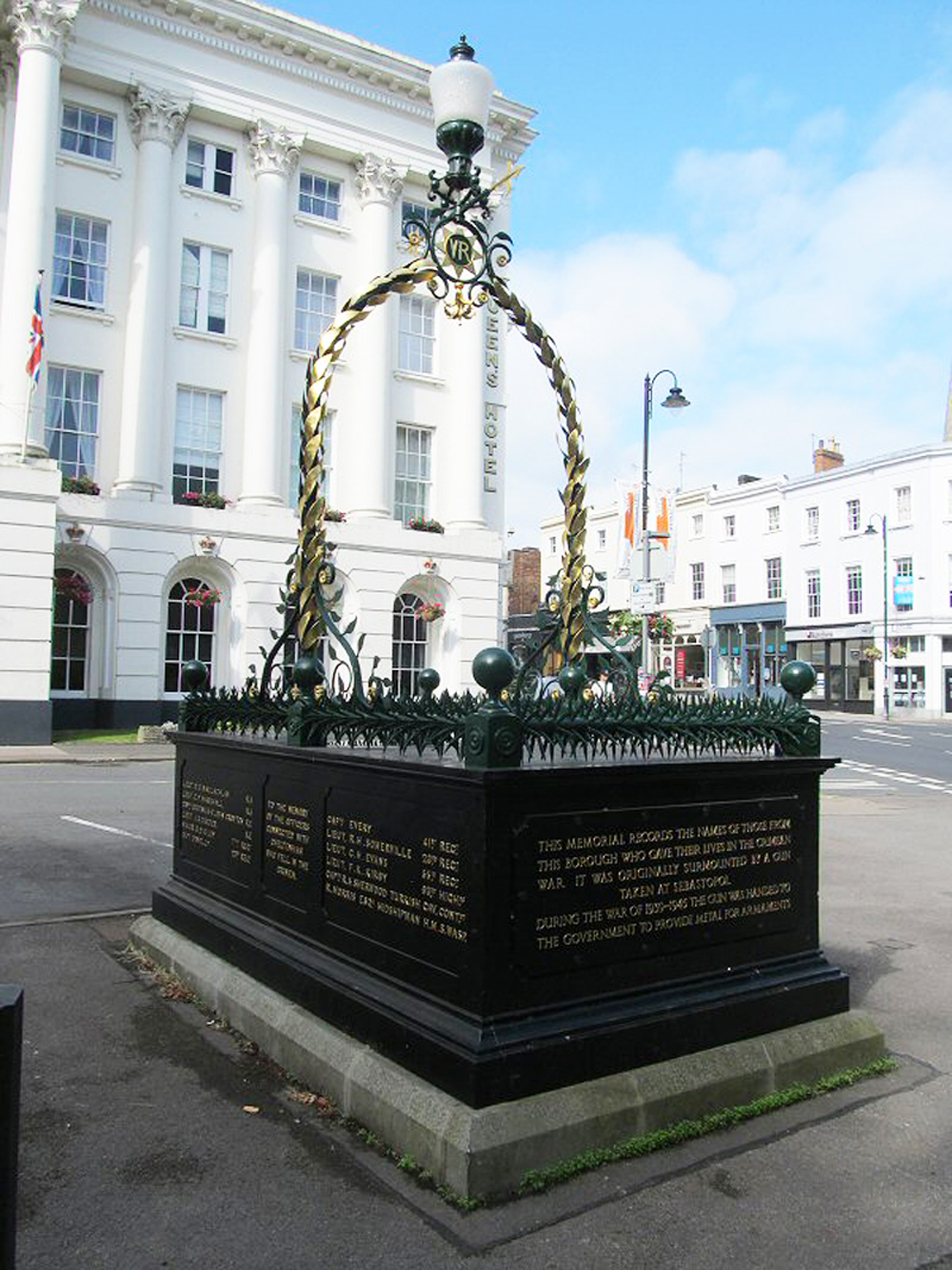
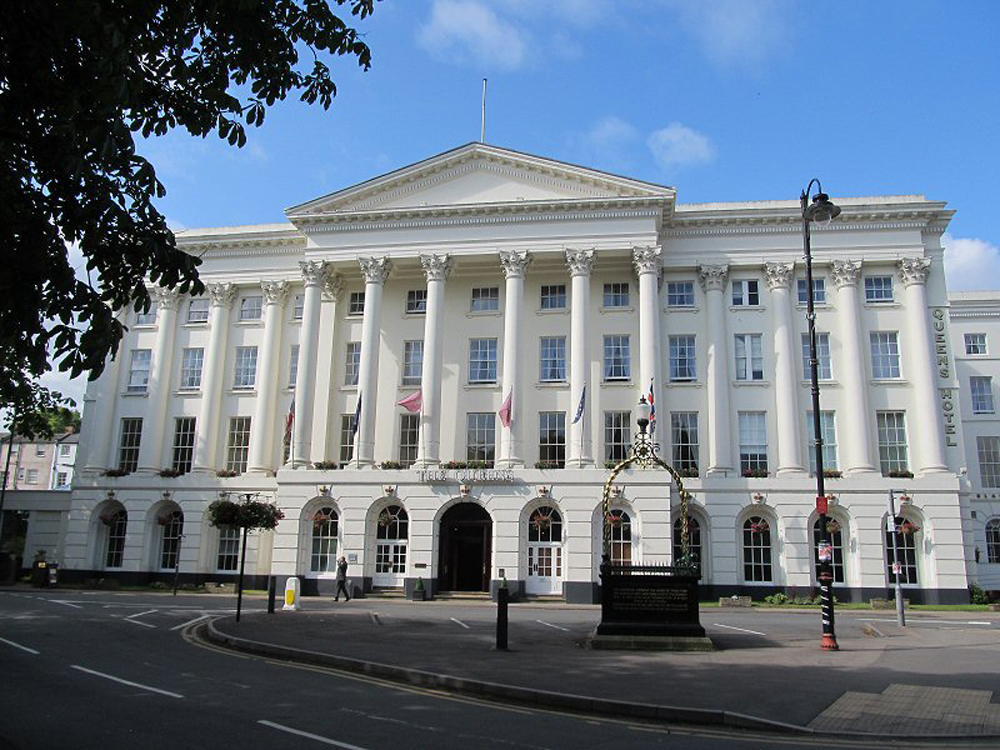
This Grade II listed memorial is located in front of the Queen's Hotel on the Promenade, Cheltenham, Gloucestershire. It is formed of a large black rectangular cast iron plinth which used to support a cannon. Around the top of the plinth is a low barrier of metal spikes with short metal posts with spherical finals at the corners, and the area within this barrier is now used as a planter for flowers. The memorial is spanned by a decorative arch painted in gilt and green, surmounted by a lamp. Underneath the lamp, supported by the arch, is a badge containing the monogram VR. There is gilded lettering around the faces of the plinth.
Over the years, the war memorial had been painted battleship grey, the metal had begun to corrode and some decorative details had been lost. In January 2008 English Heritage and the Wolfson Foundation granted £9,030 towards work to conserve the memorial and to return it as far as possible to its original appearance. The memorial was moved to a conservator's workshop to dismantle it. Investigations showed that fourteen layers of paint had been used on the memorial over time, and the original paint scheme was black on the base, with gold lettering, archway, and flowers and green leaves. The current decorative arrow finials below the lamp, and the lamp itself were shown to be later additions. However, the old photographs available were not detailed enough to see what the originals looked like and therefore it was decided to conserve the elements as they were, rather than replace them. Other features of the archway had to be re-cast, such as the flowers and leaves. The main body of the plinth had some cracks, which were repaired by fixing metal straps over the back on the inside of the base.
The iron base had originally been made to support one of a pair of Russian cannon seized after the battle of Sebastopol during the Crimean War. In 1857, Mr Davis, the proprietor of the Queen's Hotel, read in a news article that town of Colchester had asked for two Russian cannon, which were part of a group then at Woolwich Arsenal. When Cheltenham MP Capt Berkeley successfully applied for two of the canon, Mr Davis agreed to pay for them to be brought to Cheltenham as he thought that they would make a fine war memorial outside his hotel. He formed the Sebastopol Gun Committee for this purpose and the guns were erected on 5th July 1858. The lanterns on top of the guns were added in 1860 after the committee decided the lighting of the Promenade would deter local 'bad characters' from the area.
During World War II, the cannon were removed and melted down for munitions. One of the bases remained and was turned into a flower bed, still with the lantern on top.
Today the war memorial can be seen in its restored state and original colours.
The inscription on one end of the plinth, referring to the original cannon, reads
"Taken
at
Sebastopol
1856"The dedication on the side of the memorial reads
"To the memory
of the men
connected with
Cheltenham
who fell in the
Crimea"And on the other
"To the memory
of the officers
connected with
Cheltenham
who fell in the
Crimea"Their names are recorded on the sides of the plinth.
Further information
War Memorials Trust reference WM1855
UK National Inventory of War Memorials: 2070
The memorial is listed building number 475686
[Accessed 30 June 2017.]
WM reference: 2070
Memorial type: Trophy / Relic
Town: Cheltenham. Gloucestershire
Subject/Period: Crimean War (1853-1856)
Ceremony: Unveiled : July 1858
Current location:
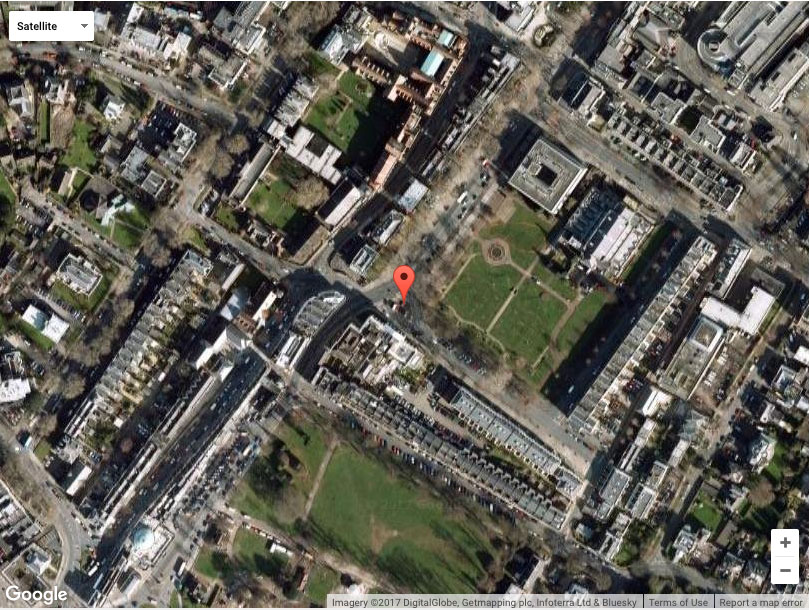
14 yrds north of the Queens Hotel
The Promenade
Cheltenham
Cheltenham
Gloucestershire
GL50 1NN
England
OS Grid Ref.: SO 94593 22011
Denomination: Undefined
Description
It is formed of a large black rectangular cast iron plinth which used to support a cannon. Around the top of the plinth is a low barrier of metal spikes with short metal posts with spherical finals at the corners, and the area within this barrier is now used as a planter for flowers. The memorial is spanned by a decorative arch painted in gilt and green, surmounted by a lamp. Underneath the lamp, supported by the arch, is a badge containing the monogram VR. There is gilded lettering around the faces of the plinth. During World War II, the cannon were removed and melted down for munitions. One of the bases remained and was turned into a flower bed, still with the lantern on top.
Inscription
Side 1: TAKEN/ AT/ SEBASTOPOL/ 1856 Side 2, centre section: TO THE MEMORY/ OF THE MEN/ CONNECTED WITH/ CHELTENHAM/ WHO FELL IN THE/ CRIMEA Side 2, left and right hand sides: (NAMES) Side 3: THIS MEMORIAL RECORDS THE NAMES OF THOSE FROM/ THIS BOROUGH WHO GAVE THEIR LIVES IN THE CRIMEAN/ WAR. IT WAS ORIGINALLY SURMOUNTED BY A GUN/ TAKEN AT SEBASTOPOL/ DURING THE WAR OF 1939-1945 THE GUN WAS HANDED TO/ THE GOVERNMENT TO PROVIDE METAL FOR ARMAMENTS Side 4: (NAMES)
Inscription legible?: Yes
Names on memorial: None recorded [!]
Subject/Period: Crimean War (1853-1856)
Total names on memorial: 27
Served and returned: 0
Died: 27
Exact count: yes
Information shown: rank,regiment
Order of information: rank,regiment
Component: Gun
Condition: Lost
Measurements: depth C 3000MM, height C 3000MM, width C 1500MM
Materials: Metal
Listed?: No
Base
Condition: Poor
Measurements: Undefined
Materials: Cast Iron
Listed?: Yes
Listed by: Historic England
Grade: II
Comments: N/A
Ceremony
Unveiled: Date: July 1858
Attended by: Local Clergy/Dignitaries
History
Over the years, the war memorial had been painted battleship grey, the metal had begun to corrode and some decorative details had been lost. In January 2008 English Heritage and the Wolfson Foundation granted £9,030 towards work to conserve the memorial and to return it as far as possible to its original appearance. The memorial was moved to a conservator's workshop to dismantle it. Investigations showed that fourteen layers of paint had been used on the memorial over time, and the original paint scheme was black on the base, with gold lettering, archway, and flowers and green leaves. The current decorative arrow finials below the lamp, and the lamp itself were shown to be later additions. However, the old photographs available were not detailed enough to see what the originals looked like and therefore it was decided to conserve the elements as they were, rather than replace them. Other features of the archway had to be re-cast, such as the flowers and leaves. The main body of the plinth had some cracks, which were repaired by fixing metal straps over the back on the inside of the base.; 1998: The base is said to be in a poor condition as it is badly rusted.; Date unknown: Original lamps were replaced with smaller versions.
Costs
Site: C £300
Memorial: Unknown or N/A
Comments: None
Trust fund/Scholarship
No
Purpose: Unknown or N/A
Sponsorship
Unknown or N/A
Details: Unknown or N/A
Responsibility of
Unknown or N/A
Notes
The iron base had originally been made to support one of a pair of Russian cannon seized after the battle of Sebastopol during the Crimean War. In 1857, Mr Davis, the proprietor of the Queen's Hotel, read in a news article that town of Colchester had asked for two Russian cannon, which were part of a group then at Woolwich Arsenal. When Cheltenham MP Capt Berkeley successfully applied for two of the canon, Mr Davis agreed to pay for them to be brought to Cheltenham as he thought that they would make a fine war memorial outside his hotel. He formed the Sebastopol Gun Committee for this purpose and the guns were erected on 5th July 1858. The lanterns on top of the guns were added in 1860 after the committee decided the lighting of the Promenade would deter local 'bad characters' from the area.
Reference: Cheltenham As It Was by Beacham, Roger [no publication details].
Reference: Cheltenham At War In Old Photographs by Gill, Peter 117; 134 Published: Allan Sutton 1994 Stroud.
Reference: Cheltenham Chronicle and Gloucestershire Graphic/ Sat/Dec/14/1918.
© IWM (WMR-2070)
[Accessed 30 June 2017]
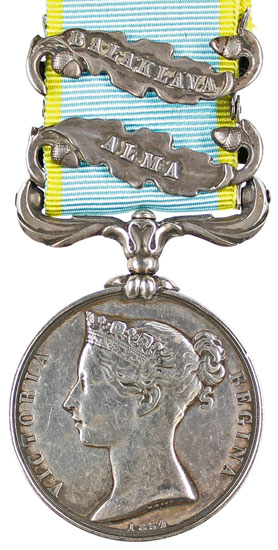
13th Dragoons Charge of the Light Brigade Casualty Medal in 9th December Medal Auction
20th November 2015
Private Algernon Holliday, 13th Light Dragoons was killed in action during the Charge of the Light Brigade, and his Crimea Medal and a pair to his brother are offered for sale in our 9th December medal and militaria auction with an estimate of £11,000.
Algernon Holliday was born circa 1827 in Cheltenham and he attested for the 13th Light Dragoons in Bath in 1850 and declared his age as 20. In May 1854, the regiment embarked on 5 transport ships for the Crimea. Holliday sailed aboard the Mary Anne. They arrived in Bulgaria on the 2nd June and only departed for the Crimea from there on the 1st September. The Light Brigade protected the army's left flank at the first action of the war at the Battle of Alma on the 20th September, but were not heavily involved.
It was during the Battle of Balaklava on 25th October 1854 that the Light Brigade were to be immortalised in history when they charged the Russian guns at the end of the valley. The 13th Light Dragoons numbering just over a hundred led the charge on the right with the 17th Lancers on the left. Running the gauntlet of artillery fire from in front and from the hills on both flanks, the Light Brigade, some 670 strong, reached the end of the valley and attacked the Russian gunners still manning their guns. Heavily outnumbered, the Light Brigade then had to retreat the way they had come, subjected to further heavy fire from all sides. The 13th Light Dragoons suffered heavy casualties with 12 killed, 32 wounded and 10 taken prisoner. Algernon Holliday was one of the 12 men from the regiment killed.
He is commemorated on the Cheltenham Crimea War Memorial which stands in front of the Queen's Hotel. The memorial lists the men from the town who had died in the war. It was originally mounted by 2 captured cannon, but these were melted down in WW2 to help the war effort.
The lot includes his brother, Charles Holliday's 1849 Punjab Medal and Army Long Service and Good Conduct Medal. Charles Holliday was born in Badworth [PB: Badgeworth?], Cheltenham, enlisted in 3rd Hussars 5th June 1844 aged 20, served in India for 5 years and was discharged after 24 years service in 1868.