Elizabeth Southerden Thompson, Lady Butler
According to EJB:
He is depicted in Lady Butler's picture "The Roll Call" and frequently recited "The Charge of the Light Brigade" at various social functions, wearing the uniform of the 11th Hussars that he had worn in the Crimea.
[Source: 1521 John Smith Parkinson, 11th Hussars.]
[PB: As a Grenadier Guard? "The Roll Call", not "Balaclava"? But he was a policeman, and described as tall and straight, so could have passed for a guardsman. How did EB find him?]
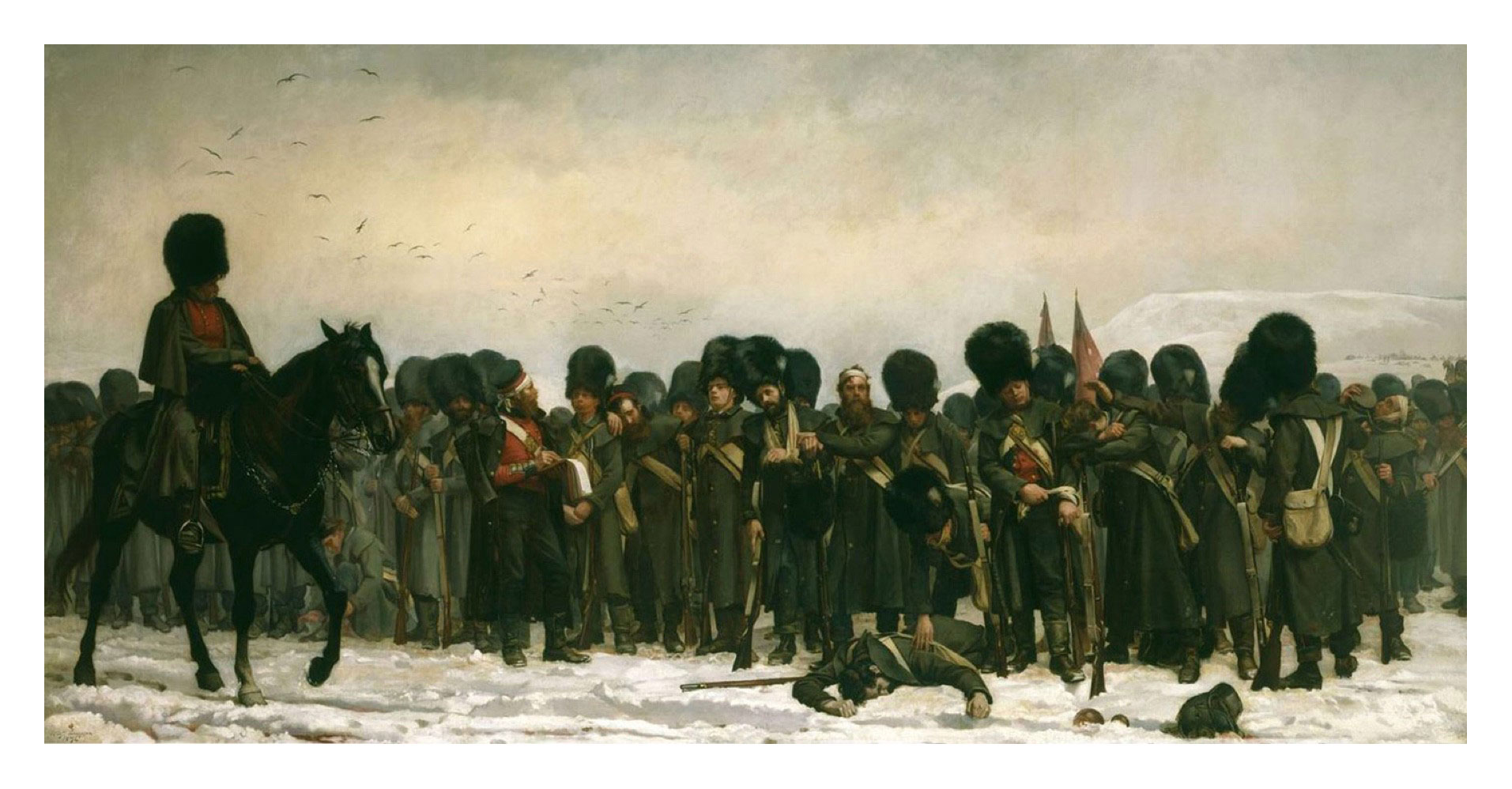
______________Calling the Roll After An Engagement, Crimea, better known as The Roll Call, is an 1874 oil-on-canvas painting by Elizabeth Thompson, Lady Butler. It became one of the most celebrated British paintings of the 19th century, but later fell out of critical favour.
The painting depicts a roll call of soldiers from the Grenadier Guards during the Crimean War. It was taken to depict an occasion following the Battle of Inkerman in 1854, but was intended to show a more generic scene from the war. An irregular line of private soldiers stand in the snow wearing their greatcoats and bearskins, many clearly exhausted or wounded. One of the privates has slumped forward onto the icy ground. An officer on horseback watches while a sergeant marks his muster roll.
The painting has a highly finished surface, reflecting Thompson's academic training, but she eschewed the traditional pyramidal composition of history paintings focusing on one prominent individual, such as Benjamin West's The Death of General Wolfe or John Singleton Copley's The Death of Major Pierson, in favour of a more democratic linear arrangement, emphasising the common soldier. The coldness of the winter is evoked by the dominant tones of black, grey, white and brown, contrasting with small splashes of red from coatees and flags. It measures 93.3 x 183.5 centimetres (36.7 x 72.2 in).
After having read parts of Alexander William Kinglake's Invasion of the Crimea, Thompson painted studies of Crimean veterans in 1873 before working on the larger painting. Thompson - then 26 years old and almost unknown - submitted the painting to the Royal Academy for exhibition at the Royal Academy summer exhibition in 1874. The work was received very favourably: the selection committee applauded when it was unveiled, and became very popular when it went on show at eye level in the prestigious Gallery Two. A policeman was detailed to stand by a railing to keep the crowds back (only the third time this step had been necessary, after David Wilkie's The Chelsea Pensioners reading the Waterloo Dispatch in 1822 and William Powell Frith's The Derby Day in 1858). The painting toured the country, attracting large crowds. Artist William Holman Hunt noted in his book Pre-Raphaelitism that "it touched the nation's heart as few pictures have ever done".
The work had been commissioned for £100 by a Manchester industrialist Charles Galloway. However, Queen Victoria insisted that she should buy it, and the work remains in the Royal Collection.
Lady Butler developed a reputation for her military pictures after the favourable reception of this painting. It was followed by a series of military paintings, Quatre Bras in 1875, and then two more Crimean paintings, Balaclava and Inkermann, exhibited at the Fine Art Society in 1876 and 1877. In 1879, Butler came within two votes of becoming the first woman to be elected as an Associate Member of the Royal Academy (apart from two founder Members, Mary Moser and Angelica Kauffman; ultimately, the first female Associate Member was Annie Swynnerton, elected in 1922, and the first full Member was Laura Knight in 1936).
The painting is the subject of the first episode of Malcolm Gladwell's 2016 podcast, Revisionist History, in an episode entitled "The Lady Vanishes."
Wikipedia references [20.12.2018]
- "The Roll Call". Royal Collection Trust. Inventory no. 405915.
- The Ultimate Spectacle: A Visual History of the Crimean War, Ulrich Keller, pp. 247-249.
- "Realism and Anti-Aristocratic Sentiment in Victorian Depictions of the Crimean War", Matthew Lalumia, Victorian Studies, Vol. 27, No. 1 (Autumn, 1983), pp. 25-51, Published by: Indiana University Press, Article Stable URL: https://www.jstor.org/stable/3827272 [EJBA pdf here
- In the late 19th century, a painting by a virtually unknown artist took England by storm: The Roll Call. But after that brilliant first effort, the artist all but disappeared. Malcolm Gladwell podcast: Revisionist History - http://revisionisthistory.com/episodes/01-the-lady-vanishes/
Lady Elizabeth Thompson Butler in the 1870s
Matthew Lalumia
Throughout the 19th century, painters who showed their work at the annual London exhibition of the Royal Academy dreamed of obtaining the ultimate distinction guarded jealously by that institution. They aspired to exhibit a picture so popular that a railing would be needed to protect the canvas from crowds of enthusiastic viewers pressing to see it. By the Academy's centenary in 1868, only two paintings had won the honor: David Wilkie's Chelsea Pensioners (1822) and William Powell Frith's Derby Day (1858), works still regarded affectionately in Britain for their colorful, anecdotal treatment of the contemporary scene.
The third picture to gain similar distinction, Calling the Roll after an Engagement, Crimea (1874; Fig. 1) was painted by Elizabeth Thompson (later Lady Butler), then unknown and still in her twenties. The painting's success created such a sensation that the Academy was obliged to station a policeman in front of The Roll Call to hold off the crowd's rush. The furor surrounding the picture delighted some of the 40 Royal Academicians-all men-but left others chagrined.
Elizabeth Thompson began formal art studies as a teenager at London's South Kensington Schools of art and design, where she soon advanced to life drawing and painting from the model. [1] Her talent at drawing was conspicuous, and she won the praise and encouragement of her teachers. She also attended private classes at a studio in Bolswer Street, where students drew from nude female models, such private instruction being the only opportunity for women to draw from the nude in Victorian England. In the late 1860s the artist studied in Florence with the Academician Bellucci. (A Catholic, Elizabeth Thompson Butler exhibited religious subjects in an Italianate style throughout her career; these works accompanied the military paintings for which she is remembered.) Visits to Paris introduced her to the modern French school of painters of whom, predictably, she admired Edouard Detaille and Alphonse de Neuville, both popular battle and history painters. In all cases, Thompson's preparation in art emphasized good drawing. A confident line and a mastery of human and equine anatomy marked her subsequent production.
Although there were no soldiers in her family, Elizabeth Thompson demonstrated early a taste for spirited sketches of cavalry troops, swordsmen, military reviews and the like.
By 1870 she had exhibited a few watercolor paintings of military scenes at the Dudley Gallery, one of the lesser lights of the spring exhibition season in London, and from 1871 to 1873 she submitted paintings to the Royal Academy with little result. 2 Nothing had thus forecast the acclaim to follow.
The Roll Call was accepted in 1874 with applause by the selection committee and hung on the line-that is, at eye level-in Gallery Two, the most enviable location in the Academy. The Prince of Wales toasted the picture and its maker at the RA banquet; its copyright for engravings fetched 1000 guineas; and Queen Victoria purchased the painting for the Royal Collection. The artist won universal praise in both the popular press and the art journals of the day; Ruskin called her an "Amazon, the Pallas of Pall Mall."3 George Augustus Sala, art critic for The Daily Telegraph, wrote that she had "proved herself the valiant compeer even of the most famous and most experienced veterans" of the Royal Academy. [4] And to top off her being young and previously unknown, Elizabeth Thompson had made her mark in an unlikely branch of art for a woman-military painting. She had, in short, defied an array of High Victorian prejudices at one stroke, and won fame in the bargain.
The Roll Call depicts the battalion of the Grenadier Guards mustering up after a winter battle in the Crimean War, the near-catastrophic invasion by England and France of southern Russia in 1854-56. Under the eyes of his colonel on horseback, the regiment's sergeant marks the toll of casualties against survivors. The Guardsmen stand in line, resting and tending their wounds; a soldier to the right of center has collapsed dead in the snow. The picture is a classic example of late 19th-century academic painting: the canvas is large and features many figures assembled in a variety of poses and characterizations; each figure was painted from life according to the traditional canon of anatomy; and verisimilitude is achieved through an almost photographic realism. The forms are modeled carefully in tones of black and grey; the cool palette and highly finished surface do not
[10]
FIG. 1. Elizabeth Thompson Butler, The Roll Call (1874), 36"x 72". Royal Collection.
permit brushwork to intrude upon the work's high premium on drawing; and the painting is rich in pictorial narrative.
All of these factors demonstrated Elizabeth Thompson's conservative training in art, as did the forum in which she sought an audience for the painting, the Royal Academy's annual exhibition.
In conception, however, The Roll Call stood well outside the conservative tradition of depicting national military events and, in this respect, Thompson begins to emerge as a representative in the fine arts of the current of political liberalism then sweeping England. Her painting touched a sympathetic chord in the public heart by summarizing the era's new perception of war and those who bear its brunt.
For the artist eschewed two premises of academic history painting on the grand scale: that fact must yield to artistic license in creating inspirational martial imagery, and that the subject of choice be a single, patriotic, high-ranking personage. Instead, by depicting accurately the common soldier's suffering Thompson achieved a truthful evocation of the Crimean War. There were neither glorious military trappings nor references to the army's commanders. Most striking was the picture's somber mood, as Thompson's emphasis of the Guardsmen's fatigue and wounds reminded The Roll Call's viewers of the physical dangers of battle.
Visitors to the Royal Academy examining the long array of figures encountered men dazed by shock and overcome by sorrow, as well as the wounded and dead. Such characterizations hardly created a splendid scene; indeed, they strike close to our modern comprehension of war.
The realism of Thompson's picture is clear when compared to the great military painting of the previous century, Benjamin West's The Death of General Wolfe (1771; National Gallery of Canada). West used a number of artistic devices to cast Wolfe's death in the most heroic light.
Whereas Wolfe actually died abandoned on the field, West surrounded him in the painting with handsomely composed groups of mourners, and the artist posed Wolfe himself in a manner derived from Baroque scenes of the Lamentation, thereby adding a note of Christ-like sacrifice to the general's end. 5West wrote: "Wolfe must not die like a common soldier under a bush. ... To move the mind there should be a spectacle to raise and warm the mind. A mere matter of fact will never produce this effect." [6] By the Victorian era, such "mere matter of fact" was more than sufficient to achieve a telling effect: The Roll Call showed the Crimean War for what it was, the most arduous campaign since Waterloo.
Because of its officers' incompetence and the harsh Russian winter, the British Army in 1855 came near to disintegration, losing thousands of men each month from disease alone. The army survived only because of the performance of the rank and file, who, pressing on without warm clothes, shelter and medicines, won battles in spite of inept leaders. Thompson further avoided the fanciful quality of West's picture by designing The Roll Call only after she had interviewed Crimean survivors, some of whom posed for the painting, and after she had read the standard history of the war by Alexander Kinglake. [7] The work was praised in The Art Journal of June 1874 for its "passionless severity of absolute fact, " while the reviewer in The Morning Post wrote: "The great strength of the picture is its truth.
. . . The grim details of death and desolation have not been omitted, there has been no attempt to gloss over stern realities."8 Similarly at odds with the tenets of academic painting was Thompson's choice and arrangement of protagonists.
Apart from the mounted officer at the far left, the picture is centered on the rank and file, who literally dominate the canvas from edge to edge. They are defined here as the principal actors in the battle. And Thompson's horizontal disposition of the figures, punctuated by narrative incidents along the length of the design, replaced the carefully structured pyramidal format that had been the norm for martial paintings for more than 100 years. The Roll Call comprised what might be termed a more democratic design in its expanse of soldiers, all of whom contributed to the work's visual impact.
Thompson followed her first triumph with two more paintings inspired by the Crimean War, both of which retained the anti-heroic realism created in The Roll Call; each was well received by the public and press and engraved for wide distribution.
In April 1876 the artist exhibited (at the Bond Street Gallery of the Fine Art Society) Balaclava (Fig. 2), a painting recounting the aftermath of the Charge of the Light Brigade through Balaclava Valley. The following year, in which she married and became Lady Butler, she unveiled at the Fine Art Society the third work of the series, Inkermann (Fig. 3), as part of a retrospective display of her most popular works. [9] In Balaclava Lady Butler plied the disastrous charge - recognized even then as the century's military fiasco - with healthy doses of the narrative anecdotes and pathos beloved of Victorian audiences. The picture depicts the return of the survivors of the doomed mission as they retreat in disarray to the British positions at the upper end of Balaclava Valley. The artist portrayed the dying remnants of the Light Brigade in a series of vignettes extending across the canvas; the painting is a narrative begging to be "read." All the incidents relating the shock and chaos amid the survivors were scrupulously rendered to the last detail; the expressive portraits of despair and fatigue among men and their animals created a tour-de-force sure to please the public. The artist's choice of moment for the scene - the violence is implied and the soldiers contemplate defeat in its wake-heightens the work's dramatic effect. Even in an age of overly-wrought sensibilities, Balaclava moved its viewers as no other martial painting had. Men and women in the Fine Art Society Gallery reportedly wept in front of the picture. [10]
Inkermann depicts the troops returning to their camp after the morning battle of November 5, 1854. At Inkermann Ridge, the soldiers, fighting without direction from commanders caught off guard by a Russian attack, had repelled the assault after six hours of bitter fighting in the rain and mist. The picture portrays the troops as they stream from over the horizon toward the foreground. The procession includes a variety of wounded soldiers, and the column passes by the corpses of British artillerymen strewn along the road. Here Lady Butler alluded, in subject and Romantic design, to a previous tradition-French depictions of Napoleon's retreat from Russia. Artists Nicolas Touissant Charlet, Denis Auguste Marie Raffet, and Boissard de Boisdenier had all treated that most epic chapter of the Napoleonic era. The fall of a supreme conqueror and the French army's losses to the Russian winter appealed to Romantic painters' taste for drama and horrific imagery. Their scenes of diagonally-disposed columns of figures too numerous to count, men weary from hardship on the march, soldiers dropping from the ranks and carrying the injured, found an echo in Lady Butler's work. Most striking was the coincidence of locale, as the French pictures of Napoleon's retreat from Moscow and
[11]
Inkermann represented the fate of invading armies in Russia in winter. Lady Butler's painting, through correspondence to its French prototypes, thus implied that the Crimean War was Britain's own version of the catastrophe that overtook Bonaparte.
Elizabeth Thompson Butler's three Crimean War paintings departed from the English artist's traditional recording of national history. Contrary to academic doctrine and the need of ambitious countries to couch martial events in glorious terms, the artist defined war as tragedy. But Butler was not a pacifist, 11 and her work did enjoy a wild popular reception. One must turn, then, to the times in which the artist worked to account for her unprecedented achievement. Lady Butler, by consolidating in her paintings a realistic treatment of war with a sympathetic portrayal of the soldiers, represented Liberal England's answer to the preceding generation's vision of military affairs. She was the product of a reformist age in which the public understood the cost of armed adventurism. More important, she launched her career at that moment when the nation acted politically to reform the army by promoting the egalitarian principles to which society as a whole subscribed; new democratic measures reduced the prerogative of the privileged classes to command and rewarded ordinary soldiers with more humane treatment.
The public had new expectations of its army, believing the military must reflect the modern, enlightened era. It followed logically that the public would have new expectations of military art as well.
Since the first Reform Bill of 1832, the British body politic had moved toward a more egalitarian base. New laws extended the franchise to a wider spectrum of citizens and rationalized representation in Parliament according to population density. The Second Reform Bill, solidifying these gains, had become law by 1867. Yet the real wave of political liberalism and the practical reforms in its wake swept through Britain only with the election of the first Gladstone ministry in 1868.
Once in office, the new government undertook a series of measures to satisfy the increasingly strident demands of the middle classes for influence in the nation's affairs. Gladstone and his cabinet began in earnest to open public education and the civil service to the recently enfranchised constituencies. [12] Of significance to this study, Gladstone and his war minister, Edward Cardwell, took on the last bastion of privilege and archaic practice in the British state-the army. The so called Cardwell Reforms swept away customs enshrined in the service for some 200 years. Against virulent conservative opposition centered in the House of Lords, new regulations abolished the system of purchased commissions and promotions, a practice which had limited high military rank to the wealthy and socially elite. Drawn almost entirely from the gentry and aristocracy, officers literally had bought their way into the army, and then up each step of the hierarchy. [13] Cardwell's legislation introduced a merit system open to all, reduced the soldiers' enlistment period, and improved barrack life.
Foremost among the beneficiaries of the Cardwell Reforms were the soldiers of the ranks. First, the new
[12]
FIG. 2. Elizabeth Thompson Butler, Balaclava(1876), 41"x 74". Manchester City Art Gallery.
regulations opened to the most able of them an avenue to higher rank. Equally important were reforms that affected their daily lot. The new regulations introduced six-year terms of active service. Prior to the Gladstone ministry's legislation, British soldiers had enlisted for 21 years or life, whichever was shorter. Other Cardwell measures abolished flogging as punishment and ended the practice of deducting the cost of the soldiers' food from their pay. Privates' wages were raised, and the regulations requiring better barracks and hospital care improved living conditions. The Cardwellian army, in sum, offered the soldiery some reward for enduring the rigors of colonial service or the dangers of war.
There is, then, more to the paintings of Elizabeth Thompson Butler than a reminiscence of a distant campaign. Her pictures appeared in the aftermath of a political debate that had captured the public mind for months. [14]. The works defined in visual terms changing political sentiment about a military that was being reshaped even as Lady Butler painted. The Roll Call and Inkermann focused on the common soldier, recalling his stoical conduct in a war won only by the good performance of the rank and file-a performance which proved the rank and file soldiers worthy of the Cardwell regulations. Balaclava, in turn, ended the issue of privilege in the officer corps. For throughout the debate leading to the Cardwell Reforms, the Charge of the Light Brigade was dredged up time and again.
All the Liberal newspapers, and not a few Conservative journals, cited the catastrophe at Balaclava as an error that would not recur in a new army led by men of ability rather than men of wealth. Reformers recalled that the officer who ordered the charge, the Earl of Lucan, and the officer who led it, the Earl of Cardigan, had each paid more than 30,000 pounds sterling for regimental commands they did not deserve. Elizabeth Thompson Butler's audience - specifically the middle-class High Victorian art consumers - had supported the end of this abuse of privilege by abolishing the purchase system. The artist thus recorded her contemporaries' perception of the useless defeat at Balaclava.
Lady Butler's pictures were also connected to a broader movement of painting in England in the 1870s, the short-lived art of conscience known today as British Social Realism. For in the very decade of her greatest success, there emerged a group of painters who depicted the straits of the chaff of Victorian prosperity, the underclass who did not enjoy the material comforts so cherished by the age and who were often a burden on the consciences of those who did. The Social Realists were largely staff artists of the picture weekly, The Graphic, a journal that emerged with the first Gladstone ministry. Indeed, The Graphic seemed often to offer a pictorial counterpoint to the government's efforts at reform. [15] Wood engravings of the poor, aged, homeless, and imprisoned dotted the pages of the paper as The Graphic sparred with the more sedate imagery of The Illustrated London News.
These same staff artists sometimes turned their sketches into oil paintings, almost all of which featured the victims of British society depicted in a somber, grey-brown tonality. In 1878, for example, Hubert von Herkomer, a Bavarian immigrant, exhibited Eventide, now in the Walker Art Gallery, Liverpool [see here]; the picture shows elderly refugees in the Westminster Workhouse for Women heaped onto plank beds or engaged at the compulsory needlework they exchanged for food and lodging. In the same year Frank Holl exhibited Newgate: Committed for Trial [see here], now in the Royal Holloway College, showing the encounter between a ragged mother, her children, and the father who is separated from them by the bars of Newgate Prison. Holl had earlier treated the themes of the dangers of the sailor's life in No Tidings from the Sea (1870) and infant mortality among the rural working class in Her First Born (1876).
The clearest expression of the Social Realist art of the Graphic circle appeared together with The Roll Call at the Royal Academy in 1874 when Luke Fildes offered his Applicants for Admission to a Casual Ward (Royal Holloway College). [16] Based on sketches made in London's East End that had appeared earlier in The Graphic above the caption "Homeless and Hungry," the painting depicts a cast of urban down-and-outs seeking shelter in the workhouse. Fildes appended to the picture a passage from a letter by Dickens warning that there were limits to human patience: "Dumb, wet, silent horrors! Sphinxes set up against the dead wall, and none likely to be at pains of solving them until the general overthrow." Fildes thus addressed-perhaps with a touch of revolution hysteria-a theme certainly familiar to the London Academy visitor and a contemporary political issue as well. For the Liberal cabinet had acted to assist the growing numbers of destitute in the cities with the Local Government Act, an early form of welfare legislation allowing municipal authorities to expand public shelters, increase the dole, and institute public health inspections. By 1875 Parliament had empowered local authorities to prohibit the construction of unsanitary dwellings and to bring existing buildings up to code. Britain's largest cities began great slum-clearance programs, leveling 40 to 50 acres of condemned firetraps at a time.
17
Fildes' Casual Ward was second in success only to The Roll Call at the Academy exhibition of 1874. Critics and public alike could not fail to note the evident similarities in their horizontally-oriented designs, expressive figures, and subdued palettes. Moreover, they were praised for their mutual qualities of truthfulness and sobriety in dealing with the harshest side of life. The Art Journal reviewer lauded The Roll Call's "reserve and silence proper to reality, " and went on to identify The Casual Ward as "the most notable piece of realism we have met for a very long time." [8] The author of an article in The Illustrated London News grouped the pictures together. Of The Roll Call the reviewer wrote: "By force of imaginative sympathy the terrible havoc of war is realized with a vraisemblance that could only be expected from an eye-witness; . . . it borders on hardness in its completeness, and is almost too painful, " and of The Casual Ward: it is "essentially true in its elements... . All honor to the artist for his courage in dealing, undeterred by its repulsiveness, with a subject in the sad moral of which we are all more or less deeply implicated." [9] Such joint reviews were not uncommon. Tom Taylor, art critic of The Times, trumpeted the pair as the pictures of the year. [20] The Victorian art-viewing public was quick to perceive the affinities between The Roll Call and The Casual Ward.
With some knowledge of the reformist spirit of Gladstone's premiership in the air, it is easy to understand how both pictures, the realistic battle painting and the scene of urban poverty, appealed to the humanitarian impulses in England during the 1870s. Both addressed social inequities in the process of being righted by government political action.
Fildes was the first painter of the day to make a case in art for the victims of urban destitution. Elizabeth Thompson Butler made an equally serious study of another mistreated element of British society, the army's common soldiers. She placed them in a setting certain to elicit a sympathetic response from Victorian viewers: the Crimea, where the soldiers had suffered most and performed best. Like the aged or homeless or imprisoned, the soldier had endured an unkind fate. Lady Butler's contemporaries, as an expression of egalitarian idealism, had altered the constitution of Britain's army. She, in turn, pleaded the cause for the body of the army that had at last won some rewards in the
FIG. 3. Elizabeth Thompson Butler, Inkermann (1877), 41"x 74". Ferens Art Gallery, Kingston-upon-Hull.
[14]
Cardwell Reforms. Thus the objects of social and political redress in the early 1870s had become subjects for pictures at the Royal Academy.
Elizabeth Thompson Butler was nominated to membership in the Royal Academy in 1879, the only woman of the century to gain that distinction. After a series of ballots, she did not win election to the Academicians' ranks; she lost first to Luke Fildes, and then to Hubert von Herkomer by a vote of 27 to 25. The liberal impulse of the 1870s fell just short of sweeping a woman into the most exclusive all-male club in England. *
1. The year of Elizabeth Thompson's birth was variously reported as 1844, 1846, and 1851. She was the product of a wealthy and artistic family, spending much of her youth in Italy in the company of her mother, an accomplished watercolorist, and her sister, poet Alice Thompson Meynell. In 1877 she married Sir William Butler, a professional soldier, and thus took the title Lady Butler. Late in life she recounted her career in Elizabeth T. Butler, An Autobiography (London: Constable, 1922).
2. A first picture was rejected by the jury, another rejected and returned with a tear in the canvas, a third was "skied" to the inconspicuous upper reaches of the exhibition gallery.
3. John Ruskin, Notes on Some of the Principal Pictures Exhibited in . ..
the Royal Academy (Kent, Eng.: G. Allen, 1875), 56.
4. Cited in Wilfred Meynell, "The Life and Work of Lady Butler, "The Art Annual (1898), 7.
5. West openly acknowledged his debt to Van Dyck's Pietd, now in Munich, in designing his picture. For an analysis of West's painting in light of contemporary academic doctrine, see Charles Mitchell, "Benjamin West's' Death of General Wolfe' and the Popular History Piece", Journal of the Warburg and Courtauld Institutes, 7 (1944), 20-33.
6. Quoted in James Grieg, ed., The Farington Diary, 4 (London: Hutchinson, 1922-1928), 151.
7. Thompson claimed to have "read and re-read" Kinglake's study. She spent the summer of 1873 sketching and interviewing the Crimean veterans; Butler, An Autobiography, 101-3, 115.
8. The Art Journal (June 1874), 163; the Post review cited in Descriptions of and Opinions of the Press on Miss E. Thompson's. . . Battle Pieces (London: Fine Art Society, 1877), 8-9.
9. The artist's inclination to exhibit her pictures at a commercial gallery rather than at the Royal Academy created a certain degree of hard feeling on the part of the Academicians who would eventually be asked to offer her membership in their ranks.
10. Butler, An Autobiography, 152.
11. She painted colorful accounts of her husband's military exploits in colonial wars and the couple's sons fought in France in 1914.
12. The so-called Great Reformist Ministry established free, secular education in a system of public instruction that trebled the number of children attending school; the refrain "we must educate our future rulers" spelled the end to the system in which only the wealthy could prepare for the professions and official posts. The Gladstone Cabinet next opened all branches of the civil service except the Foreign Office and the diplomatic corps to entrance by competitive examination.
Qualified persons thus took up careers in the government with less regard than before to patronage and family connection. The aristocracy and gentry no longer claimed plum positions in the civil service as a matter of course. See John Morley, The Life of William Ewart Gladstone, 2 (New York and London: Macmillan, 1903), 298-315, 359-65, and Erich Eyck, Gladstone (London: G. Allen & Unwin, 1938), 193-211.
13. The practice reached the point where the colonel of a prestigious cavalry regiment would have spent 14,000 pounds or more to reach the top. (The average working class family at the time lived on 50 pounds a year.) As many as seven in ten of the army's generals were aristocrats, and an even greater percentage of the officer corps at large stemmed from the gentry or better. See Gwyn Harries-Jenkins, The Army in Victorian Society (London: Routledge & Kegan Paul, 1977), 63-4, and Phillip Razzell, "Social Origins of Officers in the Indian and British Home Army: 1758-1962, British Journal of Sociology, 14 (1963), 253.
- Harries-Jenkins ?
- There is a copy of Razell's essay in the archive.
14. Opposition to the reforms by the House of Lords created much ill will split along class lines. The Times report of July 19, 1871, 9, read: "The Lords . . . have voted as they are too often wont to vote, for the maintenance of a class privilege against a free public career.... The question was whether the army should be placed in the hands of the nation? The Peers have said 'No, ' because they do not trust the nation.
The nation will say 'Yes, ' because it is determined to trust to none but itself." 15. The Graphic published its first issue in July 1869. Its stark wood engravings were an inspiration to the young Vincent van Gogh.
16. Born in Liverpool, Luke Fildes, like Elizabeth Thompson, had studied at the South Kensington Schools. Besides his work for The Graphic, he had illustrated Dickens's last novel, Edwin Drood. After his initial success with The Casual Ward he turned to crowd-pleasers of another sort colorful Venetian landscapes and portraits of the fashionable set. In his later years he became the prosperous portraitist to Kings Edward VII and George V. See Christopher Wood, Dictionary of Victorian Painters (Suffolk, Eng.: Baron, 1978), 153-54.
17. For the Local Government Act, the Public Health Act, and the Artizans' and Labourers' Dwellings Improvement Act, see Pauline Gregg, A Social and Economic History of Britain 1760-1960 (London: Harrap, 1962), 475-79.
18. The Art Journal, June 1874, 164; review continued in July, 201.
19. The Illustrated London News, May 9, 1874, 446.
20. The Times, May 26, 1874, 6.
MATTHEW LALUMIA, Assistant Professor of Art History, Trinity College, Hartford, began his research into Victorian painting and its relation to contemporary events while Visiting Fellow at London's Paul Mellon Centre for Studies in British Art.
[Lady Elizabeth Thompson Butler in the 1870s Author(s): Matthew Lalumia Source: Woman's Art Journal, Vol. 4, No. 1 (Spring - Summer, 1983), pp. 9-14 Published by: Woman's Art Inc.
Stable URL: http://www.jstor.org/stable/1358095]
[PB]