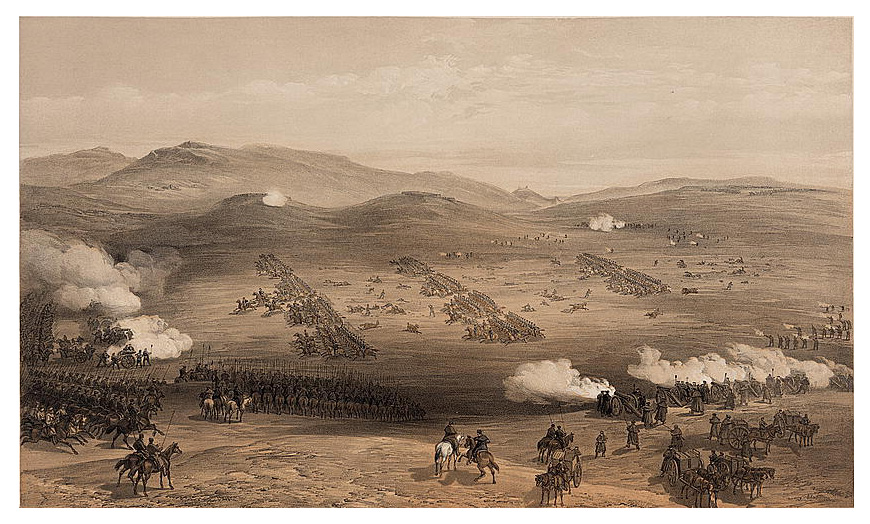
William Simpson (1823-1899) was born in Glasgow and came to London in 1851 to work as a lithographer. In 1854 he was sent by Messrs Colnaghi, the firm of art publishers, to cover the Crimean War, thus becoming one of the first-ever war artists. The firm (of Italian origin) had come to London from France during the Revolution, and was first approached by the Government for any pictures they might possess giving some idea of the topography of Turkey and the Crimea. As it happened, the only one found was an early drawing of the town of Sebastopol.
Simpson later published his drawings in 81 lithographs, entitled "The Seat of War in the East" (1855). The subjects covered all aspects of the campaign including the affair at the Bulganak River soon after the initial landing, Scutari Hospital, the cortege of Lord Raglan leaving for England, and the town and harbour at Sebastopol after its evacuation, his work earning him the sobriquet of "Crimean" Simpson.
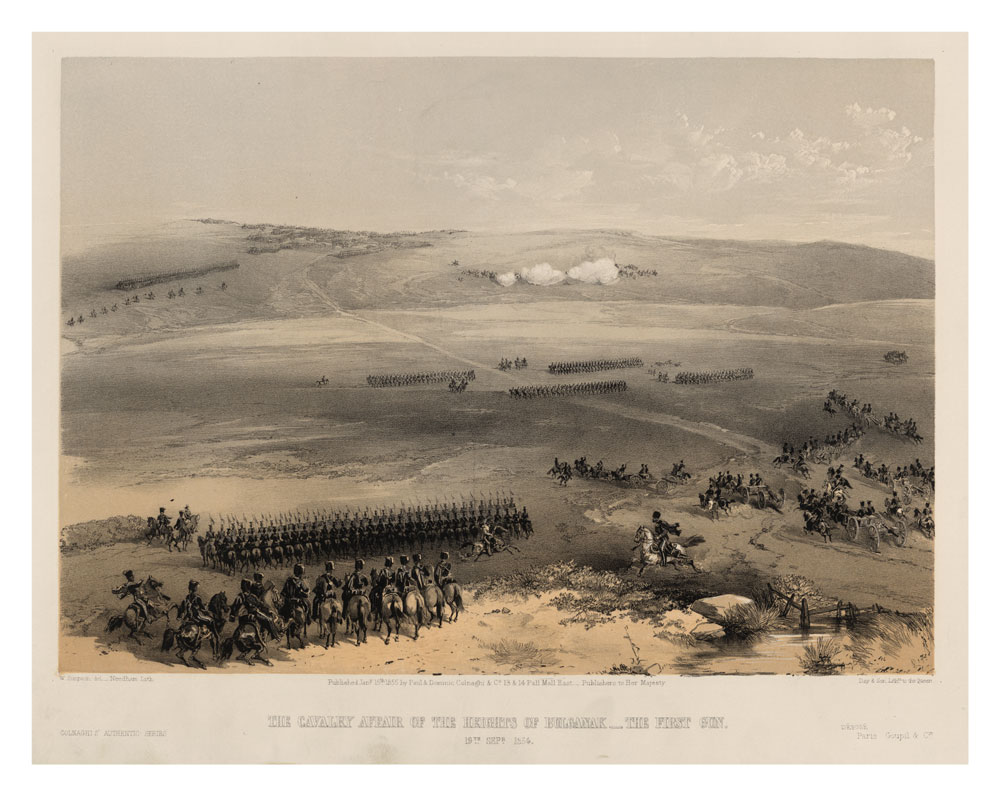
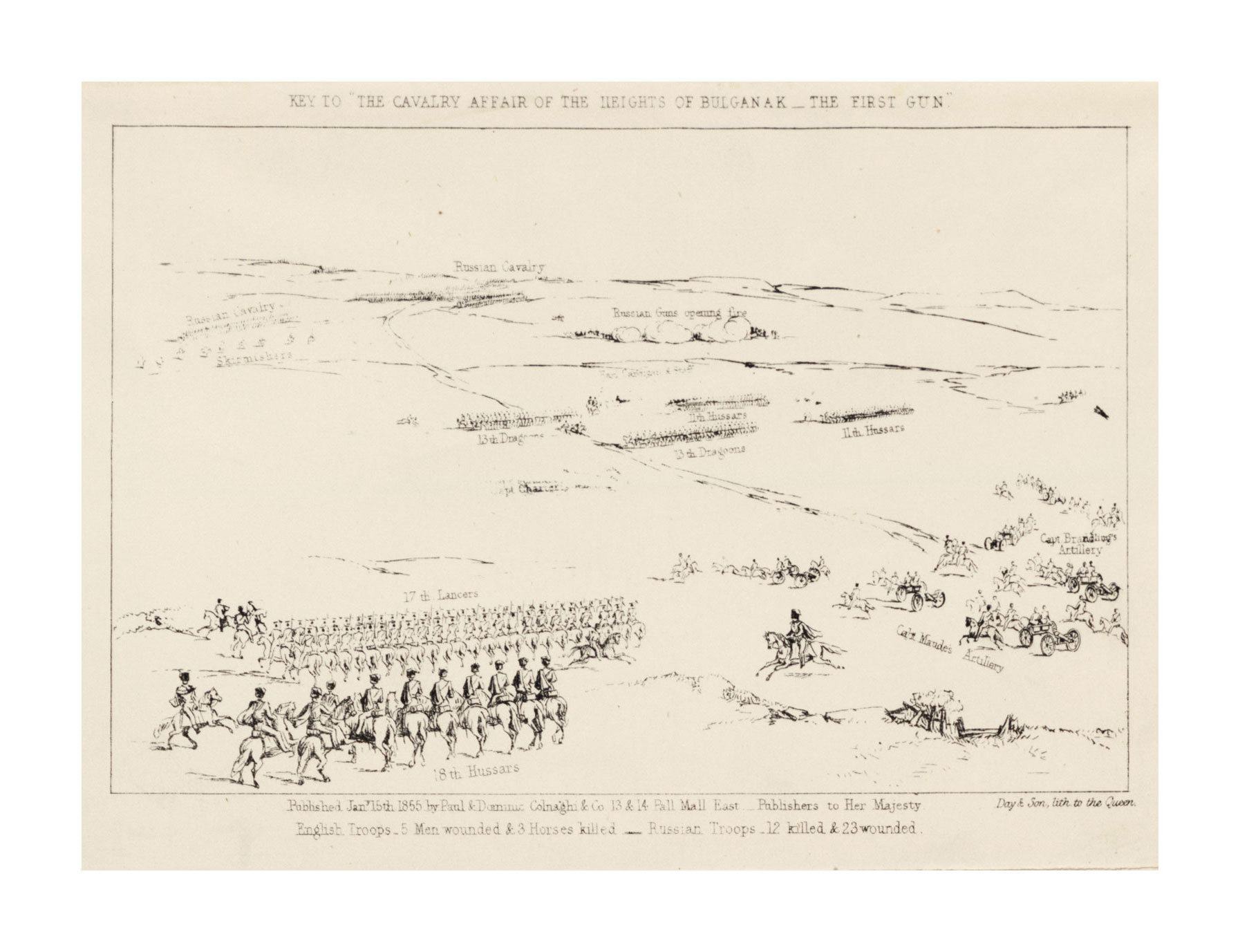
Simpson's autobiography, published in 1903, tells us that he left London by train for Constantinople on the evening of the 26th of October 1854 (the day after the Charge of the Light Brigade at Balaclava). Here he embarked aboard the P&O steamer "Colombo" and later the "Orient", a sailing ship, which remained at the mouth of the Alma river and served as his HQ the whole of the first winter there.
He approached Brigade staff and regimental officers to help him reconstruct key events that had taken place in the previous months, including the Charge of the Light Brigade:
"My letter of introduction to Lord Raglan brought me to Headquarters, where I found friends amongst the Staff and made others, one especially being Captain Maxse, RN who was his Naval ADC. The battles of Balaclava and Inkerman had taken place before I arrived in the Crimea, but it was necessary for me to get pictures of them.
I could easily make sketches of the ground, but I had to trust to those on the spot for descriptions of the events. When I came from Constantinople aboard the "Colombo" there was Captain Maxse on board - brother to the Naval ADC - and a cavalry officer, and it was through him that I was introduced to Lord Cardigan. Another ADC to Lord Raglan, Calthorpe, took me over the battleground and explained the situation at the time to me."
Unsurprisingly, Cardigan demanded some editorial control over Simpson's representation of the Charge:
"I then did a sketch and took it to Lord Cardigan. He had his yacht in the harbour and lived aboard it. I went on board and presented my sketch. He gazed at it with a vacant stare and pointing to something, said, "And what is that?" On being told he gave expression to his objection to the picture.
I returned to my quarters, made another sketch in which I tried hard to avoid the points objected to. On my going back the next day, both sketch and artist were treated very much as before. But as I was anxious to send home the sketch bearing the approval of the principal hero I determined to make another effort at the battle scene.
At the same time I had settled in my mind that it would be my last attempt and send it whether or not Lord Cardigan approved it first. I went on board a third time and on placing the drawing before him I was received with the warmest praise. The real truth was that in my last sketch I had taken greater care than in the first two to make his Lordship more conspicuous in front of the Brigade. I here make the point that I did, with all of my sketches, contact the officer or whoever was connected with the place before their final dispatch to England."
Simpson also comments that he was paid £20 for each drawing but had to pay for his own travel and other expenses.
[PB TO CLARIFY - The family of the ? Maxse brothers believed Simpson also depicted them in the Crimea, sitting around a camp fire along with Lord Cardigan the evening after the Charge.. Although this particular picture is almost certainly not a depiction of the evening after the Charge, and it was not recorded among the "Seat of War" images, there are other known facts which lend an element of truth to the story and the possibility of its being done as a favour to the brothers.]
Later, Simpson also published (again through Colnaghi's) a number of other volumes of paintings done during his expeditions to the Himalayas and Kashmir, the war in Abyssinia, during which he designed a medal for the campaign and although the final design was said to be by Princess Louise, there were some elements of his design in it (he also received the awarded medal) the Franco-Prussian War of 1871, Prince of Wales Tour of 1875-79, and the Opening of the Suez Canal.
Simpson died at Willesden on the 17th of August 1899 from "Bronchitis" stemming from a cold caught at the opening of the Firth of Forth bridge and is buried in Highgate Cemetery (Grave No. 6004) with his father and mother, whom he had brought down from Scotland.
"The autobiography of William Simpson, R.I. (Crimean Simpson), edited by George Eyre-Todd, illustrated with many reproductions of Simpson's pictures from the collections of His Majesty the King, the Duke of Newcastle... etc" (1903), is available online in various formats at http://archive.org/details/autobiographyofw00simpuoft (accessed 1.8.2013).
See also Wikipedia: William Simpson (artist), (accessed 30.7.2013))
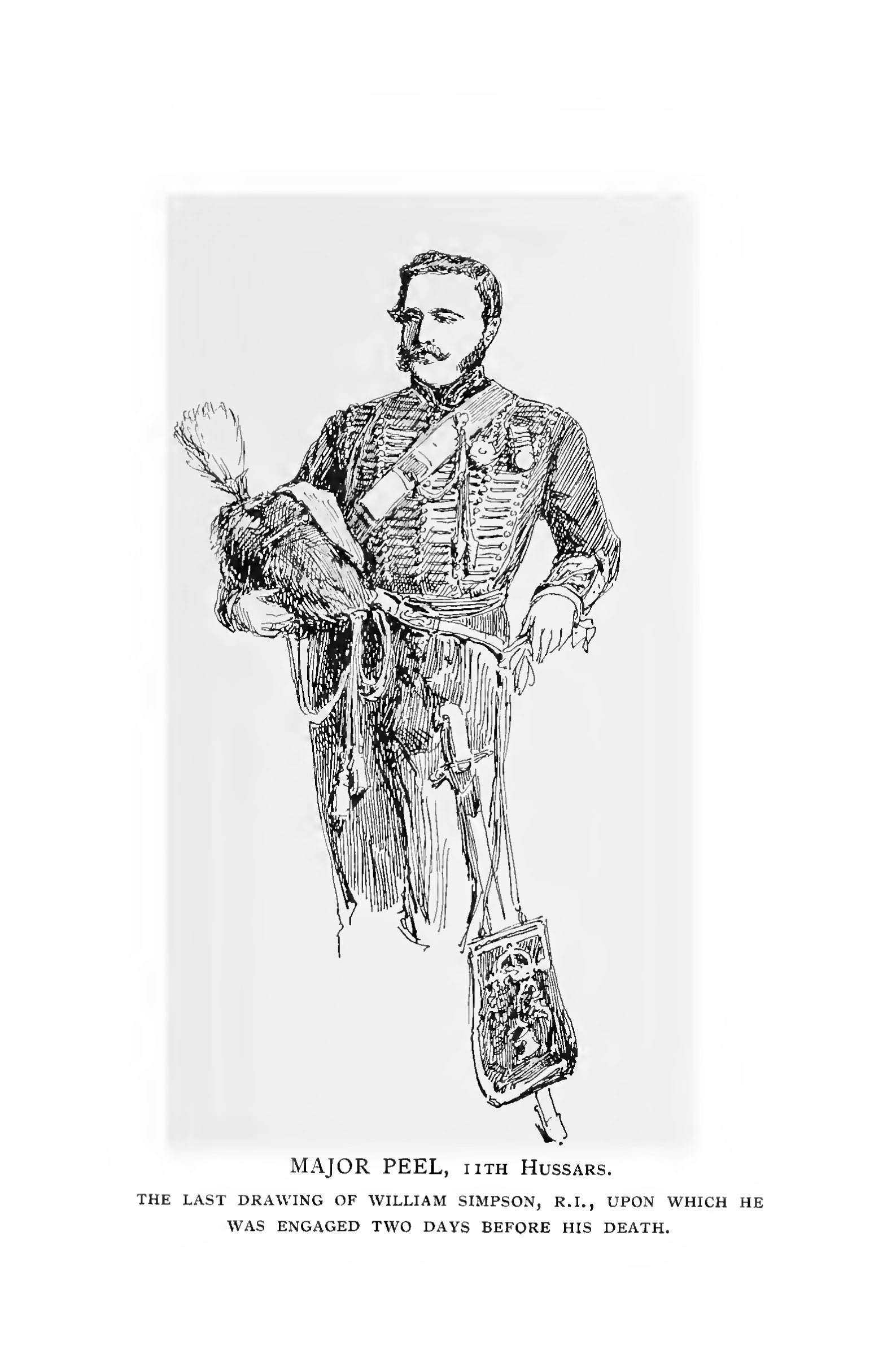
Illustration in From the Fleet in the Fifties, 1902, facing p.124. In her introduction Mrs Tom Kelly writes "My gratitude is also due...to the late Mr. William Simpson, whose last bit of exquisite work was the unfinished etching, upon which he was engaged a few hours before his earnest and kindly spirit passed away." Her From the Fleet in the Fifties was published 1902. What was Simpson's source, given that EYP had died some years earlier? A formal painted portrait? In which case, who painted it and where is it? Incidentally, there are a number of other illustrations by WS in the book.
A V&A blog about Simpson, which includes many images: vam.ac.uk/blog/tag/william-simpson
Various Simpson paintings of the charge and their engraved reproduction ? e..g. the NAM's image
Is Anna's husband's engraving by Simpson, and is it (as I vaguely recall) a reverse POV from the usual one (i.e. not from the Russian perspective on the ?Fedioukine Hills)?
NB Follow up Douglas Austin's November 2016 article on the Ground watercolour, and subsequent correspondence in the CrimeanWar group.
The National Army Museum has a marvellous collection of Simpson images.