[Unedited extract from J.W.M. Hichberger, Images of the Army, pp.90-91.]
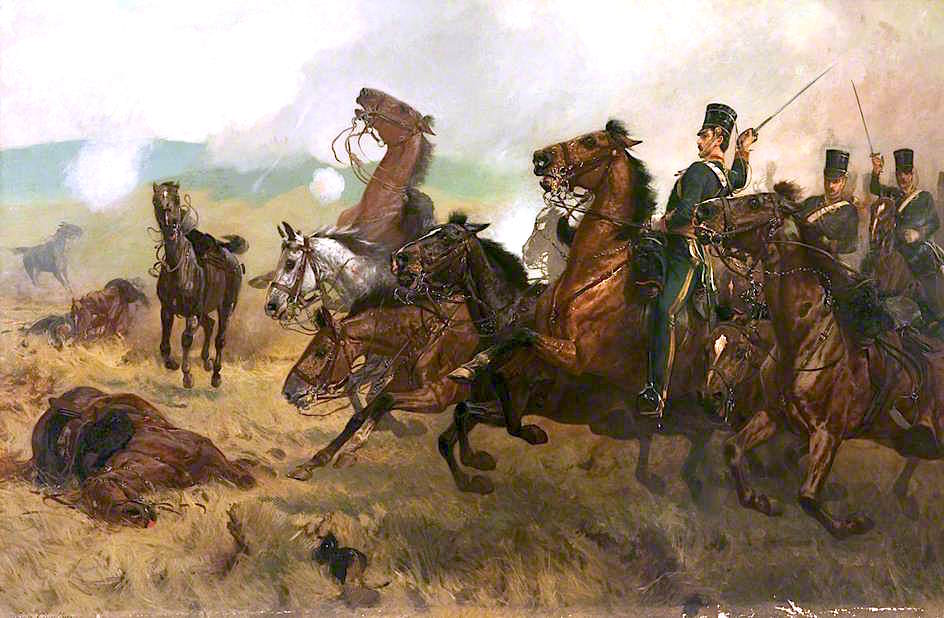
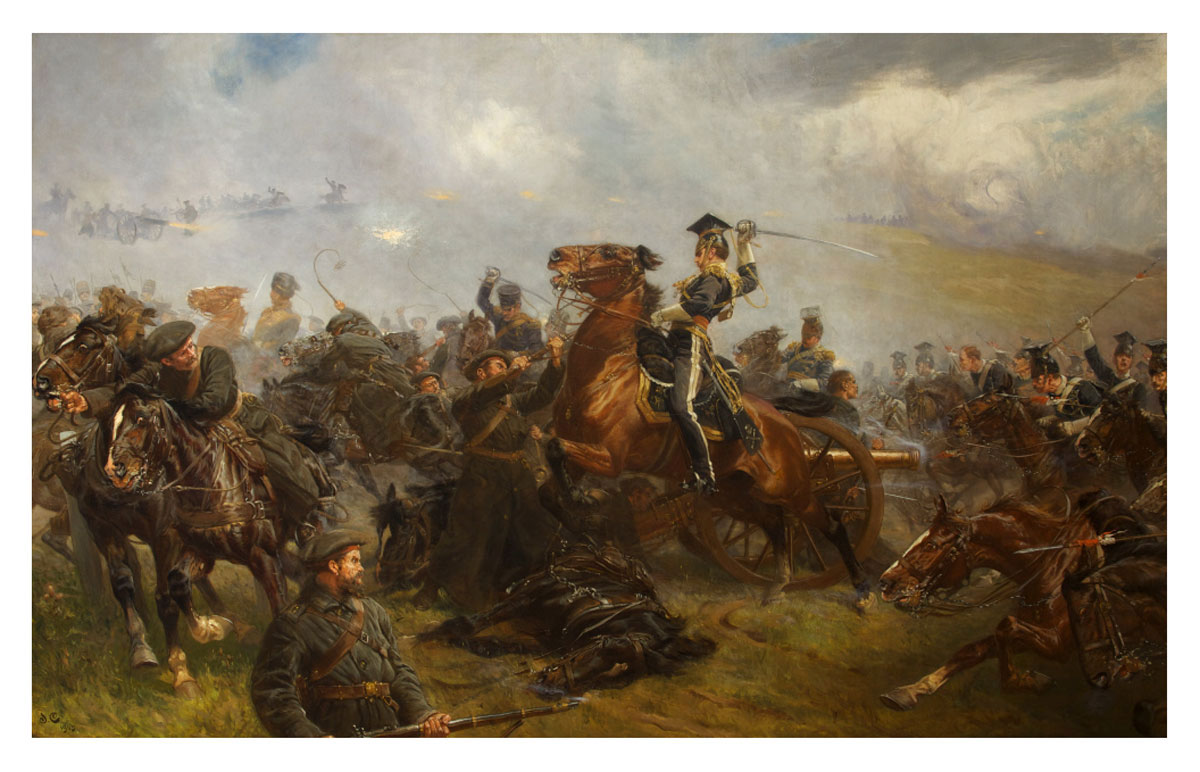
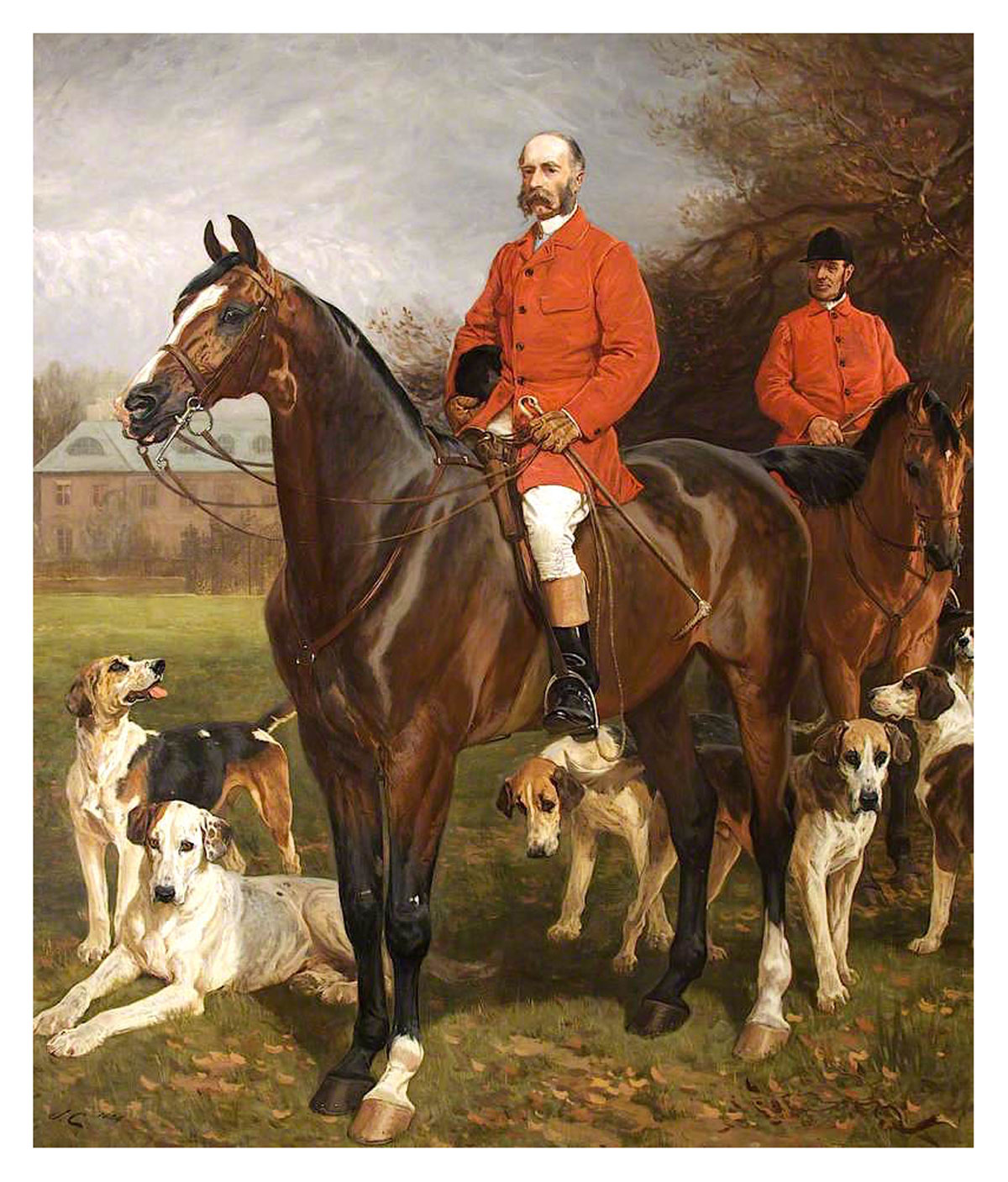
...Although the writer in Art and Letters claimed that contemporary battle artists were painting new subjects in new ways, this may not always have been entirely the case. John Charlton (1849-1917), merely used the post-1874 upsurge in interest in military painting to rework an old genre. His route into military painting was in fact remarkably traditional. Coming from Newcastle, the city which had produced Bewick and Clennell, he established a strong practice as an animal painter before settling in London in 1874.2 At first his work was almost exclusively hunting scenes, notably of prestigious hunts such as the Pytchley. In 1883 he showed the first of his battle pictures at the Royal Academy, British Artillery entering the Enemy's Lines at Tel-eI-Kebir, 13th September 1882. This subject was apparently chosen to give maximum scope for his undoubted, and known, ability for depicting horses in action, thus providing him with a bridge between his established activity as a sporting painter and his excursion into the new genre. The strategy was similar to that adopted by the sporting artist T. I. Barker three decades earlier. Like Barker, Charlton made his move when a higher level of interest in a contemporary war might have assured him of a market.
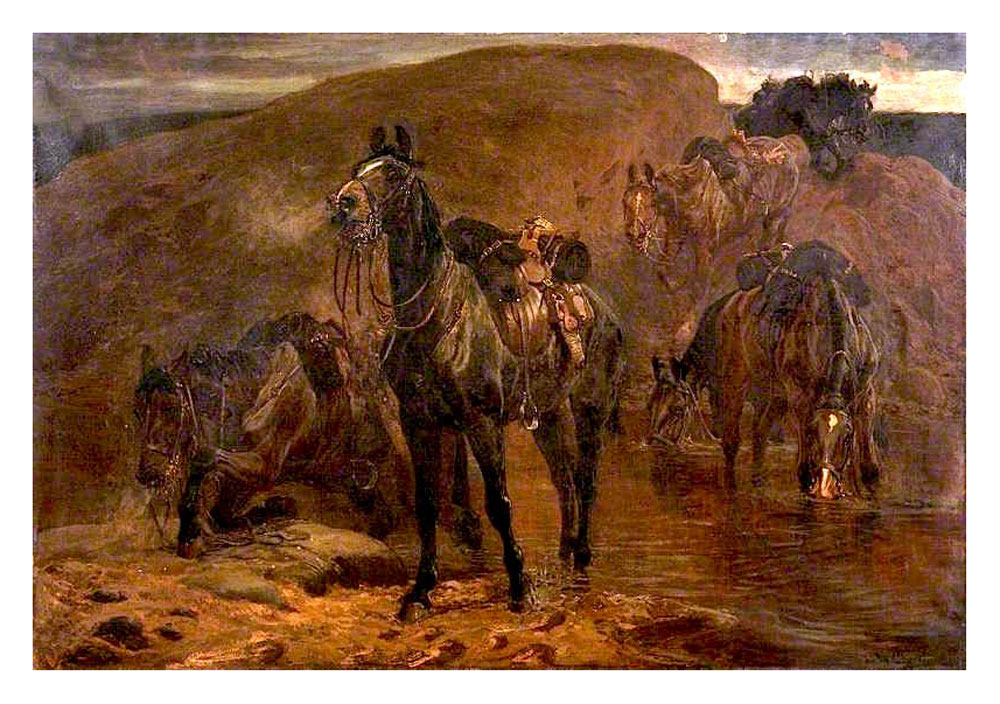
Charlton appears to have been heavily indebted to Barker, both for his approach and in borrowing direct from the older artist's subject matter,- in 1884 he exhibited After the Battle: Sedan, which depicted abandoned horses roaming after the battle. Barker had shown an earlier version of this subject, Riderless War Horses, after the Battle of Sedan, in 1873. No critics appear to have recalled Barker's earlier essay, acclaiming Charlton's work as innovatory.3 Charlton's strategy, like Barker's, was to 'suggest' the battle, the feelings of the absent human protagonists and their fate through the depiction of their horses. A lengthy discussion of his Bad News from the Front (RA 1887) describes Charlton's method and is suggestive of how this type of 'battle' painting was read:
This subject was suggested by a description sent from the seat of war to the Graphic; for which newspaper, I believe, Mr. Charlton's original study in black and white was made... In the limpid half-light, the long stretches of barren hills and the empty saddles of horses that stoop to bury their nostrils in the cool stream as they ford it. Mr. Charlton tells us a story that is as perfect and poetical in sentiment as it is artistic in his way of treating it. In imagination we see the fight in the first flush of dawn when half a score of troopers on outlying picket were surprised by a sudden swoop of natives, the hasty rush for horses, which they had
[91]
barely reached before the fierce spearmen were on them, the stubborn stand on foot and the stampede of riderless horses across miles of sandy hills before they reached the welcome pool.4
The critic bases the success of the picture on the assumption that the viewer would be able to imagine the events that led to the abandon- ment of the horses. Another believed that the 'vivid suggestion of the unseen but tremendous tragedy' stimulated the imagination so that the desired emotion was aroused 'without requiring intermediate pro- cesses of thought for its full realisation'.5 Charlton was able to rely on the 'correct' interpretation of his painting because of the powerful net- work of mythologies surrounding the relation of horses to humans.
Their loyalty was 'well known', i.e. was a familiar element of Victorian discourse, and there was a long tradition of representing animals as faithful unto death'. Landseer's The Old Shepherd's Chief Mourner, Horace Vernet's The Trumpeter's Horse and Harvey's Incident in the Life of Napoleon all showed that animals could display superior qualities of 'humanity'. Charlton could rely on his viewers 'knowing' that the horses would not have strayed or bolted but that they could only have been driven away from their masters by some disaster. The critic was able to construct a narrative around the limited information given by the artist, drawing upon the imagery and clichés of newspaper war journalism. The phrases 'sudden swoop of natives' and 'stubborn stand' had such common currency that they seemed factual, to describe the way all British soldiers confronted their colonial enemies.
Charlton's pictures, like those of Butler, were always described as battle painting. Since both artists in different ways and for different motives evaded the representation of fighting, the term 'battle painting' must have had a broader definition than we have hitherto under- stood. The work of Elizabeth Butler, in particular, can be shown to have been modified by the conflicting ideologies of war, imperialism and the military, which pervaded her social group in the 1870s. It is clear that despite her enormous importance as the first of the 'new generation' battle painters and as the establisher of 'new' military genres, her followers did not share her moral objection to depicting violence. The genres which she had used to convey sadness over war were used by them to celebrate it.
In the period 1874-1918 the illustrated press had an important impact on academic battle painting. Many of the most respected and popular battle painters were in some capacity connected with one of them.
These publications were, in some cases, a vital source of additional employment, to sustain an academic career. In the largest number of cases academic artists had worked previously for a paper, which...
[Source: J.W.M. Hichberger, Images of the Army: The Military in British Art 1815-1914 (Manchester: Manchester University Press, 1988), pp.90 - 91. Also partially accessible online at https://books.google.co.uk/books?id=Q8DnAAAAIAAJ&pg=PA90.]