[Unedited extract from J.W.M. Hichberger, Images of the Army, pp.105 -106.]
The period 1885-1914 was the most prolific time for the production of battle paintings and other celebrations of the military glory of the empire. Despite the preoccupation of the middle classes with army and empire, it is perhaps not enough to speak of the pictures as merely celebratory'. It was rather a time in which battle paintings showed a redefinition or hardening of ideological standpoints. Notions about the Empire and its relationship with other European powers, ideas about the 'natural' dominance of the white race over the black races were all given pictorial attention, suggesting concern or even a sense of crisis.
These new feelings of anxiety were most frequently located in representations of the past; the military history of England was a safe site in which to explore contemporary problems and reconstruct 'historical truths' for the new era.
Although we cannot spend too much time on pictures that drew their subject from the more distant past, it is interesting to note that in the last two decades of the century, the 1890s particularly, representations of the battles of the Napoleonic era outnumbered contemporary incidents by two to one. In the 1860s and '70s the proportion had been roughly equal. Many late nineteenth-century reviewers did not make a distinction, and would discuss a Blenheim picture in the same category as a Sudan war subject. [1] Many of the battle painters discussed in this book worked on both historical and 'contemporary' subjects with equal ease.
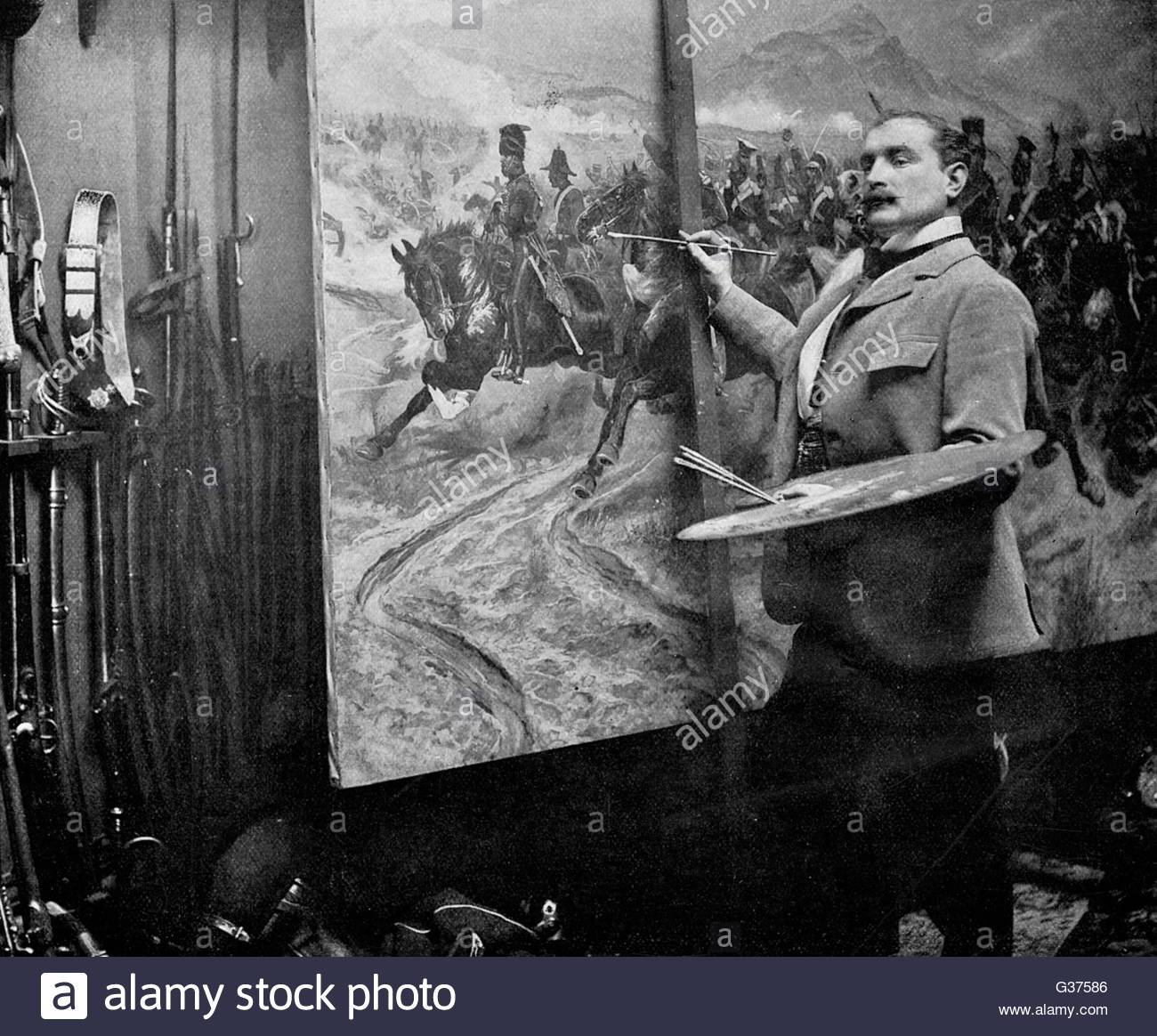
Richard Caton Woodville began his exhibiting career at the Royal Academy by showing two battles from eighteenth-century wars.[2] The subject matter of his subsequent eight pictures was 'contemporary' but in 1894 he turned back to the Peninsular campaign with Badajos, 1812.
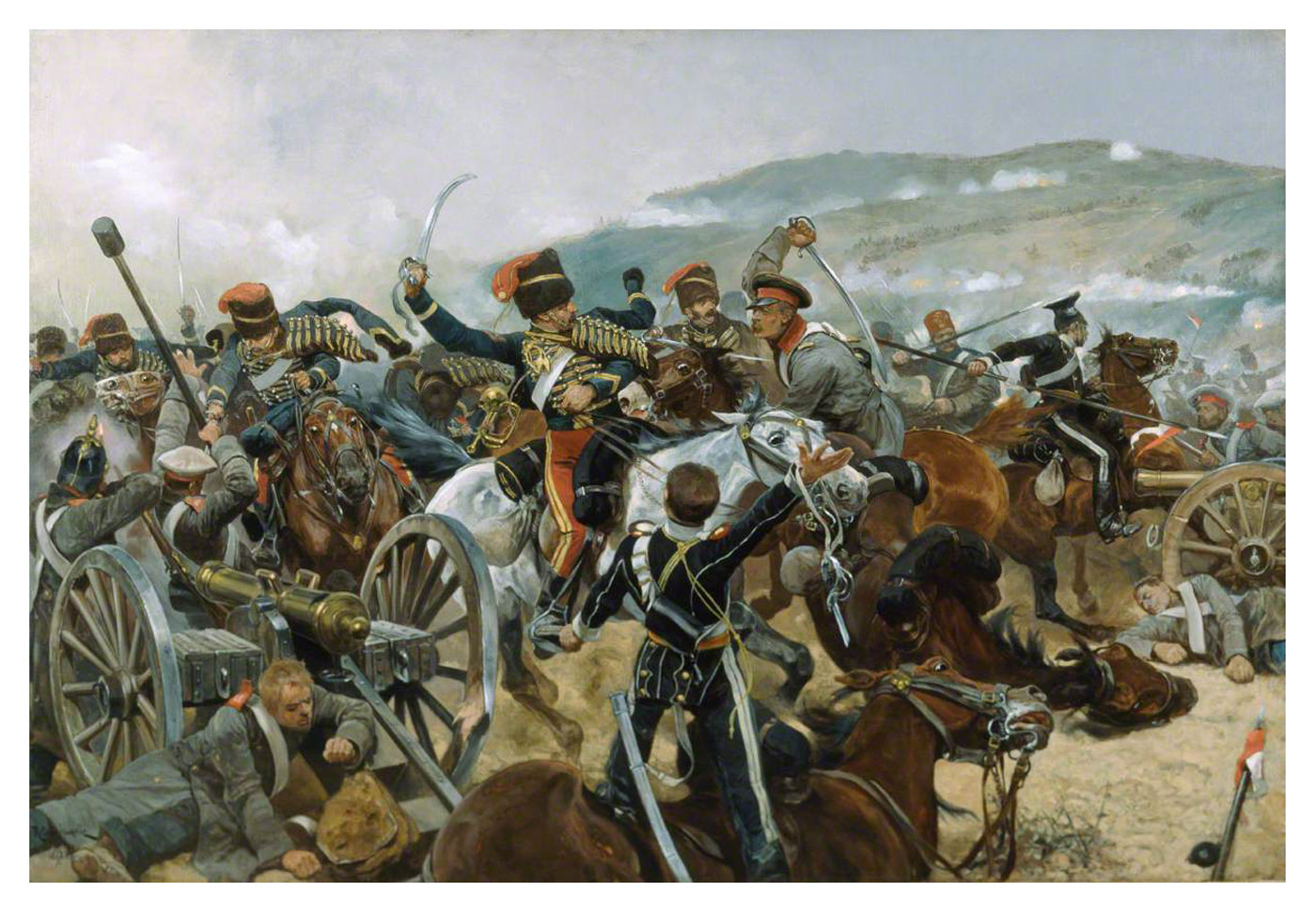
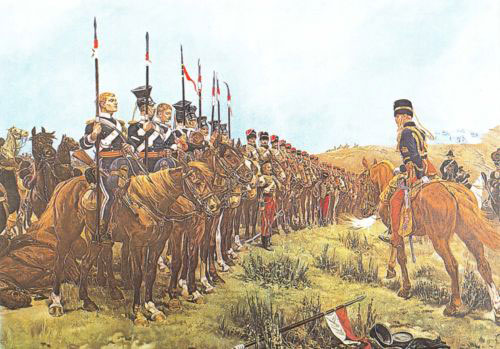
In subsequent Academy exhibitions he showed a Charge of the Light Brigade, a Relief of Lucknow, and a scene from the Peninsular battle of Fuentes Onoro. The only link between the four is that they all depicted acts of gallantry by significant military figures. With Badajos, 1812 Woodville submitted a quotation from William Napier's famous History of the War in the Peninsula which was included in the exhibition catalogue:
"When Wellington saw the havoc of the night, the firmness of his nature gave way for a moment and the pride of conquest yielded to a passionate burst of grief for the loss of his gallant soldiers."[3]
At the siege of Badajos the town had been taken only at the sacrifice of 5,000 men. In the following days the troops got completely out of control and commited atrocious acts of rape, murder and pillage.[4] The memory of Badajos was by no means entirely creditable. Woodville chose to direct his audience's attention on the image of the Iron Duke, as the aristocratic hero weeping for his men. This theme, the 'price of victory', had been current some years before and would have been familiar to his audience. The Charge of the Light Brigade, Woodville's next picture, was also a celebration of aristocratic leadership. The Earl of Cardigan, who in his day had been admired and detested equally, could be represented twenty years after his death as an example of disinterested chivalric courage. Warfare, after the Franco-Prussian conflict, was becoming more a matter of weapons and railway timetables than dependent on the inspiration and courage of individuals. The Cardwell reforms, almost contemporaneous with the Prussian war (1870 - 71), appeared to signal the end of aristocratic leadership of the army. Despite Cardigan's obvious weaknesses as a general, he undoubtedly had, with hind-sight, a glamour that some of Woodville's contemporaries lacked.
The battles of the Waterloo campaign formed the centre of late nineteenth century military nostalgia. In the Royal Academy exhibition of 1897 there were eleven paintings which took their subjects from those few months in the summer of 1815, with only one picture depicting a contemporary event, Stanley Wood's Surrender under Protest: an Incident in the Matabele War. The significance of Wellington, and more particularly Napoleon, has been touched upon in the introduction. The Regency era stood as a symbol of Britain's ability to win, even against the greatest military genius in history.5 In Chapter ten it will be suggested that the Regency period was looked back upon as an era of social harmony and uncomplicated social relations. There was undoubtedly a sense in which the warfare of that age was seen as more dignified because the technology was traditional.
In looking back into history artists may have been motivated by the desire to evade contentious issues. Armitage's Meeanee had been criticised not only as a picture but as a battle. Depicting a battle was taken
[Source: J.W.M. Hichberger, Images of the Army: The Military in British Art 1815-1914 (Manchester: Manchester University Press, 1988), pp.104-105. Also partially accessible online at https://books.google.co.uk/books?id=Q8DnAAAAIAAJ&pg=PA90.]