Added 24.12.12. Minor edits 13.3.14, 4.4.14. Some new info & an image added 15.5.14.
IN PROGRESS - NOT FOR PUBLICATION
1355, Private Edward Richard WOODHAM - 11th Hussars
Birth & early life
Born in Bristol, 1831.
PB, May 2014: According to Michael Julien [great-grandson, see below]:
The Bristol Town Council archive office has confirmed that Edward Richard Woodham was born on 20 February 1831 and his father (a cooper) was born on 18 November 1798. Both were born in Bristol and were baptised at St. Paul's Church in Bristol.
1841 Census
Newfoundland Street, St Paul's, Bristol, Gloucs.
William Woodham, 40, born c.1801, Gloucs.
Ursula Woodham, 30, c.1811, Gloucs.
Maryann Woodham, 14, c.1827, Gloucs.
Edward Woodham, 10, c.1831, Gloucs.
Jesse Woodham, 5, c.1836, Gloucs.
Elizabeth Woodham, 2, c.1839, Gloucs. [PB, May 2014]
Enlistment
Enlisted at London on the 13th of August 1847.
Age: 19.
Height: 5' 8".
Trade: Clerk.
Service
From Private to Corporal: 10th of September 1857.
Transferred to the 18th Hussars (as Corporal) at Hounslow on the 18th of February 1858. Regimental No. 18.
Promoted to Quartermaster Sergeant on the 1st of April 1858.
"Absent", 12th of September 1858, and reduced to Duty Sergeant on the 19th of September 1858.
Discharge & pension
Discharged from Aldershot, "having completed 12 years' service" on the 2nd of November 1859.
Conduct: "good".
In possession of one Good Conduct badge when promoted.
Medals
Entitled to the Crimean medal with clasps for Alma, Balaclava, Inkerman and Sebastopol.
Further detailed medal information archived.
Commemorations
He headed the list of the rank and file at the Balaclava Banquet in 1875 and was on the Committee as Chairman.
Along with a number of others, he described his experiences during the Charge in an interview which appeared in the special edition of the Illustrated London News, 30th of October 1875. The article included an engraved portrait, presumably based closely on a photograph. (There is a copy of this article in the 11th Hussar file.)
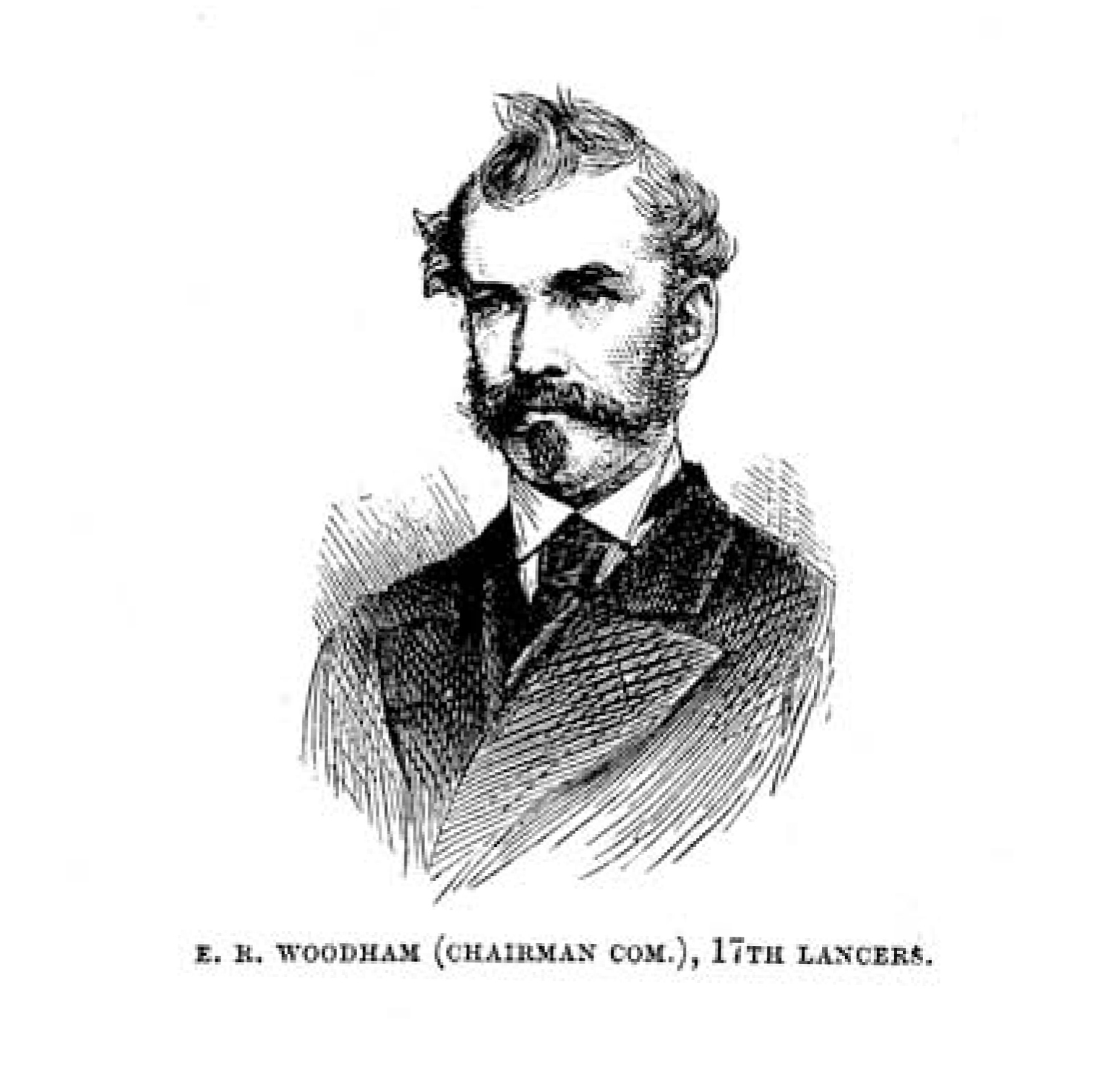
Portrait in the Illustrated London News, 30th of October 1875.
(Click on image to enlarge)
Chairman of the Balaclava Commemoration Society in 1879 [?].
[PB: Check - the Telegraph article below implies he must have been Chairman in and before 1876.]
From the Daily Telegraph, 8th of March 1876:
At the last meeting of a number of the survivors of the Balaclava Charge held about a fortnight ago it was unanimously resolved that a large photograph of the members of the Committee who organised the recent Banquet at the Alexandra Palace should be presented to the Duchess of Cardigan as a grateful recognition of the interest which she took in the matter, not only by financial support, but by her loan of valuable relics to the Crimean Room of the Exhibition at the Alexandra Palace, including the stuffed head of the Earl of Cardigan's charger, "Ronald".
Mr. R. Woodham, the late chairman, was consequently deputised to communicate with the Countess on the subject and as a result received the following communication from her Ladyship.
433 Portman Square,
March the 2nd. 1876.
The Countess of Cardigan presents her compliments to Mr Woodham and begs to thank him and the Committee for their kind intention of presenting her with a picture of the members of the late Balaclava Banquet Committee.
Lady Cardigan will have the greatest pleasure in receiving it, and hopes that Mr Woodham will come himself one day next week, most convenient to him. Lady Cardigan is most touched by the kind recollections of her late beloved husband and so begs to express her appreciation of the picture about to be presented to her...
Accordingly Mr Woodham waited upon her Ladyship last week and presented the photograph. She expressed how deeply affected she was by such a souvenir of the late lamented Lord and said that she would treasure it accordingly.
She spoke in the highest terms of the recent banquet and trusted that the festival would become an annual one, promising to support it in every way in her power, as she considered that the Charge of the Light Brigade would always stand foremost in the eyes of Englishmen as showing true British valour, when other battles and campaigns had been forgotten. These views she desired Mr Woodham to convey to the survivors in her name.
Extract from the South London Observer and Peckham Times, Saturday October 30th 1875:
(Copy of Mr Woodham's letter.)
Villiers Street,
Strand.
October 26th 1875;
To F.H. Warlock,
Dear Sir, I beg to state that you are the sole authorised photographer for the Light Brigade portraits. All others by us are considered to be spurious and entirely without the sanction of the Committee.
Yours very truly,
E.R. Woodham.
Chairman of the Banquet Committee.
The Balaklava Charge.
By kind permission of the S.E. Railway Co. the portraits of the surviving heroes from the Balaklava Charge were most successfully taken at Charing Cross Station on Monday last by Mr F.H. Warlock of 111 Grove Lane, Camberwell, previous to the departure of the gallant survivors for the Banquet at Alexandra Palace.
Hundreds of these highly interesting mementoes of that memorable charge have already been sold and copies may still be obtained by the admiring public upon application to Mr Warlock.
[PB, May 2014: How very interesting - and what a remarkably modern sensibility about the control and value of image rights! Must look further into this. Are any of these photographs known? Presumably the above is an advert in the newspaper? (not available online in May 2014) .Incidentally, although Woodham writes to the photographer as "FH Warlock", a database of London photographers active in the 19th century spells his name "Warlich":
Warlich, Ferdinand Henry Rudolph
Warlich, Ferdinand Henry Rudolph
Born in St Marylebone 1832.
Christened March 31 1833 in St Marylebone.
Md Martha (b Foots Cray, Kent 1840).
STUDIOS: 1. 1 Hebron Terrace, Grove Lane, Camberwell 1871 - March 26 1872. Also artist.
2. 111 Grove Lane, Camberwell March 27 1872 - 1881. Aka Denmark Hill Studio.
3. 107 Grove Lane, Camberwell January 1877 - 1880. Successors to Warlich & Hyne.
4. 113 Grove Lane, Camberwell 1880 - 1881.
BPatent 4367 November 21 1877 (with J W T Cadett) enlarging.
BPatent 2068 May 21 1880 enlarging.
BPatent 376 January 8 1891 ornamenting by photography, from 19 Station Road, South Norwood.
Bill of sale to James Asppiant November 11 1874 £100; Henry Levy November 11 1877 £100; October 30 1878 £100; October 24 1879 £100; William Henry Hughes November 3 1879 £150 absolute sale; Consolidated Credit Co August 26 1880 £65; Benjamin Blaiberg February 10 1881 £115; April 31882 £110.
Bankrupt October 16 1880.
Date of death unknown.[Source: http://www.photolondon.org.uk/pages/details.asp?pid=8162 (accessed 15.4.14).]]
I have not located any of his photographs, or any further information about the photographs he took and distributed on behalf of the Banquet Committee.
Life after service
Marriage
According to Michael Julien [great-grandson, see below]:
Edward Richard Woodham and Maria Jane Blizard were married on 5 October 1864.
They had four children, including my grandmother Emma Maria Woodham whose only son, Frederick Woodham Evans, served in the First World War and died in action on the 26th May 1917.
Frederick Woodham Evans was commissioned as a second lieutenant into the 21st Middlesex Regiment and died whilst attached to the Royal Flying Corps.
Birth certificates obtained from the General Register Office at St. Catherine's House showed the following children:
Edward Richard Woodham, born 20 January 1862, Pancras.
William Charles Woodham, born 14 December 1863, Weymouth.
Emma Maria Woodham, born 02 August 1865, Weymouth.
Alfred Cossham Woodham, born 04 December 1866, Weymouth.
[PB: See also "More on Richard Woodham's marriage, below. This contains material that should be integrated, where useful here.]
1871 Census
Grove, Portland, Dorset.
Edward Rd [Richard] Woodham, Head, 40, born c.1831, St Paul's, Gloucestershire.
Maria Jane Woodham, Wife, 32, c.1839, Westminster, Middlesex.
Edward Rd [Richard] Woodham, Son, 9, c.1862, Marylebone, Middlesex.
William Chas [Charles] Woodham, Son, 7, c.1864, Portland, Dorset.
Emma Maria Woodham, Daughter, 5, c.1866, Portland, Dorset.
Alfred Cossham Woodham, Son, 4, c.1867, Portland, Dorset. [PB, May 2014. Check this against EJB's notes below.]
1881 Census
62, Radnor Street, King's Road, Chelsea, London
The 1881 Census shows Edward R. Woodham as 50 years of age, born at Bristol, Gloucestershire, living with his wife Jane M., 42, born in Westminster, London.
ERW is described as an "Inquiry Officer" followed by the initials CCS (this central initial could be "&" rather than C). These initials are struck through, and the word "Customs" written above.
Four children are listed: Edward R., 19, a Clerk, William C., 17, Clerk, Emma M, 15, and Alfred C., 14, an Assistant Salesman. All the children were shown as born at Portland, Dorset.
There was also a boarder in the house, Christopher McEnroe, aged 19, a Government Clerk, born in Ireland.
Death & burial
He died at 135, [?] Road, Islington, London, on the 12th of December 1886, aged 55 years, from "Valvular disease of the heart and following a seven day bout of bronchitis." His occupation was shown as that of a commercial traveller.
A son, Albert Woodham, was shown as being present at his death. (See copy of his death certificate in the "Certificates" file.)
From the Islington Gazette for the 22nd of December 1886:
"On Thursday last were buried the mortal remains at Highgate Cemetery of the late Edward Richard Woodham, formerly of the 11th Hussars, who died from heart disease at his residence, No. 155 Thorpeville Road, Crouch Hill.
The deceased took part in the Balaclava Charge and in 1875 when the Commemoration Festival took place at the Alexandra Palace was Chairman of the organising Committee and took a great interest in the welfare of his former comrades. He was much respected and was a kind and gentle friend to all who knew him."
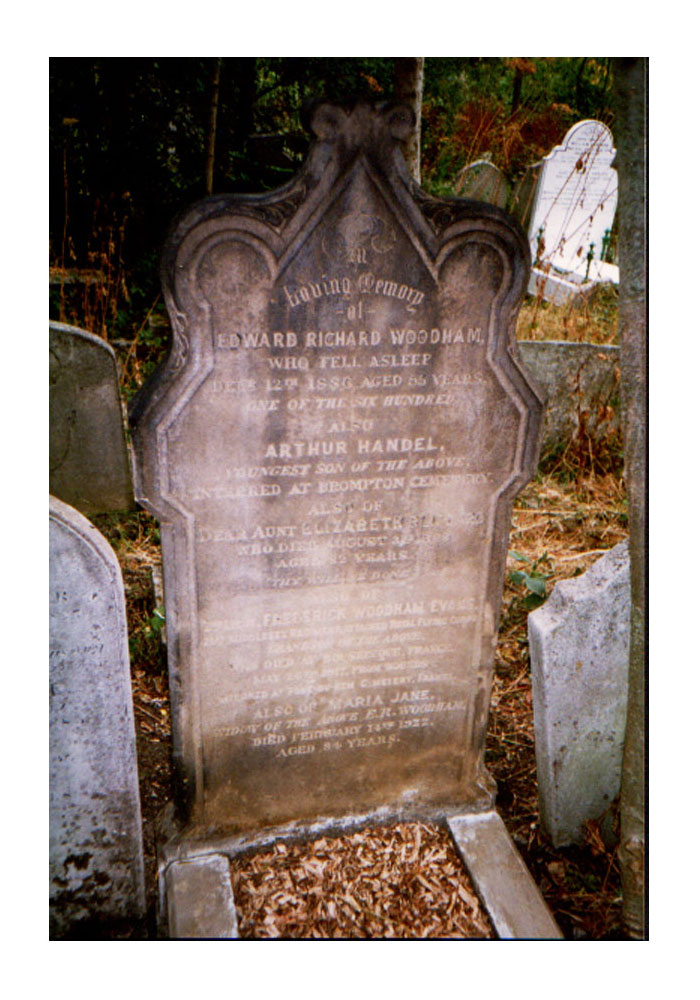
The grave in Highgate Eastern Cemetery is numbered 27283 [PB: Square 121?] and is situated some 100 yards past the Karl Marx monument from the main gate and some twenty yards off to the right. It has the following inscription on the stone:
"In loving memory of Edward Richard Woodham, who fell asleep December 12th 1886, aged 55. "One of the Six Hundred."
Also Arthur Handel, youngest son of the above, interred in Brompton Cemetery.
Also of dear Aunt Elizabeth Blizard, who died August 3rd 1888, aged 82 years.
Also of 2nd. Lieut. Frederick Woodham Evans of the Middlesex Regiment, attached to the R.F.C. Grandson of the above, who died on the 26th of May 1917 from wounds. Interred in the Pont-Dui-Hin Cemetery, France.
Also Maria Jane, widow of the above E.R. Woodham. Died February 14th 1922, aged 84 years."
(2nd Lieut. Frederick Evans. Served in the 21st Bn. (Islington) Middlesex Regiment, from the 16th of November 1916. Attached to the R.F.C. in 1917. Report of the 21st of May 1917... Pilot, Lt. Masson. Observer, 2nd Lt. Evans, in Aircraft No. A6467. Failed to return... Seen to go down in flames... Died of wounds, 26/5/1917.
The family gravesite is now [1986] very overgrown, but was cleared sufficiently to allow a photograph of the stone to be taken. (See copy in the 11th Hussar file.
In 1995, following the passing on to the greater family of the existence of the stone and its condition, efforts were made by them to have the stone renovated to some degree and the area cleared of undergrowth, arrangements also being made for the latter to be maintained.
Caption
(Click on image to enlarge)
At the same time, it being learnt that no reference was made to him in a local guide, as one of those buried in the cemetery who attained some distinction in their lifetime, it has been arranged for this to be done.
(See photograph of the stone as it now is in the 11th Hussar file.)
[1974] From his grand-daughter, Mrs Lilian Eltham, now aged 75 and living in Watford, came the following information:
"I believe that my father was his eldest son [EJB: now known to have been Alfred Cossham]. The Woodham family was a well-respected one and a Mary Woodham married a Court Physician, a Doctor Baylis. [Doctor Baylis was Court Physician to the King of Prussia.]
I think he was also at one time an official of the prison on the Isle of Wight, my grand-mother having many lovely carvings which were made by the prisoners who were detailed to do house-work for her."
She also confirms the belief that Trumpeter Woodham of the 11th Hussars was his grandson and that there was also a brother of this man who served in the 17th Lancers [sic] named Ernest.
"I remember vividly these two young cousins, in their beautiful dress uniforms, especially Alfred, who scratched a valuable chair back with the two metal buttons at the back of his uniform.
Ernest escaped father's wrath because his two back buttons were covered in braid.
My father left 'all pictures, engravings, books and other articles' to my youngest brother, and a letter from Florence Nightingale to my grandfather, to me.
(There is a copy of this letter, which appeared in the Daily Telegraph some time in October 1875, in the 11th Hussar file.)
"Unfortunately he (my brother) was very annoyed with the replies he received from an authoress engaged on research of the Crimean period [PB: I wonder who she was?] and will no longer help with any information.
I only recently found out that my grandfather was buried in Highgate Cemetery (close to the grave of Karl Marx).
The cemetery staff were very helpful and told me that the stone which bears the date, 12th December 1886, was in a very poor condition.
Apparently my grandmother was buried in the same grave-space in 1922, although my father had told me that she had died many years before, whereas she had been put in a home until her death.
My father was a real martinet, Mr Barrett of Wimpole Street being nothing compared with him.
I knew but little of my grandfather when I was young.
His wife had also lived with us for a short while after his death and I would have been about six years old then, but for some reason she was never allowed to say much about him.
Possibly he may have been the black sheep of the family."
1977: It is known that Mrs. Eltham [his grand-daughter] has asked the Regiment for the return of his Crimean medal to the family and that this has been done, but it is not known under what conditions.
Alfred William Woodham [grandson]
According to known family history Alfred William Woodham served in the 11th Hussars as No. 4968.
One of nine children in the family he was persuaded by his father to enlist into his grandfather's old regiment.
In his later memoirs Alfred Woodham said:
"On being asked if I would like to join the army I said "Yes".
By law I think I was not actually allowed to leave school until I was fourteen, but apparently my father knew the headmaster well, and was taken to St George's Barracks to enlist.
On the Recruiting Sergeant asking my age I said "Thirteen and three months" but then he said "You'd better say you're fourteen", so I said it.
That was on the 29th of May 1902, the day the Boer War officially ended.
By the beginning of the First World War he had reached the rank of Sergeant Trumpeter and embarked for France with HQ Troop on the 15th of August 1914.
In the intervening period he attended a Bandmaster's course at Kneller Hall and married.
On the 30th of March 1919 he became Bandmaster of the 1st. Battalion of the King's Shropshire Light Infantry and is said to have composed a march for them.
He is shown as having two different Regimental numbers at this time: 45950 and 40262279.
At this time he was shown as being born on the 29th of February 1888 (although the family say that he was born on the 14th of February 1889) and as having served 16 years 305 days in the ranks.
Then followed a long period of service in the Near East and India until the "Army List" for February of 1933 shows him as being at the Royal Military School of Music and in June of 1933 as being Bandmaster of the 1st Bn of the Durham Light Infantry.
He is out of the "Army List" in June of 1936 (said to have been because of not wishing to go overseas with the regiment and is known to have subsequently served with the Nigerian Police in the same position (as Bandmaster. during which time he was un-accompanied by his family) for 10 years.
For his service during World War One he was awarded the 1914-15 Star (with clasp) and the War and Victory medals.
He was still alive in 1978 and living at No. 64 General Johnson Court, Wainflete Place, Winchester, Hants.
He states that his grandfather was known in the Regiment as "Chuckster" Woodham and also that his grandmother had been in the household of Lord Cardigan.
Alfred W. Woodham died in a private nursing home at Sutton in Surrey in 1982, aged 92 years.
He had been formerly living in Winchester and in a hospital there, but being very ill and unhappy he was brought to Surrey.
Of his brothers, two were regular soldiers and one was war-time only.
John Edward Woodham [grandson]
John Edward (known in the family as Jack) was born on the 18th of June 1882 and served as No. 51820 in the Royal Horse Artillery "U" Battery, as a Bombardier until being commissioned as a 2nd. Lieutenant in the Royal Artillery on the 18th of April 1916 and becoming a Lieutenant on the 21st of February 1918.
He had served in the ranks for 15 years 64 days and for his services he was awarded the 1914/15 Star, War and Victory medals.
Ernest Richard Woodham [grandson]
Ernest Richard Woodham was born on the 23rd of April 1891, served as a Sergeant (No. 5564) in the 16th Lancers (not the 17th, as thought by Mrs. Eltham in her letter) and was commissioned as a 2nd. Lieut. in the Norfolk Regiment on the 2nd of March 1916 after being in the ranks for 9 years 259 days.
Appointed Acting Lieutenant in the 26th Battalion Training Reserve from the 19th of April to the 22nd of July he was gazetted as a Lieutenant from the 6th of August 1917.
He had served in France from the 17th of August 1914 and was awarded the 1914 Star (with clasp and rose) and the British War and Victory medals.
Thomas Woodham [grandson]
Of a third brother, Thomas, only a Gunner Thomas Woodham, who served in the R.G.A as No. 119291 can be found on the Medal cards at the PRO (although there were others of the same name who had war service from the beginning).
That this was the third brother is reasonably clear from family knowledge that he had volunteered for the army fairly late during the war, had not been commissioned and that his brothers thought him far too young to be sent to the trenches.
A photograph exists of the three elder brothers together in France in 1915. (See copy in the 11th Hussar file.) Despite family circumstances and seemingly being forced into the army by these, their father followed their progress with interest and urging them to take every opportunity to improve their education and gain promotion.
(See photograph of Alfred William as a Bandmaster and another of John Edward, Ernest Richard and Thomas in uniform, together with their father, Edward Richard Woodham (junior) in the 11th Hussar file.)
At the time of Albert William Woodham's death a son, Roger Woodham, wrote to the Regimental HQ of the Royal Hussars to inform them of his father's death and on being invited to visit found out more of his family's connections with the regiment.
There were two letters there from Mrs. Eltham's family, one dated in February of 1975 acknowledging the receipt of Edward Woodham's Crimean medal and another dated in June of 1991 from her great nephew saying that Edward R. Woodham's Crimean medal had been (presumably on his aunt's death) passed on to him.
Roger Woodham's knowledge of the family had, up till then, been very little, although one of his boyhood memories had been that the engraving of Lord Cardigan given to the survivors had hung in his bedroom, but had little idea of how it had come to us, although vague connections were known of his father's grandfather who had ridden in the Charge of the Light Brigade.
Later being in a school in Richmond, Yorkshire, he had come across an old copy of the Illustrated London News containing the article and pictures of the 21st Anniversary Dinner at Alexandra Palace in 1875.
The picture is no longer with the family - as after my father's death I searched the house from attic to cellar for it, but without success."
[Where is start of quote?]
In 1994 he had a telephone call from another grandson (who had also been to Winchester seeking information) of Edward Richard Woodham and it transpired that they were second cousins.
This gentleman had done a considerable amount of family research and was able to provide certificates of various types as well as family photographs [there are copies in the 11th Hussar file] although Roger Woodham was in possession (through his father's papers) of his own grandfather's (and also an Edward Richard) marriage certificate which stated that his father's forenames were Henry Richard.
Confused by this and thinking that he had made a mistake in his ancestry, he was pleased to have this confirmed by his cousin.
More on Edward Richard Woodham's marriage [where useful, add above]
It would now seem that in 1862 Edward R. Woodham (senior) was living as man and wife with Maria Jane Blizzard after leaving the army, and that their first child (Edward Richard junior) was born in Upper Cleveland Street, St Pancras in January 1862.
His father was shown as a "Drill Sergeant". (By this he could have been an instructor in one of the many volunteer forces existing at the time.)
In December 1862 a second son, William Charles, was born at Grove, Portland, his father now being a prison warder.
The marriage finally took place in October of 1864 at the -------- [illegible] Chapel, Pentonville, when he was described as a commercial clerk, aged 33, the son of William Woodham, gentleman, and she as Maria Jane Blizard, a spinster, aged 28, the daughter of Charles Blizard, a gas-fitter, both of 222 Pentonville Road, Clerkenwell.
Was this perhaps a charade and the descriptions given an attempt to hide it from the world in general?
It would seem so, as in October 1865 a daughter, Emma Maria, was born at Grove, Portland, he again being shown as a prison warder.
A fourth child, Alfred Cossham, was also born at Grove in December 1866, again with the same parental details.
In August 1882 his eldest son, Edward Richard, was married to Constance Eliza Collard at the parish church of St John's, Fulham.
He was shown as aged 22, a warehouseman, the son of Henry [sic] Edward Woodham, an office clerk, and his bride as aged 19, a spinster, the daughter of John Collard (deceased) a mariner, both of No. 7 Cedar Road.
Whether he did not know his father's correct Christian names or he forgot, perhaps conveniently, as he gave his age as 22, whereas in fact he was only twenty.
Did he perhaps make a couple of deliberate mistakes because he had not obtained his parents' consent to his marriage?
[PB: Can we assume the following is all EJB? Or are they notes from a member of the family?]
ERW at Portland Gaol
The chance finding of the Staff records of Portland Prison from 1853 to 1880 show that he was appointed there as an Assistant Warder on the 30th of July 1862 at the age of 31 years with an Annual rate of pay of £55, plus a Ration Allowance of £14, Lodging Allowance of £5/4/- and a Uniform Allowance of £2/8/-.
On the 15th of February 1870 he was promoted to Warder, with his Annual rate of pay increased to £60/10/- and his other allowances as £15, £9/12/- and £2/8/- respectively.
On the 10th of March 1874 however he was reduced to the position of Assistant Warder and on the 9th of November 1874 was transferred to the Millbank Prison, London.
No similar records for Millbank Prison exist.
The Governor's Daily Journals for Portland covering these dates have also existed and show for Monday, 30th of June 1862, "Asst. Warder Edward Woodham joined - on probation", for Tuesday, 15th of February 1870, "Asst. Warder Woodham, promoted to Warder", for Thursday, 10th of March 1874, "Warder Woodham released from suspension and reduced to the rank of Assistant Warder" and for "Friday, the 13th of November 1874, "Assistant Warder Woodham transferred to Millbank Prison at his own request, to pay his expenses and Asst. Warder Arthur Cottam appointed in his place."
Both were signed by George Crofton, Governor.
(This was four days after the Staff Book said he had been transferred, but may have been due to the fact that on anyone leaving the Staff, higher permission had to be sought for anyone to take their place.)
The reason for his particular suspension cannot be found recorded, although it was a common and almost daily occurrence for staff to be suspended (with sometimes fined as well) for a variety of reasons.
Being back in London would have given him the opportunity of organising the Balaclava Commemoration Banquet at Alexandra Palace in October 1875 and the dates of various happenings at the prison confirms details of what is known from marriage and birth certificates.
Further notes on Portland Gaol
For example, on the same day that Edward Woodham was released, an Assistant Warder Carswell was suspended for "sitting down and being asleep whilst on duty in the Separate Cells".
He was returned to duty two days later (the usual lapse of time - or frequently, dismissal.)[?]
Other offences were being late for reporting for duty on two consecutive occasions; being drunk, either on duty or when reporting for it; asleep in the Chapel during Divine Service; and in one instance, the warder in charge of the Carpenter's Shop for asking a prisoner to make him a photo frame and attempting to leave the prison with the pieces in his baton pocket; being seen by the Governor working in his garden when he was "officially sick"; out shopping with his wife when under the same restriction, after being given to take leave to visit his dying mother, the Governor being informed by the local priest that "the woman in question had never been better in her life", and another for "not controlling his children and allowing them to cause damage in the school-room."
The main recordings in the Journal seem to be mainly of prisoner happenings, arrivals, discharges, visits by the Governor to the working parties (as an example, 602 for the War Office in the Quarries, Admiralty 475, employed building the harbour breakwater, 485 in the prison workshops (the Prison, built in 1848, had cells for 1500 men) and to the prison itself.
Assaults on staff were an almost everyday occurrence, many being shown as "an attempt to kill" and punished by flogging.
During the time that he was employed there several warders were murdered.
What was surprising was the number of times that prisoners saved the day by restraining the violent men, and [?something] rewarded with "time off for good conduct." The Governor himself did not get away with it either, often being on the receiving end of a block of wood, rock or metal bar when making his rounds.
There was often verbal abuse as well, every word said being diligently written down.
There were often attempted escapes, which caused a flurry of excitement until they were caught.
Escape from the island was very difficult once an alarm had been raised.
Truly a microcosm of life in a convict prison during the latter half of the last century.
1871 Census
Grove, Portland [full address?].
The 1871 Census shows him as Edward Richard Woodham, aged 40, a Prison Warder, born in the parish of St Paul's, Gloster [sic?], with his wife, Maria Jane, aged 32, born in Westminster, London, and four children: Edward Richard, 9, born in St Marylebone, London, William Charles, 7, Emma Maria, 5, and Alfred Cossham, 4.
The three younger children were shown as being born at Portland and all were scholars. The showing of the parish of St James's [presumably St Paul's?] (assuming this was Bristol) does give a small clue as to where he was born.
EJB?: I have looked at the 1841 Census Returns for this parish but can find no trace of the family or of the name being mentioned at all. However, some 13/14 years had elapsed since his birth so the family could well have moved.
I think, though, that I have found some idea of his parentage.
A check of the only available records of the marriages at Bristol between 1800 and 1837 shows that on the 3rd of April 1826 a William Woodham married an Ursula Sheppard Cosham, both of the parish, after banns, at St Paul's Church, Bristol.
A possible previous generation might have been the William Woodham who married Martha Jackson (b.o.t.p) at St Augustine's Church on the 18th of November 1802 and John Nicholls Cossham who married Mary Lorymer (b.o.t.p.) at St Augustine's Church on the 14th of April 1803.
(There were several other "Woodham" marriages of both sexes during the intervening years, but these do not appear to have any relevance.)
Further information
An Alexander Allen Vaudrey, B.A. of St James's Parish married Ann Mary Cossham (b.o.t.p. [both of this parish] at St Paul's Church on the 23rd of June 1831.
A John Middleton Cossham was in business as a Public Accountant at Shannon Court, private address, 5 St James's Sq. in 1840 and someone who was almost certainly his son, Stephen G.C. [?] was carrying on the business in 1852 at the same address, but living at 9, Wellington Place, Ashley Road until at least 1876.
A William Woodham was in business as a Cooper at 8, Newfoundland St from 1854 until 1876.
A Mrs. E. Woodham was a private resident at 8, York Street in 1852, and the last known available was a Miss Winifred Woodham, a teacher of music, living at 25 Collingwood Road, Woolcott Park, in 1885.
The disparity of dates is because they were taken from Kelly's Directory for the only available years.
External links
http://en.wikipedia.org/wiki/Edward_Richard_Woodham (accessed 14.5.14)
A Walk Through Highgate Cemetery (accessed 14.5.14)
Michael Julien's Family History: Edward Richard Woodham (accessed 14.5.14). MJ is ERW's great-grandson.
To do
PB: The family history above is quite complicated - it would greatly benefit from tidying up, with material about Edward Woodham moved up to "Life after service".