Home Search Index of men A-Z

LIVES OF THE LIGHT BRIGADE
The E.J. Boys Archive

Added 26.11.12. Minor edits 2.4.14, 4.4.14, 1.11.15, 25.7.16.

IN PROGRESS — NOT FOR PUBLICATION

1181, Private David THOMAS — 4th Light Dragoons

Birth & early life

Born at Carmarthen, Wales, c.1825.

Enlistment

Enlisted at Exeter on the 3rd of November 1843.

Age: 18.

Height: 5' 10".

Trade: Labourer.

Service


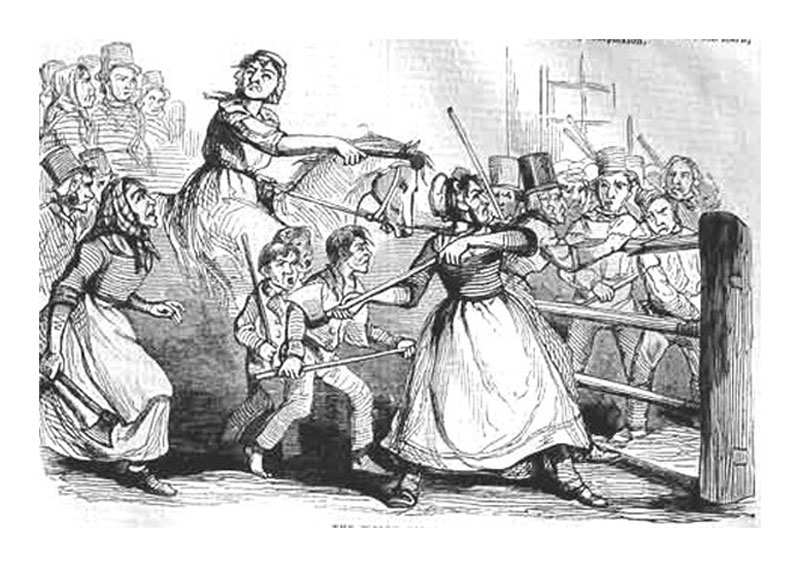
Rebecca Rioters (date? source?)

(Click on image to enlarge)

David Thomas rode in the Charge, and was later awarded the Distinguished Conduct Medal. He was recommended for it on the 5th of February 1855, and received a gratuity of £5, but it is not known under what circumstances - however, the award was most probably given for his conduct at the time.

It appears that his colonel was surrounded by five of the enemy and was in imminent danger of being killed, when Dai [i.e. David], grasping the situation, rode to his relief, and - according to his version - cut off the head of one, broke the arm of another, and having disposed of the third, he would have gone for the other two, but they ran away. However, the colonel's life was saved, and Dai did not lose his reward, for while the colonel lived he received a regular pension from him, which, after his death, was commuted by the family for a lump sum.

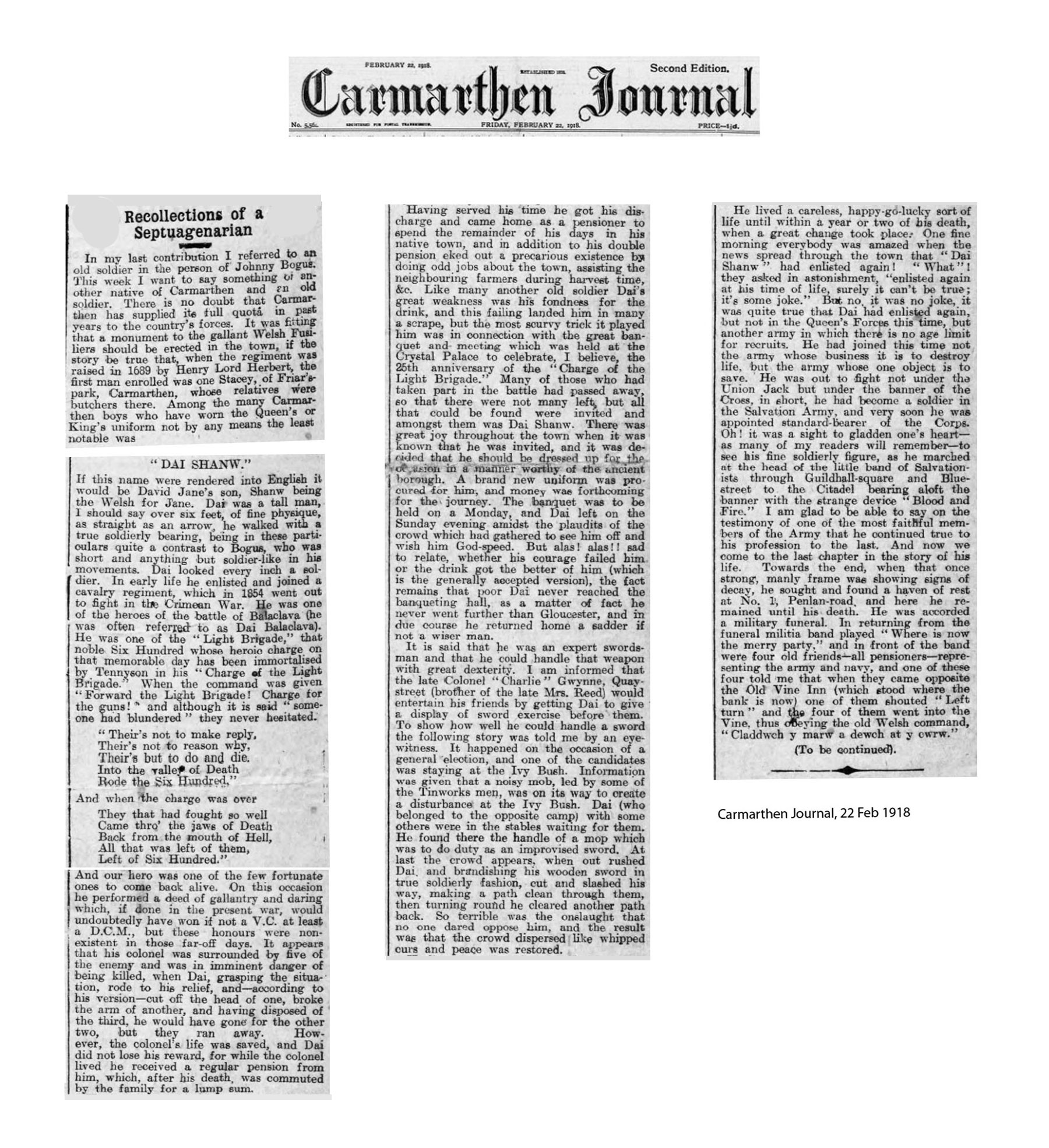
[Carmarthen Journal, 22nd Feb 1918, quoted in full below.]

In an affidavit filed in the Cardigan-Calthorpe law-suit in June 1863 (sworn 29th May 1863, filed 2nd June 1863 when he was a Private in the 4th Hussars stationed at Newbridge, Ireland), David Thomas recalled that Cardigan had turned back from the Charge before reaching the guns:

1./ I have nearly twenty years' service and I remember the Light Cavalry Charge at the battle of Balaclava on the 25th of October 1854. On that day I was in the right squadron, about the centre of the front rank. At starting the 8th Hussars were in line with us.

2./ Before we reached the Russian guns, and whilst we were about 300 yards off them I saw Lord Cardigan on a chestnut horse, cantering back to the rear. He was on the left of our front.

3./ I remember perfectly that after we got back through the guns, hearing Lord George Paget ask where Lord Cardigan was, and I heard Major Low say that he had gone back. We were ordered to reform on the 17th Lancers, but someone said they were the enemy and Lord George gave us the order to retire.

4./ When we got back I saw Lord Cardigan in front of us at the original starting point and facing us, on horseback. When we came up he said, "This is a great blunder, but don't blame me for it."

5./ I have often heard the fact of Lord Cardigan's returning talked of, both immediately after the battle, and since.

7. David Thomas -- "About 300 yards from the guns saw Lord Cardigan returning 'on the left of our Regiment' (the 4th Light Dragoons).

Impossible -- could not have passed the left flank, as asserted.

Sent to Scutari on the 26th of November 1854.

Invalided to England on the 13th of June 1855.

He is shown on the Regimental "Married roll" from the 13th of August 1867, his wife being named on one occasion as Eliza and at other times as Harriet.

A son, John Edward, was born at Piershall Barracks, Edinburgh, in 1868.

Discharge & pension

Discharged from Canterbury on the 10th of November 1868.

"Free, at own request after 24 years' service."

Served 24 years 93 days.

In Turkey and the Crimea: 1 year.

Conduct: "Fair."

In possession of one Good Conduct badge.

Forty-six times entered in the Regimental Defaulter's book. Seven times tried by Court-martial.

Tried and imprisoned by Court-martial, 25th of September—16th of October1846, 10th of May—4th of June 1847, 4th of May—15th of June 1850, 31st of August—4th of November 1851, 16th of February—29th of March 1852, 1st of February—1st of April 1858, and the 2nd of January—3rd of April 1862.

He was granted a pension of 9d. per day.

He said he intended to live at 27, Water Street, Carmarthen, after discharge, and was still living in the Cardiff Pension District in 1875.

Medals

Entitled to the Crimean medal with clasps for, Alma, Balaclava, Inkerman, and Sebastopol.

Documents confirm the award of the Crimean medal with four clasps, the Turkish Medal and the D.C.M. with a gratuity of £5.

Awarded the Distinguished Conduct Medal. He was recommended for it on the 5th of February 1855, and received a gratuity of £5., but it is not known under what circumstances. He is known to have ridden in the Charge, and the award was most probably given for his conduct at the time.

Commemorations

Life after service

His documents were sent to the War Office on the 23rd of March 1890, and returned to the Royal Hospital Chelsea before being again sent to a Mr. Rochford at the War Office on the 12th of March 1893.

Death & burial

David Thomas died in the Carmarthen Workhouse in March 1893.

From the United Services Gazette, 21st of March 1893:

David Thomas, a Balaclava hero, has just died in the Carmarthen Workhouse, aged 68 years. He joined the 4th Light Dragoons in 1843, when the Regiment was suppressing the "Rebecca" riots and he served 26 years. He was at the Alma, Inkerman, and also in the Balaclava Charge. He held the Crimean medal with four clasps, the Turkish medal and a medal for distinguished conduct in the field. The deceased was a fine powerful man, and of later years he had eked out his pension by working as a town porter...

From the Carmarthen Weekly Reporter [date?]:

David Thomas, a Balaclava veteran, died in the Carmarthen Workhouse at 7.30 on Thursday evening in his 69th year. When the 4th Light Dragoons (better known as the 4th Hussars) left Carmarthenshire in 1844 after the "Rebecca" riots, the deceased, who had commenced a great inclination for them, followed the regiment on its return journey to the head-quarters, eventually becoming one of their number and remaining with them for twenty-five years.

He was one of "Six Hundred", and during the charge at Balaclava was instrumental in saving the life of a Scotch officer, whose horse had been shot under him and who at the same time received a shot through one of his legs, which rendered any flight impossible. Seeing the officer's condition, our hero, a fine stalwart figure of some 5' 11" in height, took the officer on to his own horse and literally pulled him from the jaws of death.

For his deeds and this service the deceased got 9d. per day pension and his three medals, the Crimean medal with four clasps, the Turkish medal and a medal — (very rarely obtained) for distinguished service in the field — yet he died a pauper...

The funeral took place on Monday afternoon, when the remains of David Thomas were interred in Carmarthen Cemetery with full military honours. The solemn and very impressive funeral cortege started from the residence of the deceased's sister at No 36 Little Water Street at 4 o'clock and passing through the main thoroughfares, reached the Cemetery about 5.15.

There was a great concourse of spectators all along the route. The order of procession was as follows — a firing-party of 14 members of the P.V.R. under the charge of Colour-Sergeant Lewis and headed by Corporal E.W. Williams — in full-dress and pouch — the Band of the Corps (18 strong) and six bandsmen of the Carmarthenshire Royal Artillery Militia under Bandmaster Johnson playing the Dead March in "Saul", followed by the open hearse containing the coffin of polished oak, covered with the Union Jack, and by wreaths and crosses. On the breast-plate was the inscription: "David Thomas. Died March 13th 1890, aged 68."

Then came the mourning coaches containing the bereaved family, a company of Volunteers under the command of Sergeant-Major Cooper (in full-dress, helmets and waist-belts) and members of the Staff of the Royal Artillery Militia followed by the Mayor (Mr. T. Davis) some members of the Corporation and a large number of influential towns-people. At the church, the Revd. D.J. Evans, curate of St. Peter's, officiated and at the graveside the Revd. J. Lloyd, assisted by the Revd. T.B. Williams, took part.

After the service had been gone through the firing party fired three volleys over his grave, and afterwards marched off, with fixed bayonets. A very large gathering of people were also here and amongst whom could be seen several civilians wearing medals who had also fought many a fierce battle. After the ceremony ended the soldiers were brought into file and then marched homeward, headed by the band playing, "A Soldier and a Man..."

It would appear as if local people paid for the funeral, as a subscription list was published showing the receipt of £3/1/6d. and the expenditure as £3/7/6d. There was apparently a family argument later as to who should make up the deficiency.

He was buried in Grave No. B935 in the Carmarthen Cemetery on the 17th of March. Four other members of the Thomas family are also buried in the same grave, but no memorial stone was erected.

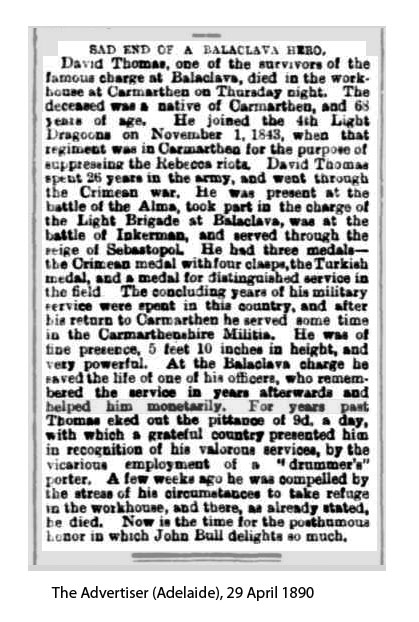
His passing was noticed in Australia:


(Click on image to enlarge)

SAD END OF A BALACLAVA HERO.

David Thomas, one of the survivors of the famous charge at Balaclava, died in the work-house at Carmarthen on Thursday night. The deceased was a native of Carmarthen, and 68 years of age. He joined the 4th Light Dragoons on November 1, 1843, when that regiment was in Carmarthen for the purpose of suppressing the Rebecca riots.

David Thomas spent 26 years in the army, and went through the Crimean war. He was present at the battle of the Alma, took part in the charge of the Light Brigade at Balaclava, was at the battle of Inkerman, and served through the seige of Sebastopol. He had three medals - the Crimean medal with four clasps,theTurkish medal, and a medal for distinguished service in the field.

The concluding years of his military service were spent in this country, and after his return to Carmarthen he served some time in the Carmarthenshire Militia.

He was of fine presence, 5 feet 10 inches in height, and very powerful. At the Balaclava charge he saved the life of one of his officers, who remembered the service in years afterwards and helped him monetarily.

For years past Thomas eked out the pittance of 9d. a day, with which a grateful country presented him in recognition of his valorous services, by the vicarious employment of a "drummer's" porter. [PB: meaning?] A few weeks ago he was compelled by the stress of his circumstances to take refuge in the workhouse, and there, as already stated, he died. Now is the time for the posthumous honour in which John Bull delights so much.

[Source: The Advertiser (Adelaide, South Australia), 29 April 1890: http://nla.gov.au/nla.news-article26750692 (accessed 25.7.2016).]

Further information


(Click on image to enlarge)

Recollections of a Septuagenarian

...Among the many Carmarthen boys who have worn the Queen's or King's uniform not by any means the least notable was

"DAI SHANW"

If this name were rendered into English it would be David Jane's son, Shanw being the Welsh for Jane. Dai was a tall man, I should say over six feet, of fine physique, as straight as an arrow, he walked with a true soldierly bearing... Dai looked every inch a soldier.

In early life he enlisted and joined a cavalry regiment, which in 1854 went out to fight in the Crimean War. He was one of the heroes of the battle of Balaclava (he was often referred to as Dai Balaclava). He was one of the "Light Brigade," that noble Six Hundred whose heroic charge on that memorable day has been immortalised by Tennyson in his "Charge of the Light Brigade." When the command was given "Forward the Light Brigade! Charge for the guns! and although it is said "someone had blundered" they never hesitated.

And when the charge was over

And our hero was one of the few fortunate ones to come back alive.

On this occasion he performed a deed of gallantry and daring which, if done in the present war, would undoubtedly have won if not a V.C. at least a D.C.M., but these honours were nonexistent in those far-off days. It appears that his colonel [PB: Lord George Paget] was surrounded by five of the enemy and was in imminent danger of being killed, when Dai, grasping the situation, rode to his relief, and - according to his version - cut off the head of one, broke the arm of another, and having disposed of the third, he would have gone for the other two, but they ran away. However, the colonel's life was saved, and Dai did not lose his reward, for while the colonel lived he received a regular pension from him, which, after his death, was commuted by the family for a lump sum.

Having served his time he got his discharge and came home as a pensioner to spend the remainder of his days in his native town, and in addition to-his double pension eked out a precarious existence by doing odd jobs about the town, assisting the neighbouring farmers during harvest time, &c.

Like many another old soldier Dai's great weakness was his fondness for the drink, and this failing landed him in many a scrape, but the most scurvy trick it played him was in connection with the great banquet and meeting which was held at the Crystal Palace to celebrate, I believe, the 25th anniversary of the "Charge of the Light Brigade" [i.e. 1879]. Many of those who had taken part in the battle had passed away, so that there were not many left but all that could be found were invited and amongst them was Dai Shanw.

There was great joy throughout the town when it was known that he was invited, and it was decided that he should be dressed up for the cession in a manner worthy of the ancient borough. A brand new uniform was procured for him, and money was forthcoming for the journey. The banquet was to be held on a Monday, and Dai left on the Sunday evening amidst the plaudits of the crowd which had gathered to see him off and wish him God-speed. But alas! alas!! sad to relate, whether his courage failed him or the drink got the better of him (which is the generally accepted version), the fact remains that poor Dai never reached the banqueting hall, as a matter of fact he never went further than Gloucester, and in due course he returned home a sadder if not a wiser man.

It is said that he was an expert swordsman and that he could handle that weapon with great dexterity. I am informed that the late Colonel "Charlie" Gwynne, Quaystreet (brother of the late Mrs. Reed) would entertain his friends by getting Dai to give a display of sword exercise before them.

To show how well he could handle a sword the following story was told me by an eyewitness. It happened on the occasion of a general election, and one of the candidates was staying at the Ivy Bush. Information was given that a noisy mob, led by some of the Tinworks men, was on its way to create a disturbance at the Ivy Bush. Dai (who belonged to the opposite camp) with some others were in the stables waiting for them. He found there the handle of a mop which was to do duty as an improvised sword. At last the crowd appears, when out rushed Dai and brandishing his wooden sword in true soldierly fashion, cut and slashed his way, making a path clean through them, then turning round he cleared another path back. So terrible was the onslaught that no one dared oppose him, and the result was that the crowd dispersed like whipped curs and peace was restored.

He lived a careless, happy-go-lucky sort of life until within a year or two of his death, when a great change took place.

One fine morning everybody was amazed when the news spread through the town that Dai Shanw had enlisted again What they asked in astonishment, "enlisted again at his time of life, surely it can't be true; it's some joke." But, no, it was no joke, it was quite true that Dai had enlisted again, but not in the Queen's Forces this time, but another army in which there is no age limit for recruits. He had joined this time not the army whose business it is to destroy life, but the army whose one object is to save. He was out to fight not under the Union Jack but under the banner of the Cross, in short, he had become a soldier in the Salvation Army, and very soon he was appointed standard-bearer of the Corps. Oh! it was a sight to gladden one's heart as many of my readers will remember to see his fine soldierly figure, as he marched at the head of the little band of Salvationists through Guildhall-square and Bluestreet to the Citadel bearing aloft the banner with the strange device "Blood and Fire." I am glad to be able to say on the testimony of one of the most faithful members of the Army that he continued true to his profession to the last.

And now we come to the last chapter in the story of his life.

Towards the end, when that once strong, manly frame was showing signs of decay, he sought and found a haven of rest at No. 1, Penlan-road, and here he remained until his death. He was accorded a military funeral. In returning from the funeral militia band played "Where is now the merry party," and in front of the band were four old friends - all pensioners - representing the army and navy, and one of these four told me that when they came opposite the Old Vine Inn (which stood where the bank is now) one of them shouted "Left turn" and the four of them went into the Vine, thus obeying the old Welsh command, "Claddwch y marw a dewch at y cwrw." [PB: Possibly meaning something on the lines "Bury the dead and bring on the beer".]

[Source: Carmarthen Journal, 22 Feb 1918.]


New on the site Search Index of men T
For further information, or to express an interest in the project, please email the editors, Philip Boys & Roy Mills, via info@chargeofthelightbrigade.com