Born in Coventry on the 28th of September 1834, the son of 51 James Nichol, 8th Light Dragoons, and Margaret Nichol (unknown maiden name).
His father was born at Killeshandre, Co. Cavan, and had enlisted at Dublin at the age of 18 on the 10th of January 1822. He was 5' 6" in height, with fair hair, grey eyes and a fair complexion. His trade was given as Labourer.
He was discharged, at tge age of 32, from Portobello Barracks, Dublin, on the 29th of October 1836, having served 14 years 273 days. His conduct and character had been "that of a very good soldier, although he had been in a Civil Prison from the 2nd of September 1824 to the 16th of February 1825." All of his service had been spent at home stations.
The Medical Report on his discharge stated that:
"he has suffered much for some considerable time, but more especially for the past twelve months with rheumatic pains of the upper and lower extremities. Several remedies were adopted as, warm baths, Dover powders, moderate bleeding and other applications which afforded only temporary relief. From the frequent attacks and weakening of the ankle joints, I consider him unfit for the duties of a dragoon, His conduct in hospital has been good."
James Nichol died on the 14th of March 1856 at Tullamore, Ireland.
Enlisted at Westminster, from theRoyal Military Asylum, Chelsea, on the 25th of October 1848.
He had entered the Royal Military Asylum (also known as The Duke of York's School) on the 30th of June 1843, aged 8 years 9 months. His father, Pte James Nichol of the 8th Hussars, was then shown as "Still alive," and his mother, Margaret, as "Dead."
Aged 14 years 1 month.
Height: 5' 7".
Trade: Shoe-maker.
Appearance: Fresh complexion. Hazel eyes. Brown hair,
Attained the age of 15 years and on to "Man's Pay" on the 27th of September 1849.
(Lummis and Wynn record him as No.1027.)
Embarked for the Crimea aboard the H.T. "Medora" on the 27th of April 1854.
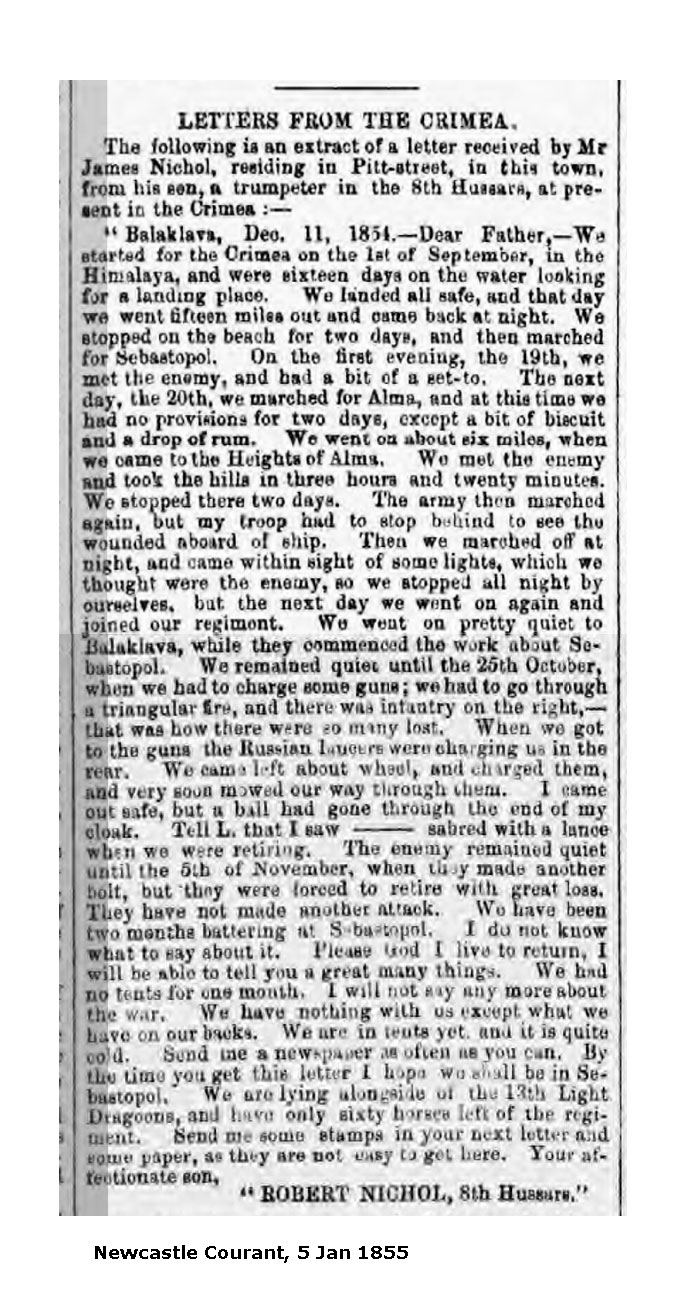
The following is an extract of a letter received by Mr James Nichol, residing in Pitt-street, in this town [Newcastle], from his son, a trumpeter in the 8th Hussars, at present in the Crimea:
Balaklava, Dec. 11, 1854.
Dear Father,
We started for the Crimea on the 1st of September, in the Himalaya, and were sixteen days on the water looking for a landing place. We landed all safe, and that day we went fifteen miles out and came back at night. We stopped on the beach for two days, and then marched for Sebastopol.
On the first evening, the 19th, we met the enemy, and had a bit of a set-to. The next day, the 20th, we marched for Alma, and at this time we had no provisions for two days, except a bit of biscuit and a drop of rum.
We went on about six miles, when we came to the heights of Alma. We met the enemy and took the hills in three hours and twenty minutes. We stopped there two days. The army then marched again, but my troop had to stop behind to see the wounded aboard of ship. Then we marched off at night and came within sight of some lights, which we thought were the enemy, so we stopped all night by ourselves, but the next day we went on again and joined our regiment.
We went on pretty quiet to Balaklava, while they commenced work at Sebastopol. We remained quiet until the 25th October, when we had to charge some guns; we had to go through a triangular fire, and there was infantry on the right — that was how there were so many lost. When we got to the guns the Russian lancers were charging us in the rear. We came left about wheel, and charged them, and very soon mowed our way through them. I came out safe, but a ball had gone through the end of my cloak.
Tell L. that I saw ________ sabred with a lance when we were retiring.
The enemy remained quiet until the 5th of November, when they made another bolt, but they were forced to retire with great loss. They have not made another attack. We have been two months battering Sebastopol. I do not know what to say about it. Please God I live to return, I will be able to tell you a great many things. We had no tents for one month. I will not say any more about the war. We have nothing with us except what we have on our backs. We are in tents yet, and it is quite cold. Send me a newspaper as often as you can.
By the time you get this letter I hope we shall be in Sebastopol. We are lying alongside of the 13th Light Dragoons, and have only sixty horses left of the regiment. Send me some stamps in your next letter and some paper, as they are not easy to get here.
Your affectionate son,
ROBERT NICHOL, 8th Hussars.
[Source: Newcastle Courant, 6 Jan 1855. Checked by PB against the original, 19 March 2015.]
Discharged from Dundalk on the 21st of October 1856, as "Not likely to become an efficient soldier from general debility — the result of repeated attacks of Intermittent Fever when on service in the Crimea."
Conduct and character: "Bad." Not in possession of any Good Conduct badges.
Served 3 years 298 days, to count.
In Turkey and the Crimea: 1 year 10 months.
Three times tried by Court-martial.
Tried by a Regtl, Court-martial on the 15th of July 1854 for "using insolent language." Given 25 lashes.
Tried by a Regimental Court-martial on the 27th of August 1855 for "using insolent and abusive language to a superior." Given 50 lashes.
Tried by a District Court-martial on the 26th of November 1855 for "drunkenness, offering violence and resisting arrest and using insolent and abusive language to a superior officer." Given 50 lashes and sentenced to six months imprisonment with hard labour, but three months of this sentence was remitted.
Awarded a pension of 6d. per day for three months. This was restored for a period of one year from the 23rd of November 1859. Awarded a "Special Campaign Pension" from the 2nd of December 1894.
Pension details also quote, "Convicted of felony, for abstracting money from an envelope whilst employed as a letter carrier in 1859."
To live in Newcastle-upon-Tyne after discharge.
Documents confirm the award of the Crimean medal with four clasps.
Entitled to the Crimean medal with clasps for Alma, Balaclava, Inkerman, and Sebastopol.
A Crimean medal with four clasps, named to "Robt. Nichol." 8th Hussars." and the Turkish Medal were sold at a Glendining's auction on the 20th of December 1929.
His Crimean medal, with engraved naming in small capital letters and in a "worn state," was again sold at a Sotheby's auction, Lot 72, on the 16th of February 1970. (See picture of this Crimean medal in the 8th Hussar file.)
Attended the first Balaclava Banquet in 1875.
Member of the Balaclava Commemoration Society in 1879.
Signed the Loyal Address to the Queen in 1887.
Attended the Annual Dinners in 1893 and 1895.
He was tried at the Special Sessions of Oyer and Terminal and Jail Delivery, held at the Guildhall of Newcastle-upon-Tyne on the 5th of December 1859 for "larceny of post letters, he being employed under the Post Office," and sentenced to six years' imprisonment.
See report of his trial and conviction for larceny, taken from the local newspaper of the time, and also a photograph of him taken in civilian clothes, in the 8th Hussar file.
He died at 13, Charlotte Street, Newcastle, on the 20th of June 1897, and was buried in Elswick Cemetery, Newcastle-upon-Tyne, on the 20th of June 1897, in Grave No. E. CON 289. The plot was a common one, and no headstone was erected.
(See the full report of his death and funeral taken from the Evening Chronicle" of the 26th of June 1897 in the 8th Hussar file).