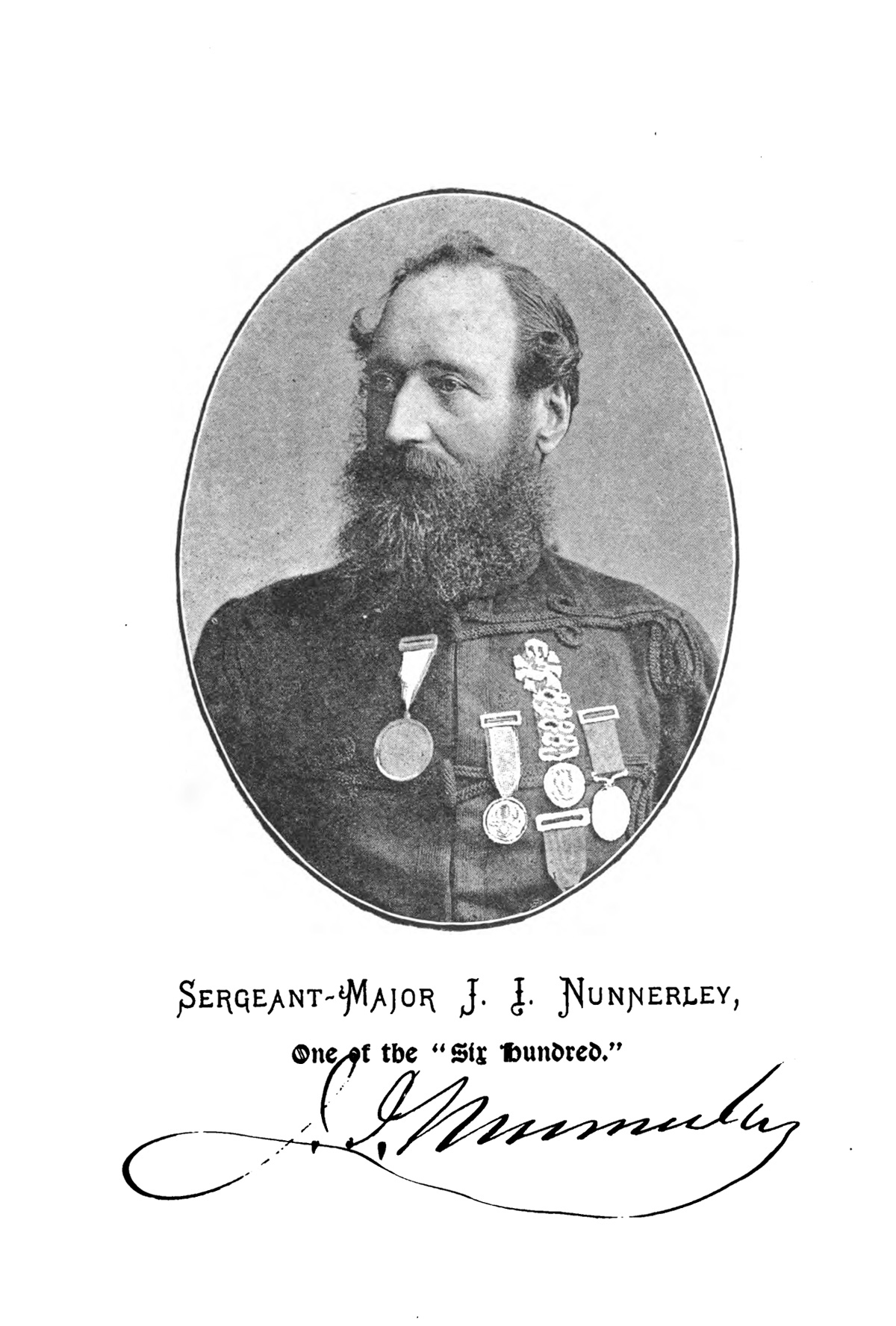
James Nunnerley was born c.1828 at Wilderspool, in the Moreton Sub-District, near Market Drayton, Cheshire, the seventh of eight sons of Richard Nunnerley by his second wife, Mary (died in 1870, aged 80) [PB: sic?].
[PB: Roy Dutton says JN was born Warrington, Cheshire; parents Richard & Mary. Richard christened Whitchurch, 2 July 1790, and buried St Thomas's Church, Stockton Heath. Mary, daughter of William Ikin of Nantwich, d. 28 June 1843, and bd. Warrington Parish church. CHECK.]
His father was a native of Shropshire, and served in the Yeomanry Cavalry of that county for some considerable time, but afterwards resided near Warrington.
His mother was the daughter of James Ikin (from whom JIN took his full name of James Ikin Nunnerley) of Nantwich, Cheshire, where he carried on the business of a builder and timber merchant.
After the Peninsula campaign, and also to commemorate the battle of Waterloo, a blind or screen was erected in Nantwich Church, on which was painted the representations of the three Christian graces, "Faith, Hope and Charity". Being then about twenty years of age, and considered the prettiest of the fair sex in that town, she was chosen to portray the central figure in the group, that of "Hope".
Married at Knutsford in 1819, she had nine children, the first eight being boys, and the last a girl.
His mother died in 1842.
At the age of twelve, young Nunnerley saved the life of a companion. Two boys, named John and William Mason, were in a rowing boat with him on the Duke's canal near Warrington, when John Mason tried to get out of the boat just as a flat [canal boat?] was passing. He stood on the side of the boat ready to spring across to the other one when the rowing boat was turned upside down, with the other two boys underneath. Nunnerley rescued William Mason from under the boat and swam with him to the bank.
Of the boys [PB: i.e. of his seven brothers?], two joined the Army, the youngest serving in the Artillery as a Sergeant. He was also in the Crimea, receiving the medal with one clasp. [PB: Is this Wright Jebb Nunnerley, below?]
His brother, Wright Jebb Nunnerley, died at Golaphur, India, on the 25th of August 1874, aged 47 years 7 months. A memorial stone was erected.
The sixth son, Wright Jebb Nunnerley, was a Second Class officer on board ship in the years 1853-54 and 55 and during the Burma War of 1853 he took part in the capture of a fort at Pegu, for which he had received a medal and a considerable amount of prize money.
Enlisted at Dundalk on the 28th of July 1846.
Age: 18.
Height: 5' 8".
Trade: Draper.
From Private to Corporal: 6th of September 1849.
Regimental prisoner (as a Corporal) 19th — 29th April 1850. Reduced to Private by a Regimental Court-martial and in Garrison cells until the 5th of May.
From Private to Corporal: 26th of January 1852.
Present at the funeral of the Duke of Wellington in 1852.
From Corporal to Sergeant: 26th of October 1854.
Granted "free discharge on the Reduction of the Regiment" at Dublin on the 25th of March 1857.
Served 10 years 233 days.
Conduct: "good". In possession of one Good Conduct badge.
Entitled to the Crimean medal with clasps for Alma, Inkerman, Balaclava, Sebastopol, and the Turkish medal.
Awarded the French Military War Medal on the 6th of March 1861. The citation stated; "Present at the Alma, Balaclava, Inkerman and Sebastopol. Was never absent from his duty."
Awarded the Meritorious Service Medal on the 2nd of April 1904.
From a contemporary newspaper report (uncertain source):
"On the 23rd of July Sergeant Major Nunnerley went to Cardwood Park, near St. Helen's, to receive a silver medal for meritorious service conferred upon him by the King, together with a £5 annuity. The presentation was to have been made by Colonel Richard Pilkington of the 2nd South Lancashire Volunteers, St Helen's Detachment, but in his absence Captain and Adjutant Oakley, who was in command, was called upon to perform the ceremony.
The men, numbering over 300, were formed up and Captain Oakley, after reading the letter received from the War Office, made a few touching remarks about the veteran's career and the example he had set. Three hearty cheers by the men was followed by the pinning of the medal on the hero's breast by Sergeant Major Dooley and an acknowledgement made in military fashion by the recipient. We may add that the annuity was subsequently increased to £10."
The MSM Register shows the following:
"Sergeant J. Nunnerley, late 17th Lancers and Lancashire Hussars Yeomanry, although short service in the Army, being discharged in 1857 — specially noted on account of good work. Authority dated the 18th of February 1895... The annuity granted on the award of the medal on the 2nd of April 1904 was increased to £10 the 22nd of July of that year.
Attended the first Balaclava Banquet in 1875.
Member of the Balaclava Commemoration Society in 1877 and 1879.
Signed the Loyal Address to the Queen in 1887.
Attended the Annual Dinners on 1890-97 and 1905.
On the 5th of November 1895, he, together with just over 100 veterans of the campaigns up to and including the Ashanti War of 1874-78, were invited to an Assembly and Banquet at Shrewsbury, and from the Market Square marched to the Music Hall.
[PB: Was't JIN singled out when Buffalo Bill came to England in 189?? Why was he named (so prominently) on the Ormskirk Boer War memorial? Is JIN the 17th-Lancer cradling the mortally wound young trumpeter Billy Brittain in Lady Butler's painting? (/furtherinfo/artists/thompson_e/thompson_e.html)]

JIN is said to have been the model for the mounted 17th-Lancer cradling a mortally wounded comrade, Trumpeter Billy Brittain (just to the right of centre).
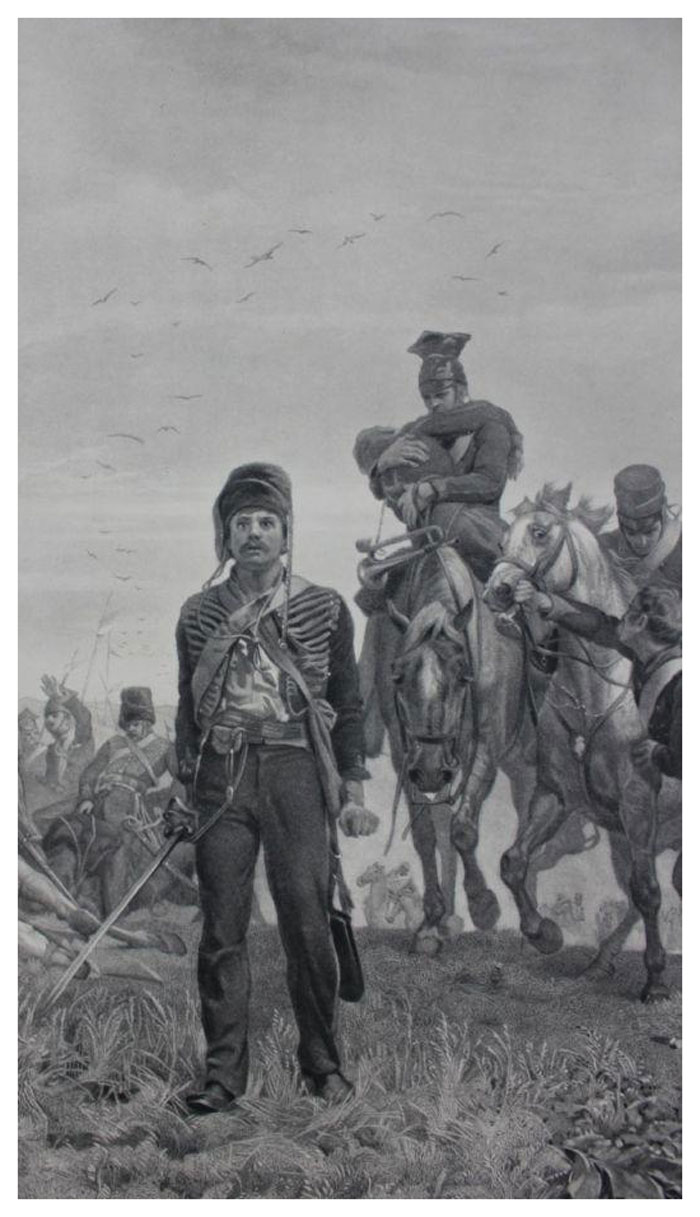
JIN is said to have been the model for the mounted 17th-Lancer cradling a mortally wounded comrade, Trumpeter Billy Brittain (just to the right of centre).
[PB: Rachel Anchor [Rachel Bates] cites Lummis p.256]
In addition to her study of Kinglake and research into the memories of combatants, Thompson employed actual veterans of the battle as her models, and it is possible to identify some of the main figures.
Correspondence in the curatorial archives at the Manchester Art Gallery reveals that the mounted figure in the centre-right of Balaclava, holding a wounded trumpeter, is Corporal James Nunnerley of the Seventeenth Lancers, who survived being in the front line of the advance. Thompson's portrayal of him seems to fit with accounts that, once he was clear of the Russians, he returned to the battlefield and helped a seriously wounded trumpeter, although it remains unclear whether he brought him back to safety on an abandoned horse as is shown in the painting. After the Crimean War, Nunnerley stayed on in the army, following a brief spell as a stationmaster, and eventually retired as a Sergeant-Major. (Lummis p.256)...
It can be inferred from the photograph of Pennington, and from the information known about Nunnerley and Smith, that Thompson was carefully capturing both the likenesses and traits of her models' characters, while the dramatic impression of action was derived from careful studies of the same models artificially staged.
[Source:]
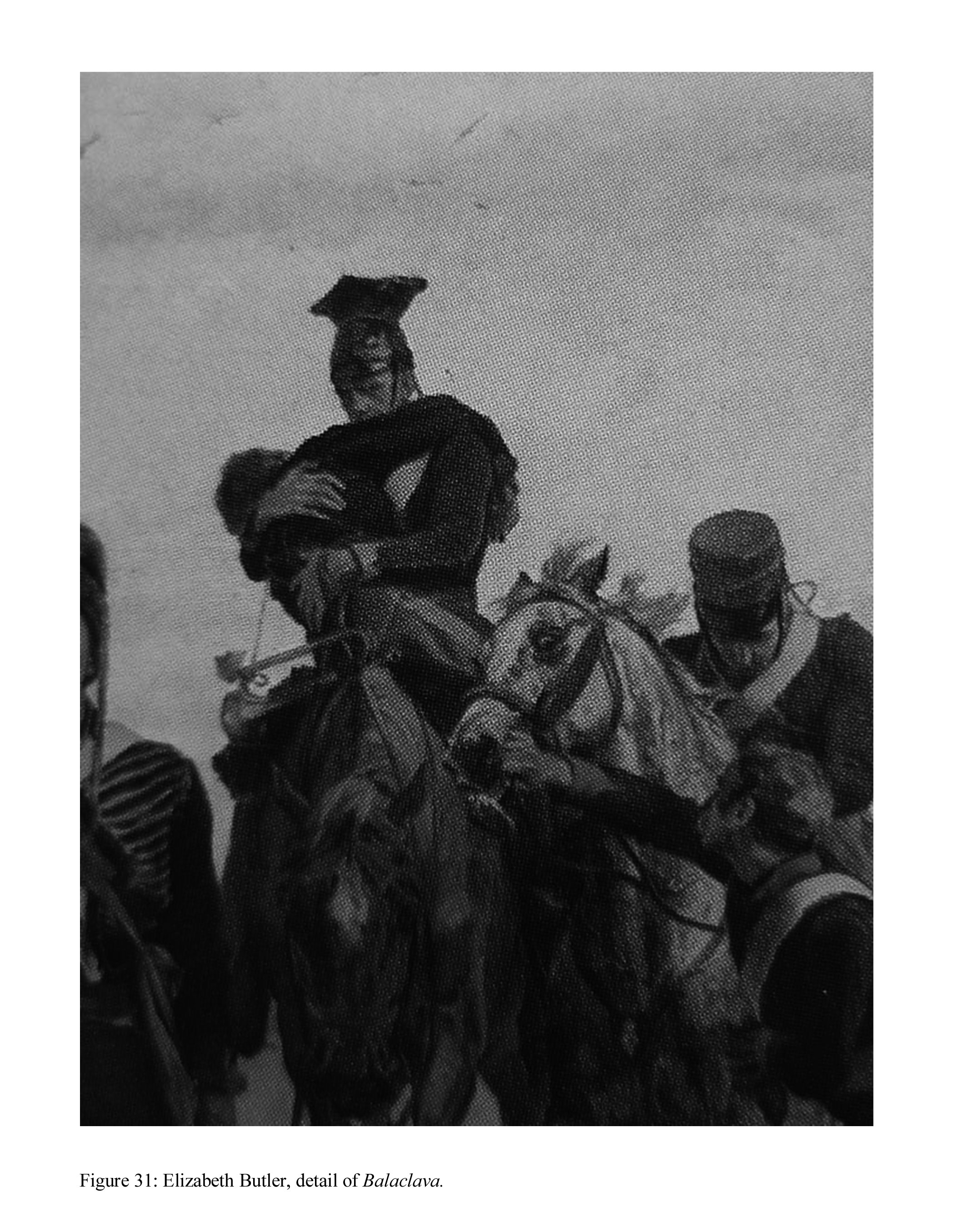
JIN is said to have been the model for the mounted 17th-Lancer cradling a mortally wounded comrade, Trumpeter Billy Brittain (just to the right of centre).
To the right of Balaclava's central figure, a mounted lancer clasps the dead trumpeter to his chest, almost maternally as a pietà (fig.31), as he bears him tenderly home, his hands overlapping as they emphasise the tiny body in his arms.
Here Butler may well have been influenced by the account of Nathaniel Steevens, a witness to the bombardment of the Russians' rifle pits, who wrote of the death of "a great pet" of the Colonel who "though wounded snatched him up in his arms and carried him off declaring 'they shall never take my child'", in just such an exhibition of great tenderness. [n.204: Figes, 2011: 361] The trumpeter's instrument is clearly visible, a counter-reference to the sounds of battle, now silenced...
Across the painting, the emphasis is on physical contact between the men, with the hand appearing as a "recurring trope", much as it does in the memoirs of the nurses in military hospitals. [n.206:] These soldiers are seen not simply as victims of violence, but also, unusually, as carers of their fellow men, a role traditionally ascribed to women, in a blurring of genders, with an oblique reference to Butler's own femininity.
[Source: ]
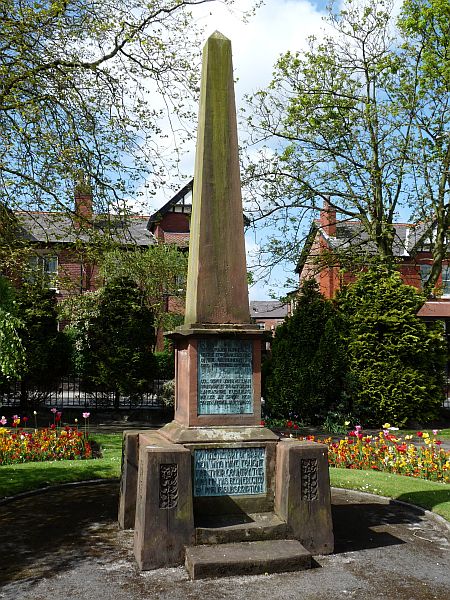
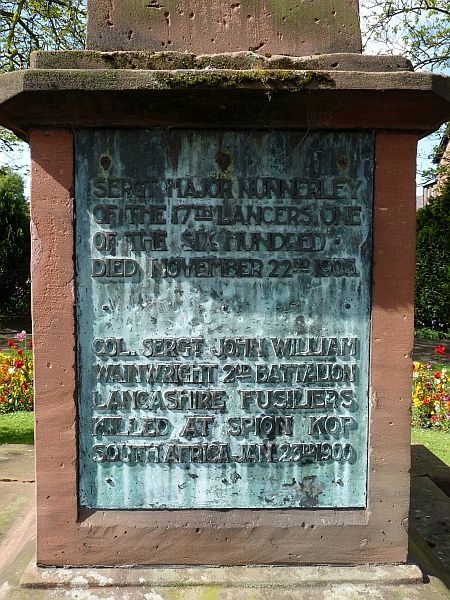
Erected when? Was JIN added because he died while the memorial was being planned? [Source: WarMemorialOnline:....]
BOER WAR MEMORIAL IN VICTORIA PARK, ORMSKIRK
SD40NW ST HELEN'S ROAD 663-1/4/174 (East side) Boer War Memorial in Victoria Park
Boer War memorial. c.1905. Red sandstone with bronze plaques. Obelisk type. Square base with square corner piers approx. 1 metre high, slightly tapered and the sides carved in narrow panels with floral patterns in Art Nouveau style. Between the piers on the east side the base has a bronze panel with raised lettering: "TO THE MEMORY OF BRAVE / MEN WHO HAVE FOUGHT / FOR THEIR COUNTRY THIS /COLUMN HAS BEEN ERECTED / BY PUBLIC SUBSCRIPTION". The square pedestal to the obelisk has a similar plaque above this, headed with the words: SERGT. MAJOR NUNNERLY OF THE 17TH LANCERS ONE OF THE SIX HUNDRED. DIED NOVEMBER 22ND 1905" (commemorating a survivor from the Charge of the Light Brigade during the Crimean War, who became a draper in Ormskirk); and the name and details of one Boer War casualty below this. The west side has a similar plaque with the details of two other Boer War casualties.
Listing NGR: SD4165807951
[Source: https://historicengland.org.uk/listing/the-list/list-entry/1197067 (accessed 27.7.2018). Notice the mis-spelling of his name, and the emphasis on his work as a draper.]
He was Drill Instructor to "D" Troop of the Lancashire Yeomanry Cavalry at Ormskirk, being finally discharged, after 22 years' service, at Ashton-in-Mackersfield on the 30th of September 1881 as "Medically unfit", with a pension of 8d. per day.
He was then 55 years of age, 6' 1" in height, with a fair complexion, blue eyes and brown hair. His trade was that of an "engineer" and his conduct and character "very good."
He was at some time the Station Master at Disley, Cheshire, before going into business as a Gentlemen's Out-fitter.
[PB: His enlistment papers describe him as a Draper.]
In an Account and Address Book formerly used by James W. Wightman when Secretary of the Balaclava Society, his address was shown as 27, Moor Street, Ormskirk.

James Nunnerley died at "Inkerman Lodge", Greetby Hill, Lancashire, on the 22nd of November 1905. (See photographs of "Inkerman Lodge" in the 17th Lancer file (the name is on a small wooden plate over the door) and "Alma Villa" (on the left) and "Balaclava House" (both said to have also been built by him). The names of the houses are carved into the gateposts.
See copies of his obituary notice and funeral report taken from the Ormskirk Advertiser for the 23rd and the 30th of November 1905 in the 17th Lancer file vol.2.
[PB, July 2018: The BNA has yet to digitalise these — the earliest date is Jan. 1914.]
He was buried in the Parish Churchyard, Grave No. 42 North East Plot, on the 25th of November 1905. A memorial stone was erected. His name is also to be found on the War memorial in St. Helen's Park Road. (See photograph of this last in the 17th Lancer file.)
1985: No headstone can yet be found for him in the churchyard of St. Peter and St. Paul at Ormskirk. Large areas of the graveyard have been cleared and the stones laid flat on the ground to form pathways and it is possible that his has been so used, many being seen bearing dates around the time he died. Many of these stones can rather be called "slabs", as they are often 7 feet by 3 feet six inches, some 3 or more inches thick and very heavy.
One theory is that they were used as such to deter grave-robbers by their sheer weight. Being now rapidly "grassed over," it has become impossible to search for any particular one. (See photograph of the churchyard of St. Peter and St. Paul's, and the church of the same name, in the 17th Lancer file.)
1986: After a further intensive search a gravestone to him has been found in the churchyard at Ormskirk, the inscription on it being as follows:
"James Ikin Nunnerley, late 17th Lancers and One of the "600", who died Nov. 22nd 1905, aged 74 years. — "Nobly they fought, and well." (There is a photograph of this gravestone in the 17th Lancer file.)
A Mr Sedbury, of Southport Road, Ormskirk, whose first job was that of an errand boy in Nunnerley's shop just before the old man died, said that his aunt, a Miss Alice Seddon, had been Nunnerley's housekeeper the whole of the time he was in Ormskirk.
Nunnerley was married, but his wife was not living with him at the time. There were no children, the couple having married late in life, and his wife had pre-deceased him. His (Mr. Sedbury's) impression of him was that, although he was a huge man physically, he was very fond of, and gentle with, children.
In his will he left personal effects to the value of £840. His wife, from whom he was separated, died on the 13th of January 1905, when living in Fenny Street, Lower Broughton, Lancashire.
In June 1968, a Mrs Mavis Mandel wrote of her great uncle to the then Regimental Secretary. She thought that at the time of his death he was at least a Colonel, but that family pride may have accounted for this promotion.
She had been told by her father that he (James Nunnerley) had brought in a mortally wounded bugler, a particular friend of five years' standing, 726 Billy Brittain, 17th Lancers. He had cut off his bugle, intending to keep it as a souvenir or memento, as it was pierced with a lance. He lost touch with Brittain, who went into hospital, but Brittain's brother, Frederick — also in the regiment — came to him and asked him for the bugle as by then Billy was thought to be dead. He gave the bugle to the brother, who said he wanted to take it home for the family.
Although the bugle was Regimental property, Captain Morris (the C.O.) said that Nunnerley could keep it as it was damaged and useless and would not blow. Sergeant Nunnerley, however, felt that Fred Brittain had a moral right to it and gave it to him. (See the record of 726 William Brittain.)
James Nunnerley wrote a pamphlet (published at Ormskirk in 1891) on his family, his life, and his service in the 17th Lancers. (There is a copy in the "Memoirs" file and also a photograph of him in civilian clothes and wearing his medals, in the 17th Lancers file.)
According to his memoir he had "assisted Joseph Malone, 13th Light Dragoons, whose horse had fallen on him." From this it would seem that had he not done so Malone would not have had the chance of getting his VC.
After his horse had been shot under him, Nunnerley was himself knocked down and trodden on by riderless horses. Regaining his feet, he observed Joseph Malone of the 13th Light Dragoons unable to free himself from under his dead horse. Nunnerley dragged the horse off and set Malone at liberty.
This story, coupled with Private James Lamb's account of how he and Malone drew lots for the VC, would make it appear that the latter's award was almost pure chance.
[RM: Nunnerley appears in two photos taken of northern Light Brigade veterans attending a benefit performance of Buffalo Bill's Wild West show at Whally Ridge, Manchester on 31 July 1891.]
He also signed an affadavit in 1905 concerning the sounding of the Charge. [ADD/SUMMARISE?]
Nunnerley was also involved in an incident concerning an officer of Nunnerley's troop, Lt Standish, in the Lancashire Hussars in 1863. From The Times, Tuesday, 15th of September 1863:
EXTRAORDINARY PROCEEDINGS.
On Friday after noon, Mr W.S.C. Standish, of Duxbury Hall, near Wigan, one of the magistrates for the petty sessional division of Chorley, Lancashire, formerly in the regular army, and at present holding the position of lieutenant in the D (Lord Skelmersdale's) troop of Yeomanry Hussars, came forward to answer the charges of having shot at a man named Michael Burke, and of having wounded another named Thomas Hesketh, on the highway in Lathom, near Ormskirk.
It appeared that for some days Mr Standish had been drinking rather freely, and on Tuesday last, about noon, obtained from a shoemaker in Tarleton, near Ormskirk, about an ounce and a half of No.3 shot. With this he loaded a cavalry pistol, and rode away.
In the evening he came up to four harvestmen near Mathom-house. He presented his pistol at three of them in succession, firing at the third man, and hitting him on the shoulder. He then galloped off to Lathom-house, where he was met by Sergeant-Major Nunnerley, of Lord Skelmersdale's troop, to whom he delivered two pistols, one empty and the other charged, and began to talk incoherently about there being a riot at Ormskirk, and the troop being called out.
After a short stay, Mr Standish again took the road to Ormskirk. Presently they were met by Inspector Jervis, of the Ormskirk police, and Mr. Standish was called upon to surrender, but he declined to do so, turned his horse round, and galloped off furiously, brandishing his sword.
While thus engaged, he came up to Hesketh and another man named Mordaunt. The latter threw himself down and escaped, but Hesketh received a cut on the chin and fell to the ground, where he was subsequently found bleeding.
The police inspector obtained a horse and went in pursuit of Mr.Standish, but after riding about two miles all trace of him was lost, and the chase was abandoned. Mr Standish eluded capture till Wednesday, at noon, when he was apprehended at Newburgh, a few miles from Ormskirk. He then said he was very sorry for what had occurred; that it was a mad freak, and that he did not intend to hurt any of the men.
The wounds were described as not in any way serious, Burke's being nothing more than an abrasion, and Hesketh's an incised wound about two inches long, but not deep. The pistol with which Burke had been shot appeared to have been loaded with blank cartridge only, and the charged pistol which Nunnerley received was found to contain a piece of paper, a thimbleful of powder, and a wad.
Burke identified Mr Standish, but Hesketh and his companion would not swear to him as he rode at them quickly, and was out of sight before they recovered themselves.
For the defence it was contended that there had been no wounding within the statute. There was a total absence of malice on the part of Mr Standish, who had never seen Burke before, and as regarded the wounding with the sword, the wounded man had not identified Mr Standish.
The magistrate, however, held that prima facie cases had been established. It was his painful duty to commit Mr Standish for trial at the next Liverpool assizes. Mr. Standish was accordingly committed, but admitted to bail."
[PB, January 2014: There is an interesting correspondence on rootschat.com, which includes a remarkable photograph showing Nunnerley in old age with a young boy, Thomas Hough, in uniform wearing his medals. Given his former trade as a "draper", is it possible he made the uniform himself?]

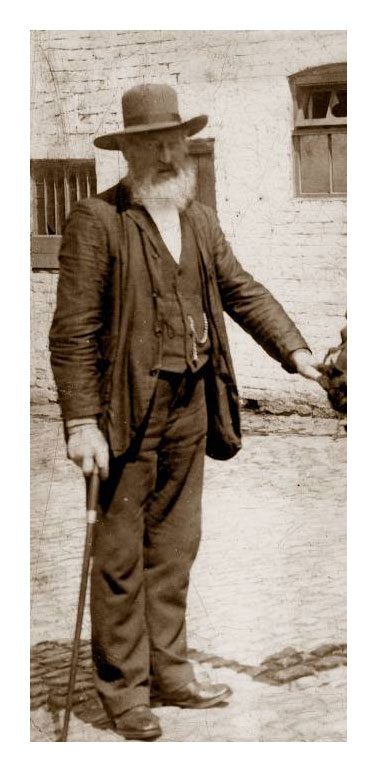
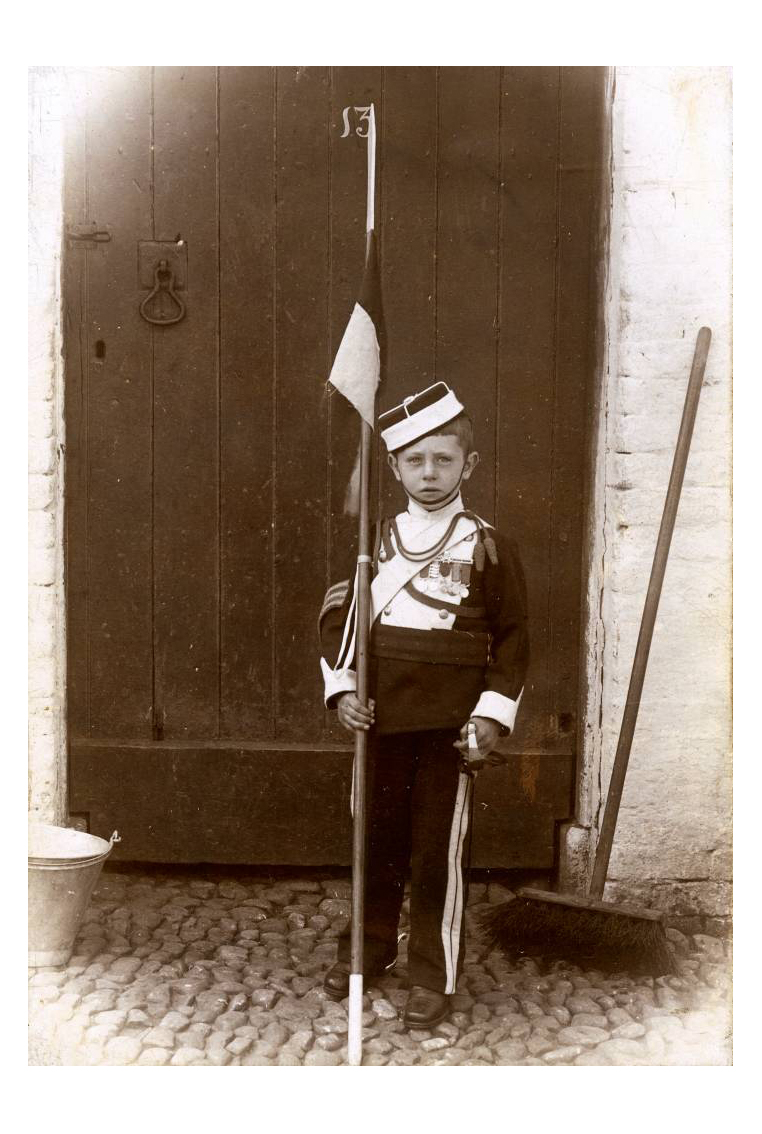
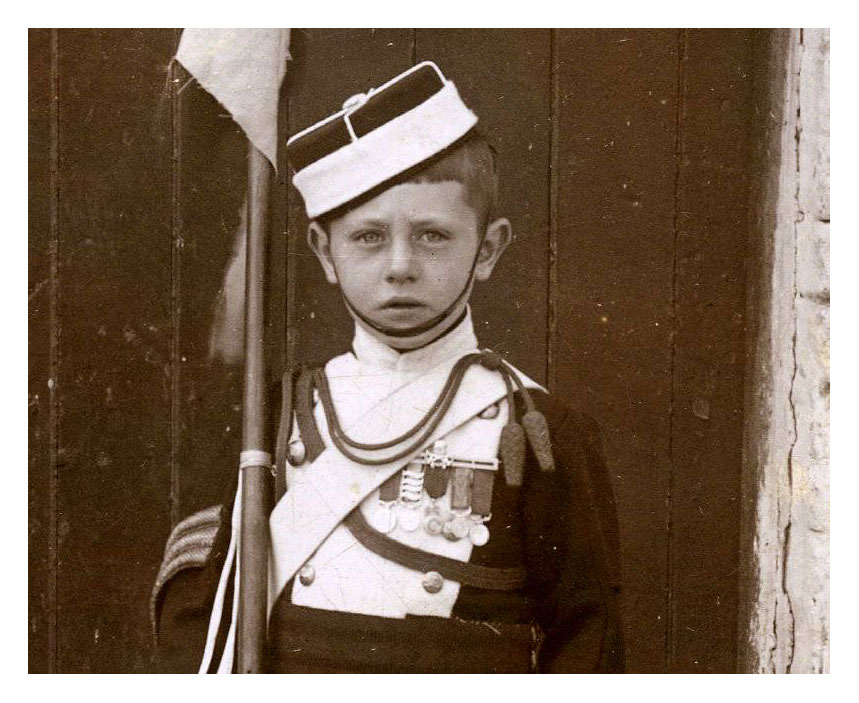
The photographs were posted by Robert Hanley (username "Batstiger"), stating that the boy in the picture was his father-in-law, Thomas Hough (1895-1985), of Ormskirk.
He added:
Gravestone is at Ormskirk Parish Church and reads "In Loving Memory of James Ikin Nunnerley. Late 17th Lancers and one of the Six Hundred who died November 22nd 1905 aged 74 year. Nobly they fought, and well" (death or glory skull and cross bones on gravestone).
Portrayed in "Balaclava" painting by Lady Butler (presently in Manchester City Art Gallery). He is shown cradling the mortally wounded Trumpeter William Britton. His uniform and medals are in the 17th Lancers museum at Grantham.
James Ikin Nunnerley was born the 7th son of Richard and Mary [nee Ikin], in Warrington Cheshire. He was christened at Warrington Parish Church on 22nd May 1843. His father, Richard, was christened in Whitchurch on 2nd July 1790 and died 11th June 1870, he is buried at St Thomas's Church, Stockton Heath. His mother Mary was daughter of William Ikin of Nantwich, she died 28th June 1843 and is buried at Warrington Parish Church.
James Ikin Nunnerley attended the Duke of Wellington's funeral as a corporal.
During the Crimean war he never missed a day's service and was present during the whole of the engagements. He received the Crimean medal with 4 clasps, the Turkish Medal and the French War medal with Diploma. These can be seen at the 17th/21st Lancers Museum at Belvoir Castle, Grantham.
Bob
"HawkesFH" added a note about 'Miniature Sgt-Major Nunnerley' (22 October 2014):
"These pictures were probably taken in the Yard of the Queen's Head Hotel, Moor Street, Ormskirk, in early August 1902, when at the town's Coronation Gala Master W Hough, son of Mr W Hough of the Queens Head Hotel, won first prize in the 'Most attractive and amusing turnout on a quadruped' (that means 4 legs) :) Master Hough's theme was 'Miniature Sgt-Major Nunnerley' and he won £2 for his efforts! All info from the Ormskirk Advertiser dated 14th August 1902."
Best wishes
Dot
Facebook: Ormskirk Bygone Times
A respondent added:
I grew up in Ormskirk and lived in Greetby Hill. Two houses there, Alma Villa and Balaclava Villa, were built by Sergeant Nunnerley on his return from the Crimean War. On the gateposts are cannonballs which he brought back with hiim from the battles. I lived in Alma Villa, number 38. On mischief night, local lads used to try and remove the cannonballs. My dad, who taught at the local grammar school, secretly hoped they would fall on their toes!
Many people remembered Sergeant Nunnerley's funeral and I think there were even pictures of it.
Stephen [no surname given, username "smitch4517"]
Another wrote:
I have recently seen info and photos of my 1st cousin, 7-times removed, James Ikin Nunnerley of the 17th Lancers.
My G-G-Grandmother was Anne Ikin, his niece and grand-daughter of said William Ikin of Nantwich.
JIN's mother was subject of a rood screen in St Mary's Church, Acton-by-Nantwich where she appears as Hope in a depiction on the screen of "Faith, Hope and Charity", "She being the fairest of the fair sex" at that time (1815).
With regards to photos. This is definitely JIN, and was probably taken shortly before his death in 1907 (?) [1905] and probably in Ormskirk at one of the houses he had built there. (There were several, aptly-named Sebastopol, Inkerman etc, Terrace. He moved there from Finney Street, Salford, Lancs, after the death of his wife some ten months earlier.
He did leave a Will in which he left money to a friend. His Will is on the Will Admin and Probate Registers in some libraries on fiche. He also dictated a 40-odd page booklet of his life of which I have a photocopy. (An original costs about 600 pounds)...
Tony Sant
Chairman, North Cheshire Family History Soc., Sale, Cheshire and Hazle Grove, Stockport.
[Source: http://www.rootschat.com/forum/index.php?topic=508145.0 (posted 14.1.2011, accessed 1.1.2014).]
[PB, July 2018: the Facebook link is very interesting — there are a number of photographs of JIN, his shop, and his houses. ADD.]
[PB: JIN's memoir is noted in Rachel Bates, "Negotiating a 'Tangled Web of Pride and Shame': A Crimean Case-Study", Museum & Society, November 2015, 503-521. (Available online at www2.le.ac.uk/departments/museumstudies/museumsociety/documents/volumes/bates)]
[JIN is named in Mona Duggan, Ormskirk in old picture postcards.]
22. In the park in Ruff Lane is a memorial to Sergeant Major Nunnerley of the 17th Lancers who survived the Charge of the Light Brigade. His bravery is the subject of a painting in Manchester Art Gallery, depieting the sergeant major supporting his wounded captain as they struggle away from the battlefield. Nunnerley returned to Ormskirk and built four houses in Greetby HilI, which he called Inkerman, Balaclava, Alma and Sebastopol, to commemorate those battles in the Crimean War. Ormskirk Brass Band used to play in the park on Sunday evenings in the summer and people used to gather to listen to the music. The house with circular bays overlooking this peaceful scene, later became Clarendon School and is now part ofthe Abbeyfield Sheltered Housing Society.
23. Later, Sergeant Major Nunnerley set up business in 27 Moor Street. This card, posted in 1904, shows his shop next door to the Old Baat Inn, where the landlord was John Birchall. Further down Moor Street we re a wine and spirit shop and Rimmer's butcher's whose delicious park sausages are still remembered. Near the doek tower in the picture can be seen the glass canopy of the Corn Exchange where farmers met to conduct business on market days. On the opposite side of the raad was Ablett's shoe shop with a sign high up on the front of the building. In those days, few market traders had the comfort of an awning over their stalls to proteet them from the weather. The stalls seem to have had fewer goods and less variety than they do today.
[Source: Mona Duggan, Ormskirk in old picture postcards, https://www.europese-bibliotheek.nl/nl/boeken/Ormskirk_in_old_picture_postcards--Lancashire/100-136840/artikel/3#fragment (accessed 27.7.2018)]
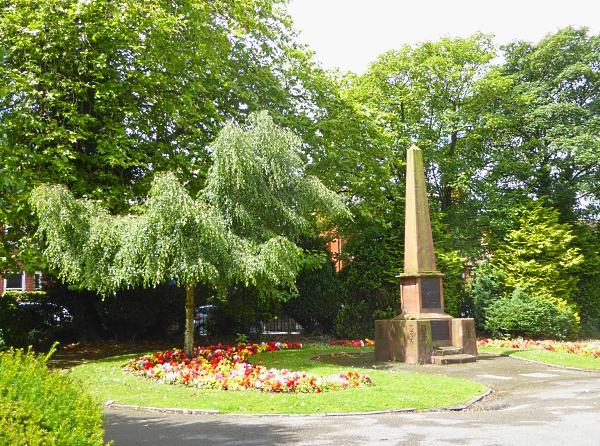
In a blog, 16 July 2017, "Barbara", Merseyside Naturalists' Association, describes seeing the Nunnerley memorial on a nature walk:
The path brought us back to the station, and then John led us to a tiny formal park in a triangle between St Helens Road and Ruff Lane, where we had our sandwiches. The flower beds were bright with cultivated blooms, but some of the gardeners had skimped their work, because the "weed" Gallant Soldier flourished amongst the showier Geranium blooms. The little park seems to have been formed around an interesting pre-WWI War Memorial, because plaques on the obelisk named a local man who had participated in the Charge of the Light Brigade (but survived): "Sgt Major Nunnerley of the 17th Lancers, one of the Six Hundred" and also three men who had been killed in the Boer War. There was a young Weeping Birch next to it, which was appropriate.
[Source: http://naturalistsnotebook.mnapage.info/2017/07/17/ormskirk-parks-16th-july-2017/ (accessed 27.8.2018)]