Added 3.12.12. Last edited 25.1.2013. New info. added 19.10.16, 21.10.16, 23.10.16.
IN PROGRESS — NOT FOR PUBLICATION
1121, Private Thomas HURST — 8th Hussars
Birth & early life
[PB: Born, according to Censuses, in Southwark, c.1830 (4th December? See notes about his pension, below).]
Enlistment
Enlisted at Westminster on the 3rd of December 1849.
Age: 19.
Height: 5' 7".
Trade: None shown.
Service
Embarked for the Crimea aboard the H.T. "Wilson Kennedy" on the 2nd of May 1854.
From Private to Corporal: 1st of May 1855.
Served with the detachment of the regiment under Lt. Colonel De Salis in theExpedition to Kertch on the 22nd of May 1855.
Corporal to Sergeant: 2nd of May 1856.
See also the record of 385 Francis Finnegan — 8th Hussars, whose wife Letitia is said by Mrs Duberly to have "cast her net" around Corporal Hurst after her husband died in the Charge. Duberly remarks that he "finally extricated himself...dextrously".
[PB: See if there's more in Christine Kelly's edition, p.214.]
Discharge & pension
Discharged on the "Reduction of the Regiment", from Dundalk, on the 6th of April 1857.
Served 7 years 143 days.
Conduct: "good".
In possession of one Good Conduct badge.
He sent money from the Crimea to a Mrs Thomas Hurst, address or relationship not shown.
[PB: Probably his first wife, Emma, born in St Pancras c.1825, who died in 1889.]
There is an entry by the side of his name in WO/25/3879 — D.P. 4d. 4/12/80. Nothing can yet be found to substantiate this entry for an obviously "deferred" pension of 4d. per day upon reaching the age of 50 years, and from his known service, it is difficult to see how he came to be entitled to it.
Medals
Entitled to the Crimean medal with clasps for Alma, Balaclava, Inkerman and Sebastopol.
Family medal groups have come to auction with British War and Victory medals for World War One to "Acting-Colour Sergeant A.V. Hurst. Machine Gun Corps." The latter was possibly a grandson of Thomas Hurst.
The medal cards at the P.R.O. confirm the award of the British War and Victory medals to No. 46699 A/Col/Sergeant Albert Victor Hurst, but show nothing of the theatre of war he served in nor the dates of any overseas service. He went on to the Class "Z" (A & R.) on the 12th of April 1919.
Commemorations
Shown as a member of the Balaclava Commemoration Society in 1877 but not in the 1879 revised list.
He wrote from 84, Blackfriars Road, London, when accepting an invitation from Mr. T. H. Roberts to attend the Jubilee celebrations held at his Fleet Street offices in June 1897. He was not shown the list of those actually present, so the invitation was possibly an error.
[PB: However, CP has found that Thomas Hurst was supported by the Light Brigade Relief Fund in 1890, and in 1891 received £30 from the Fund.]
Life after service
[PB, October 2016: According to Censuses and newspaper articles published just before his death, TH worked in the Metropolitan Police, the City Mounted Police, and later worked as an engine-driver and in "many other callings" (e.g. in the 1891 Census he is described as a "House Decorator"). He also performed at the Canterbury Music Hall (see below).]
[PB: It is not known when he married Emma. Four children are shown on the 1871 Census. The first was born around the time of his discharge in 1857. There may have been other children, born earlier, who had already left home.]
1871 Census
Rose Alley, Bishop Gate [Bishopsgate].
Thomas Hurst, 39, City Police, born Southwark .
Emma Hurst, 43, born St Pancras.
Thomas Hurst, 14, born Dundalk, Ireland [born c.1857].
Louise Emma Hurst, 12, born Vauxhall [c.1859].
Rosina Hurst, 10, born Bishop Gate [c.1861].
Albert Hurst, 7, born Bishop Gate [c.1864].
[PB: The area includes Liverpool Street Station and Spitalfields Market. Rose Alley, near Bishopsgate Police Station, was home to a number of policemen, so it is likely that TH was employed there too. I found very few photographs of Rose Alley online, but it appears only a narrow gated passage remains. It may be worth continuing the search.
There are brief mentions in Henry A Harben, 'Rose Alley, Bishopsgate — Rose Court', in A Dictionary of London (London, 1918), British History Online http://www.british-history.ac.uk/no-series/dictionary-of-london/rose-alley-bishopsgate-rose-court [accessed 13 October 2016].]
1881 Census
12, Parfitt Road, Rotherhithe.
Thomas Hurst, 49, Engine Driver, born Southwark.
Emma Hurst, 54, born St Pancras.
Louise Hurst, 22, Tailoress, born Vauxhall.
Rosina Hurst, 20, Servant, born Aldergate.
Albert Hurst, 17, Coachman, born Aldergate.
Death registered
Emma Hurst [1st wife], aged 60 years, December Quarter 1889, St Olave.
Marriage registered
Thomas Hurst to Jane Elizabeth M Fox [2nd wife], December Quarter 1890, St Olave.
1891 Census
217, Rotherhithe New Road, Rotherhithe.
Thomas Hurst, 59, House Decorator, born Southwark.
Jane Hurst, 44, born Camberwell.
Wilfred [sic?] Hurst, 23, Deal Porter — Dock, born Camberwell [born c.1868].
A visitor and one servant are also shown.
[PB: Is "Wilfred Hurst" Jane's child, hence TH's stepson? In the 1901 Census he seems to appear as "Alfred Buck", born in Camberwell, like his mother.]
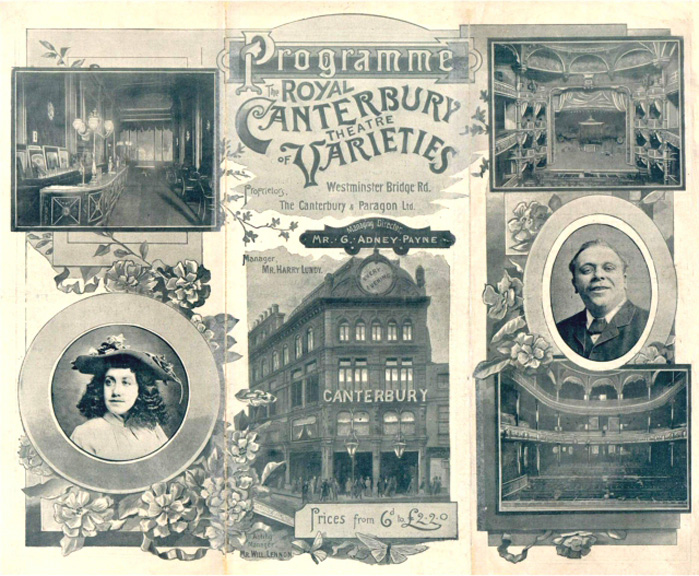
[PB, October 2016: His last days were covered in a number of newspapers around the country, with calls to support him and his wife, and for his funeral expenses to be covered. Some of the articles contain intriguing snippets of information, including a fragment of a poem about the Charge said to have been written by him at Balaclava, which he recited in the Canterbury Music Hall, Westminster Bridge Road, Lambeth. Charlie Chaplin, who was born nearby in 1889, is said to have followed his father on to the stage here.
The Canterbury was London's first purpose-built tavern music hall (See e.g. Wikipedia: Canterbury Music Hall, V&A: The Story of Music Hall, Arthur Lloyd: The Music Hall and Theatre History Website, East London Theatre Archive: Music Hall and Variety, The Vauxhall Society: Canterbury Theatre, and Theatres Trust: Canterbury Hall.]
[NB: CHECK NEWSPAPER TRANSCRIPTS AGAINST ORIGINALS...COMMENTARY ETC TO BE COMPLETED...]
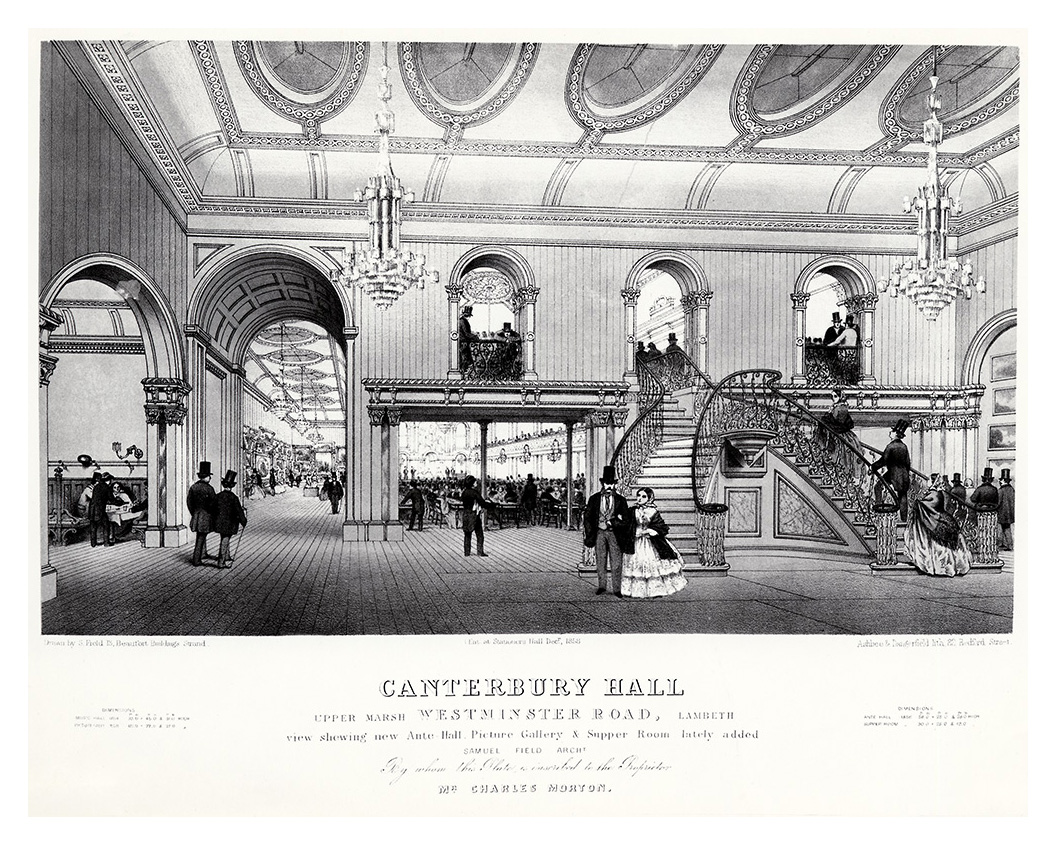
[N.B The Canterbury Music Hall was rebuilt a number of times, so check date of this image etc.]
The Canterbury Hall
Mr Charles Morton, publican of the Canterbury Tavern in Lambeth, opened the first purpose built music hall, The Canterbury Hall, in 1852. It held 700 people. Audiences were seated at tables and food and drink was served throughout the performance, which took place on a platform at one end of the hall under the watchful Chairman, the vocalist, Mr John Caulfield.
Entrance was by a sixpenny refreshment ticket and the star was Sam Cowell, who had been lured from Evans' Supper Rooms. So great was Cowell's success that Morton had to build a larger hall on the same site. The more ornate hall opened in 1856 complete with chandeliers, balcony and art exhibition. It held 1500 people. Admission was sixpence to the floor and ninepence to the gallery. Refreshments, now charged separately, were served at tables. Mr Chairman sat at a table on the stage.
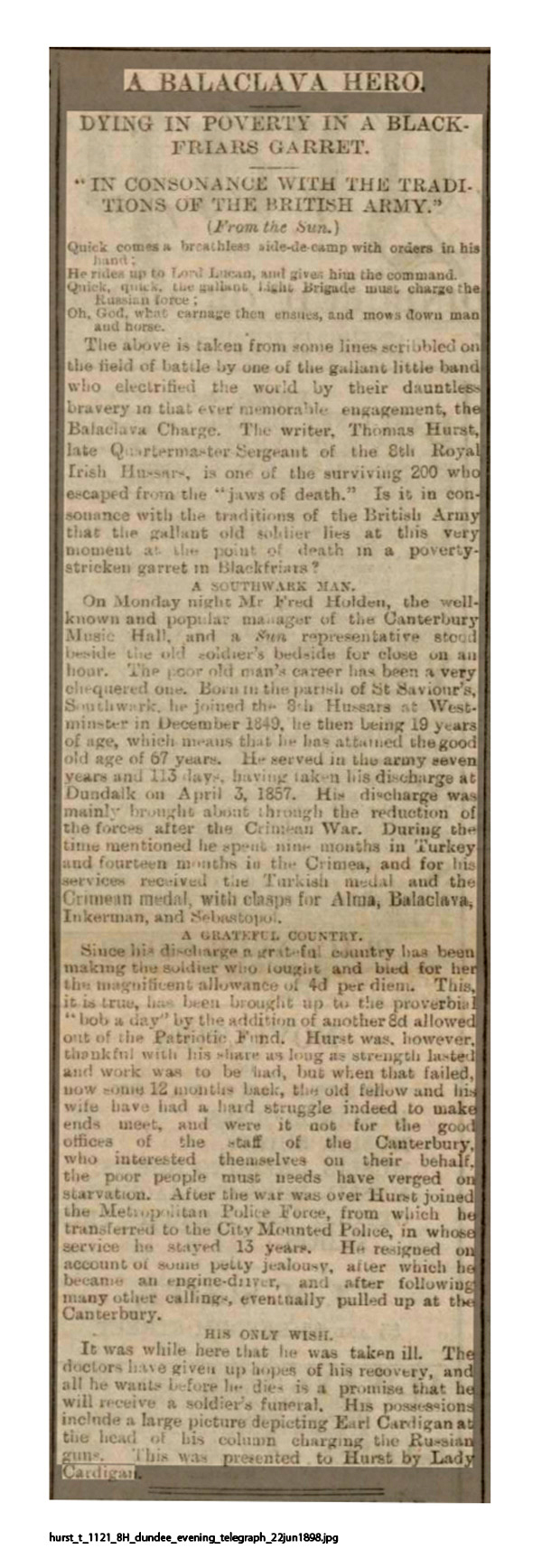
A BALACLAVA HERO.
DYING IN POVERTY IN A BLACKFRIARS GARRET.
"IN CONSONANCE WITH THE TRADITIONS OF THE BRITISH ARMY."
(From the Sun.)
Quick comes a breathless aide-de-camp with orders in his hand;
He rides up to Lord Lucan, and gives him the command.
Quick, quick, the gallant Light Brigade must charge the Russian force;
Oh, God, what carnage then ensues, and mows down man and horse.
The above is taken from some lines scribbled on the field of battle by one the gallant little band who electrified the world by their dauntless bravery in that ever memorable engagement, the Balaclava Charge. The writer, Thomas Hurst, late Quartermaster Sergeant of the 8th Royal Irish Hussars, is one of the surviving 200 who escaped from the "jaws of death." Is it in consonance with the traditions of the British Army that the gallant old soldier lies at this very moment at the point of death in a poverty-stricken garret in Blackfriars?
A SOUTHWARK MAN.
On Monday night Mr Fred Holden, the well-known and popular manager of the Canterbury Music Hall, and a Sun representative steed beside the old soldier's bedside for close hour. Our old man's career has been very chequered one. Born in the parish of St Saviour's, Southwark. he joined the 8th Hussars Westminster in December then being 19 years of age, which means that he has attained the good old age of 67 years. He served the army seven years and lays, having taken his discharge Dundalk April 3, 1857. His discharge was mainly brought about through the reduction of the force after the Crimean War. During the time mentioned nine months Turkey and fourteen months in the Crimea, and for his services received tins Turkish medal the Crimean medal, with clasps for Alma, Balaclava, Inkerman, and Sebastopol.
COUNTRY.
Since his discharge country has been making the soldier who fought and bled for her the magnificent allowance of 4d per diem. This, it is true, has been brought up to the proverbial "bob a day" by the addition of another 8d allowed out of the Patriotic Fund. Hurst was, however, thankful with his share as long as strength lasted and work was to be had, but when that failed, now some 12 months back, the old fellow and his wife have had a hard struggle indeed to make ends meet, and were it not for the good offices the staff of the Canterbury, who interested themselves on their behalf, the poor people must needs have verged on starvation.
After the war was over Hurst joined the Metropolitan Police Force, from which he transferred to the City Mounted Police, in whose service he stayed 13 years. He resigned on account of some petty jealousy, after which he became an engine-driver, and after following many other callings, eventually pulled up at the Canterbury.
HIS ONLY WISH.
It was while here that was taken ill. The doctors have given up hopes of his recovery, and all he wants before he dies promise is a promise that he will receive a soldier's funeral. His possessions include a large picture depicting Earl Cardigan at the head of his column charging the Russian guns. This was presented to Hurst by Lady Cardigan
[Source: Dundee Evening Telegraph, Wednesday 22 June 1898
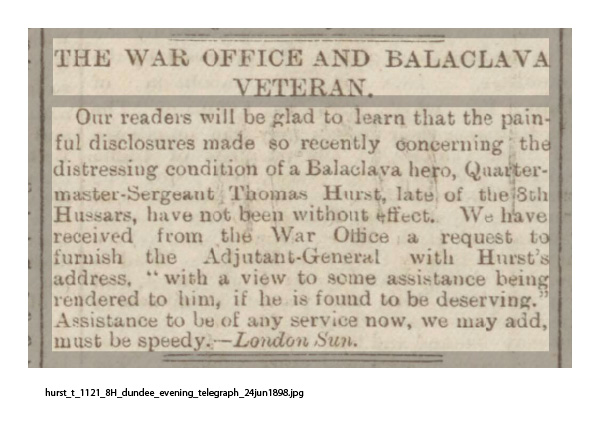
THE WAR OFFICE AND BALACLAVA VETERAN
Our readers will be glad to know that the painful discosures made so recently concerning the distressing condition of a Balaclava hero, QuartermasterSergeant Thomas Hurst, late of the 8th Hussars, have not been without effect. We have received from the War Office a request to furnish the Adjutant-General with Hurst's address, "with a view to some assistance being rendered to him, if he found to be deserving". Assistance to be of any service now, we may add, must be speedy. — London Sun.
[Source: Dundee Evening Telegraph, Friday 24 June 1898.]
BALACLAVA HERO'S LAST DAYS.
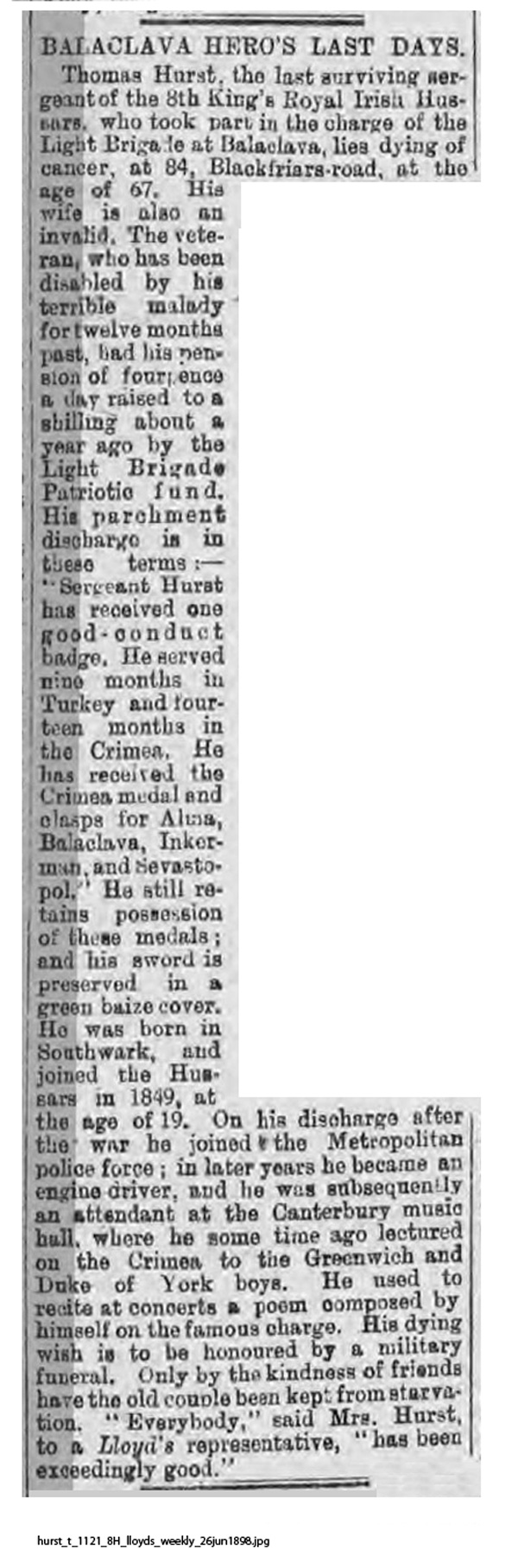
Thomas Hurst, the last surviving sergeant of the 8th King's Royal Irish Hussars who took part in the charge of the Light Brigade at Balaclava lies dying of cancer, at 84, Blackfriars-road, at the age of 67. His wife is also an invalid. The veteran, who has been disabled by his terrible malady for twelve months past, had his pension of fourpence a day raised to a shilling about a year ago by the Light Brigade Patriotic Fund. His parchment discharge is in these terms: "Sergeant Hurst has received one good- conduct badge. He served nine months in Turkey and fourteen months in the Crimea. He has received the Crimea medal and clasps for Alma, Balaclava, Inkerman, and Sevastopol." He still retains possession of these medals; and his sword is preserved in a green baize cover.
He was born in Southwark, and joined the 8th Hussars in 1849, at the age of 19. On his discharge after the war he joined the Metropolitan police force; in later years he became an engine driver, and he was subsequently an attendant at the Canterbury music hall, where he some time ago lectured on the Crimea to the Greenwich and Duke of York boys. He used to recite at concerts a poem composed by himself on the famous charge. His dying wish is to be honoured by a military funeral. Only by the kindness of friends have the old couple been kept from starvation. "Everybody," said Mrs. Hurst, to a Lloyd's representative, "has been exceedingly good."
[Source: Lloyd's Weekly Newspaper, Sunday 26 June 1898.]
A CASE FOR MR BRODRICK.
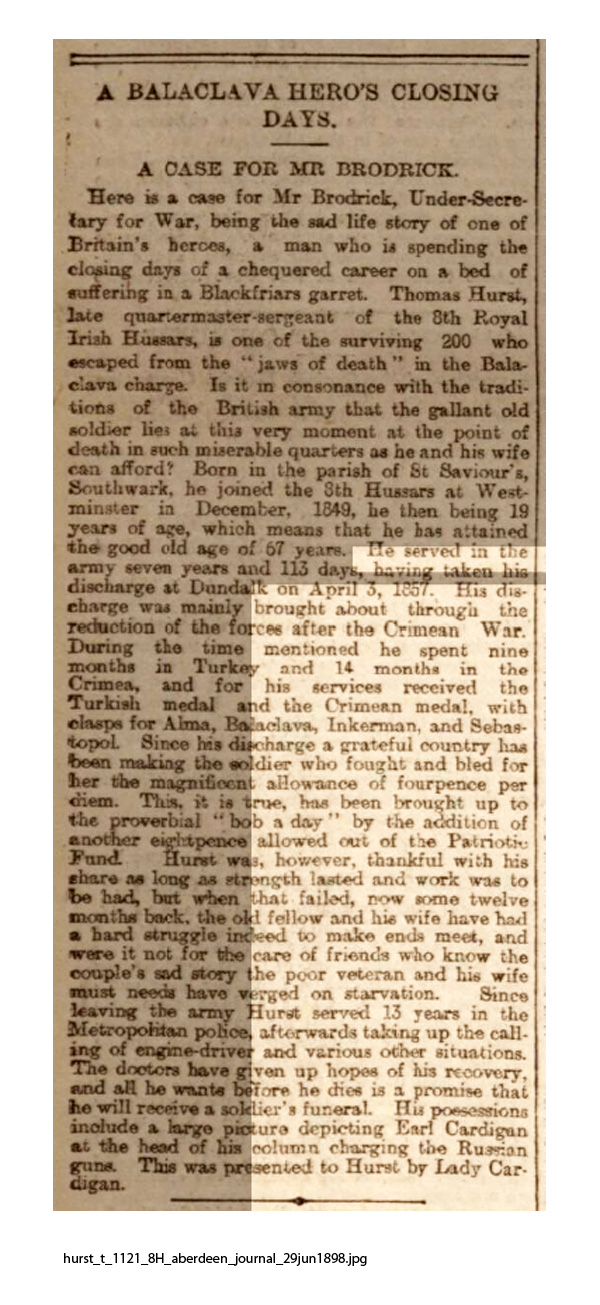
Here is case for Mr Brodrick, Under-Secretary for War, being the sad life story of one of Britain's heroes, a man who is spending the closing days of a chequered career on bed of suffering in Blackfriars garret.
Thomas Hurst, late quartermaster-sergeant of the 8th Royal Irish Hussars, is one of the surviving 200 who escaped from the "jaws of death in the Balaclava charge. Is it in consonance with the traditions of the British army that the gallant old soldier lies at this very moment at the point of death in such miserable quarters he and his wife can afford?
Born in the parish of St Saviour's, Southwark, joined the Hussars at Westminster in December, 1849, then being 19 years of age, which means that he has attained the good old age 67 years. He served in the army seven years and 113 days, having taken his discharge at Dundalk on April 3, 1857. His discharge was mainly brought about through the reduction of the forces after the Crimean War. During the time mentioned he spent nine months in Turkey and 14 months in the Crimea, and for his services received the Turkish medal and the Crimean medal, with clasps for Alma, Balaclava, Inkerman, and Sebastopol.
Since his discharge grateful country has been making the soldier who fought and bled for her the magnificent allowance four pence per diem. This, is true, has been brought up to the proverbial "bob a day" by the addition of another eight pence allowed out the Patriotic Fund. Hurst was, however, thankful with his share as long as strength lasted and work was to be had, but when that failed, now some twelve months back, the old fellow and his wife have had hard struggle indeed to make ends meet, and were it not for the care of friends who know the couple's sad story the poor veteran and his wife must needs have verged starvation.
Since leaving the army Hurst served 13 years in the Metropolitan police, afterwards taking up the calling of engine-driver and various other situations.
The doctors have given up hopes his recovery, and all he wants before he dies is promise that he will receive a soldier's funeral. His possessions include large picture depicting Earl Cardigan at the head of his column charging the Russian guns. This was presented to Hurst by Lady Cardigan.
[Source: Aberdeen Journal, Wednesday 29 June 1898.]
Death & burial
Death registered
Thomas Hurst, aged 68 years, September Quarter 1898, St Saviour.
[PB: Can we find any obituaries? ]
Further information
1901 Census
14, Walpole Street, Deptford.
Jane E.M. Hurst [2nd wife], widow, 54, born Camberwell.
Alfred Buck, son [sic], 33, Deal Porter at dock, born Rotherhythe [sic?].
Louisa E Hurst, daughter, 43, Laundress, born Vauxhall.
[PB: Is "Alfred Buck" the "Wilfred Hurst" of the 1891 Census? Is he Jane's son from a previous marriage (though she was "Fox" when she marrried TH)?]
Marriage registered
Jane Elizabeth M Hurst to Stephen Joseph Regan, June Quarter 1901, Holborn.
Death registered.
Jane E.M. Regan [2nd wife], aged 64 years, September Quarter 1910, Greenwich.
References & acknowledgements
Additional marriage and death registrations, information about the Light Brigade Relief Fund, and Census data for 1871, 1881, 1891 and 1901 kindly provided by Chris Poole. Chris also located a number of remarkable newspaper articles dating from TH's last days.