Home Search Index of men A-Z

LIVES OF THE LIGHT BRIGADE
The E.J. Boys Archive

Added 25.11.12. Addition of image and some minor text edits 16.1.2014. 14. Entry tidied up 16.3.17.

IN PROGRESS — NOT FOR PUBLICATION

1547, Private John FORD — 4th Light Dragoons

Birth & early life

Born in Kennington, London, c.1835.

Enlistment

Enlisted at London on the 30th of December 1852.

Age: 17 years.

Height: 5' 7".

Trade: Marble-polisher.

Service

His horse was shot under him during the Charge and he was assisted by1420 John Farrell, 4th Light Dragoons.

Recollections of the Charge

In an affidavit signed by him in the Cardigan-Calthorpe law-suit he stated that he was then a Private in "G" Troop, stationed at Newbridge, Ireland:

In an affidavit signed by him in the Cardigan-Calthorpe law-suit he stated that he was then a Private in "G" Troop, stationed at Newbridge, Ireland, sworn 29th May, 1863; filed 2nd June 1863.

1. I have been ten and a half years in the service. I was in the front rank near the centre of the right squadron of the 4th Light Dragoons during the Light Cavalry Charge at the Battle of Balaclava.

2. My horse was shot as we were advancing to the Russian guns, and fell with me, my leg lying [LC: "being"] under him. This was about three hundred [LC: "300"] yards from the battery.

While lying on the ground and looking for someone to assist me by lifting the horse off me, I saw Lord Cardigan to the left of where I was lying, cantering to the rear. He was quite alone.

After [LC: "Just after"] Lord Cardigan passed me, a private named Farrell came up, and assisted in getting the horse off me."

At Scutari: 4th of April — 11th of May 1855.

Documents made public in 1988 (see Further information below) show that he had married a Harriet [name illegible] at Dublin on the 4th of November 1860. His father was Robert Ford, a Labourer, of the parish of St. Mary's, Middlesex.

Discharge & pension

Discharged, "time expired", from Hamilton, Scotland, on the 30th of December 1865.

Conduct and character: "good".

In possession of two Good Conduct badges.

On discharge John Ford was intending to live at 17, Lisson Grove, London.

Medals

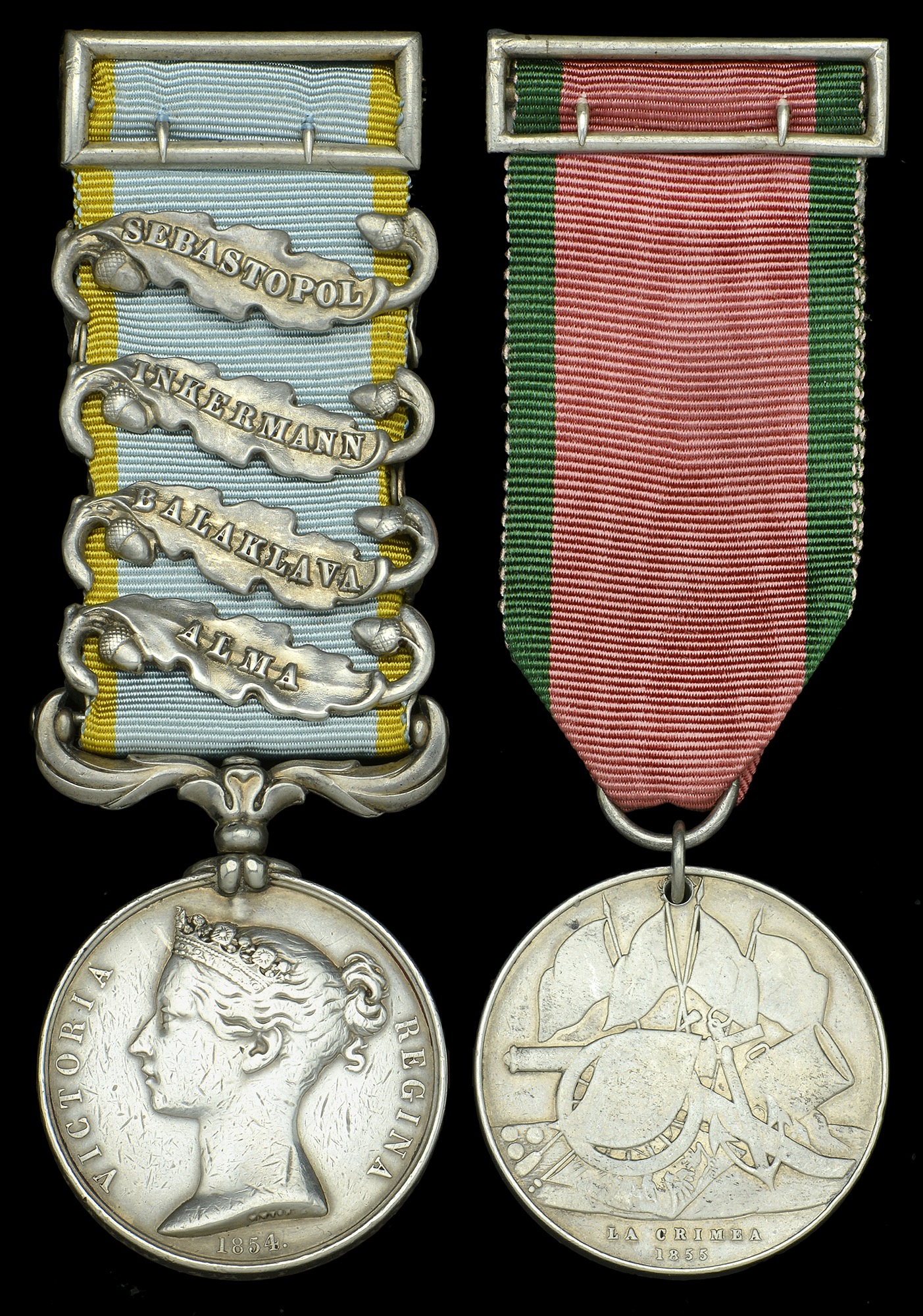
Entitled to the Crimean medal with clasps for Alma, Balaclava, Inkerman and Sebastopol.

Further medal information archived.

He was awarded a Special Campaign Pension (no date shown).

Commemorations

Attended the first Balaclava Banquet in 1875.

Member of the Balaclava Commemoration Society in 1879.

Signed the Loyal Address to the Queen in 1887.

Present at most of the Annual Dinners and certainly in 1890, 1893, 1895, 1899 and 1906, 1908, 1909 and 1910.

Present at the Jubilee Dinner given byT.H. Roberts at his Fleet Street offices in June 1897 and signed the testimonial given to Mr. Roberts on that occasion. (See copy in the "Memoirs" file.)

Life after service

On the 23rd of June 1871 he re-attested into the 1st Class Army Reserve at Regent's Park Barracks, London. His occupation was then shown as a "Railway Porter" and his home address as 18, Durnford Place, Kentish Town, London.

He lived at one period at "The Grange," Wraysbury, Middlesex, from which he replied to T.H. Roberts's invitation to the Jubilee celebrations:

June 13th 1897.

Dear Sir,

I received your kind and generous invitation, which brought tears to my eyes to think we had such a kind friend as you to bring us old soldiers together to see our Gracious Majesty's Procession, and to meet and shake hands with our old comrades on such an occasion, and I am sure your name and kindness will never be forgotten as long as one of them lives; and, please God, I will be at your place on Monday the 21st, about 5 o'clock.

With all good wishes for your health and happiness to you and yours,

I remain,

Your humble servant,

John Ford

One of the survivors of the Charge of the Light Brigade, late 4th Queen's Own Light Dragoons.
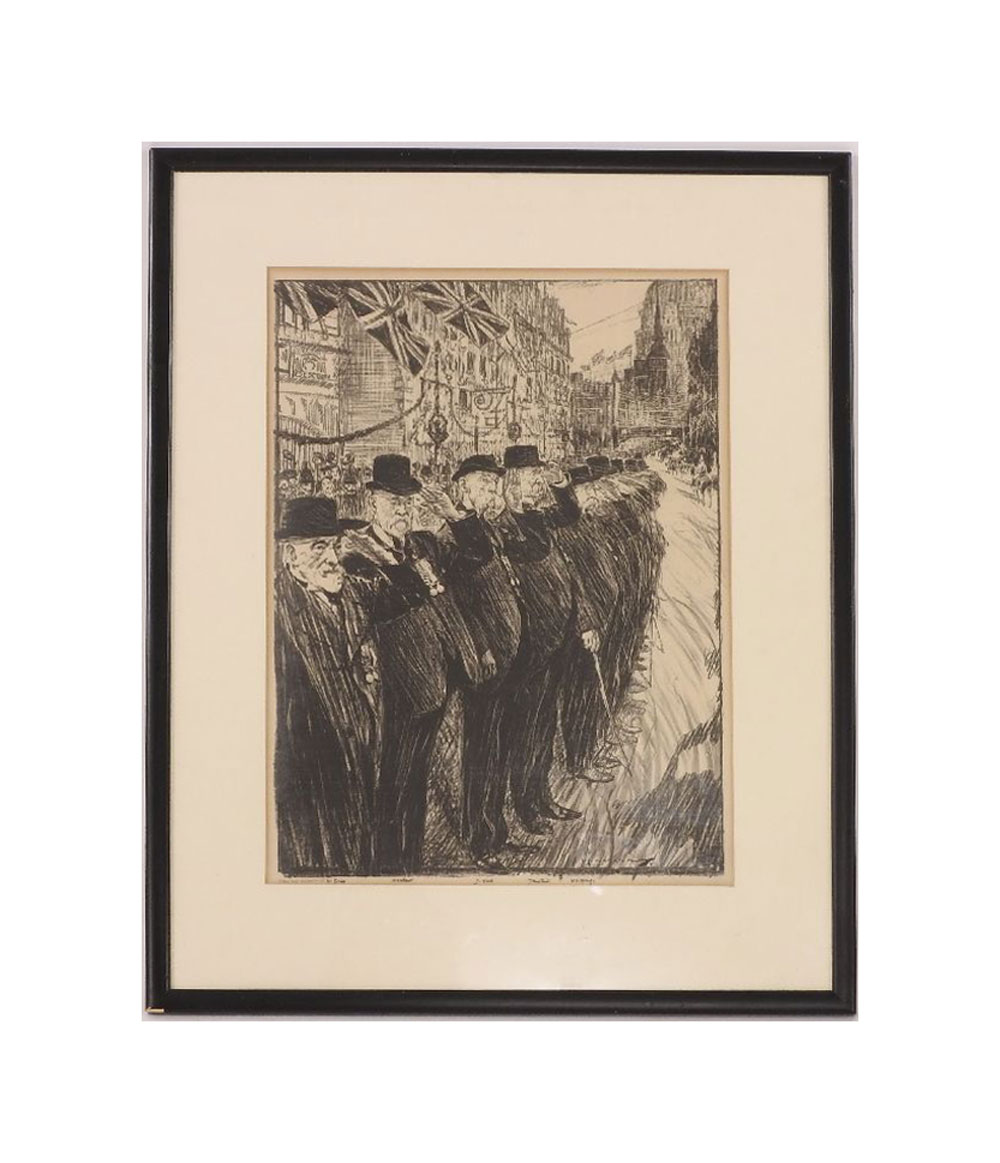


[PB: Artist/Source of engraving? Veterans lining the route. George V's Coronation, date 1911. Ry knows of a photograph, so it may be possible to name those depicted.]

[Source:]

(Click on image to enlarge)


Present at the Coronation celebrations of George V in June 1911 and stood, with other veterans, in a place of honour in front of the troops lining the route. He was then 78 years of age.

See also a copy of a photograph of him which appeared about the mid-1890s in the 4th Hussar file. He also appears in a number of other photographs taken at various times in which he is pictured with other members of the Brigade. These may be found in one or other of the Regimental files.

Early in 1900 he had, following an increase in wages from his employment at the time, given up the five shillings a week he received from the Roberts Fund, but on the 29th of April he wrote again:

Wraysbury,

Near Staines.

Dear Sir,

Once more I beg to trespass upon your great kindness, as my employers have made great alterations and enlarged the grounds where I am now employed, which requires a great deal more labour and my employers considering that on account of my age, am incapable of doing it, they have given me notice to leave.

This means I shall now have to give up the cottage, which is a great loss to me as I shall have to sell up my home unless I can get other employment. I have been in this position almost 16 years, and during that time have been receiving 15/- to £1 a week, which as you know, is really hard to manage with, especially with the great expense I have had with the illness and death of my dear wife.

I remain,

Your most obedient servant,

(Signed) John Ford

One of the survivors of the Six Hundred.

On being told by Mr. Roberts that he was once more on the "Fund" list, he again wrote that he would "have to get out in two or three weeks, there being no local work or lodgings, only farm work, and they wanted young men for that. He would have to come back to London, where he hoped to secure a position as a doorman at a large drapers or theatre.

Extract from theUnited Services Gazette for the 16th of September 1909:

"Cheered to the echo by a powerful house, which included the Mayor and Mayoress and the commanding officers of the troops in garrison here, John Ford, aged 74, who rode with his comrades into the "Valley of Death" at Balaclava, recited Tennyson's "Charge of the Light Brigade" at the Colchester Hippodrome a few nights ago. The aged ex-trooper wore his old uniform of the 4th Hussars."
Death & burial

John Ford died on the 2nd of August 1911. The St. Catherine's House records show a man of his name died in the Wandsworth [sic] District at this time.

The Roberts Fund paid for his funeral.

The records of Paddington Cemetery, Willesden Lane, London, show him as buried there on the 8th of August 1911, aged 75 years [sic], from No. 115 Portnall Road, Paddington, W2. This is a common grave, the grave number being No. 9515 Plot 3W, and there is no headstone. His burial area was one in which low-cost private burials were also made, some of which have small headstones.

There are photographs of his grave-plot (between the two small stones) and of the general plot area, and also copies of his funeral report taken from an unknown newspaper and from the"Paddington Mercury", in the 4th Light Dragoons file.


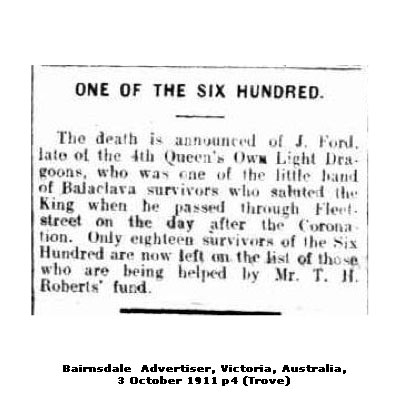
Death of 1547 John Ford 4th Light Dragoons noted in Australia. Click to enlarge.

John Ford's death was also noted in Australia, for example in theBairnsdale Advertiser and Tambo and Omeo Chronicle, 3rd of October 1911.

[Source: http://trove.nla.gov.au/ndp/del/article/91129418? (accessed 15.1.2014).]

(Click on image to enlarge)


Likenesses

There is a photograph of him in uniform, circa 1856, and a number of others, in the 4th Light Dragoons file.

Further information / 1

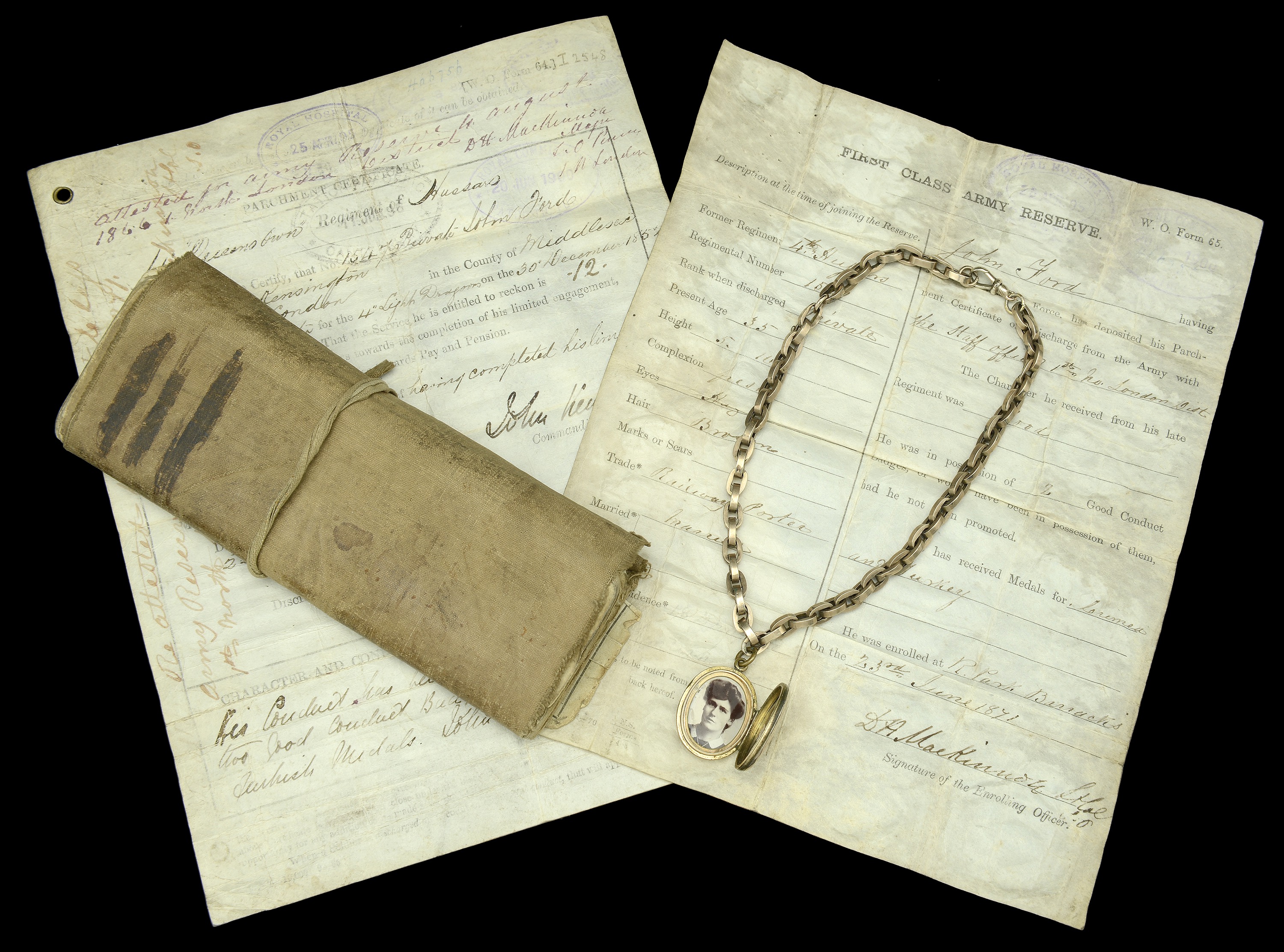
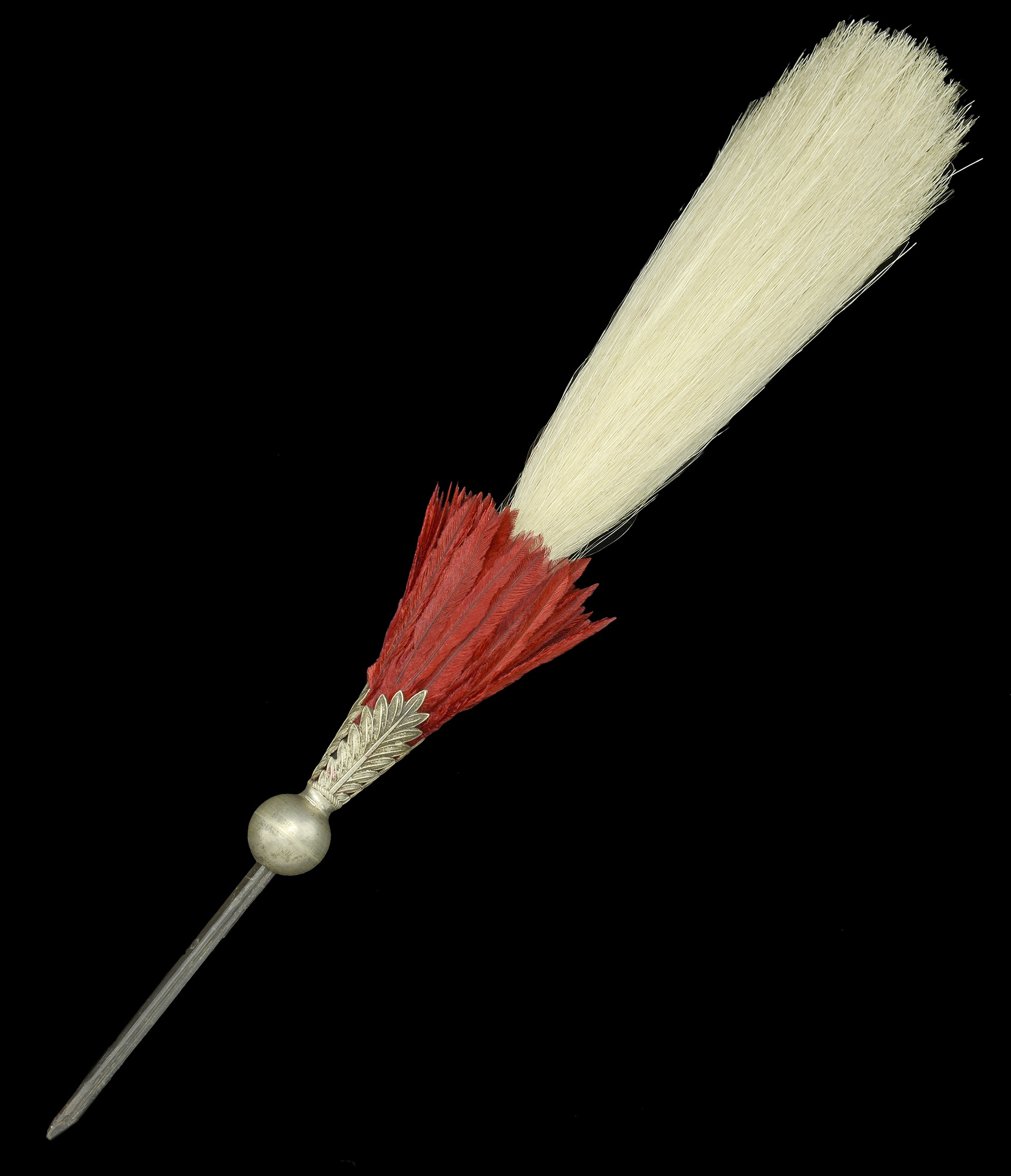
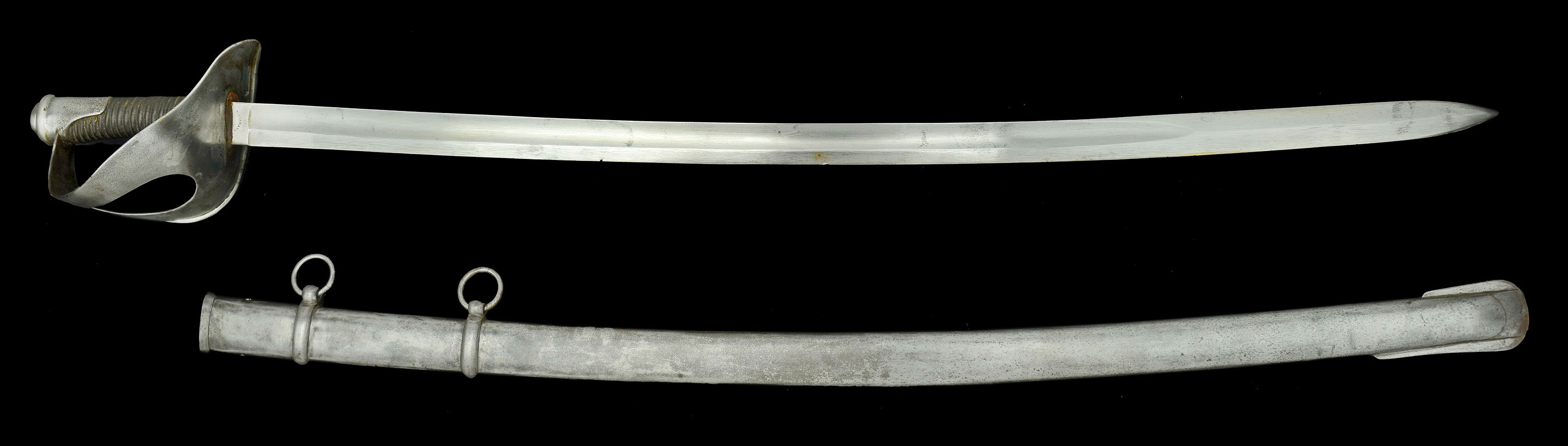
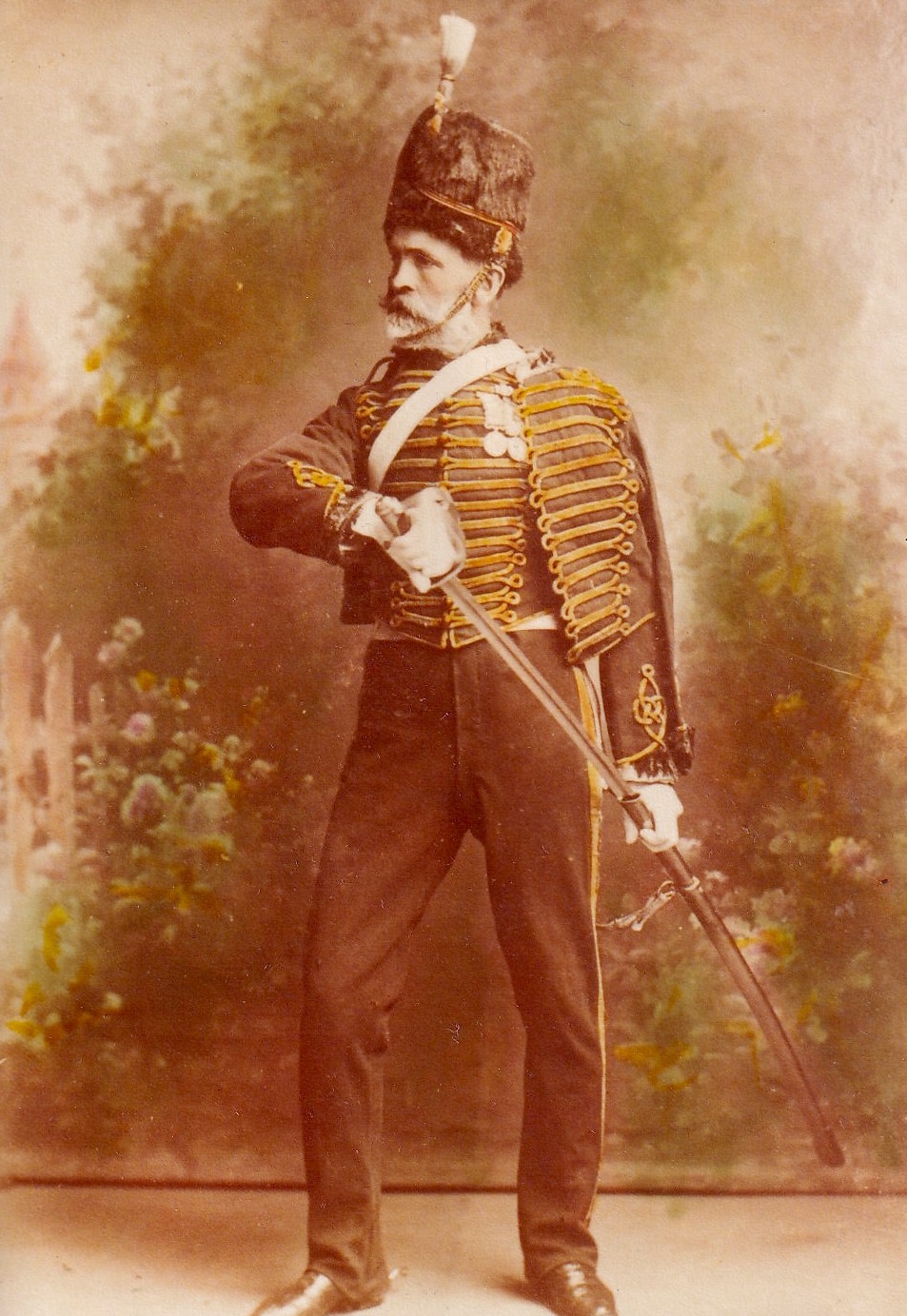
His medals and a number of other items, including a sabre, busby plume, photograph (probably as he appeared on stage) discharge documents, account book, Army Reserve enrolment certificate, and a watch chain and locket containing miniatures of himself and a young woman (from her hair style and dress, possibly a daughter) appeared in a Christie's auction on the 22nd of November 1988. (See photographs in the 4th Hussar file.)

The sabre (with the hilt marked "Beckman") is probably of late-19th-century German origin and from this not an original Crimean period type.

His various documents showed that he had married a Harriet [surname illegible] at Dublin on the 4th of November 1860. His father was Robert Ford, a Labourer, of the parish of St. Mary's, Middlesex. On discharge John Ford said he was intending to live at 17, Lisson Grove, London.

On the 23rd of June 1871 he re-attested into the 1st Class Army Reserve at Regent's Park Barracks, London. His occupation was then shown as a "Railway Porter" and his home address as 18, Durnford Place, Kentish Town, London.

Further information / 2

June 2021: I am very grateful to Chris Poole for drawing my attention to a DNW auction held 15 October 2020 in which items from the 1988 Christie's auction appear to have come up again.


(Click on image to enlarge)

[DNW: Link]

Lot 12

Date of Auction: 15th October 2020

Sold for £7,500

Estimate: £6,000 — £8,000

Medals from the Collection of Warwick Cary

The Crimean War pair awarded to Private J. Ford, 4th Light Dragoons, who was trapped by his felled horse and rescued by a comrade during the Charge of the Light Brigade at Balaklava, 25 October 1854

Crimea 1854-56, 4 clasps, Alma, Balaklava, Inkermann, Sebastopol (J. Ford. 4th Lt. Dragns.) officially impressed naming, clasp carriage fractured; Turkish Crimea 1855, Sardinian issue, unnamed as issued, pierced with ring suspension, both with top silver riband buckles, contact marks, nearly very fine (2) £6,000- £8,000

Footnote

Provenance: Christie's November 1988

John Ford was born in 1835 in Kensington, Middlesex and enlisted in the 4th (Queen's Own) Light Dragoons in London on 30 December 1852 aged 17 years and 0 months, standing 5 feet 7 inches, stating his trade as 'marble polisher' and next of kin 'Father, Robert Ford of St. Marylebone, London'. Arriving in Turkey with his regiment on 2 August 1854, he proceeded to the Crimea, landing on 17 September 1854 and three days later was present at the Battle of the Alma.

He took part in the celebrated Charge of the Light Brigade at Balaklava on 25 October 1854 where, advancing towards the Russian guns with his regiment under Colonel Lord George Paget, his horse was shot and fell to the ground, pinning his leg beneath it. He was rescued by Private John Farrell, also of the 4th Light Dragoons. In 1863, Ford, by then a Private in G Troop, 4th Hussars, stationed at Newbridge, Ireland, provided the following sworn affidavit as testimony in the much publicised 'Cardigan versus Calthorpe' case:

'I have been ten years and a half in the service. I was in the front rank near the centre of the right squadron of the 4th Light Dragoons, during the Light Cavalry charge at the battle of Balaklava. My horse was shot as we were advancing to the Russian guns, and fell with me, my leg being under him. This was about 300 yards from the battery. While lying on the ground looking for someone to assist in lifting the horse off me I saw Lord Cardigan to the left of where I was lying, cantering to the rear. He was quite alone. Just after Lord Cardigan past me, a Private named Farrell came up, and assisted in getting the horse off me.'

Following Balaklava, Ford was present with the remaining members of his regiment at Inkermann, gaining entitlement to the relevant clasp and served during the lengthy Siege of Sebastopol from the commencement to its fall on 8 September 1855, excepting a period at Scutari Hospital from 4 April 1855 until 11 May 1855. After a further stay at Scutari, Ford landed back in England on 26 May 1856, following which he was initially stationed with his regiment in Brighton. On 5 November 1860, he married Harriet in Dublin and after further service at a number of home stations he was discharged 'time expired' at Hamilton, Scotland, from the re-named 4th Hussars on 30 December 1865 aged 30 years, in possession of two Good Conduct Badges, with his conduct judged to be 'Good' and with the intention of returning to Lisson Grove, London. He attested for the Army Reserve, 1- South London District, on 4 August 1866, stating his occupation as 'Railway Porter' and was also enrolled in the First Class Army Reserve at Royal Park Barracks on 23 June 1871.

Aside from his sworn affidavit, Ford's participation in the charge is recognised by all the authorities on the subject and well documented: he attended the first Balaklava Banquet in 1875; was a member of the Balaklava Commemoration Society in 1879; signed the Loyal Address to the Queen in 1887; present at most of the Balaclava Light Brigade Charge Survivors Annual Dinners and identified on many of their respective group photographs; present at the Jubilee Dinner given by T. H. Roberts at his Fleet Street offices in June 1897 and signed the testimonial given to Mr Roberts on that occasion; pensioner of the T. H. Roberts Fund; claimed from the Light Brigade Relief Fund aged 58 while giving his address as The Grange, Wraysbury, Nr Staines; present at the Coronation celebrations in June 1911 standing with other veterans in a place of honour in front of the troops lining the route.

When he died on 2 August 1911 in Wandsworth, the Roberts Fund paid for his funeral. The records of Paddington Cemetery, Willesden Lane, London, show him as buried there, in a common grave with no headstone, on 8 August 1911, having lived at 115 Portnall Road, Paddington.

Two years before his death, the following extract had appeared in The United Services Gazette 1909:

'Cheered to the echo by a powerful house, which included the Mayor and Mayoress and the Commanding Officer of the troops in garrison here, John Ford, aged 74, who rode with his comrades into the Valley of Death at Balaclava, recited Tennyson's 'Charge of the Light Brigade' at the Colchester Hippodrome a few night ago. The aged ex-trooper wore his old uniform of the 4th Hussars.'

Sold with the following items:

i. Ford's original 4th Light Dragoons Account Book covering the entirety of his service, 1853-65, including personal details, services abroad and monthly settlements — entries include time at 'Camp Balaklava' and 'Scutari'. This aged but contents well preserved.

ii. Original parchment certificate of discharge, dated 1865.

iii. Original First Class Army Reserve enrolment certificate, dated 1871.

iv. A gilt metal chain and locket containing portrait photographs of Private Ford in uniform in later life and a lady, thought to be his daughter.

v. Two copied photographs 16cm x 21cm of Ford. The first in uniform wearing Crimea Medal, circa 1857; the second in theatrical pose wearing full dress uniform, taken in later life.

vi. A Hussar style white hair plume, with crimson feather base and ornate white metal ball socket in lacquered metal tubular case, 37cm.

vii. A cavalry trooper's heavy sabre with hilt marked 'Bleckmann' in its steel scabbard, probably German late 19th Century.


New on the site Search Index of men F
For further information, or to express an interest in the project, please email the editors, Philip Boys & Roy Mills, viainfo@chargeofthelightbrigade.com