IN PROGRESS — NOT FOR PUBLICATION.
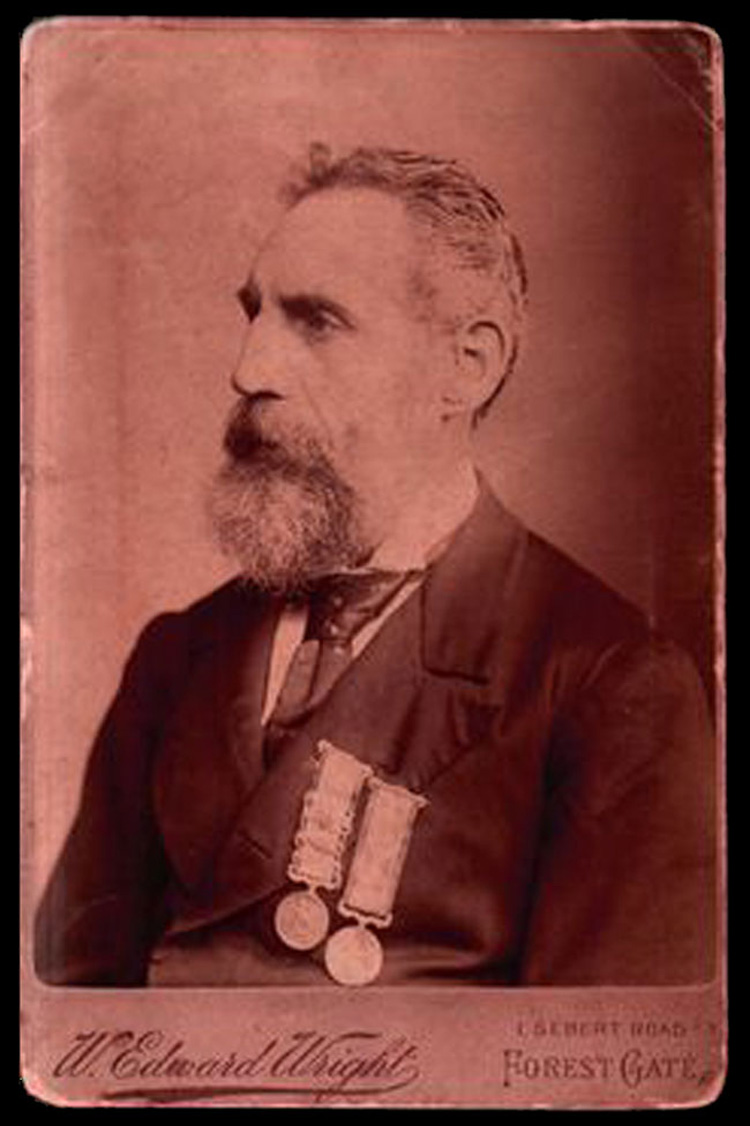
Born at East Dereham, Norfolk. Believed to have been the son of John Eastoe and his wife Mary (nee Banyard), who were married on the 27th of October 1829.
1841 Census
Baxter Row, East Dereham, Norfolk.
John Eastoe, 60, Baker.
Harriet Eastoe, 35.
David Eastoe, 7.
Nehemiah Eastoe, 4.
All born in Norfolk.
[PB]
1851 Census
Baxter's Row, East Dereham, Norfolk.
Harriet Eastoe, Head, 44, born Burcham [presumably Bircham], Norfolk.
David Eastoe, Son, 16, Dereham, Norfolk.
Nehemiah Eastoe, Son, 14, Dereham, Norfolk.
Robert Skipper, 26, Shipdham, Norfolk.
William Deeks, 19, Dereham, Norfolk.
[PB]
[PB: It seems he overstated his age by a year or so when he enlisted. Both the ages given in the 1841 and 1851 Censuses, and a comment he made when he was interviewed in 1897 (see below), suggest he was only a little over 15.]
Enlisted at King's Lynn, 9th of November 1852.
Age: 17.
Height: 5' 8".
Trade: Grocer.
Discharged, "by purchase", from Colchester on the 13th of July 1857 with a payment of £30.
Served 3 years 157 days.
Conduct: "good". Not in possession of any Good Conduct badges.
Entitled to the Crimean medal with clasps for Alma, Balaclava, Inkerman, and Sebastopol, and the Turkish medal.
Attended the first Balaclava Banquet in 1875.
Member of the Balaclava Commemoration Society in 1879.
Attended the Annual Dinners in 1890, 1892, 1893, 1895, 1899 and 1906.
He appeared with other Crimean War veterans as a "Battle of Balaklava Hero" in the Lord Mayor's Show, 9th November 1890. A specially printed programme for this event lists all these men and Eastoe is shown travelling in the 11th carriage in the procession. [RM]
He appears in a photograph taken after the 1890 Dinner and also in one in a picture-magazine [Illustrated Bits?] published in the mid-1890s. (There are copies of both in the 11th Hussar files.)
He was present at the Fleet Street offices of T.H. Roberts for the Jubilee celebrations arranged by him in June 1897.
In an interview given at that time [14 Aug 1897?] NE stated that he had not long turned 60, having joined the Army when little more than 15 years of age, but gave himself as two years older. He had been enlisted by >Sergeant Major Seth Bond, whom he had met again that evening and who had long forgiven him for his little deception. He had never been sick throughout the whole campaign, although his horse had been shot under him in the Charge. After catching a loose Russian horse, he had ridden back unhurt.
(There is a facsimile copy of the Illustrated Bits article in the "Memoirs" file. [PB: I have not located this yet.])
ADD IMAGES FROM ARCHIVE. EJB writes: "He appears in a photograph taken after the 1890 Dinner and also in one in a picture-magazine [Illustrated Bits?] published in the mid-1890s. (There are copies of both in the 11th Hussar files.)"
[PB: It seems a little odd that he should be recorded as a cabinet maker, which is normally considered a highly skilled craft, requiring an apprenticeship, and this skill was not obviously in his background. At some point, he began to run a shop selling tobacco and confectionery.]
1861 Census
1a Thornhill [?], St Mary's Islington, Middlesex.
Nehemiah Eastoe, Head, 24, Cabinet Maker, born [illegible], Norfolk.
Susan Eastoe, Wife, 20, Tattenhall, Cheshire.
Hannah Eastoe, Daughter, 10 months, East Dereham, Norfolk.
[Note: 12 people were recorded at this address, in three households. 2015: There is a Thornhill Road near Barnsbury Square, Islington.]
[PB]
[PB: According to the "Eastoe Roots in Norfolk Family Tree" ("susanyoung_46"), Susan Jane ? was b.1840 in Tattenhall, Cheshire, and d. April 1881. Their children were Robert E. b.1862, Leah R. b.1866, Bertha F. b.1872, Emily Annie b.1874, and Jennie A. b.1879. I have not verified this information.]
Marriage
Nehemiah William Eastoe and Mary Charlotte Edmonds, April Quarter 1885, Pancras, London [1b 248].
[PB]
Robbing a Crimean Hero.
On Friday evening a labourer named Knight, who said he came from Brentwood, applied to Mr. N. W. Eastoe, of High-street, Wanstead, for a night's lodging. When Knight left on Saturday morning it was found that a silver medal presented to Mr. Eastoe in the Crimea in 1854, with four silver bars bearing the words "Sebastopool [sic], lnkermann, Balaklava, Alma," had been stolen.
The police found that Knight had exhibited the medal at Woodford the next day stating that he had picked it up in the road. The medal has not yet been returned. Mr Eastoe one of those who rode in the charge of the Light Brigade.
[Source: Chelmsford Chronicle, 22 March 1889.]
A Commercial Directory for 1893 shows him to have been a Tobacconist, in the High Street.
1891 Census
4, High Road, Wanstead, Essex.
Nehemiah W Eastoe, Head, 54, Tobacconist, born East Dereham, Norfolk
Mary C. Eastoe, Wife, 35, Brompton, London.
William Eastoe, Son, 5, Scholar, St Pancras, London.
Agnes M. [?] Eastoe, Daughter, 3, Daughter, Wanstead, Essex.
Maud E. [?], Daughter, 2, Wanstead, Essex.
An 18-year-old "Shop Assistant Tobacconist", and a male lodger, a Land Surveyor [?], 56, were also present.
[PB: Sometime in the following decade, NE was no longer a Tobacconist and had moved from Wanstead to Leyton.
By 1897, he and his family were in a workhouse (presumably West Ham), but was given considerable support from the Roberts Fund and other sources which allowed them to leave. In that year, NE was the subject of a number of debates among the West Ham Guardians, one so acrimonious that it was reported in detail (rather gleefully) in the local press. The family was allowed some outdoor relief.
For more on workhouses in the area, see www.workhouses.org.uk/WestHam/, and familysearch.org/learn/wiki/en/West_Ham_Poor_Law_Union,_Essex.]
Extract from newspaper report [unknown source and date]:
"One of the Six Hundred, His Wife, and Four Children, all go to the Workhouse.
At a meeting of the West Ham Board of Guardians it was reported that William Eastoe, of Wanstead, his wife, and four children were inmates of the workhouse. Eastoe, who is 63 years of age, was a corporal in the 11th Hussars: he served in the Crimean War and was one of the famous Light Brigade. He had oftentimes publicly recited Tennyson's poem, and he frequently devoted much time and energy to promote the creation of a fund to relieve necessitous survivors of the charge.
Now the poor fellow is himself in the workhouse, and the West Ham Guardians have referred the case to a special committee. His wife is 43, and the children with him are aged twelve, ten, eight and five."
[PB: It would be good to know when exactly this report was published. If NE was indeed 63 and his wife 43, this would suggest 1900-1. If the ages of the children are accurate, perhaps a year or two earlier.
WEST HAM GUARDIANS.
THE CASE OF ONE OF THE SIX HUNDRED.
At the meeting of the West Ham Guardians yesterday, it was agreed that a letter be sent to the colonel of the 11th Hussars, calling his attention to the circumstances of Mr. Wm. Eastoe, of Wanstead, one of the survivors of the famous Balaclava charge.
A report was presented recommending on Jubilee Day a substantial hot dinner to all the inmates, with gifts of tobacco and tea and medals for the children, and additional grants in kind to the extent of 2s. to those in receipt of out relief. It was agreed that the report be printed and sent to the members for consideration. Alter a discussion vaccination, Mr. Bell gave notice move that no prosecution be ordered until the parent dad had opportunity appearing before the board.
[Source: Chelmsford Chronicle, 28 May 1897.]
RELIEF of ONE of the SIX HUNDRED
The West Ham Guardians yesterday decided to grant Wm. Eastoe, one of the survivors of the Balaclava charge — who, with his wife and family, was still in the Workhouse — out relief to the extent of 6s. a week for stated period.
[Source: Chelmsford Chronicle, 4 June 1897.]
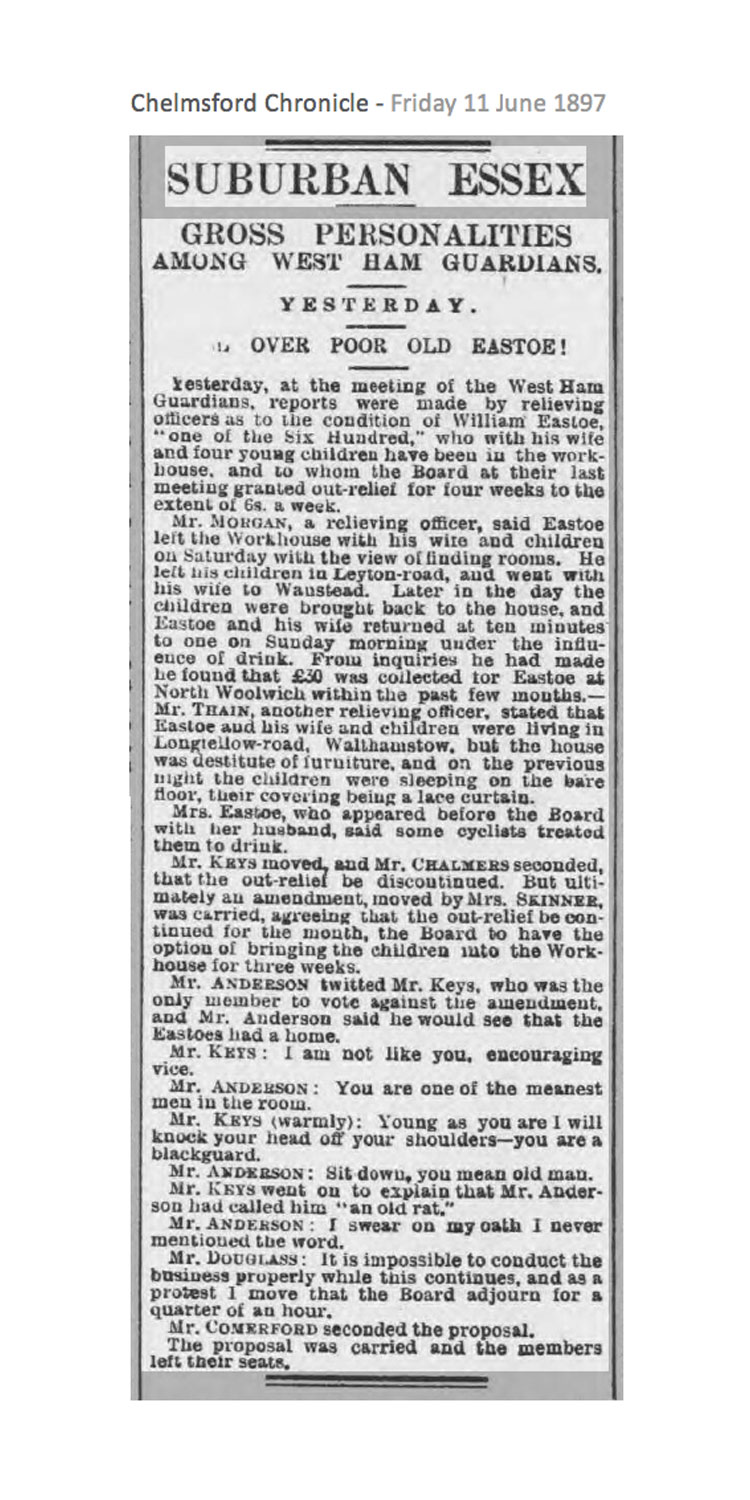
SUBURBAN ESSEX
__________
GROSS PERSONALITIES
AMONG WEST HAM GUARDIANS.
__________
YESTERDAY.
__________
OVER POOR OLD EASTOE!
__________
Yesterday, at the meeting of the West Ham Guardians, reports were made by relieving officers as to the condition of William Eastoe, "one the Six Hundred," who with his wife and four young children have been in the workhouse, and to whom the Board at their last meeting granted out-relief for four weeks to the extent of 6s. a week.
Mr. MORGAN, a relieving officer, said Eastoe left the Workhouse with his wife and children on Saturday with the view of finding rooms. He left his children in Leyton-road, and went with his wife to Wanstead. Later in the day the children were brought back to the house, and Eastoe and his wife returned at ten minutes to one on Sunday morning under the influence of drink. From inquiries he had made he found that £30 was collected for Eastoe at North Woolwich within the past few months.
Mr. THAIN, another relieving officer, stated that Eastoe and his wife and children were living in Longfellow-road, Walthamstow, but the house was destitute of furniture, and on the previous night the children were sleeping on the bare floor, their covering being a lace curtain.
Mrs. Eastoe, who appeared before the Board with her husband, said some cyclists treated them to drink.
Mr. KEYS moved, and Mr. CHALMERS seconded, that the out-relief be discontinued. But ultimately an amendment, moved by Mrs. SKINNER, was carried, agreeing that the out-relief be continued for the month, the Board to have the option of bringing the children into the Workhouse for three weeks.
Mr. ANDERSON twitted Mr. Keys, who was the only member to vote against the amendment, and Mr. Anderson said he would see that the Eastoes had a home.
Mr. KEYS: I am not like you, encouraging vice.
Mr. ANDERSON: You are one of the meanest men in the room.
Mr. KEYS (warmly): Young as you are I will knock your head off your shoulders — you are blackguard.
Mr. ANDERSON: Sit down, you mean old man.
Mr. KEYS went on explain that Mr. Anderson had called him "an old rat."
Mr. ANDERSON: I swear on my oath I never mentioned the word.
Mr. DOUGLASS: It is impossible to conduct the business properly while this continues, and as a protest I move that the Board adjourn for a quarter of an hour.
Mr. COMERFORD seconded the proposal.
The proposal was carried and the members left their seats.
[Source: Chelmsford Chronicle, 11 June 1897.]
In July 1897 Eastoe was helped out of the East [presumably West?] Ham Workhouse by T.H. Roberts. In a letter quoted in the Illustrated Bits magazine for the 14th of August 1897 it was stated that "Eastoe's home is bare, he has a wife and five young children [sic] and the money is all eaten up by Thursday." Eastoe received a total of £239/5/- from the Roberts Fund, and which also paid his funeral expenses.
[PB: In 1901, NE was living in crowded conditions in Leyton, and his occupation given as "One of the Six Hundred Recites the Charge". This cannot have been very lucrative.
The house is shared with another household, that of John Smith, a Builder's Watchman, living with his wife, and four children. This may help to explain why NE's son William Eastoe, 14, is shown two doors along at number 31. He is one of two Boarders in the home of William Baker, his wife, and three children. There is another family, of three, in the same house.
1901 Census
27, Wadley Road, Leyton, Essex.
Nehemiah W Eastoe, Head, 63, One of the Six Hundred Recites the Charge. Pension, born East Dereham, Norfolk.
Mary C Eastoe, Wife, 44, Brompton, London.
Agnes Eastoe, Daughter, 12, Wanstead, Essex.
Maud Eastoe, Daughter, 11, Wanstead, Essex.
Dorothy Eastoe, Daughter, 8, Wanstead, Essex.
31, Wadley Road, Leyton, Essex.
William H Eastoe, Boarder, 14, Junior Commercial Clerk, Kensington, London.
[PB]
Died at Leytonstone, Essex, on the 14th of January 1907.
Death registered
Nehemiah W. Eastoe, aged 69, Jan Quarter 1907, West Ham.
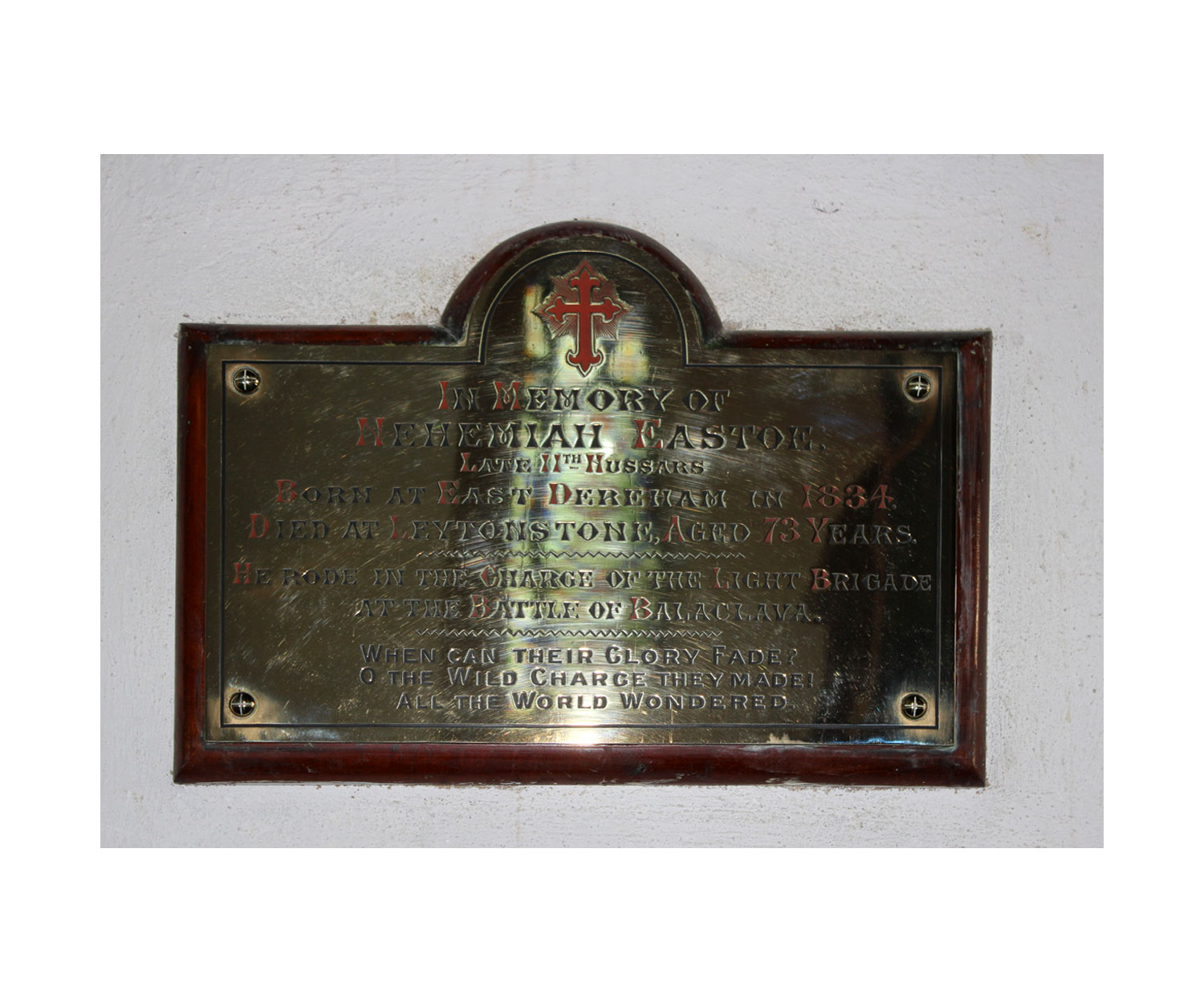
There is a brass plate erected to his memory in the North Transept of the Church of St. Nicholas at East Dereham, Norfolk. (There is a photograph of this memorial tablet in the 11th Hussar file.) The brass plate in East Dereham Church bears the inscription:
In memory of Nehemiah Eastoe, Late 11th Hussars. Born at East Dereham in 1834. Died at Leytonstone, Aged 73. He rode in the Charge of the Light Brigade at the battle of Balaclava.
When can their Glory Fade? O the Wild Charge they made! All the World Wondered.
From the Wanstead Express and Independent, 19th of January 1907:
"Balaclava Hero's Death. — A familiar figure in the locality has been removed by the hand of death in the person of Mr. N.W. Eastoe, who was widely known as being "One of the Six Hundred."
Mr. Eastoe died at his residence in Lincoln Street, Leytonstone, on Monday evening (the 14th). He was in his 74th year, and was the father of twenty-two children. For some time the veteran kept a confectionery and tobacconist's shop at Wanstead, and this was a favourite call for cyclists.
He then removed to Leytonstone, and fell upon hard times. He made many appearances upon concert platforms and there recited Tennyson's lines on the "Light Brigade." Attired in his regimentals, he continued to present a soldierly figure even in his old age and his appearance always won applause."
From Lloyd's Weekly News, 19th of January 1907:
"One of the Six Hundred — Nehimiah [sic?] W. Eastoe, who was said to have been the youngest survivor of the Light Brigade at Balaclava, died on Tuesday at his home in Lincoln Street, Leytonstone, in his 74th year [sic]. He joined the Army under age, as a private in the 11th Hussars. Eastoe was the father of 22 [!] children, the youngest being now only eight years of age."
The Cemetery records of Chingford Mount Cemetery show him as having been buried there on the 18th of January 1907 from 43, Lincoln Street, Leytonstone, at the age of 69 years. The grave number is 74484 in Plot D11. The service was conducted by the Revd. G. Ridgeway and the undertaker was Hayes and English of Hoxton Street. The grave was a common one and is now [1994] in a part completely covered with trees and shrubs and impossible to trace. (There is a photograph of the area in the 11th Hussar file.)
[RM: See also copies of two photographs sent by a descendant, Rex Martin, from South Africa in 2004.]
[PB: There was an article about three "Long forgotten heroes of war" from the East End (Nehemiah Eastoe, Captain George Lockwood, and William Perkins) by Karen Armstrong in the Guardian (Epping Forest, Waltham Forest, Chingford, Wanstead & Woodford area), 29 October 2004. It concluded by asking whether readers thought there should be a memorial plaque to him on his former home in Wanstead High Street. I have not followed up on the response.]
Little may be known of what became of Private Nehemiah Eastoe, a soldier who took part in the Charge of the Light Brigade, but the war hero lived on the corner of Wanstead High Street. The Guardian looks at his role in one of the most famous charges in military history and the lives of his East End comrades
WAR historians will no doubt be up in arms if they knew Private Eastoe's last home in Wanstead is not commemorated with a plaque or a heritage trail in Redbridge.
Woodford Green resident, Ernest Glynn has painstakingly researched Essex and East End soldiers who took part in the charge.
Mr Glynn has tried to find Mr Eastoe's grave and believes he may be buried in a cemetery in Leyton.
The 69-year-old has a special connection to the Crimean War: the father of his grandfather's uncle, William Hypson Glynn, was in the 9th Lancers and fought in the Crimea.
Wanstead resident Private Eastoe was born in 1834 in Dereham, Norfolk, possibly to a farming family. A brass plaque in Dereham Church may be the only memorial bestowed on this soldier.
The soldier would have fought in one of the five regiments who took part in the Charge of the Light Brigade during the Crimean War. The British soldiers were part of an allied force fighting Russia.
War historians have records of one soldier's thoughts on the charge. He survived unscathed but many died.
He said: "My horse made a tremendous leap into the air, though I know not what at. The smoke was so dense that I could not even see my arm before me.
"Then suddenly I was in the battery, and in the darkness there were sounds of fighting and slaughter. In this gloom we cut and thrust and hacked like demons."
[PB: Source of this account?]
After the war Private Eastoe fell on hard times and lived in the West Ham workhouse with his wife and three children.
Soldiers returning from the Crimea had to find work where they could. It is possible that Mr Eastoe may have worked as a gatekeeper for gentry. But somehow he managed to get himself and his family out of the workhouse and into number one, High Street, Wanstead.
Mr Eastoe died on January 14, 1907, aged 73. A relief fund from philanthropist T H Roberts paid for his funeral.
Captain George Lockwood, who came from Abridge, has a memorial stone in Abridge Evangelical Church.
Mr Lockwood became an ensign in the 75th Foot Cavalry in July 1837, and then a lieutenant in the same regiment in August 1840. Four years later he joined the 8th Hussars as a lieutenant and became captain of the same regiment on Boxing Day, 1844.
Mr Lockwood then became aide-de-camp to Lord Cardigan, who led the charge of the Light Brigade.
But no one knows what became of Captain Lockwood.
He was last seen after the charge returning to the valley to look for Lord Cardigan.
Captain Lockwood's body was never found and there is no record of him being taken prisoner by the Russian Army.
William Perkins, a bugler with the 8th Hussars, was from Forest Gate. It is believed the soldier ended his days working as a toilet attendant telling old war stories.
Let us know if you think Wanstead High Street should have a plaque to commemorate Private Eastoe. Call Karen Armstrong on 8498 3432.
[Source: Karen Armstrong, "Long Forgotten Heroes of War", Guardian (Epping Forest, Waltham Forest, Chingford, Wanstead & Woodford area), 29 October 2004. Online at guardian-series.co.uk/news/540049.Long_forgotten_heroes_of_war/ (accessed 10.3.2016).]
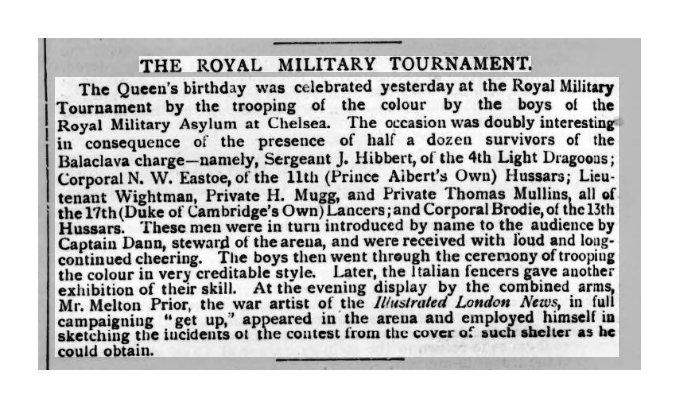
Press clipping about his presence at the Royal Military Tournament in 1892, kindly provided by Chris Poole.