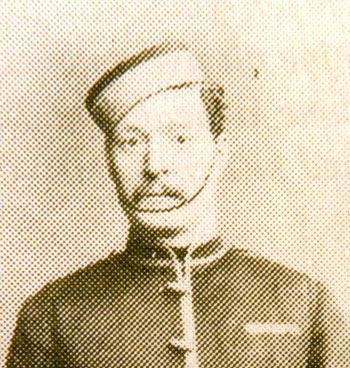
1386, Private Michael Thomas CUMMINGS, 8th Hussars
Birth & early life
Born in Clerkenwell, London.
Although he enlisted, and signed his name on discharge, as "Michael Cummings", a number of muster rolls show him with a second initial of "T" and this is now known to have stood for Thomas.
Enlistment
Enlisted at Westminster on the 10th of August 1854.
Age: 17. Height, 5' 7".
Trade: Farrier.
Appearance: Fair complexion. Brown eyes. Dark brown hair.
Service, discharge & pension
Joined the regiment in the Crimea on the 24th of July 1855, having left the Newbridge Cavalry Depot on the 18th of June.
He is shown as one of the seventy other ranks, who under Captain James Naylor and two subalterns, were sent on the 29th of October 1855 to form the escort to General Simpson and to find all the orderlies for the various Divisions.
(This escort replaced that under Captain Chetwode, which had been escort to Lord Raglan, but had rejoined the regiment after the latter's death).
Embarked for India from Cork aboard the S.S. "Great Britain" on the 8th of October 1857.
From Private to Farrier (ranking as Sergeant): 1st of November 1861.
Promoted to Farrier-Major, and on the Staff of the Regiment, from the 1st of October 1862.
Returned to England aboard the "St. Lawrence" on the 9th of January 1864.
In confinement: 23rd — 25th of August 1864. Tried by a Regimental Court-martial on the 26th of August 1864, reduced to Private and imprisoned "in cells" to the 22nd of September 1864.
"In cells": 1st — 6th of October 1864.
Marriage
Michael Cummings married Ann Martin, March Quarter 1865, Westminster.
He is first shown on the Regimental "Married roll" from the 24th of February 1865, his wife's name being Ann, nee Martin. He had married her (by licence) at St. Peter and St Edward's Church (Roman Catholic) in Palace Street, Westminster, London, on the 14th of February 1865 (the regiment was then at York).
The marriage certificate shows him as being 29 years of age, a bachelor, a Soldier, the son of Peter Cummings, a Labourer (deceased). Ann Martin was shown as being a spinster, of the same age, the daughter of Thomas Martin, a labourer, (Deceased). The place of residence of both was given as 11 Lewisham Street, Westminster.
From Private to Farrier (as Sergeant): 17th of May 1865.
Re-engaged for 12 years' further service at Birmingham on the 21st of March 1867.
Promoted to Farrier Major on the 18th of January 1875 with a daily rate of pay of 3/7d.
Discharged from Aldershot on the 14th of November 1876.
"At his own request, free to pension after 21 years service."
Served 21 years 71 days (under age: 1 year 1 month) for pensionable purposes.
In Turkey and the Crimea: 9 months
In India: 7 years.
Aged 38 years on discharge:
"His character has been very good, and he was when promoted in possession of four good conduct badges and would, had he not been promoted now be in possession of four good conduct badges. He is in possession of the Crimean medal with clasp for Sebastopol, the Turkish medal and the Mutiny medal with clasp for Central India, also the Good Conduct medal. His name appears six times in the Regimental Defaulter's book. He has been once tried by Regimental Court-martial."
Granted a pension of 2/5d. per day, "for life."
Medals & commemorations
Entitled to the Crimean medal with clasp for Sebastopol.
Mutiny medal with clasp for Central India.
Served at Kotah.
Awarded the Long Service & Good Conduct medal on the 30th of November 1875, without gratuity.
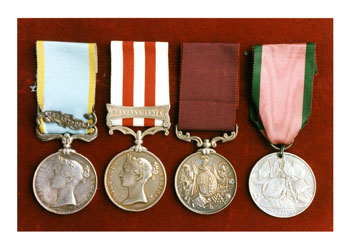
His documents confirm the award of the Crimean medal, clasp for Sebastopol, the Turkish medal, Indian Mutiny medal, clasp for Central India and the Long Service & Good Conduct medal. The award of this last is unusual given that he had been tried by a Court martial in 1864.
Not in possession of a school certificate.
He was also in receipt of 2d. per day allowance for "good swordsmanship".
Not recorded by Lummis and Wynn.
Further detailed medal information archived.
When the medals came up for auction in 1978, with the group was a presentation pipe with a silver band engraved, "To Farrier-Major M. Cummings, 8th Hussars. From his sincere friend, John W. Glynn." The latter is contained in a case. (See photographs of both medals and pipe in the 8th Hussar file.)
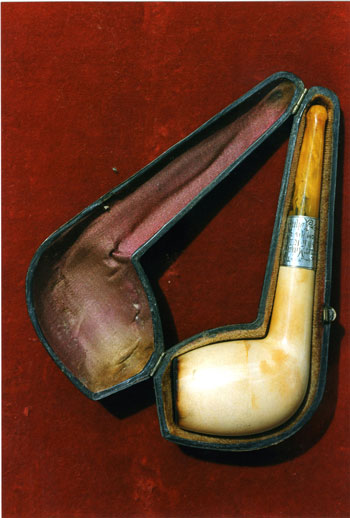
Pipe engraved: ""To Farrier-Major M. Cummings, 8th Hussars. From his sincere friend, John W. Glynn."
(Click on image to enlarge)
To reside at No. 86 Regent Street, London, the family being shown as issued with rail warrants to travel from Aldershot to London. A check of a street directory for the period, however, shows no mention of who was living at No 86, but previous and following numbers show that they were occupied by various businesses, tailors, furriers, umbrella makers, etc.
Further information
1861 Census
No 11 Lewisham Street, Westminster.
The 1861 Census shows an Ann Martin, aged 60 years, lodging in Lewisham Street, Westminster. She was a widow, working as a Charwoman, born in Cork, Ireland. She was not living there in 1871.
The Army Chaplain's Baptismal Registers also show an Ellen E. Cummings as being born into the 8th Hussars at Westminster, London, during 1866, but St. Catherine's House records show the birth of an Ellen E. Cummings as having been registered during the April-June Quarter of 1866 in the Pancras District.
The records of christenings at St. Peter and St. Edward's however, obtained from the Diocesan Archives, show her as being born on the 30th of June 1866 and being baptised on the 5th of August, the daughter of Michael and Ann Cummings, nee Martin. Her father is not shown (being already deceased by February of 1865), but her mother is named as Maria Martin. (See copies of both the Church and St. Catherine's House records in the "Certificates" file."
No address is given at the time of the christening (although the church wedding certificate gives the same as already known for both) but her mother was not living at No 11 Lewisham Street in either 1861 or 1871, so Ann Martin may have been an aunt, but from the descriptions of the other residents at the time this was but a common lodging house and given at the time of the wedding as an accommodation address.
It was thought that his wife, Ann, had died sometime during the second half of 1868, or at the beginning of 1869, the regiment being stationed in Scotland at this time, the headquarters being in Edinburgh, but a protracted search through the Scottish Record Office files over a five year period shows no trace of her. Although detachments are shown as being at other locations, there is nothing to show that he in particular was anywhere else than at Edinburgh.
The Regimental "Married roll" for the first quarter (March-April) of 1868-69 (the first time such a roll appeared in the general musters, having been kept only by the regiment concerned previously) shows him (also wife, Ann, and one child) in the next two quarters, July-September and October-December, 1868/69, but with his name underlined in red ink.
There is no entry for him in the January-March quarter of 1868/69, but at the very end of the roll there is a cross in red ink and a memo in pencil, "Ask why Farrier Cummings has been omitted", made by the Accounting Department. There are no further comments or explanation. He is next shown again on the Regimental "Married roll" from the 19th of January 1875, which was the day after he had been promoted again to Farrier-Major, when his wife's name was shown as Mary.
The Army Chaplain's Baptismal Register shows a St. M. A. Cummings as being born into the 8th Hussars in Gort, Ireland, during 1874. (See copy of his baptismal certificate — as Saint Michael Angelo Cummins [sic] in the 8th Hussars file.)
The Regimental HQ. and Depot was at Longford at this time, with detachments in other places, including Gort. His second marriage certificate shows that he had married Mary Gilgeish (note the spelling as another of the various ways it was spelt over the years) in the Catholic Chapel at Gort in Co. Galway on the 14th of September 1873. He was then shown as being aged 36 years, a widower, and a Farrier-Sergeant of the 8th Hussars from the The Barracks, Gort. His father was shown as Peter Cummings (Deceased) a bricklayer.
His wife was shown as a spinster, 20 years of age, a milliner, and living in The Square, Gort, at this time, her father being Patrick Gilgeish (also deceased), formerly a shoemaker. (See copy of this in the "Certificates" file.
There is also something odd too, about the number of children recorded in the family at the time of his discharge. The April-June quarter of 1876 shows two, but the July and August quarter, three, the youngest being aged 6/12 years. On his final discharge from the service the three children recorded were aged 9.5/12 years, 2.3/12 years and 9/12 years.
It is surprising that there are two unexplained non-entries for him, as the regulations stated quite clearly, "NOTE. The cause of all changes in the Married Establishment must be fully explained." What was usually recorded were dates of births of additional children, deaths of these or their parents, the removal of a child on reaching the age of 14 years (this was probably for issued ration purposes) and, quite often, the removal from the "Married roll" for "Misconduct"
__________
In 1996 the curator of the Regimental Museum of the Queen's Royal Hussars was approached regarding any possible knowledge they might have of a Farrier-Major Cummings who had once lived in a particular house in Petworth, Sussex, at least from 1881. Pictures were also provided which were purported to be of him (see copies in the 8th Hussar file) as well as a copy of his "Soldier's Documents" from the PRO.
The Museum (or the Regiment) not having any knowledge of him, the request was passed on [to EJB]. It later transpired that the house in which he and his wife and family are said to have once lived had now been taken over by a local history group, "The Petworth Society", with the idea of restoring it and furnishing it in the style of the first years of the century as a Cottage Museum and available to be visited by tourists.
Research had unearthed the negatives of the photographs in the West Sussex Record Office (these were copies of the originals and were taken off these, probably by order of his widow, by Walter Kevis who was a photographer said to be in business at Petworth from 1878 to 1908, the original photographer's name printed on them being a "J. Jacklett", and further enquiry from the Leconfield Estate to which the house had belonged, provided the name of its one-time tenant.
Requests for information on anything known of the family were published in the Society's Magazines and brought replies from local residents who had known his wife. The following are extracts from the publications of the time:
The first, that for September of 1994, described the cottage as it was at the time, pictures of its then condition, what it was intended to do to it and copies of the personal photographs in an effort to find out if anyone knew what uniform was being worn, it then being thought they were as existed just before the Boer War. The second, that for March of 1996, contained what had been found up to that point, and news of a proposed May opening:
Leconfield Estate records show that a Mrs. Cummings was resident at No. 346 High Street, in 1910. She may not then have been living there for any great period, but she would live on for some considerable time in the cottage, leaving only to move to the Somerset Hospital (local almshouses maintained by the Estate) about 1930 and died in 1935. In 1910, Mary Cummings (called Maria in Roman Catholic Church records) would have been 54 and it is almost certain that her surviving children would have left home.
(It is now known that Mary Cummings died at 20 Somerset Hospital, Petworth, on the 11th of January 1935 at the age of 80 years, from "Cardiac Failure and Bronchitis." Shown as the widow of Michael Thomas Cummings, a Farrier, a son, A. Cummings, of 33 Rossiter Road, Balham, London, SW12., was the informant of her death.) (See copy in the "Certificates" file.)
The first mention of the Cummings family in Petworth comes in the Census of 1881, when they were then living in Back Street (now High Street) but as is usual with Census Returns impossible to determine exactly where. Head of the family was Michael Thomas Cummings, farrier, plough smith and Army Pensioner, aged 43 and born in Clerkenwell in Middlesex, his wife, Mary, as much younger, being 25 years old and born in Manchester and there were three sons, Michael A., (shown as a scholar) Arthur A. and Alfred H., aged six, two and one respectively. Michael A. had been born in Galway and the two younger boys at Petworth. Living with them was a Mary Gilchrist, aged 46, a widow, and Mary's mother. She too, had been born in Galway, Ireland. By 1891 Mary was living in East Street, still listed as married, but Michael Thomas Cummings is not mentioned. He was clearly still alive, and was probably working away. There is no mention of Mary's mother either — perhaps she had returned to Ireland. Michael A. Cummings, now 16, was a carpenter's apprentice, and noted as living at home, as were Arthur Alexander, (12) Alfred Harold, (11) and Edith Eleanor, (9) and all as "Scholars".
The last three children were all born at Petworth, their births being registered in September 1878, June 1880 and March 1882 respectively, but according to local church records, Alfred died at the turn of the century, while as for the rest of the family, they would seem to have left Petworth. At some time before 1910 Mary Cummings moved to 364 High Street, the indications being that by this time her husband was possibly dead. It is clear enough that Mary Cummins was working at Petworth House at this time, as 346 High Street was an estate tenancy. Mary was then employed as a seamstress, living out, but whether her husband had come to Petworth to work on the estate has yet to be established. (See previous paragraph in Michael Cumming's service record for fuller details of his marriage(s) etc.)
Recollections of Mary Cummings
"Mrs Cummings had a soft Irish accent and she was a nice unassuming person who never raised her voice. We had the Post Office at Duncton right opposite the Roman Catholic Church. Mrs Cummings was a friend of my Granny and asked Mother if my Father would look after the three graves she had in Duncton. Dad was too busy so she got old Mr. Rowe to tend the graves for her. As far as I know Mr Rowe and Mrs Cummings never actually met but twice a year she would walk to Duncton carrying her big umbrella, have a cup of tea with Granny and hand Dad Mr Rowe's money for doing the graves. She'd then walk back for evening service at Petworth Roman Catholic Church.
As befitted a widow Mrs Cummings wore a round black hat, probably of straw, with a swathe of silk or lace round the brim. I suppose she usually came when the nights were lighter and after all she had to walk back again. As was the custom at the time, she kept her hat on when she was having tea. She wore a high collar and black coat. She was a pale looking lady with a small delicate face and underneath her hat you could see she had whitish grey hair. She would talk of Arthur, one of her sons and Michael her late husband, although I did not realise who Michael was at the time.
I remember her funeral at Duncton and one of her sons coming in to see us and talking to my father. He then went over to see the graves. She always called my brother and I "the babies", although we would have been seven or eight at the time. She was a very neat little person, someone nice whom we liked instinctively. I would say that she had been very pretty as a girl; she had a small delicate mouth, I can't remember the colour of her eyes. I do remember my mother cleaning knives on an emery board and Mrs Cummings saying, "You work too hard, I just stick all my knives and cutlery in the dirt." She had very small hands, in fact nothing about her was big. Glasses? I think so, but I am not sure. A small physique and wearing the button boots of the time."
A lady who worked at Petworth House from 1926 to 1931 had this to say about Mrs Cummings:
" I knew Mrs Cummings the seamstress quite well. As I recall she had five shillings a day for mending. She'd mend tea-towels or things from the kitchen and the staff looked after her very well. She had her own room upstairs and worked from ten o'clock till four. I always thought it a bit unfair that my mother at Normanby worked nine to five and was paid three shillings! Mrs Cummings had coffee and scones when she came, a meal at mid-day and tea in the afternoon... Sometimes Mrs Cummings would sit and sew with Mrs. Counley, the housekeeper."
Mr Cummings: If Mrs Cummings was a hazy memory for a few people, there was unlikely to have been anyone who remembered Mr Cummings. 43 years old at the time of the 1881 Census he would be presumably have been born in 1836 and was eighteen years older than his wife. He seems to have still been alive in 1891, but after that, nothing. Oral tradition was unlikely to help. The only clue to him was three quarter plate prints from copy negatives made by Walter Kevis and marked "Cummings copy". They bore no date, all showed the same man (with two others) in military dress and one had been printed in reverse. All were pictured in the Magazine with the request for information as to who they might have been, but without response.
A further logical step was to send the photographs off to the National Army Museum. They replied that the medals were not clear enough to distinguish but the photographs clearly showed a Farrier-Major in an Hussar regiment. On the chevrons was a badge consisting of a female harp surmounted by a monarchical crown indicating the 8th (King's Royal Irish) Hussars. "The subject is in walking-out dress which is shown by the undress, pill-box forage cap being worn with full dress overalls rather than pantaloons and knee boots."
The lack of collar badges indicated a date pre-1902. The men to his left are from the 17th Lancers. The other two single pictures again show a Farrier-Major, this time in the stable dress of the 8th (King's Royal Irish) Hussars.) Enquiry from the Public Record office brought copies of his discharge papers....
Then follows extracts from these and are identical to what is already known.
In 1996 an open letter was sent to the local newspaper asking for any possible information on the family formerly living in the Balham area, but failed to elicit a single response. Around the same time a Research Agent was employed by the Petworth Society and his findings were that Alfred Harold died in January of 1901 from "Tuberculosis Arthritis of the knee joint. Amputation", at the age of 20.
Unmarried, he was a Warehouse Porter by trade and living in Egremont Row, Petworth, Arthur Alexander, the son who had reported his mother's death and who lived in Balham, did not marry until June of 1930, when, at the age of 51 he married Emma Simmonds (aged 43) at Shoeburyness. He was then an "Engineer's Fitter" and his father was shown as Michael Thomas Cummings, a Farrier, (deceased).
He died in April of 1953 in St. James's Hospital, Balham, from "Bronco-pneumonia" at the age of 74 years. No children can be found from this marriage, and most probably the reason why there were no replies to the open letter, the family having died out. No trace of any possibly relating marriage of the daughter, Edith Eleanor, could be found either, up to the point when she would have been 50 years of age.
St. Michael Thomas Cummings married Blanche Grant at St. George's Roman Cathedral at Southwark on the 27th of May 1899 and died at Walthamstow on the 13th of June 1944. (His sister, Edith Eleanor was a witness at this, but did not sign her full name.) Two daughters were born of this marriage, Veronica Louisa, born in September of 1901 and Blanche Angela, born in January of 1904. Both girls died, unmarried, in the 1970's.
In their wills, there was no mention of the Crimean medals in particular, or of family — only bequests of household effects and jewellery to friends and charities being mentioned. Michael Thomas Cummings died on the 19th of June 1916 at the age of 79 at No 153 Merton Road, Wimbledon ( but his home address was given as 62 Russell Road, Wimbledon, and from the local Street Directory this was a house under the name of Francis William King, a private resident) from "Cerebral Haemorrhage (6 months) and "Cardiac Failure, 1 day." He also was shown as being an Army Pensioner, but of no other occupation. The Charles Edward Wright who was present and the informant of his death, was a Nursing Home Proprietor in business at No's 153 and 155, Merton Road.
Michael Cummings was buried in grave No H. C.3. 40, in the Gap Road Cemetery at Wimbledon on the 24th of June. This was a common grave, his being the 3rd of the four interments in it and no headstone was erected. (See photograph of his grave site (in the centre of the picture and between the kerbed graves) in the 8th Hussar file and also copies of all the various certificates in the "Certificates" file
(Further research shows that the "J.(oseph) Jacklett" shown as the original photographer was in business as such in Grosvenor Road, Aldershot from 1875, later in Union Street in 1889 and a Mrs Joseph William Jacklett was also in business as a photographer at 160 Victoria Road, Aldershot, at the same time. From this, the a/m photographs must have been taken at Aldershot some time between August and November of 1876 and not in Dublin as at first thought. The figure dressed as a Troop Sergeant Major of the 17th Lancers or the third man of the same regiment, cannot now be identified.)
Extract from the "West Sussex Gazette" for the 24th of July 1884:
"Attempted suicide
On Tuesday, before William Peachey and Henry Upton, Esquires, Michael Thomas Cummings of Petworth, a farrier, was brought up in the custody of the police and was charged with having on the 10th inst., at Petworth, attempted to commit suicide by cutting his throat with a razor.
No evidence for the prosecution and on the prisoner's behalf having been taken, the matter was considered and the prisoner set at liberty on bail to appear at the Petty Sessions to be held on Saturday the 2nd of August next.
Prisoner stated that his mind was very much troubled and had been for years: he had a very uncomfortable home."
From the "West Sussex Gazette" of the 7th of August 1884:
Michael Thomas Cummings, who was brought up in custody on the 22nd for attempted suicide surrendered his bail this day and was afterwards discharged...
According to the "Men's Time Books" for Petworth House, a Thomas [sic] Cummings was employed as a shoeing smith from the 6th of August 1877 to the 16th of July 1884 (This latter date would agree with the dates in July of 1884 when he appeared in court regarding his attempted suicide, and possible losing of his job because of this, although there is a reference in August of 1884 of Thomas Cummings being paid an extra shilling for looking after the horses when they were sick. )
He earned 5/- per day, and worked a six-day week. At the start of his employment he was paid 7/6d for travelling expenses, so it would seem that he came to Petworth because of finding a job here. He was also paid 3/- a week lodging allowance until the 19th of October 1884.
On the 20th of October a person called William [sic] Cummings took over the tenancy of 328M Percy Row, at a rent of 1/11d. per week. Although the cottage rentals persist in calling him William Cummings each year until he ceases to be a tenant on the 31st of August 1884, the arrears of £4/12/0d which were then owing are said to be owed by M.T. Cummings, and there is no William Cummings listed on the 1881 Census for Petworth. (The debt was eventually paid off in 1888.)
Also in 1996 the Petworth Society wrote to Glendining's Medal Dept, asking if it would be possible for the Society to be told of any known provenance of the medals (and pipe) before they were sold by auction in 1978 and fully explaining the reasons for this.
The reply was that:
"Because of the lapse of time since the sale to the present day, no records survive relating to the original vendor, only copies of the sale catalogue recording the buyer and the price paid. Because of the dates of the auction and the deaths of the last known members of the family, it was quite probably someone who had been left the items by the will of either of the two daughters of St. Michael Angelo Cummings."