Added 2.12.12. Minor edits 15.4.14. New info added 14.10.14. Minor edits 28.12.14.
IN PROGRESS — NOT FOR PUBLICATION
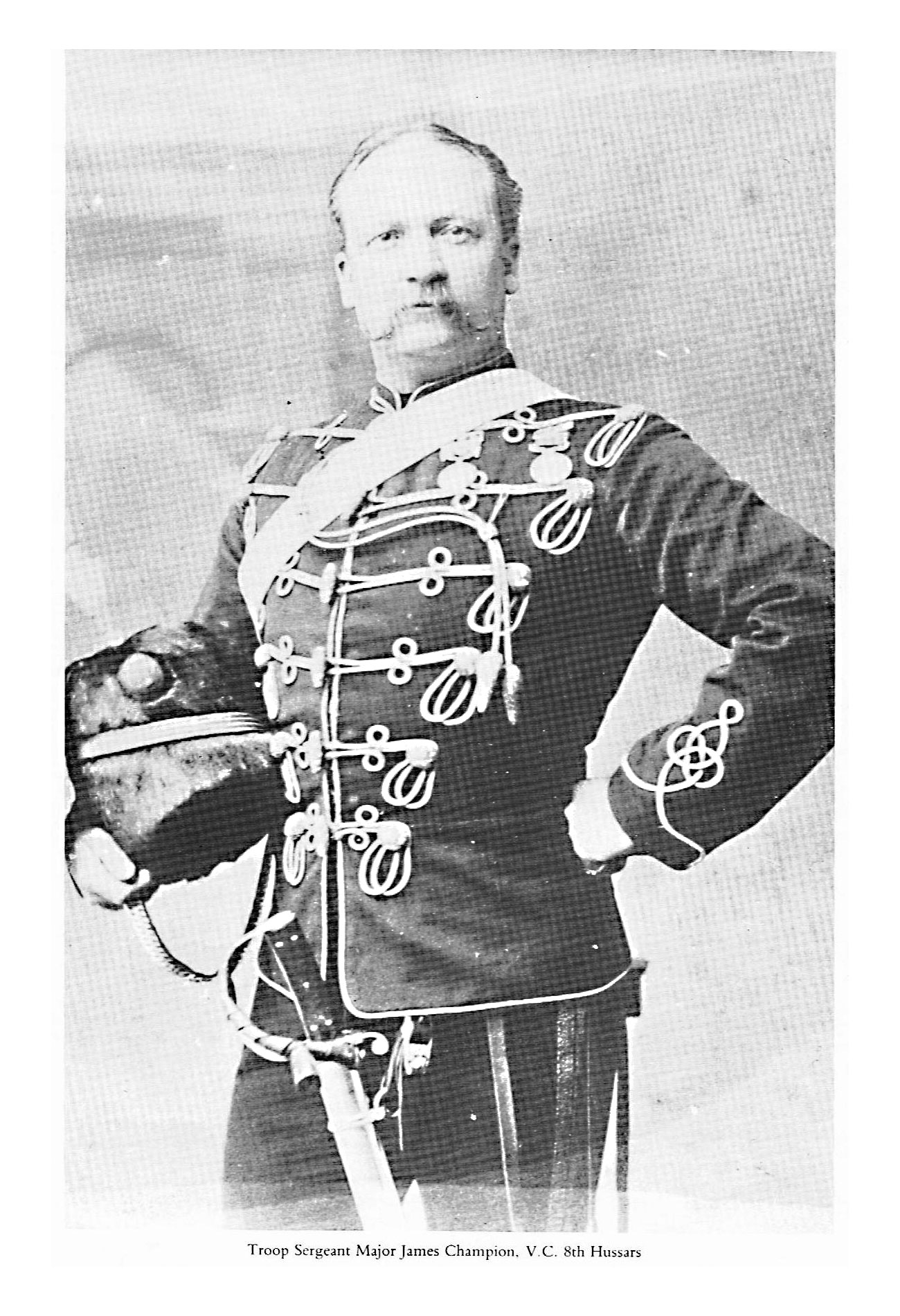
Photograph of James Champion, reprinted in Christie's catalogue, lot 107, Tuesday March 22nd, 1988.
(Click on image to enlarge)
1194, Private James CHAMPION — 8th Hussars
Birth & early life
Born at Hammersmith, London, the son of William Champion, a policeman.
[1991] It is now known (from a great-granddaughter now living in Warwickshire) that Edward Champion was baptised in St. Paul's Church at Hammersmith, London, on the 18th of August 1835.
William Champion [father]
William Champion was born at Tichfield, Hampshire, on the 20th of April 1807, and had joined the Metropolitan Police on the 11th of April 1832. He had served as a Police Constable in "T" or Kensington Division for 32 years and 39 days before retiring on the 14th of June 1865, aged 57 years.
Before his retirement he lived with his wife, Mary Ann, at 4, Police Cottages, Brook Green, Hammersmith, London.
Edward Champion [brother]
A brother, Edward, was also in the 8th Hussars as No. 1368. Born at Hammersmith, he enlisted in July 1854 at the age of 19 years.
1841 Census
Police House, Hammersmith.
William Champion, 30.
Mary Champion, 30.
William, 12; Elizabeth, 11; James, 7; Edward, 6; Emma, 4; Frederick.
__________
29, Wilderness Lane, St Bride & Precinct, London.
Mary Hamblin, 40, Laundress.
Sarah Hamblin [future wife], 10.
James Champion was educated at Latymer School, Hammersmith.
1851 Census
Cock Tavern, St Bartholomew Exchange.
There were 13 Servants and 3 Lodgers present, including:
James Champion, Servant, unmarried, 18, born Hammersmith.
Sarah Hamblin [future wife], 18, Servant, Chambermaid, born St Bride London.
Enlistment
Enlisted at Westminster on the 17th of September 1851.
Age: 19.
Height: 5' 10".
Trade: Servant.
Service
Embarked for the Crimea aboard the H.T. Shooting Star on the 25th of April 1854.
At Scutari General Depot from the 16th of October 1854 and was sent to rejoin the regiment on the 23rd of November 1854.
In February, March and April of 1855 he was shown as being on "Letter Duty," and in May and June of the same year as being with his troop on "Escort Duty" to Lord Raglan.
From Private to Corporal: 15th of December 1854.
Corporal to Sergeant: 28th of February 1855.
Appointed to Troop Sergeant Major on the 12th of March 1856.
Marriage
Marriage registered
James Champion to Sarah Hamblin, December Quarter 1856, Kensington.
He married Sarah Hamblin (she is named as "Ruth" on the Regimental "Married roll"), the daughter of David John Hamblin, of Brook Street, Hammersmith, at St. Stephen's Church, Hammersmith on the 11th of November 1856 and was placed on the "Married roll" of the regiment on the same day.
[CP: EJB's original notes say "Hanklin", but should be Hamblin.]
Four children are known to have been born to him and his wife: Henry J. (place unknown) in 1857, Emma Martha, at Meerut, India, in 1861, Bejapore at Meerut in 1863, and William E. (place unknown) in 1865.
The India Office records show that his son, full name Bejapore Frederick Thomas, was born at Meerut on the 18th of January 1863 and baptised on the 28th of February by the Revd. John Sharkey. His wife was shown at that time as being named Sarah Champion. It is believed that two more children were born after he left the Army.
Embarked for India from Cork aboard the SS Great Britain, 8th of October 1857.
From Troop Sergeant Major to Regimental Sergeant Major on the 31st of August 1858.
Re-engaged in India for a further 12 years' service on the 19th of September 1863.
Awarded the Victoria Cross during the Mutiny and was decorated with it in India in 1860, probably by Sir Hugh Rose (Lord Strathnairn).
1256 James Rawlins, 8th Hussars, recorded in his diary:
"October 29th [1860] We had a parrade for to present R.S.M. Champion with the Vict. Cross, the hole of the Brdge parraded for it."
From the London Gazette of the 20th January 1860:
"James Champion, T.S.M., 8th Hussars"
"For distinguished bravery at Beejapore on the 8th of September 1858, when both of the officers attached to the Troop were disabled and he himself severely wounded at the commencement of the action by a ball through the body, in having continued at his duty throughout the pursuit, and disabled several of the enemy with his pistol.
Also recommended for distinguished conduct at Gwalior on the 17th of June 1858 in a charge by his regiment."
From D.H. Parry's book, The VC: Its Heroes and their Valour" comes this description of how James Champion won his VC:
"Troop Sgt Major Champion of the 8th Hussars was also recommended for his bravery in the rocky gorges of Gwalior and he should by rights have had a lac [?] of rupees, as the famous Rani of Jhansi, for whose capture a large reward had been offered, was killed there, but a Bombay Staff-Colonel disputed his claim and the money was withheld.
Less than three months afterwards — when acting Regimental Sergeant Major — when both his officers were wounded and he himself hit in the chest by a bullet, he led his troop in hot pursuit of the rebels at Beejapore for three hours, on a fine bay horse, 16 hands high, killing 450 of them with his forty men.
Faint from loss of blood, he brought his party in and lost only one man killed and eight wounded.
They lifted him off his horse and laid him under a banyan tree where the surgeon found that the ball had gone clean through his chest and out of the back.
The wound was dressed with the Sergeant Major's own shirt-tail as there were no bandages to be had.
"Never mind, Sir," said Champion, to his Major who had come to commiserate with him, "We've given them a good doing."
And so thought Colonel Robinson [sic — this should have been "Robertson"] who recommended him at once for the V.C., saying, 'There never was a better little action fought and you shall have the order of merit.'
Few men saw more fighting than Sergeant Major Champion, whose face, the very beau ideal of a fine old hussar, was well known in Aldershot, where he rested on his gallantly earned laurels — for besides the V.C., he had the Crimean, Turkish, Mutiny and Meritorious Service medals, having moreover refused a commission on four separate occasions."
The 4th/8th Museum have a collection of testimonials as to his character, etc, written by various officers and others, dating from just before his leaving the Army in 1873 to leaving the Yeomanry Cavalry in 1885. (Copies in the 8th Hussar file.)
He was R.S.M. of the Cheltenham Troop of the Royal Gloucestershire Yeomanry from 1873 to 1885.
Discharge & pension
Discharged from Longford, "at his own request after 21 years' service", on the 23rd of December 1873,
Served 22 years 60 days.
In Turkey and the Crimea: 2 years. East Indies: 6 years 1 month.
Conduct: "very good". Had no Good Conduct badges when promoted, but would now be in possession of five.
Twice entered in the Regimental Defaulter's book. Never tried by Court-martial.
Aged 41 years 3 months on discharge.
Next of kin: Wife, Ruth Champion.
Intended to live at Badminton, Cirencester, Gloucestershire after discharge.
Medals
His documents confirm the possession of the Crimean medal, clasps for Alma and Sebastopol, Turkish Medal, Indian Mutiny medal with clasp for Central India, Long Service & Good Conduct medal with a gratuity of £5 and the Victoria Cross with an annuity of £20.
Entitled to the Crimean medal with clasps for Alma and Sebastopol.
Mutiny medal with clasp for Central India.
Served at Kotah and Gwalior. He was severely wounded by a musket-ball through the body at Burapore on the 8th of September 1858.
Awarded the Long Service & Good Conduct medal on the 6th of November 1869. (In the Remarks column is written "Granted medal and annuity". but should this not have been, it being a "Gratuity".)
Awarded the Meritorious Service Medal on the 13th of July 1878, with an annuity of £20. (There is no comment about his having had to return or being given permission to retain the Long Service & Good Conduct medal on being awarded the M.S.M.)
Awarded the Empress of India Medal in 1887. This was long after he had left the Army. The award seems odd in that it was otherwise given to a selected soldier from each regiment serving in India at the time.
Further detailed medal information archived.
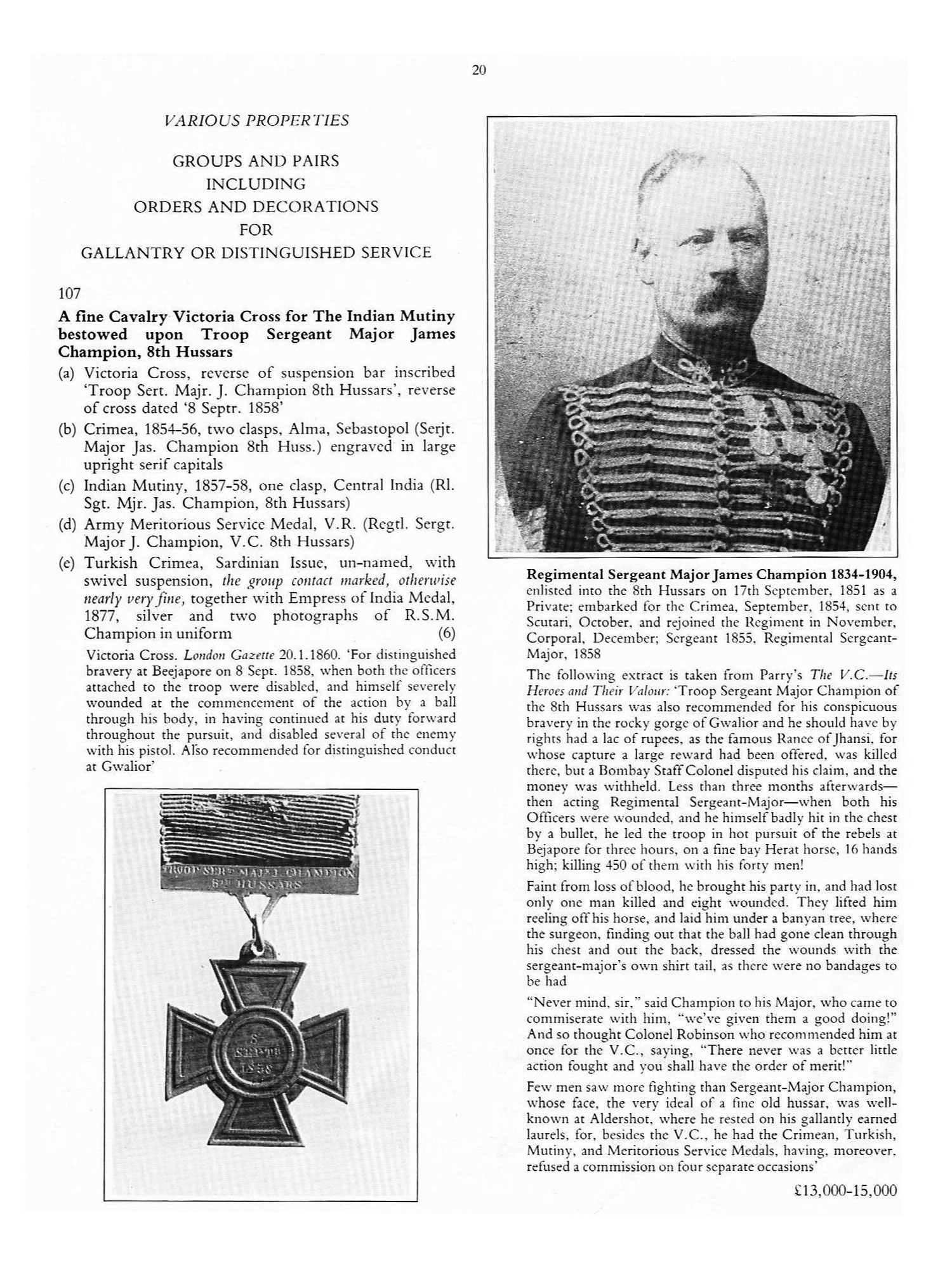
James Champion's medals at auction, Christie's, lot 107, Tuesday March 22nd, 1988.
(Click on image to enlarge)
Commemorations
Life after service
R.S.M. of the Cheltenham Troop of the Royal Gloucestershire Yeomanry, 1873 — 1885.
1881 Census
1, Lodge Street (Colston Arms), parish of St. Michael, Bristol.
The 1881 Census shows him as a Visitor at this address, a Sgt-Major Pensioner (Army), aged 47, born Hammersmith, London.
__________
The Slad, Slad, Painswick.
Sarah Champion, 47, Sergt Major's wife, born London
Alma, 14, born Birmingham; Lavina, 12, born Edwinstow; Alice, 10, born Dublin; Ada, 6, born Stroud; Rudolph 4, born Stroud.
__________
25, Stafford Terrace, Kensington.
Beejapore Champion [son], 18, Footman, born India.
1891 Census
Marie House, New Road, Edmonton.
James Champion, 57, Steward, born Hammersmith.
Sarah Champion, 57, Nurse, born St Dunstan, London.
Alice, 20, born Ireland; Rudolph, 14, born Stroud; Alice (grand-daughter), 8, born South Africa.
1901 Census
87a, Grosvenor Road, Aldershot.
James Champion, widower, 67, army pensioner, born Hammersmith.
Alma Champion, granddaughter, 18, born South Africa.
Dorothy Champion, granddaughter, 7, born Aldershot.
Death & burial
Deaths registered
Sarah Champion [wife], aged 67 years, March Quarter 1901, Farnham.
James Champion, aged 70 years, June Quarter 1904, Fulham.
Died at 37, Dewhurst Road, South Hammersmith, London, on the 4th of May 1904.
He was buried in Grave No. 30 E40 in Margravine Cemetery, London, W6. There was at one time a memorial stone on the grave but this has been buried in the gravespace under the Council's Garden of Rest scheme.
His son, Beejapore (obviously named after the place in India where his father had gained the V.C.) and who died at 116, Herbert Gardens, Willesden, London, aged 79 years, was buried in the same grave on the 15th of January 1942.
Also in the same grave is a Martha Champion, who was buried on the 15th of February 1926. James Champion's wife, Ruth, had her name inscribed on the stone although she had died at 87a, Grosvenor Road, Aldershot, on the 24th of January 1901, and was buried there.
The last owner of the Right of Burial lives, or lived, in Hornchurch, Essex, the last referred date being in 1942.
(There is a photograph of his grave-area in Margravine Cemetery, Hammersmith, in the 8th Hussar file.)
Further information
During his service, when stationed at Mansfield, Nottinghamshire, he had met a Mary Ward, and in 1872 married her there, remaining in Mansfield as a labourer and foundry man. He died in 1891, at the age of 56.)
Although he later served in the Crimea, he did not qualify for a medal. He did however, serve during the Mutiny at Kotah and Gwalior and received the medal with clasp for Central India. He became a Corporal in 1857 and a Sergeant in 1859.
However, in September of 1865 he was discharged from the Army, "In consequence of being unfit for further service, but able to earn his livelihood." His character was "very good," and he had never been tried by a Court-martial. He was awarded a pension of 1/2d per day. His intended place of residence was in Gray's Inn Road, Kings Cross, London.
1881 Census
6, Wood Street, Mansfield, Notts.
The 1881 Census Return shows him as a General Labourer, aged 47, born in London, with his wife, Mary, aged 37, born at Mansfield, Notts, and one son, Ernest A., aged 4 years.
Beejapore Frederick F. Champion
1881 Census
25, Stafford Terrace, Kensington, London.
His son Beejapore was shown in the 1881 Census Returns as a Footman, aged 18 years, born in India.
1891 Census
8, Adie Road, Hammersmith.
Beejapore F.F. Champion, 28, Messenger University Life Office, born Meerut, Bengal.
Martha Champion, 41, born Woodstock, Oxon [Slightly Deaf].
Marriage registered
Beejapore Frederick F, September Quarter 1884, Kensington.
[CP: I cannot prove which is his wife. It looks like Evelina Maria Falle, Margaret Daly or even perhaps someone else entirely.]
1901 Census
37, Dewhurst Road, Hammersmith.
Frederick Champion, 38, Cashier Life Assurance Coy, born Meerut, India.
Martha Champion, 50, born London.
1911 Census
37, Dewhurst Road, West Kensington Park.
Beejapore Champion, 48, Insurance Clerk (Cashier), born Meerut India, resident.
Martha Champion, 61, born Woodstock, Oxon.
Deaths registered
Martha Champion [daughter-in-law, wife of Beejapore], aged 76, March Quarter 1926, Hammersmith.
Beejapore F.F. Champion, aged 79, March Quarter 1942, Willesden.
Rodolphe de Salis Champion [son]
From further information received from Mr. Morrison, it is known that another of the sons was christened Rodolphe de Salis Champion.
Born at Stroud in Gloucestershire on the 28th of January 1877, on leaving school he is said to have joined the 8th Hussars, serving during the Boer War and later in the Metropolitan Police from August of 1903, rejoining the Army during World War One, going back to the Police in May of 1919 and retiring in 1929. Dying in 1946 at the age of 69, he had five children.
1881 Census
The 1881 Census shows him as living at The Stad, Painswick, Gloucestershire, with his mother, Ruth, then Head of the Household and a Sergeant Major's Wife, aged 47, born in London, with his four older sisters. He himself was 4 years old at this time, and a Scholar. He is named only as Rudolph Champion in this.
More intensive research has now shown that the latter was enlisted by "Special Authority" into the 8th Hussars on the 3rd of June 1891, at the age of 14 years and 9 months, the following letter being the authority for this. Dated the 27th of May 1891, written from The Horse Guards and addressed to B. J. Mahon, then Adjutant of the 8th Hussars:
Sir, I am directed by the Commander-in Chief to acquaint you that His Royal Highness approves as a very special case of the boy named in the margin and alluded to in your communication of the 21st inst., being enlisted for the 8th Hussars.
J.H. Roche,
Inspector-General of Recruiting.
He joined the Regiment at Norwich on the 9th of June 1891, Regimental No. 3382. He was described as being 5' 3" in height, with a fresh complexion, blue eyes and fair hair. His religion was C. of E.
He attained the age of 18 years on the 5th of September 1894 (this date of birth would appear to contradict that previously noted, said to have been provided by the Metropolitan Police from their records), and was appointed L/Corporal on the 20th of March 1896, Corporal on the 26th of June 1898, L/Sergeant on the 28th of June 1900 and to Sergeant on the 29th of July 1901.
He was discharged (as Sergeant) "on the termination of his first period of service" on the 29th of June 1903. He had served in South Africa (embarking as a Corporal in "A" Squadron) from the 13th of February 1900 to the 20th of June 1903, being awarded the Queen's South Africa Medal with clasps for Belfast, C.C. and O.F.S., and the King's South African Medal with clasps for 1901 and 02. He was mentioned in the Regimental History of the 8th Hussars under the following terms:
Dated the 26th of February 1902 (when with "C" Squadron, under Major Henderson). A large force of Boers made a determined attempt to break through the line at Stetfontein at 12.30 a.m., the brunt of the attack falling on Sergeant Champion's picquet, but who succeeded in driving them off with the following casualties — one man killed and four wounded (two dangerously.) Mentioned in Lord Kitchener's Final Despatch dated Capetown, 23rd June 1902.
During World War One he had re-enlisted into the 4th Dragoon Guards as No. D/14522. Ranking as a Sergeant, he was awarded the War and Victory Medals. His next of kin was shown originally as his "Father, James Champion, The Institute, Lower Edmonton. Brother, Bejapore, St. George's Hall, New Road, London, and Sister, Agnes, 107, The Grove, Hammersmith", but later as his "Wife, Agnes" (nee Bing), whom he had married at York Register Office on the 12th of June 1897, but not coming on to the Regimental "Married Establishment" until the 1st of April 1899. No children of this marriage are recorded up to the time of his discharge.
During his service he had passed a Course of Instruction at the Riding Establishment, Maidstone, on the 8th of December 1898 and obtained the 3rd (at York) and the 2nd (at Hounslow) Certificates of Education on the 8th of September 1891 and the 4th of December 1893, respectively.
Henry J Champion [son]
At the time of James Champion's funeral a report of this appeared in the Aldershot News of the 14th of May 1904 and besides describing events in his life, stated that his eldest son, Henry J., had served with the Royal Engineers, where he "won renown in the Zulu War by volunteering to carry up the powder charge to blow up the stronghold of the powerful native chief, Seccaconi" [Sekukuni].
A check of the medal rolls for this campaign showed a No. 11714 Sapper H.J. Champion who had served there with the 2nd Field Company and would have been entitled to the medal without the clasp for 1879. It further stated however, "No Medal, Deserted..." He had enlisted into the Royal Engineers at the Curragh Camp, Ireland, on the 10th of July 1872 at the age of 15 years and 9 months. No other enlistment details are shown.
He then transferred from one Company to another on a number of occasions and serving at various times at Aldershot, Southampton, Edinburgh, Oxford, Cork Harbour and Spike Island, to mention but a few, being at first in the 40th Company (and where he passed from "Boy's Service" and being paid as a Sapper on the 1st of January 1873, on the 1st of April 1873 to the 35th Company, to the 16th Company on the 11th of February 1874 (receiving Good Conduct pay of 2d per day on the 12th of October 1875) until the 1st of January 1877, to the 23rd Company on the 15th of February 1877, where he forfeited his Good Conduct pay of 2d. per day on the 2nd of July 1877.
This was restored on the 5th of July 1878. He transferred to the 17th Company, then at Aldershot) on the 8th of April 1879 and embarked for Natal on the 29th of May 1879 to join the 2nd Company. This he did on the 17th of July 1879.
The 2nd Company, then stationed at Shorncliffe, under the command of Captain (later Brevet-Major) Warren R.C. Wynne, had embarked for Durban on the 2nd of December, 1878, arriving in Natal on the 2nd of January 1879.
The Company, on joining No. 1 (or Colonel Pearson's Column) took part in the engagement on the Inyezane River at Etshowe, where it was employed as Light Infantry and, following the Isandhwlana disaster, remained there as part of the garrison — in an abandoned missionary station — being totally cut off from all communication with the outside world, some forty miles inside the border.
Here it held out for almost ten weeks before being relieved. From all known facts he could not have been present with the 2nd Company during this time. neither could he have been present during the operations against Chief Sekukuni either (these were carried out between the 11th of November and the 2nd of December 1879) as the muster rolls show him as "Awaiting trial", from the 26th-29th of October 1879 and being sentenced to serve in a Military Prison from the 29th of October until the 22nd of December 1879 and to forfeit his previous good conduct pay.
No charge is specified against him. He deserted from Pretoria on the 28th of December 1879 (leaving behind 9/11d in his "credits") and no further trace can be found of him in the muster rolls of the 2nd Company as rejoining up to the time they left the country to return to England aboard the S.S "Anglian" on the 1st of July 1883, en route for Chatham. A considerable number of men had deserted during the time the unit was in South Africa.
The "Official Dispatches for the Operations against Sekukuni" show that two columns were employed in the attack on Sekukini's Town and stronghold, the latter being called the "Fighting Koppe."
The central force for this attack and seizure of the Fighting Koppe — an isolated irregular mass of boulders, rocks and with caves strongly defended with stone walls, opposite to the centre of the Town.
This force was commanded by Lieut. Colonel Murray of the 94th Regiment and a detachment of the 2nd Company R.E. under Lieutenant John Macgregor (who had come to the Cape with the Telegraph Department and had been previously in charge of the telegraphs and signalling up to Ulundi) with other units, formed part of this.
The first attack on Sekunini Town was at 4.15. a.m. on the 28th of November 1879 and slightly later against the Koppe. Sekunini himself had escaped at this time although his two eldest sons were killed on the 28th.
He however, gave himself up on the 2nd of December 1879 when the cave in which he taken refuge, was already totally surrounded.
The 2nd Company R.E formed part of the small force which remained in the area until things had quietened down. No references are made in the Despatch, apart from some 16th officers, to any particular action being performed by an O.R.
From The Dictionary of South African Biography:
"Sekukini was the Paramount Chief of the Bedupi Empire in the N.E Transvaal. After his defeat he was given a new location in which to live under the terms of the Treaty of Pretoria 1881 between the Boers and the British. On the 22nd November 1882 he was stabbed to death by his enemy, Mapina, for which the latter was hanged."
References & acknowledgements
Photographs of the Christie's catalogue, 1988, and additional marriage, birth and death registrations kindly provided by Chris Poole.