My dear Uncle...
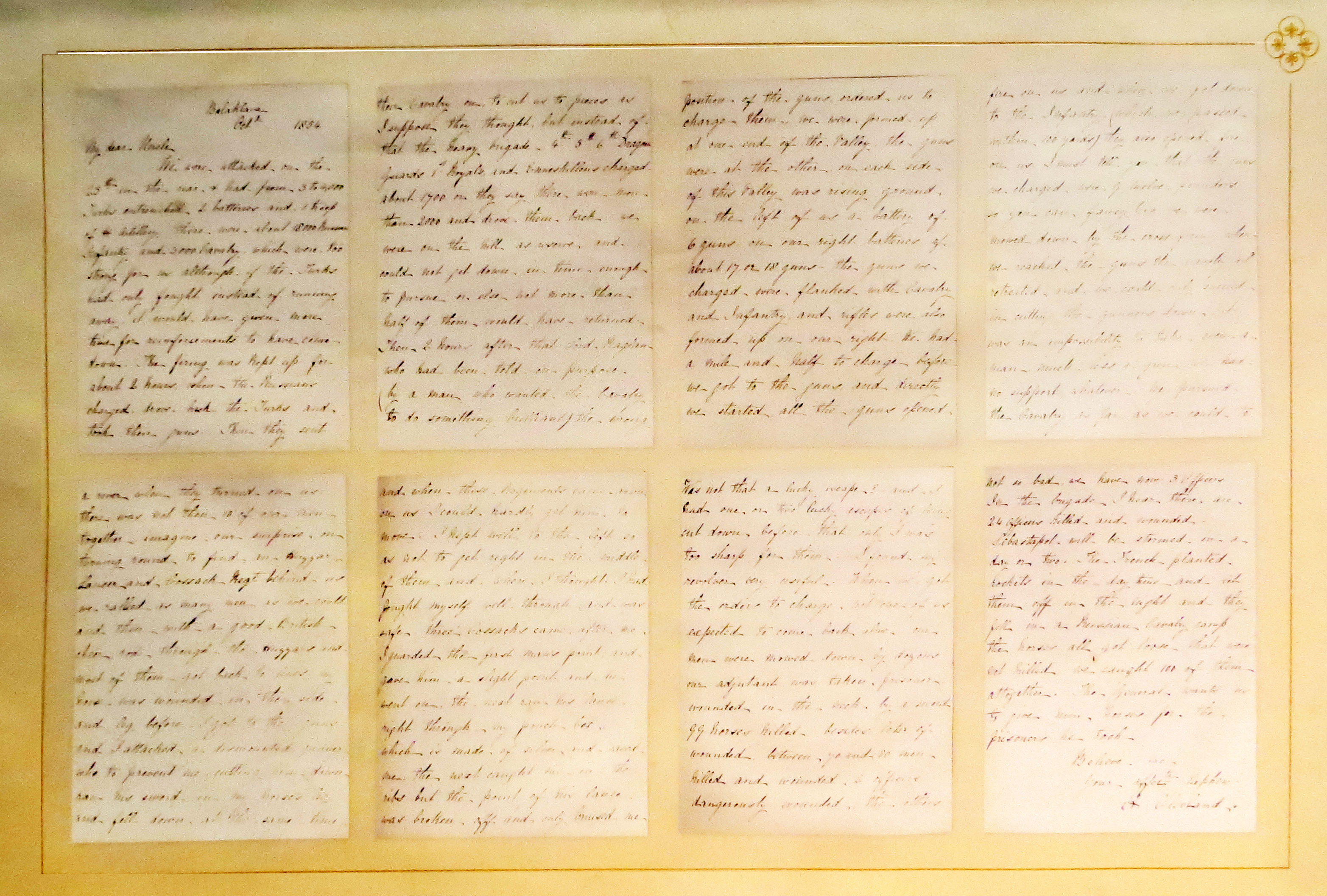
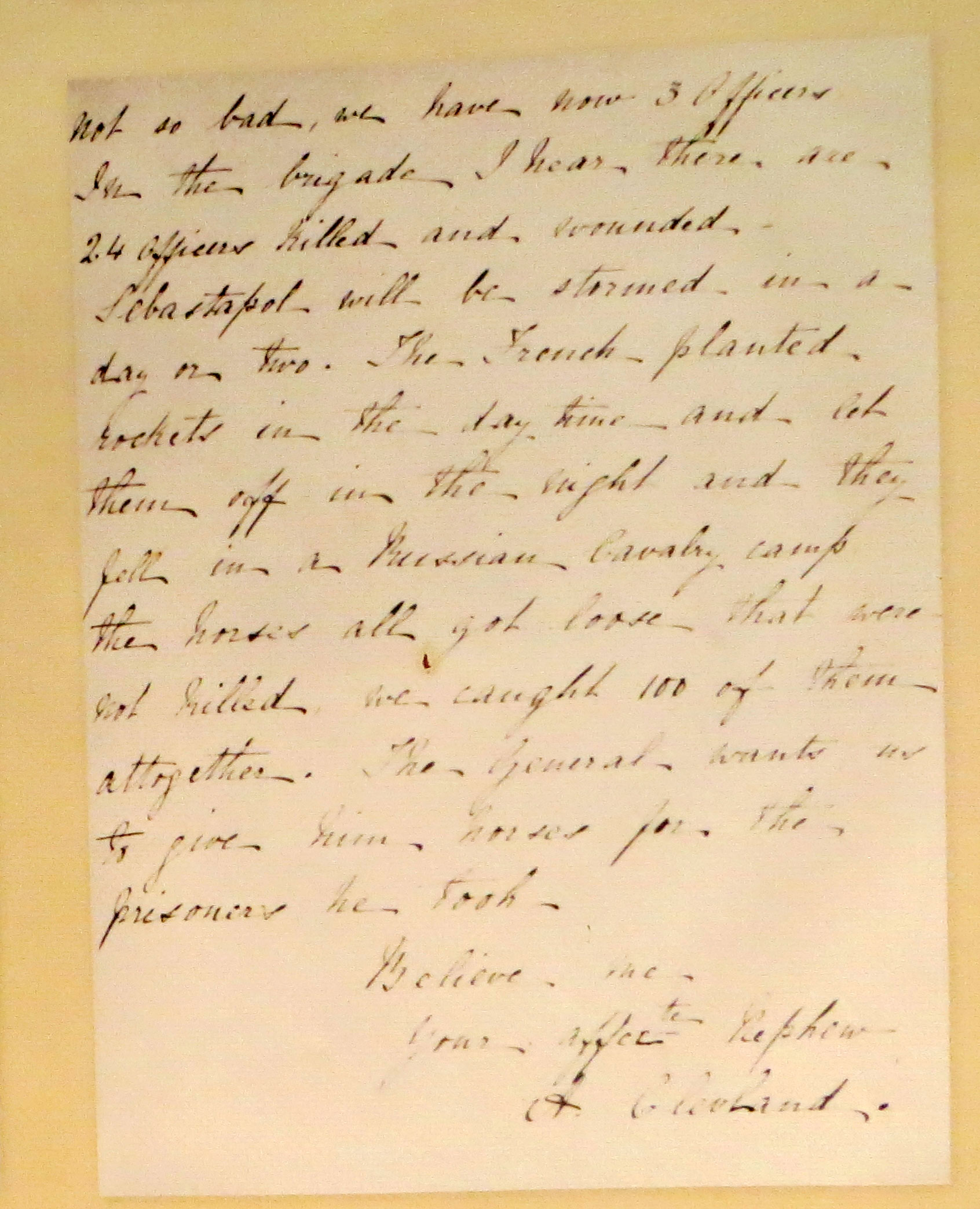
The original letter photographed and displayed at Tapeley.
Photograph: Philip Boys, August 2016.
(Click on image to enlarge)
Archibald Clevland wrote to his uncle from Balaklava October 1854. (The published version says on the 26th but AC does not date it.) Transcript by PB, August 2015, from the photograph of the letter on display in a small exhibition at Tapeley House. It differs considerably from the version as published (opens in a new window).
[Name of Uncle? Expand details of publication.]
[1]
(Click on image to enlarge)
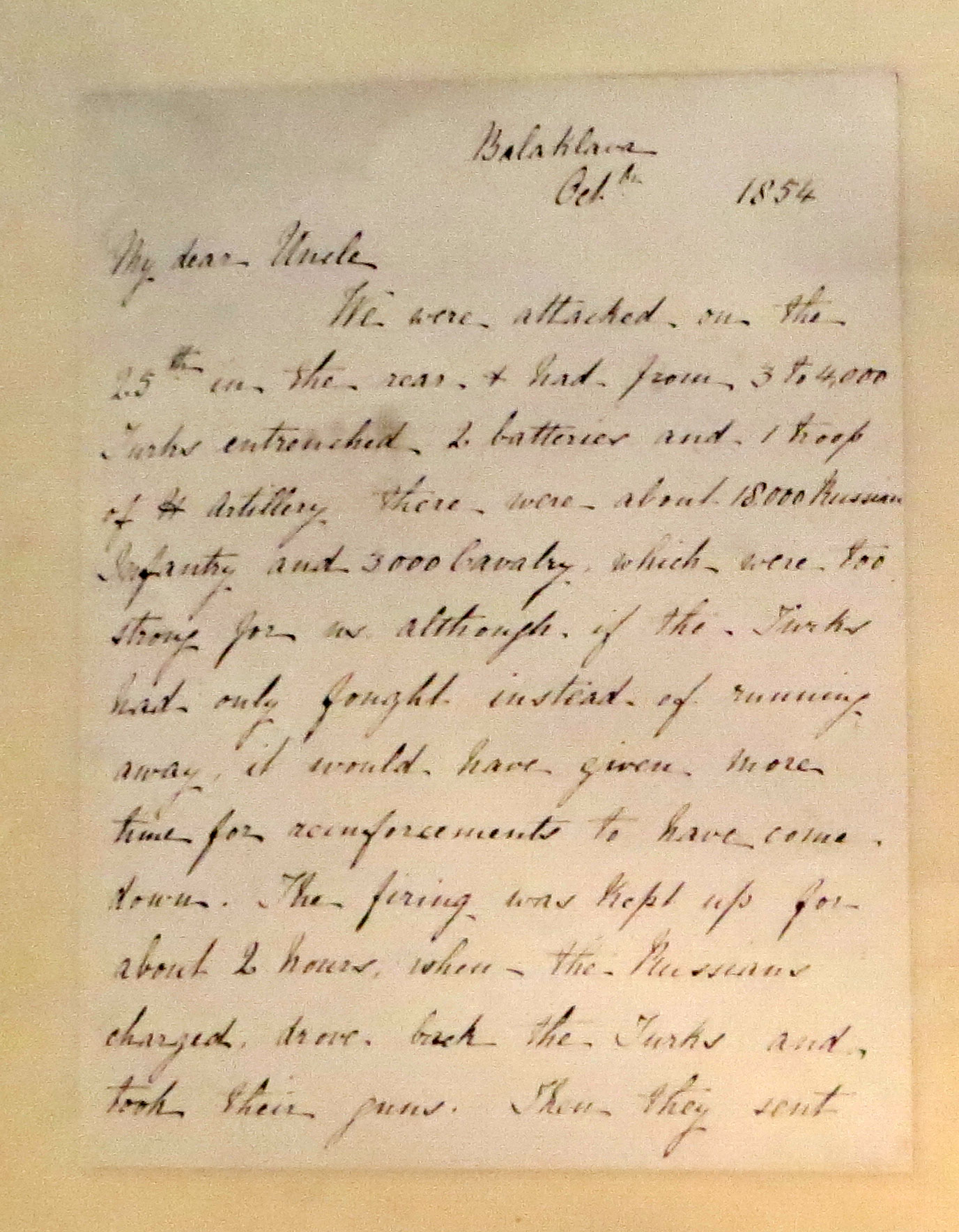
Balaklava
Octbr 1854
My dear Uncle
We were attacked on the 25th in the rear, & had from 3 to 4,000 Turks entrenched, 2 batteries and 1 troop of the H [Horse] Artillery, there were about 18000 Russian Infantry and 3000 Cavalry, which were too strong for us although, if the Turks had only fought instead of running away, it would have given more time for reinforcements to have come down. The firing was kept up for about 2 hours, when the Russians charged, drove back the Turks and took their guns. Then they sent
[PB: A letter written by THL Hony, published in the Western Morning News, 18th April 1938, says AC's uncle was "John Clevland, of Tapley, then Recorder of Bideford." Check.]
[2]
(Click on image to enlarge)
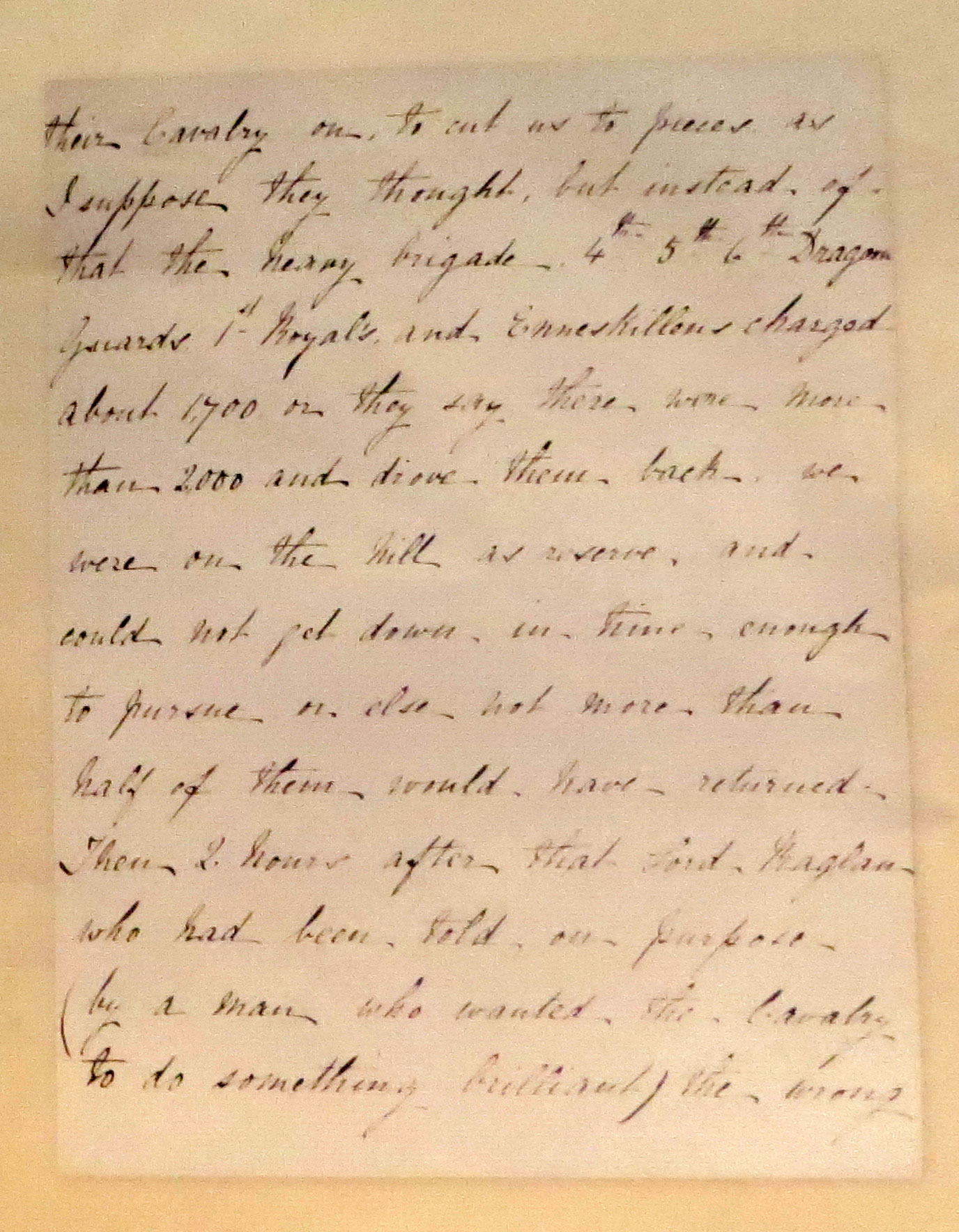
their Cavalry on [?], to cut us to pieces as I supposed they thought, but instead of that the heavy brigade - 4th 5th 6th Dragoon Guards 1st Royals and Enneskillens [sic?] charged about 1,700 or [?] they say there were more than 2,000 and drove them back. We were on the hill as reserve, and could not get down in time enough to pursue, or else not more than half of them would have returned.
Then, 2 hours after that Lord Raglan, who had been told on purpose (by a man who wanted the Cavalry to do something brilliant) the wrong
[PB: Presumably the "man who wanted the Cavalry to do something brilliant" is Louis Nolan, but a different accusation to the claim that Nolan misled Lucan and Cardigan. Ask DJA.]
[3]
(Click on image to enlarge)
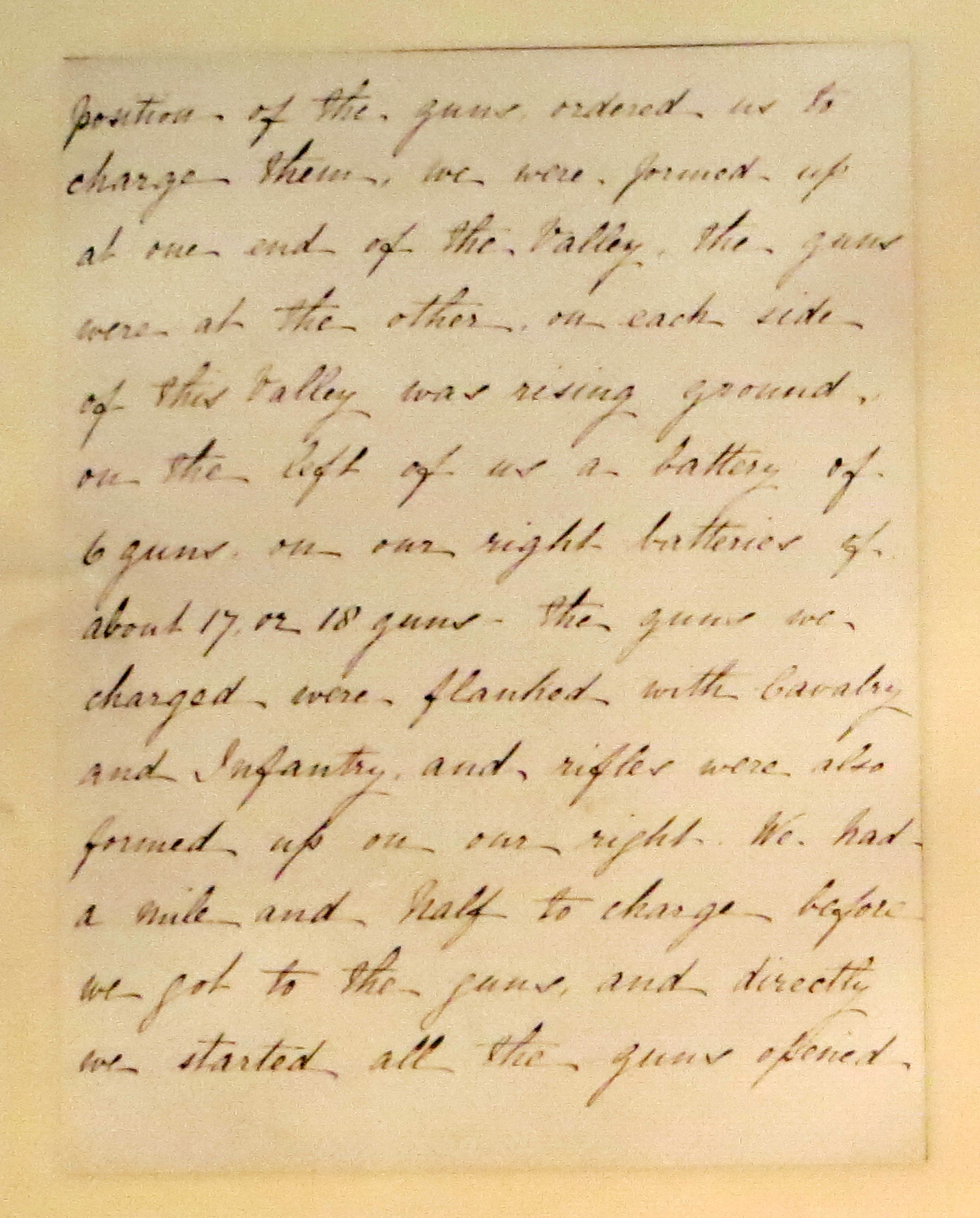
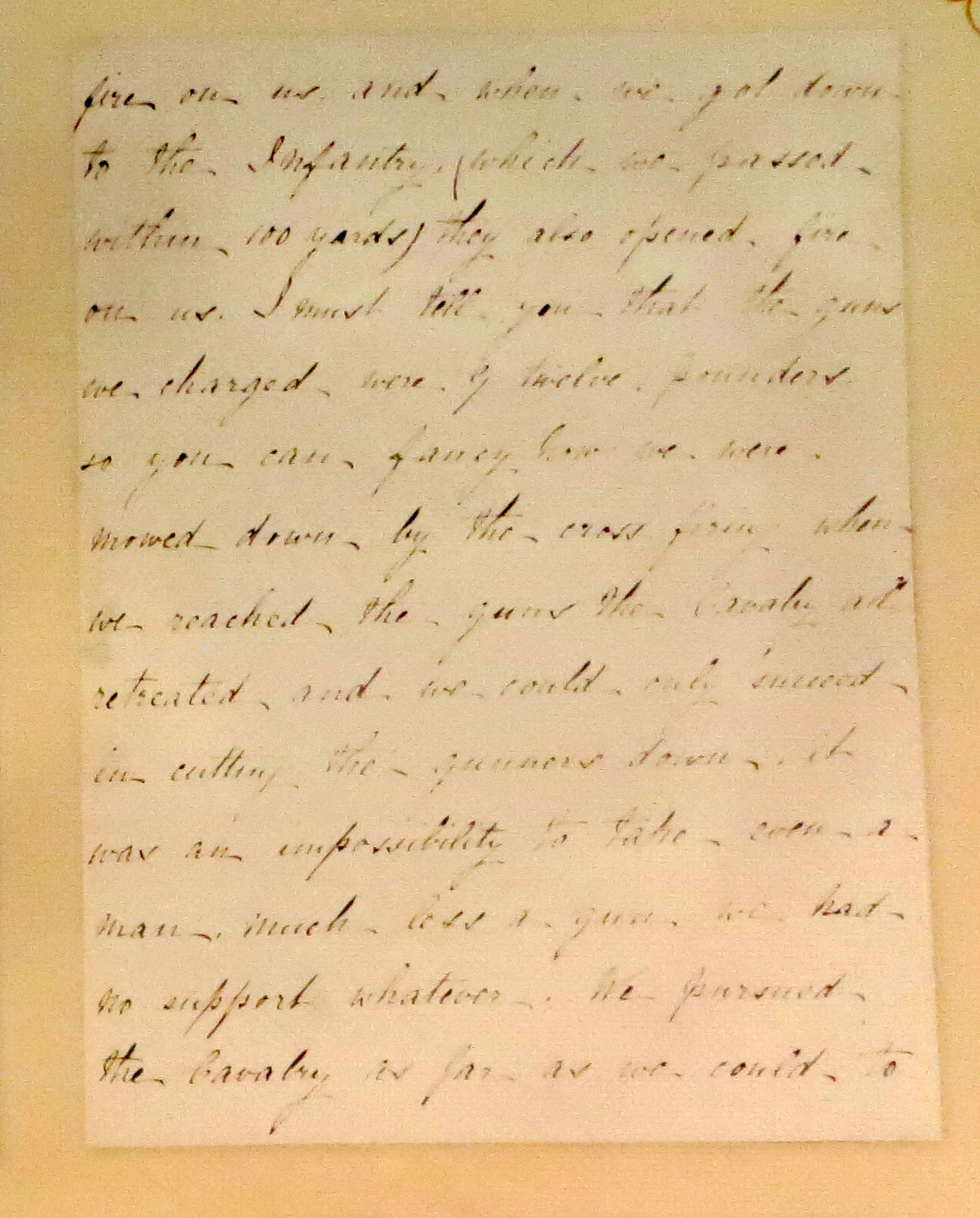
position of the guns, ordered us to charge them. We were formed up at one end of the Valley, the guns were at the other, on each side of this Valley was rising ground, on the left of us a battery of 6 guns, on our right batteries of about 17 or 18 guns - the guns we charged were flanked with Cavalry and Infantry, and rifles were also formed up on our right. We had a mile and half to charge before we got to the guns, and directly we started all the guns opened
[4]
(Click on image to enlarge)
fire on us and, when we got down to the Infantry (which we passed within 100 yards) they also opened fire on us. I must tell you that the guns we charged were 9 [?] twelve pounders so you can fancy how we were mowed down by the cross firing, when we reached the guns the Cavalry had [?] retreated and we could only succeed in cutting the gunners down. it was an impossibility to take even [?] a [?] man much less a [?] gun. we had no support whatever. We pursued the Cavalry as far as we could to
[5]
(Click on image to enlarge)
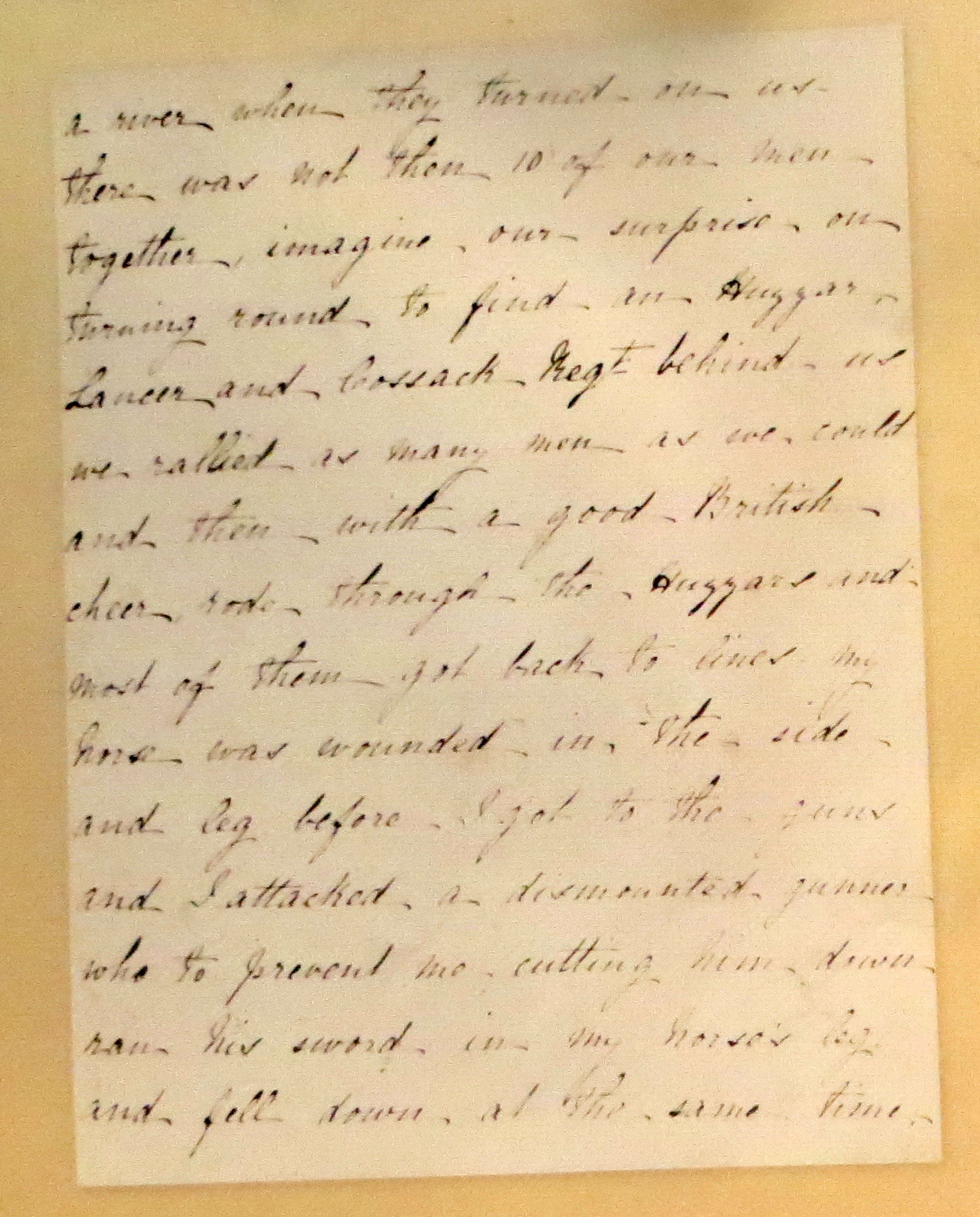
a river when they turned on us. there was not then 10 of our men together - imagine our surprise on turning round to find an Huzzar, Lancer and Cossack Regt behind us. we rallied as many men as we could and then - with a good British cheer - rode through the Huzzars and most of them got back to lines [?]. my horse was wounded in the side and leg before I got to the guns and I attacked a a dismounted gunner who to prevent me cutting him down ran his sword in my horse's leg and fell down at the same time.
[6]
(Click on image to enlarge)
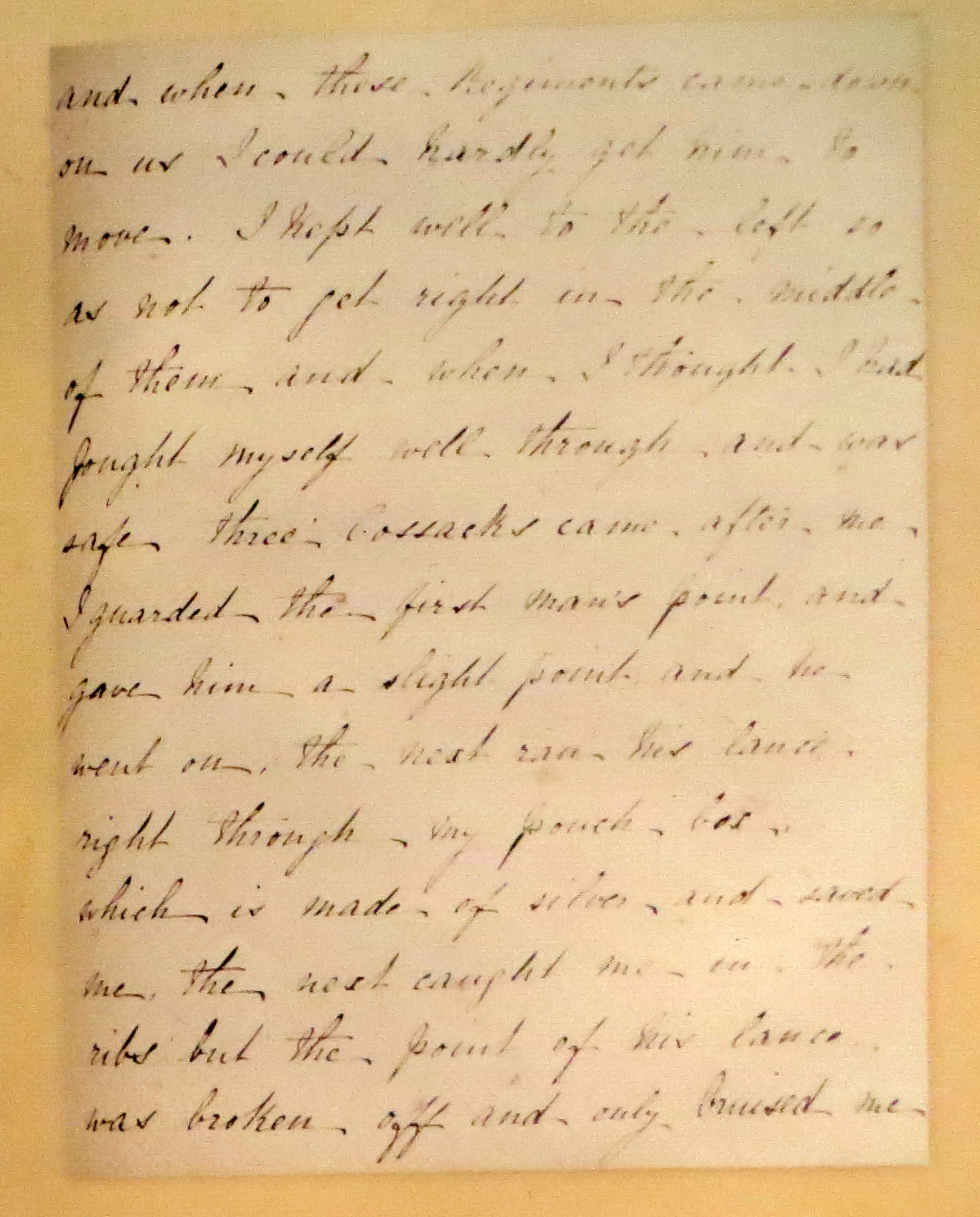
and when these Regiments came [?] down on us I could hardly get him to move. I kept well to the left so as not to get right in the middle of them, and when I thought I had fought [?] myself well through and was safe [?] three Cossacks came after me. I guarded the first man's point and gave him a slight point and he went on. the next ran his lance right through my pouch box [?] which is made of silver and saved me. the next caught me in the ribs but the point of his lance was broken off and only bruised me.
[7]
(Click on image to enlarge)
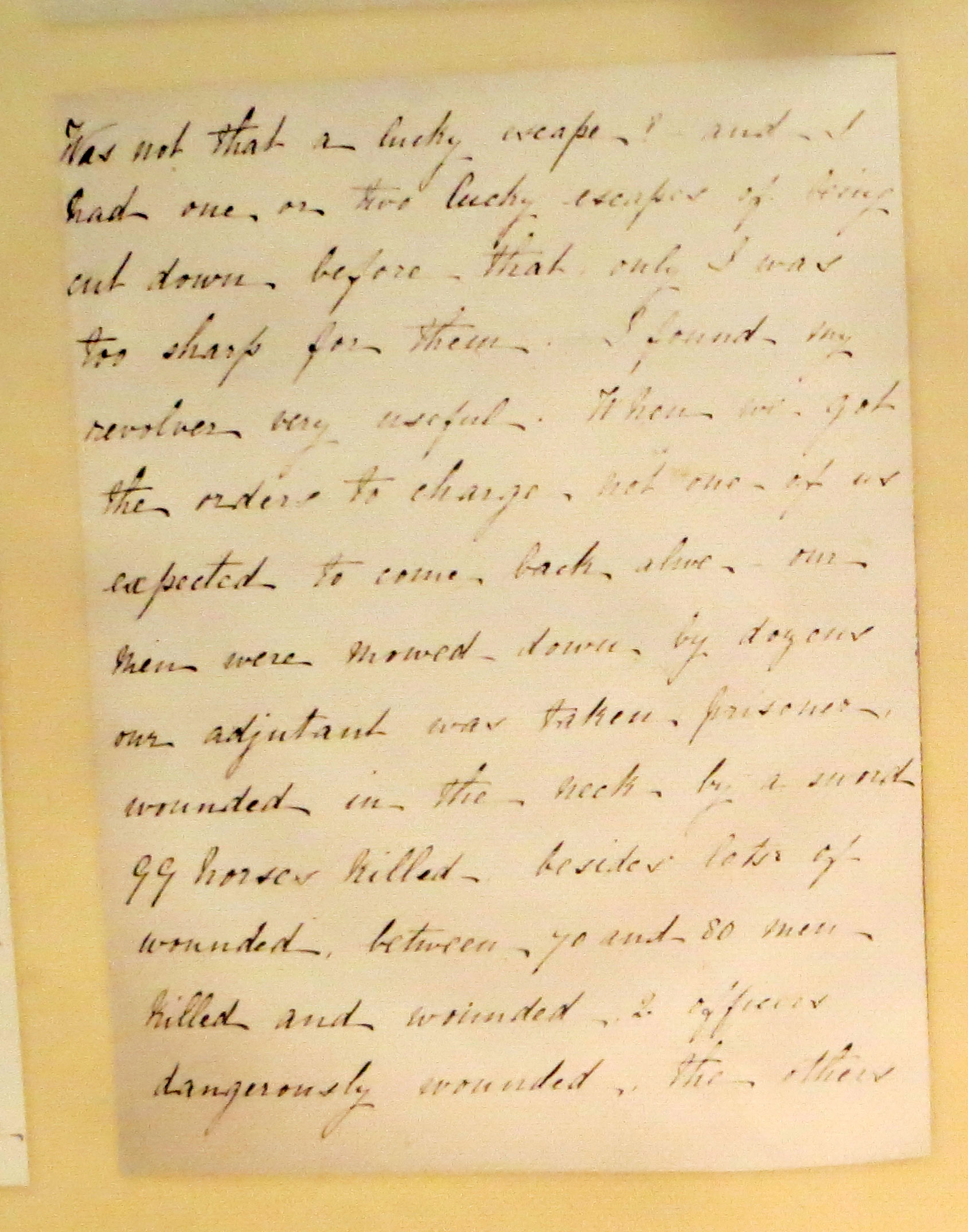
Was not that a lucky escape? and I had one or two lucky escapes of being cut down before that only I was too sharp for them. I found my revolver very useful. When we got the orders to charge, not one of us expected to come back alive, our men were mowed down by dozens [?] our adjutant was taken prisoner, wounded in the neck by a sword. 99 horses killed, besides lots of wounded, between 70 and 80 men killed and wounded, 2 officers dangerously wounded, the others
[PB: The adjutant was Cornet John Chadwick.]
[8]
(Click on image to enlarge)
not so bad, we have now 3 Officers. In the Brigade, I hear there are 24 Officers killed and wounded.
Sebastopol will be stormed in a day or two. The French planted rockets in the day time and let them off in the night and they fell in a Russian Cavalry camp the [?] horses all got loose that were not killed. we caught 100 of them altogether. The General wants us to give him horses for the prisoners he took.
Believe me
Your affecte Nephew
A Clevland.
[PB: "The General wants us to give him horses for the prisoners he took" - Meaning?]