LIVES OF THE LIGHT BRIGADE
The E.J. Boys Archive
Last modified 9 October 2026
Amended 14.5.11. Minor edits 17.2.2014. Cutting added 9.12.16. Captivity material added 9.10.2026.
1526, Private George COOPER — 13th Light Dragoons
Also recorded as "John" Cooper.
Birth & early years
Born in the parish of St. Nicholas, Rochester, Kent c.1825
Enlistment
Enlisted into the 3rd Light Dragoons at Maidstone on the 13th of September 1845. Regimental No. 1771.
Age: 20 years 6 months.
Height: 5' 6"
Trade: Labourer.
Appearance: Sallow complexion. Hazel eyes. Brown hair.
Service
Embarked for India on the 30th of June 1846.
Transferred to the 13th Light Dragoons on the 13th of July 1853.
Severely wounded in action at Balaclava and taken prisoner of war by the Russians. Honourably acquitted by a Court-martial on his returning to the Regiment, on the 5th of October 1855 — no further court of enquiry held.
He was shown on a nominal roll of men of the Regiment made out at the Cavalry Depot, Scutari on the 9th of November 1855 as being On Duty there from the 4th of November. (This contrasts with other men known to have been prisoners of war, who are still shown as being such.)
From Private to Corporal, 6th of February 1856.
Tried by a Regimental Court-martial on the 20th of May 1856 and returned to Private.
Sent to the Invalid Depot at Netley from Canada on the 17th of October 1868.
[Added 9 October 2026:] James Wightman, 17th Lancers, a fellow prisoner, tells how near Odessa three prisoners sent to buy food were attacked by six men with clubs: "there were not three finer men in the British Cavalry than Bird (8th Hussars), Cooper (13th Light Dragoons), and Chapman (4th Dragoon Guards). Settling to business in good old English style, they severely punished their antagonists who bolted, but not before damaging our men considerably." The next morning the attackers turned out to be soldiers of the escort; a fight followed, and on arrival at Odessa "Bird, Cooper, and Chapman reported the affair personally to the Governor, who placed the officer and the six men under arrest, and, as we were told, punished them severely."
[Source: James Wightman, "Balaclava and the Russian Captivity", The Nineteenth Century, May 1892: transcription. See also 1209, William Bird, 8th Hussars.]
Discharge & pension
Discharged from the Royal Victoria Hospital, Netley, on the 1st of November 1868, as
"Unfit for further service. Has Asthma Angina and general physical unfitness — the results of long and arduous service. — cannot contribute but in a partial manner towards earning his livelihood. He received eighteen wounds at Balaclava. "
Served 23 years 6 days. East Indies, 6 years 10 months.
In Turkey and the Crimea, 2 years. Canada, 2 years 6 months.
Fourteen times entered in the Regimental Defaulter's book. Twice tried by Court-martial.
Awarded a pension of 11d. per day.
Medals
Entitled to the Crimean medal with clasps for Alma, Balaclava, Sebastopol and the Turkish medal.
Documents confirm the award of the Crimean medal with three clasps, the Turkish Medal and the Punjab medal with clasps for Chilianwala and Goojerat.
Also the Punjab medal with clasps for Chilianwala and Goojerat. Served throughout the whole of the campaign in the Punjab up to the occupation of Peshwar.
A request was sent by the War Office to the East India Company's medallists on the 12th of March 1856, that "he be issued with a replacement Punjab medal (at public expense) with clasps for Chilianwala and Goojerat." This medal was sent to the Treasury on the 17th of April 1856.
Attended the Annual Dinner in 1890 and is shown in a photograph taken at that time. (See copy in the 17th Lancer file.)
Commemorations
He is not known to have ever been a member of the Balaclava Commemoration Society, or to have ever attended any other of the veterans' functions.
He is mentioned in the "Memoirs" of 117 James Wightman of the 17th Lancers (see copy in the "Memoirs" file) and also in the record of 1209 William Bird of the 8th Hussars.
Life after service
To live in Chelsea after discharge, but he was living at Greenwich in 1875.
Applied to become an In-Pensioner at Chelsea Royal Hospital. Told he was eligible, 1st of November 1887. Application withdrawn, 20th of January 1888.
[PB, December 2016: It is now known that George Cooper died in 1893 (see below), so the following would appear to refer to a different GC.]
1881 Census
No 44 Maidstone Street, Shoreditch, London.
A man of this name is shown on the 1881 Census Returns as a Boot-last Maker, aged 56, born at Chatham, Kent, with his wife, Rebecca, 53, born in Spitalfields, London, and one son, aged 20, also a Boot-last Maker.
1891 Census
Maidstone Road, London.
George Cooper, 66, Bootmaker, born Chatham.
Rebecca Cooper, 66. [CP]
1901 Census
Maidstone Road, Shoreditch.
George Cooper, 76, General Shop Keeper, born Chatham.
Rebecca Cooper, 72, born Spitalfields. [CP]
Death registered
Rebecca Cooper, 79, December Quarter 1907 in Shoreditch. [CP]
Death & burial
[PB, September 2015: There was no information in the EJBA about George Cooper's death. But see the brief article in the Whitstable Times and Herne Bay Herald, 8th of April 1893, which would be worth following up.]
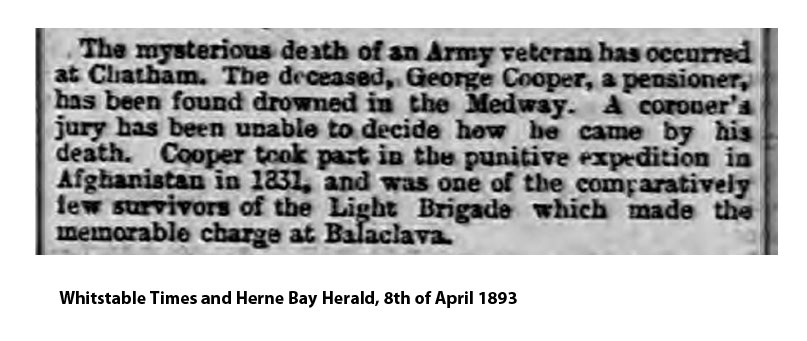
George Cooper's death by drowning, possibly a suicide, reported in the Whitstable Times and Herne Bay Herald, 8th of April 1893. Other newspapers reported the event.
(Click on image to enlarge)
The mysterious death of an Army veteran at Chatham. The deceased, George Cooper, a pensioner, has been found drowned in the Medway. A coroner's jury has been unable to decide how he came by his death. Cooper took part in the punitive expedition in Afghanistan in 1831 [actually 1841], and was one of the comparatively few survivors of the Light Brigade which made the memorable charge at Balaclava.
[Source: Whitstable Times and Herne Bay Herald, 8th of April 1893.]
George Cooper's death reported in the Nottingham Evening Post, 30th of March 1893.
(Click on image to enlarge)
SAD DEATH OF A BALACLAVA HERO
George Cooper, an old army pensioner, has been found drowned in the Medway, at Maidstone. How he got into the water is unknown. Deceased took part in the Punitive expedition in Afghanistan in 1841 [sic], and was present at the memorable charge by the Light Brigade at Balaclava.
[Source: Nottingham Evening Post, 30th of March 1893.]
[PB: There are numerous references to similar articles to follow up here
This report states that GC had been missing for seven weeks, and hints at a sacking and drunkenness (though which came first is not stated). Notice his name is given as "John" Cooper. The verdict — "found drowned" — is perhaps evasive.]
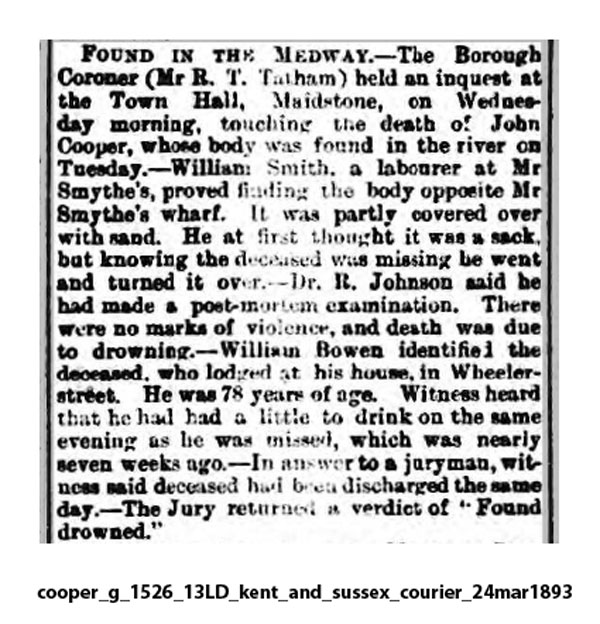
The inquest into George ("John") Cooper's death by drowning, reported in the Kent & Sussex Courier — Friday 24 March 1893, 24th of March 1893. He was missing for seven weeks, having "been discharged" presumably from "Mr Smythe's Wharf". He had been drinking.
(Click on image to enlarge)
FOUND IN THE MEDWAY.
— The Borough Coroner (Mr B. T. held inquest the Town Hall, Maid-tone, on Wednesday morning, touching the death of John Cooper, whose body was found in the river Tuesday.
— William Smith, laborer Mr. Smythe's, proved finding the body opposite Mr Smythe's wharf. It was partly covered over with sand. He at thought it was a sack, bat knowing the deceased was missing went and turned it over.
— Dr. R. Johnson said he had made a post-mortem examination. There were no marks of violence, and death was due to drowning.
— William Bowen identified the deceased, who lodged at his house, in Wheeler-street. He was 78 years of age. Witness heard that he had had little drink the same evening he was missed, which was nearly seven weeks ago.
— In answer to a juryman, witness said deceased had been discharged the same day.
— The Jury returned verdict "Found drowned."
[Source: Kent & Sussex Courier, Friday 24 March 1893.]
[PB: there is a little more info. here. GC was described as a night watchman employed by the Gas Company, was "active for his age", "his mind was all right"< and that although he had been drinking he "was quite sensible":]
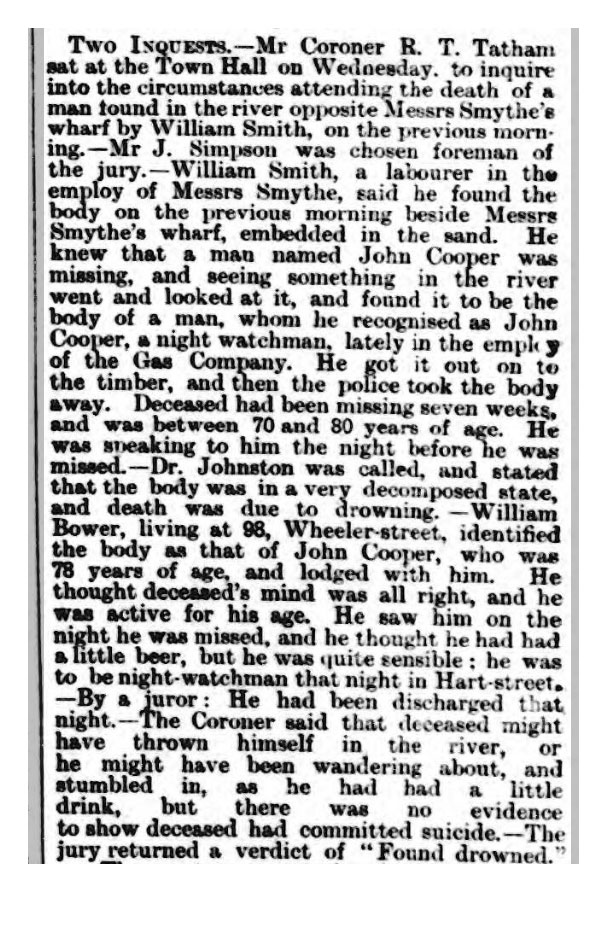
The inquest into George ("John") Cooper's death by drowning, reported in the Maidstone Journal and Kentish Advertiser, Thursday 23 March 1893.
(Click on image to enlarge)
TWO INQUESTS.
— Mr Coroner R. T. Tatham sat at the Town Hall on Wednesday, inquire into the circumstances attending the death of man found in the river opposite Messrs Smythe's wharf by William Smith, on the previous morning.
— Mr J. Simpson was chosen foreman the jury.
— William Smith, a labourer in the employ of Messrs Smythe, said he found the body on the previous morning beside Messrs Smythe's wharf, embedded in the sand. knew that a man named John Cooper was missing, and seeing something in the river went and looked at it, and found it to be the body of man, whom recognised as John Cooper, a night watchman, lately in the pay of the Gas Company. He got it out on to the timber, and then the police look the body away. Deceased had been missing seven weeks, and was between 70 and 80 years of age. was speaking to him the night before he was missed.
— Dr. Johnston was called, and stated that the body was in a very decomposed state, and death was due to drowning.
— William Bower, living 98, Wheeler street, identified the body that of John Cooper, who was 78 years of age, and lodged with him. He thought deceased's mind was all right, and he was active for his age. He saw him the night he was missed, and he thought he had had a little beer, but he was quite sensible; he was to be night-watchman that night at Hart street.
— By a juror: He had been discharged that night.
— The Coroner said that deceased might have thrown himself in the river, or he might have been wandering about, and stumbled in, as he hail had a little drink, but there was no evidence to show deceased had committed suicide.
— The jury returned a verdict "Found drowned."
[Source: Maidstone Journal and Kentish Advertiser, Thursday 23 March 1893.]
References & acknowledgements
Registration of Rebecca Cooper's death, and Census information for 1891 & 1901, kindly provided by Chris Poole.
r