Born in the parish of All Saints, Peasholme, York, Yorkshire, c.1810. (Some sources say St Cuthbert's, which amounts to the same place, i.e. York's Fishergate area.)
PB: It is interesting to relate GC's military career to his early life [Check with someone who knows York's history?], and became an iron moulder before joining the 11th Light Dragoons at York Barracks, less than a mile south of Fishergate.
The cattle and other livestock market was located in the Fishergate area until 1827, when it was moved to nearby Paragon Street, just outside the city walls. The Shambles were also close. "The influx of farmers, drovers and buyers led to a great many pubs and inns being built in the area, some with extensive stabling and overnight accommodation."
Fishergate leads directly into Fulford Road, where the Cavalry Barracks had been erected in 1795-6.
PB: See the informative discussion in Ancestry.co.uk: What was an Iron moulder?: An iron moulder made moulds (usually from sand) from which castings were made (by an iron founder or caster). It is likely that a moulder would have started as a founder since to make moulds that work one would need to know how molten iron flowed and cooled. A moulder was higher paid than the founder.
This raises the question of why a relatively well-paid, skilled man would have chosen to be a soldier (on a horse). (At just the time that the first railways were being created nearby, which is likely to have increased the demand for a man with his skills.) It is easy to speculate but impossible to know without other evidence.
Notice that GC suffered in the Crimea from rheumatism that chiefly affected his right arm. Was this perhaps related to his earlier work in a foundry?
[PB: When exactly were the 11th Hussars or other cavalry regiments using York Barracks?]
Enlisted at York on the 31st of October 1832.
Age: 21.
Height: 5' 7".
Trade: Iron-moulder.
Appearance: Fresh complexion. Hazel eyes. Brown hair.
Tried and imprisoned by Regimental Court-martial: 13th of June — 2nd of July 1833. [What for? Did his offence perhaps relate to his imminent embarkation for India?]
Embarked for India on the 14th of July 1833.
[PB: The regiment had been in India since [1819].]
GC returned to England in 1838, having served 4 years 4 months in India [W97].
Tried and imprisoned by Regimental Court-martial: 7th of August — 9th of October 1839.
1841 Census
Hampton Court Barracks, Hampton, Middlesex
George Coultate, 27, Soldier 11th Regiment of Hussars, not born in the county.
[Source: Ancestry: George Coultate, 1841 Census.]
Tried and imprisoned by Regimental Court-martial: 7th of September-21st of October 1843.
[PB: Cardigan was at Pockthorpe Barracks Norwich in 1851 — was the rest of the regiment there? In fact, George and Sarah Coultate can be found with two daughters, Jenny and Sarah, in the Ipswich Barracks.]
1851 Census
Queens Barracks, Ipswich
George Coultate, Soldier, Married, 37, Private 11th Hussars, born York, Yorkshire.
Sarah Coultate, Wife, Married, 30, Soldier's wife, born Spratton [?], Northamptonshire.
Jenny Coultate, Daughter, 3, Soldier's daughter, born Manchester, Lancashire.
Sarah Coultate, Daughter, 10 months, Soldier's daughter, born Ipswich, Suffolk. [PB]
[Source: Ancestry: Sarah Coultate. If "Spratton", see e.g. Wikipedia: Spratton.]
In the Crimea, his next of kin was his wife, Sarah Coultate, born c.1820. [PB: Try to find out more about their marriage.]
Three children were born into the Coultate family between the years 1848 and 1852: Jane, born in York c.18?, and Eliza and Sarah, born in Dublin c.1850 [PB: EJB's source? Notice Jane is named Jenny in 1851, and birthplaces are different.]
According to Laurence Crider, GC sent a remittance of £1.10.0 to Sarah on 21.2.1854 (In Search of the Light Brigade (2004), p.163).
The regiment left Ireland for the Crimea in May 1854.
GC was tried by a District Court-martial on the 2nd of October 1855 for "habitual drunkenness". Given 50 lashes and to lose 1d. per day for 6 months.
Invalided to England from Scutari on the 19th of March 1856.
Sent to Chatham Invalid Depot from Newbridge on the 1st of January 1857.
Discharged, "Medically unfit", from Chatham Depot on the 17th [19th?] of March 1857 [1856?]:
"Was attacked by rheumatism at Balaclava whilst serving with the Army in the Crimea. This has now settled in the right arm and it is most unlikely that he will ever again become efficient. Attributable to the climate and not aggravated by vice or mis-conduct."
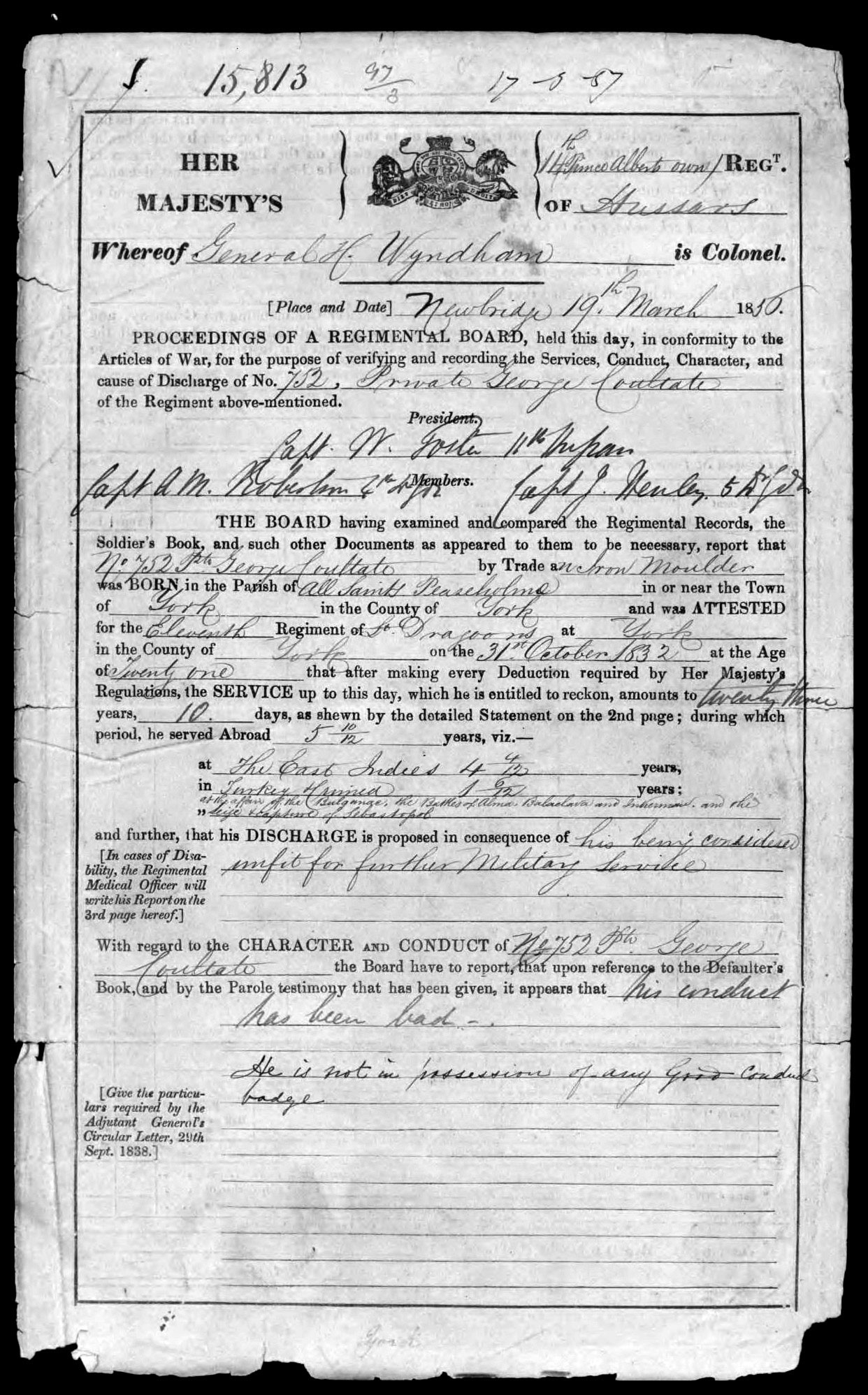
[PB: Examine in detail. Is there a second page? The date appears to be given as 19th March 1856, not 1857 (though notice an annotation "17-3-57" at the top). Did he lose time? He enlisted in 1832, so by 1856 he would have served for over 24 years, and over 25 years if 1857.]
Served 23 years 10 days.
Served abroad 5 years 10 months.
In Turkey and the Crimea: 1 year 6 months.
"At the affair of the Bulganac, the Battles of Alma, Balaclava and Inkerman, and the Seige and capture of Sebastopol."
In India: 4 years 4 months.
Aged 45 years 9 months on discharge.
Conduct and character: "His conduct has been bad. He is not in possession of any Good Conduct badges."
Awarded a pension of 1/- per day on discharge. He was living in the Leeds Pension District in 1861.

Entitled to the Crimean medal with clasps for Alma, Balaclava, Inkerman and Sebastopol, and the Turkish medal.
Documents confirm the award of the Crimean medal with four clasps.
His name was on the list of members of the Balaclava Commemoration Society in 1877 but not on the 1879 revised list.
[RM: It is very likely that GC was a Charger — he is absent from the 1879 list because he died, aged 69, at York in the December quarter of 1878.]
The 1871 Census shows him as a "Pensioner" [RM]
1871 Census
23, Edward Street, Walmgate, York.
George Coultate, Head, Married, 61, Pensioner, born York, St Cuthbert.
Sarah Coultate, Wife, Married, 51, b. Spratton, Northamptonshire.
George Coultate, Son, 16, Carter, b. York, St Lawrence.
William [Inkerman] Coultate, Son, 14, Scholar, b. Chatham, St Mary's.
Jane Coultate, Daughter, 10, Scholar, b. York, St Lawrence. [PB]
[Source: Ancestry: George Coultate.]
[PB: Jane, born 1861? Above it says Jane/Jenny was born c.1851 above. Check.]
Death registration
[George Coultate] died aged 69 at York in the December quarter of 1878. [RM]
In February 2018 the EJBA was contacted by Alison Bradley, GC's great-great-great-grand-daughter, who was kind enough to send a copy of his WO97 document (above) and other information (see below).
[PB: I have some difficulty in interpreting these notes. But notice e.g. GC sent a remittance of £1.10.0 to his wife Sarah on 21.2.1854. The sun symbol denotes someone who fought in the Crimea but who (in LC's view) did not Charge. RM, however, believes it is very likely that GC did Charge. Is there evidence one way or the other in LC's notes?]
[PB: In February 2018, Alison Bradley contacted the EJBA asking for information about George Coultate. I sent a link to this page, and she replied with some fascinating additional information.]
George Coultate is my great-great-great-grandfather. I have obtained a copy of his military discharge certificate, which I have attached...
Interestingly, George's first child was named Alma Coultate and a later son named William Inkerman Coultate, so we've always been interested to find out more!
In the 1841 census his parents were living with his younger brother Henry in Blyth's Yard, Walmgate, and his other brother Thomas was in a separate property in Blyth's Yard with wife and first child.
I came across 2 theses which give a good description of the housing conditions at the time. They were pretty grim, by all accounts, so I wonder if the army seemed like a good option?
(See e.g. https://humanities.exeter.ac.uk/media/universityofexeter/collegeofhumanities/history/exhistoria/volume7/Creating_the_slum-_representations_of_poverty_in_the_Hungate_and_Walmgate_districts_of_York,_1875-1914.pdf.)
I also found a couple of appearances in the York Gazette for brawling, in 1831 and 1832, prior to enlisting, which seems to be commonplace in the slums of that area. These are attached.
In terms of his children, I have Jenny (b.1849 Manchester), Sarah (b.1850 Ipswich), George (b.1854 York), William Inkerman (b.1857 Chatham) and Jane (b.1860 York).
I also attach a newspaper article about the theft of George's Crimean medal.
The final documents I've attached relate to his pension, but I'm not fully clear how to interpret them! Otherwise I have no further specific information relating to his military career.
I am in contact with 2 cousins of my father, who are also direct relatives of George Coultate and I believe they may have more information, so I will ask the question and let you know. I had George's date of death from them as 27 October 1878, but I will find out exactly what information they have.
[ADD ATTACHMENTS.]