Born at Gissing, near Diss, Norfolk, and baptised at St. Mary's Church there on the 18th of May 1819. He was the son of George Baker, a school-master, and his wife, Harriet.
1841 Census
Church Street, Diss.
Charles Witting, 50, Tea Dealer.
Mary Witting, 45.
Hannah Witting [future wife], 15.
Thomas Witting, 12.
1851 Census
Charles Witting, 60, Tea dealer, born Diss.
Mary Witting, 53, born Roydon.
Hannah Witting [future wife], 29, born Diss.
also includes one lodger.
Enlisted at London on the 24th of June 1837.
Age: 20 years.
Height: 5' 8".
Trade: Shoe-maker.
Appearance: Fresh complexion. Grey eyes. Brown hair.
From Private to Tptr. 3rd of January 1839.
Resigned to Private in order to embark for India. 5th of June 1840.
From Private to Trumpeter: 7th of January 1841.
Returned to duty as Private, 1st of June 1842.
From Private to Corporal: 25th of September 1851.
Corporal to Sergeant: 20th of October 1854.
Sent to Scutari on the 27th of October 1854 and rejoined the regiment on the 14th of December 1854.
[PB, May 2016: CHECK! "Sent to Scutari on the 27th of October 1854 and rejoined the regiment on the 14th of December 1854" does not fit with the letter written by Sergeant Baker to his parents, from "Camp in Front of Sebastopol, Nov 7th, 1854", immediately after Inkerman.
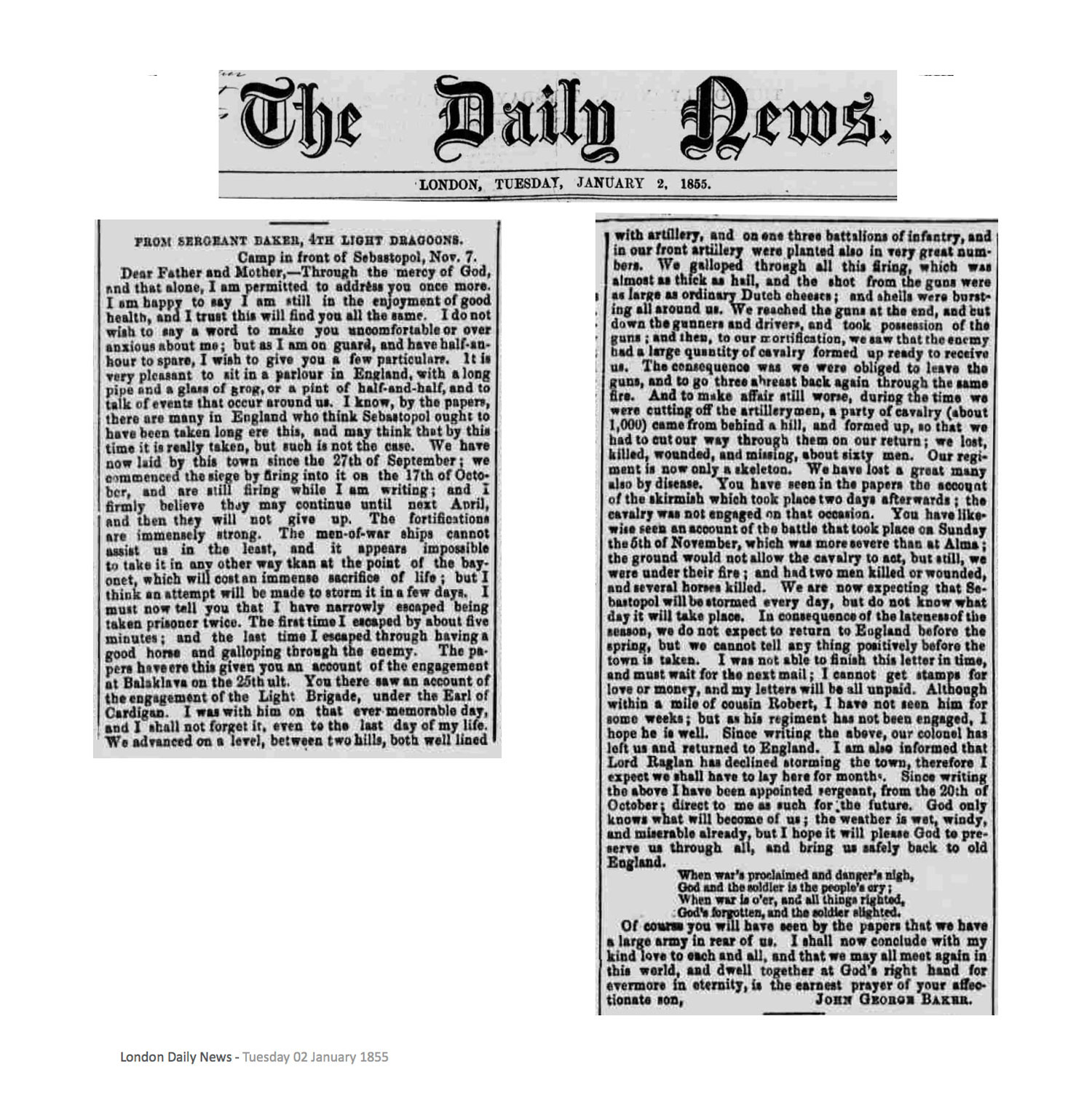
This letter is from Anthony Dawson's collection, which gives as the reference "Soldier's Letter from the Crimea", in the Leeds Mercury (30 December 1854). I have not been able to locate it there. But, as Dawson adds, the letter was also reprinted in the Daily News, 2 Jan 1855, which is where I found it. Notice JB's religiosity.]
Camp in Front of Sebastopol,
Nov. 7th, 1854.
Dear Father and Mother,
Through the Mercy of God, and that alone, I am permitted to address you once more. I am happy to say I am still in the enjoyment of good health, and I trust this will find you all the same. I do not wish to say a word to make you uncomfortable or over anxious about me; but as I am on Guard, and have half an hour to spare, I wish to give you a few particulars.
It is very pleasant to sit in a parlour in England, with a long pipe and a glass of grog, or a pint or half-and-half, and to talk of events that occur around us. I know, by the 'papers, there are many in England who think Sebastopol ought to have been taken long ere this, and may think that by this time it really is taken, but such is not the case. We have now laid by this town since the 27th of September; we commenced firing into it on the 17th of October, and are still firing while I am writing; and I firmly believe they may continue until next April, and then they will not give in. The fortifications are immensely strong. The men-of-war ships cannot assist us in the least, and it appears impossible to take it in any other way than at the point of the bayonet, which will cost an immense sacrifice of life; but I think an attempt will be made to storm it in a few days.
I must now tell you that I have narrowly escaped being taken prisoner twice the first time I escaped by about five minutes, and the last time I escape through having a good horse and galloping through the enemy.
The papers have ere this given you an account of the engagement of the Light Brigade under the Earl of Cardigan. I was with him on that ever-memorable day, and I shall not forget it, even to the last day of my life. We advanced on a level, between two hills, both well lined with artillery, and on one three battalions of infantry, and in our front artillery were planted also in very great numbers. We galloped through all this firing, which was almost as thick as hail, and the shot from the guns were as large as ordinary Dutch cheeses; and shells were bursting all around us.
We reached the guns at the end, and cut down the gunners and drivers, and took possession of the guns; and then, to our mortification, we saw that the enemy had a large quantity of cavalry formed up ready to receive us. The consequence was, we were obliged to leave the guns, and to go three abreast back again through the same fire. And to make the affair still worse, during the time that we were cutting off the artillerymen, a party of cavalry, (about 1,000) came from behind a hill, and formed up, so that we had to cut out way through them on our retreat. We lost, killed, wounded, and missing, about sixty men. Our regiment is now only a skeleton. We have lost a great many also by disease.
You have seen in the paper the account of the skirmish which took place two days afterwards; the cavalry was not engaged on that occasion. You have likewise seen an account of the battle that took place on Sunday, the 5th of November, which was more severe than at Alma; the ground would not allow the cavalry to act, but still, we were under fire; and had two men killed or wounded, and several horses killed.
We are now expecting that Sebastopol will be stormed every day, but do not know what day it will take place. In consequence of the lateness of the season, we do not expect to return to England before spring, but we cannot tell anything positively before the town is taken.
I was not able to finish this letter in time, and must wait for the next mail; I cannot get stamps for love or money, and my letters will be all unpaid. Although within a mile of cousin Robert, I have not seen him for some weeks: but as his regiment had not been engaged, I hope he is will. Since writing the above, our Colonel has left us and returned to England. I am also informed that Lord Raglan has declined storming the town; therefore I expect we shall have to lay here for months.
Since writing the above I have been appointed Serjeant, from the 20th of October; direct to me as such, for the future.
God only knows what will become of us: the weather is wet, windy and miserable already; but I hope it will please God to preserve us though all, and. bring us safely back to Old England.
When war's proclaim'd, and danger's nigh,
God and the soldier, is the people's cry;
When was is o'er, and all things righted,
God's forgotten, and the soldier slighted.
[PB: See notes below for the origins of this poem.]
Of course you will have seen by the 'papers, that we have a large army in rear of us.
I shall now conclude with my kind love, to each an all, and that we may all meet again in this world, and dwell together at God's Right Hand for evermore in eternity, is the earnest prayer of your affectionate son.
[Source: Letter from Sergeant John George Baker (number 888), 4th Light Dragoons, to his parents, in Dawson,
Letters from the Light Brigade, pp.144-145. he cites "Soldier's Letter from the Crimea", Leeds Mercury (30 December 1854), and says the letter was also reprinted in the Daily News (2 Jan 1855). PB: I have not found it in the Leeds Mercury. ]
Marriage registered
John George Baker married Hannah Elizabeth Witting, September Quarter 1856, Depwade.
Birth registered
Alice Mary Baker, September Quarter 1857, Depwade.
1861 Census
Castle Street, Ruthin.
John George Baker, 42, Troop Serg-Major (Army), born Gissing.
Hannah E Baker, 40, born Diss.
Alice M Baker, 3, born Diss.
Discharged from Dublin, "at his own request, after 24 years' service", on the 2nd of July 1861.
Served 24 years 290 days.
In Turkey and the Crimea: 1 year 10 months
In India: 1 year 4 months. (He had joined the regiment in India on the 28th of October 1840.)
Conduct: "a good soldier."
In possession of three Good Conduct badges when promoted.
Never entered in the Regimental Defaulters' book. Never tried by Court-martial.
Aged 44 years 2 months on discharge.
To live in Ruthin, Denbighshire, Wales, but he was living in West London in 1863.
Awarded a pension of 1/7d. per day, but this was increased to 1/8d. from the 8th of November 1871.
Entitled to the Crimean medal with clasps for Alma, Balaclava, Inkerman and Sebastopol.
He was awarded the Long Service & Good Conduct medal on the 25th of November 1858, with a gratuity of £5.
He was recommended for an increase in the gratuity with his Long Service & Good Conduct medal on the 1st of March 1859 from £5 to £10, and this was agreed to.
Attended the first Balaclava Banquet in 1875.
Member of the Balaclava Commemoration Society in 1877 and 1879.
Signed the Loyal Address to the Queen in 1887.
Attended the Re-Union at the Alexandra Palace on the 25th of October 1890.
1871 Census
Tapster Street, Barnet.
John G Baker, 52, Relieving Officer and Chelsea Pensioner, born Gissing.
Hannah E Baker, 50, born Diss.
Alice M Baker, 13, scholar, born Diss.
1881 Census
Tapster Street, Barnet.
John George Baker, 62, A Pensioner of Chelsea Hospital and Relieving Officer of Barnet, born Gissing.
Hannah E Baker, 60, born Diss.
Alice Mary Baker, 23, born Diss.
1891 Census
22, Tapster Street, Chipping Barnet, St Albans.
John George Baker, 72, Retired Army Pensioner, born Gissing.
Hannah Baker, 70, born Diss.
Alice Mary Baker, 33, born Diss.
Died on the 8th of May 1893 and was buried in the old Baptist Church burial ground in Union Street, Potter's Bar.
Deaths registered
John George Baker, aged 74 years, June Quarter 1893, Barnet.
Hannah Elizabeth Baker, aged 77 years, March Quarter 1898, Barnet.
The burial registers of the Potters Bar Baptist Church show the following:
Entry 220. The remains of John George Baker were interred May 12th 1893, aged 74 years. The Revd. F. Matthews officiated.
Entry 283. The remains of Hannah Elizabeth Baker were interred February 8th 1898, aged 77 years. The Revd. W. Emlyn Jenkins officiated.
The records do not show the address from which either of them was brought.
Extracts from the Barnet Press, 20th of May 1893 [PB: it is possible two articles have been run together here]:
"Death of a Balaclava Hero"
"We regret to have to record the death on the 8th last of Sergeant-Major John George Baker at the age of 74, one of the few remaining veterans who took part in the ever memorable charge at Balaclava.
Serjeant-Major Baker enlisted into the 4th Light Dragoons in June of 1837, at the age of 18. He served in India for about two years.
At the outbreak of hostilities between Turkey and Russia, he went with his regiment to the seat of war, remaining there throughout the campaign and taking part in several engagements.
At the close of a diary, kept by him with true military precision, is the following interesting note. -"John George Baker was by the providence of God, spared throughout the whole Russian War, and embarked at Scutari for England on Monday, May 5th 1856 and landed at Plymouth, Friday, May 30th. They embarked for the Crimea with 250 horses, not more than six of which lived to return home, nor above one squadron of the entire regiment."
Sergeant-Major Baker was honestly proud of his three medals — one was for good conduct and long service, one the Turkish medal and one the Crimean medal with four clasps, for Alma, Balaclava, Inkerman and Sebastopol.
He was for two years in a Yeomanry regiment in Wales, and quitted that service in 1861. Since then he has worthily filled the post of relieving-officer in Barnet for 24 years, resigning the position in 1885.
He enjoyed but a short period of well-earned rest, for three months after his retirement a stroke of paralysis left him shattered in body and enfeebled in mind.
The last few weeks of his life were passed in suffering such as only his unwavering faith in his God, and his soldierly courage could have carried him patiently through. His mortal remains were laid to rest today (Friday) in the little grave-yard at Potter's Bar.
A correspondent who was intimate with the late Mr. Baker says: He was born in Norfolk in 1819; and at the age of eighteen enlisted into the 4th Light Dragoons (now the 4th Hussars).
He saw a great deal of service in various parts of the world, and was one of the 600 who composed the immortal Light Brigade at Balaclava.Singularly enough, he passed through that terrible charge unharmed; out of eight men who turned out of one tent that morning, he was the only one who returned to it at night — five had been left in the Valley of Death and the remaining two had been wounded.
After the battle he was sent out with an ambulance party to aid the wounded, and at this occupation he was twice again under fire. He served for twenty-four years in the Army, retiring from it with the rank of Sergeant-Major.
On leaving the Army he was appointed Regimental Sergeant Major to a Yeomanry Regiment in Wales, where he served for about two years. Then he obtained the appointment of Relieving Officer to the Barnet Union; a post he held for twenty four years, retiring on a superannuating allowance in 1885.
A few months after his retirement he was seized with paralysis, which seriously affected his eye-sight and powers of locomotion.
Mr. Baker left the army with a clean hospital sheet and a clean defaulter's sheet, the latter a convincing proof of his exemplary character in the regiment, which character he maintained in his private life.
While his health permitted, Mr Baker attended the annual banquets of the survivors of the Light Brigade. The numbers of these veterans is now rapidly diminishing, and soon there will be none remaining to answer the roll-call here on earth...
The late Sergeant Major Baker
In referring to the death of the late Sergeant Major J. G. Baker, the Revd. J. Matthews made a pulpit reference at the Barnet Congregational Church on Sunday evening, in which he said an event of special importance had occurred in the history of the church in the sad departure of their esteemed friend, Mr. Baker.
For many years he had been associated with the work of the Church and the psalmody, to which he rendered long and efficient service.
The late Mr. Baker's religious life commenced at the age of 16, when at a camp meeting he devoted himself to the service of Christ and for fifty-eight years he had done so. He was present throughout the entire Crimean campaign and was one of the gallant band who rode into the Valley of Death.
During twenty-four years of that period he had served his country in Crown service. No doubt much of the suffering of his later years was caused by the exposure incurred during that war.
As a servant of the Board of Guardians he had faithfully discharged the duties of his office and won the confidence and esteem of the Guardians.
He bore his long and painful illness with fortitude. To all young men he (the preacher) commended the example of Sergeant-Major Baker as a proof of the energy religion imparts to the character.
Some thought religion was effeminate, but let them look back to the masculine character and heroic devotion of their departed friend as proof of the vigour and manliness of true Christian manhood."
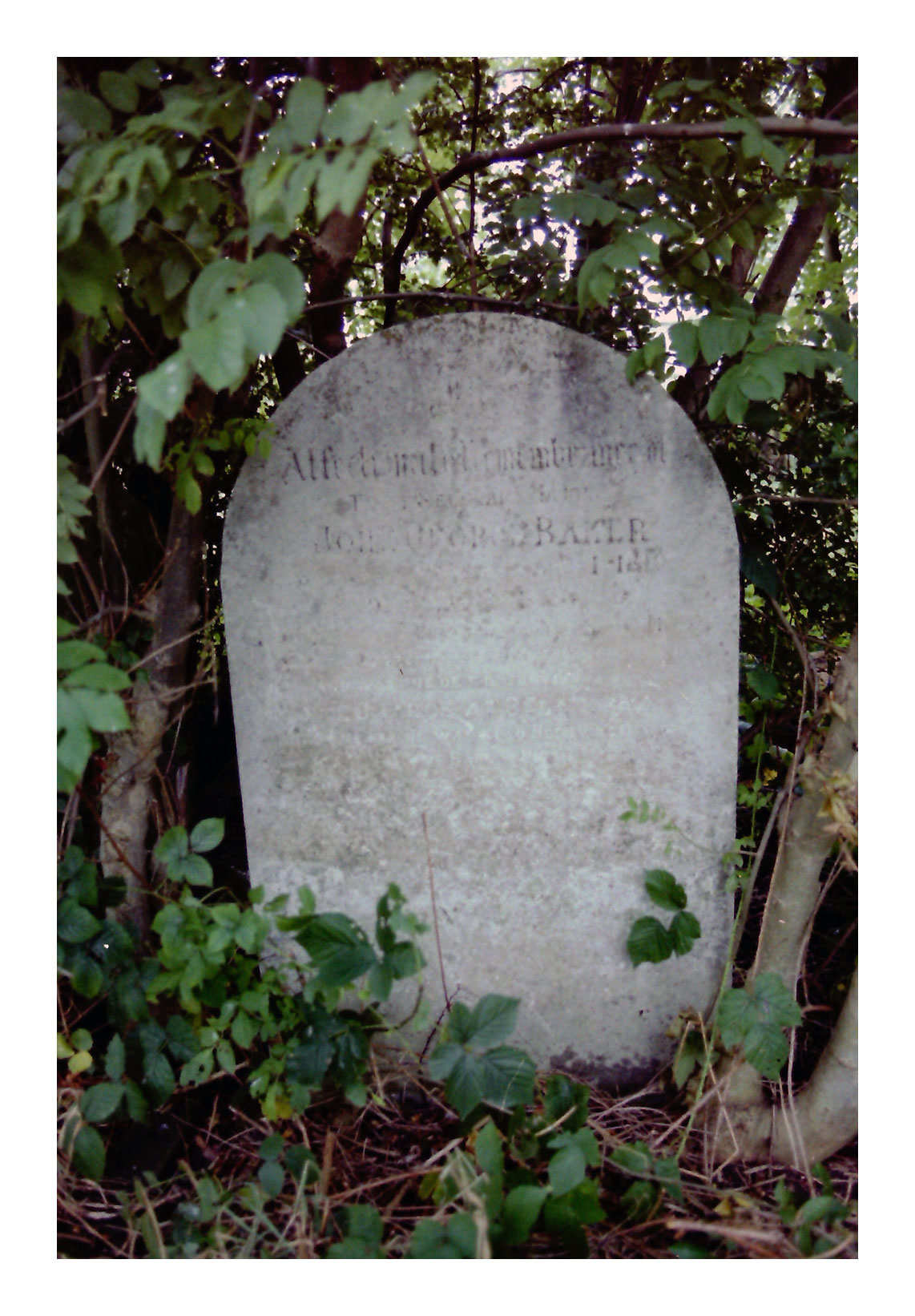
The erected memorial stone is now (1983) in a very dilapidated state and most of the inscription is almost unreadable.
Careful deciphering of the inscription on his tombstone has now (1985) revealed almost all the wording, or at least what refers to him and is as follows:
"In affectionate remembrance of John George Baker. Born at Gissing, Norfolk. April 1st 1819. — Died May 8th 1893. Joined the 4th Light Dragoons, June 26th [sic] 1837. Served with the Regiment throughout the Crimean War and was a survivor of the Charge at Balaclava. Afterwards Relieving Officer of the Barnet Union." Also "...... "Eliza ......
The rest is illegible, but could refer to his wife. There is also a small foot-stone on the grave which bears the initials, "J.G.B." and the year, "1893."
There is a photograph of the stone in the 4th Hussar file.
It is now [1990] learnt that during the previous year the part of the graveyard in which he was interred has been cleared and turned into a car-park. All the removed headstones (which includes that of John G. Baker) have been placed around an outside wall.
Death registered
Hannah Elizabeth Baker, aged 77 years, March Quarter 1898, Barnet.
1901 Census
John George Baker, Hillcrest Avenue, Potter Newton, Leeds.
Alice M Baker [John Baker's daughter], 43, single, living on own means, born Diss.
[Living with Charles S Witting and his family, listed as cousin. See 1841 & 1851 Census details above for the Witting connection, i.e. her mother's family.]
1911 Census
7, Leopold Street, Leeds.
Alice Mary Baker [daughter], 53, single, Boarder, born Diss.
[She is living with Eliza Sophia Baker, widow, and her step-daughter, Maud, and servant. No relationship is stated.]
John George Baker
BORN: Diss [Norfolk]
OCCUPATION[S]: Shoemaker
1st REGIMENT NO: 888
ENLISTED: 23 06 1837 London
ATTESTED: 30 06 1837
TROOP NO: Jan 1839: Depot Troop
RANK: 1837: Private
1839: Private, Trumpeter,
1840: Trumpeter, Private
1841: Private, Trumpeter
1842: Trumpeter, Private
1Q 1848: Private, Clonmel, Waterford, Clonmel
1851: Private, Corporal
1854: Corporal, Sergeant
1855: Sergeant
1861: Troop Sergeant Major
PROMOTIONS: From Private to Trumpeter 03 01 1839, Depot
From Private to Trumpeter 06/07 01 1841
From Private to Corporal 26 09 1851 vice Prince resigned
From Corporal to Sergeant 20 10 1854 vice Kelly promoted
REDUCTIONS: From Trumpeter to Private on embarkation, 05 06 1840
From Trumpeter to Private on arrival in England and reduction of troops 31 05 1842 / 01 06 1842
MEDALS: Crimea, Alma, Inkerman, B[alaklava] clasps. List dated 07 01 1855.
EMBARKATIONS: 05 06 1840 Java England
10 11 1841 Mary Bombay India
DISEMBARKATIONS: 26 10 1840 Java India
12 03 1842 Mary Gravesend England
DISCHARGED TO OUT PENSION: 23 07 1861 Dublin
DISCHARGED TO OUT PENSION: 23 07 1861 Chester
PENSION DISTRICT: 1861: Chester
1863: North London 1
1865: North London 1
NOTES: Troop Sergeant Major at discharge
NOTES: 4Q/1855: 11 days on ship, 81 days on shore
TNA SOURCES: WO/12/647-652
WO/12/655
WO/12/657
WO/12/659-660
WO/12/666
WO/23/52
WO/23/62
WO/180/24
[Source: Wendy Leahy, shadowsoftime.co.nz/4ths/dragoonb/baker8.html (accessed 18.5.2016).]
Additional marriage, birth and death registrations, and Census information for 1841, 1851, 1861, 1871, 1881, and 1891 kindly provided by Chris Poole.
The editors are very grateful to Wendy Leahy for allowing us to quote from her website, Shadows of Time (http://shadowsoftime.co.nz/).
[PB: Where is the verse in JB's letter home from? Where did he learn it? Was it widely repeated by soldiers at this time — it certainly has been since?]
When war's proclaim'd, and danger's nigh,
God and the soldier, is the people's cry;
When was is o'er, and all things righted,
God's forgotten, and the soldier slighted.
It is remarkably similar to Kipling's "A Time for Prayer" [date?]:
"In times of war and not before,
God and the soldier we adore.
But in times of peace and all things righted,
God is forgotten and the soldier slighted."
See also http://www.bartleby.com/73/1731.html:
Francis Quarles (1592 — 1644)
Our God and Souldiers we alike adore,
Ev'n at the Brink of danger; not before:
After deliverance, both alike required;
Our God's forgotten, and our Souldiers slighted.
FRANCIS QUARLES, "Of Common Devotion," The Complete Works in Prose and Verse of Francis Quarles, ed. Alexander B. Grosart, vol. 2, p. 205 (1880).
President John F. Kennedy quoted this in remarks to members of the First Armored Division, Fort Stewart, Georgia, November 26, 1962: "Many years ago, according to the story, there was found in a sentry box in Gibraltar a poem which said:
God and the soldier, all men adore
In time of danger and not before
When the danger is passed and all things righted,
God is forgotten and the soldier slighted.
This country does not forget God or the soldier. Upon both we now depend. Thank you." — Public Papers of the Presidents of the United States: John F. Kennedy, 1962, p. 840. The First Armored Division had been deployed during the Cuban crisis.
It is quoted slightly differently on http://www.military-quotes.com/military-poems.htm
Our God and soldier we alike adore.
Even at the brink of danger; not before;
After deliverance, both alike requited.
Our God's forgotten, and our soldiers slighted.— Francis Quarles (English poet), 1632