Trial & imprisonment
In November 1863 he was again in trouble, this time for assaulting another soldier and stealing the latter's medals. For this he was given three years' penal servitude, with hard labour. He also forfeited his Victoria Cross.
One cannot help feeling he had rather a raw deal in this affair, although his conduct during the previous three years or so must have been taken into account.
The following is an account of the trial taken from "The Times":
"Western Circuit, Winchester, 3rd of December 1863.
Valentine Bambrick, a soldier, and Charlotte Johnston, spinster, were indicted for violently assaulting Henry Wilmer Russell and stealing from his person four medals to the value of 30/- at Aldershot on the 15th of November 1863. Mr. H.T. Cole prosecuted...
It appears that the prisoners were standing at the door of a common lodging-house in Pickford Street, Aldershott, at night, on the 15th of November last. Russell, who was a Lance-corporal in the Commissariat Corps came up, Bambrick asked him to drink, and he took some beer out of his pint. They then went into Russell's room, who lodged in the house, and Russell said he would stand them some beer and was in the act of giving the female some money to get the beer when Bambrick seized him by the throat, threw him on the bed, and took from his breast four silver medals, one for the Punjab, one for the Sutlej and one for the Crimea [it does not say what the fourth medal was]. Russell called "Murder," and his cries were heard by some of the other soldiers, who rushed into the room and took Bambrick off Russell and he was conveyed to the guard-room. Two of the medals were afterwards found in the passage of the house. Russell was insensible, having been nearly choked...
Bambrick made a long address to the jury. He stated that he had been in the service for ten years and would have been discharged the day after the occurrence. He had a pension of £10 and what was dearer to the heart of any soldier, a Victoria Cross, but he would tell the jury the real facts. On the night, when he was walking with the female prisoner towards the house, in which she also lodged, he heard cries of "Murder." He hastened towards the house, and running inside, saw a girl named Hayley, coming out of Russell's room. She was crying, and said that Russell had almost strangled her.
He ran into the room and struck Russell and they had a struggle together and then the other soldiers came in and took them up. These facts could have been proved the first day of the Assizes, because Hayley was still in Winchester, but as she was what was called "an unfortunate," she could not afford to remain in Winchester.
The learned judge having summed up, the jury found the prisoners "Guilty," and the judge said he would defer passing sentence until the morning...
Bambrick, - It is of no consequence what you do to me now. I don't care about my pension, but I have lost my position. I don't care what you do to me. You may hang me if you wish...
This morning his Lordship passed sentence. - He said, "Valentine Bambrick, I do not know when I have had a more painful duty than in considering your case. I have felt great anxiety about it and have considered everything you urged in your defence; but the evidence which satisfied the jury has also satisfied me and it does now appear to be as clear a case as was ever tried. You may say that you had a witness and that witness might have put some other construction on the matter. If you had made an application to have had your trial postponed I should have been the first to have listened to your application and I cannot help thinking that from the intelligence you have shown you must have been aware that you could have made such an application.
I am bound to say that I do not think any witness could have altered the facts; you were found in a deadly struggle with another man. He was under you and the witness has said that when he found you Russell was almost choked and suffocated by the pressure of your hand on his throat. It is also perfectly clear that he was robbed of his medals, and some were found in the house where the woman lodged. How could they have come to be there; how did they come from the breast of Russell.
I have no doubt that you have exhibited great gallantry and great courage and have well entitled yourself to the Victoria Cross. If it had not been for your character I would have put the facts under the provisions of a recent statute and subjected you to personal castigation, but as it is I will deal with your case without this consideration. I should have been delighted if the jury could have seen their way to a doubt. I believe you must have been under the influence of drink for there is no other reason since the value of the medals is so trifling. Your punishment must be severe. It must be penal servitude for three years.
With regard to you, Charlotte Johnston, you took a very subordinate part in the affair..."
Bambrick, holding up the girl's hand. "Look at this small hand, my Lord. She could never hurt a strong man. She was merely in the room."
The Judge, "When I say she only took a subordinate part I shall not punish her so severely as the male prisoner. She must be imprisoned, with hard labour, for 12 months."
Bambrick, "There won't be a bigger robber in all England when I come out."
The case was tried by Mr. Baron Piggott."
There is a copy in the files of a newspaper report of the trial of Valentine Bambrick taken from the "Hampshire Chronicle" dated 5th December 1863, which differs in some respects from the previously known reports:
ASSAULT. Valentine Bambrick and Charlotte Johnson, spinster, were charged with violently assaulting Henry Milner Russell, and stealing from his person four medals, value 30s, his property, at Aldershot on the 15th November 1863. Mr. Cole prosecuted.
It appeared that the prosecutor (Russell) was invited by Bambrick on the evening in question, whilst passing through the street, to take some ale in a private house at Aldershot, the male prisoner standing with a pot of ale in his hand. Prosecutor offered to stand some drink in return, and he put his hand into his pocket to get the money, when the male prisoner seized him and threw him down, the female assisting in holding the prosecutor, who was a lance-corporal, down.
During the affray the soldier lost the four medals from his breast, which the prisoners had torn off, and made their escape with. On the landing two of the medals were picked up by the landlord, and the prisoners were both apprehended the same evening.
Bambrick, in defence, said he was going up to the room of the female prisoner, when he saw another female leaving her room, and she appealed to him for protection. A fight ensued, in which the prosecutor lost his medals. He (Bambrick) urged that if his better feelings would not have prevented him committing such a paltry robbery, his interest would, for he was in possession of a medal more prized by the British soldier than all those possessed by the prosecutor - the Victoria medal, which conferred £10 annually upon him, and also a pension, all of which he would lose if convicted.
He urged that it would have been much easier for him to have dashed the beer he had in his hand in the prosecutor's face whilst in the street if he wanted to rob him of his medals, and averred that the prosecutor had generally stated in his evidence that which was false.
The proof of the prisoner's guilt, however, was considered to be conclusive by the jury, who immediately found them both guilty of the charge.
On hearing the verdict Bambrick immediately change his tone, spoke most contemptuously of the Court, and said he did not care what his sentence should be, and threatened that he would be revenged on Henry Russell.
His lordship said it was most sad to see a soldier in the position of the prisoner - one holding so high a mark of honour conferred upon him by his country, and that he should take time to consider his verdict.
The prisoners were subsequently sentenced - Bambrick to three years' penal servitude, and Charlotte Johnson to twelve months imprisonment.
Forfeiture of his Victoria Cross, 1863
Copies of letters relating to the forfeiture of his Victoria Cross:
"The Staff Officer for Pensions, Southampton. December 8th, 1863:
With reference to my letter of the 21st ultimo. I am directed by the Secretary of State for War to acquaint you that his attention has been called to a report of the trial of Valentine Bambrick at a recent Assizes at Winchester which was contained in "The Times" newspaper of the 5th inst. It appears from the report that this man was convicted of the offence of which he stood charged and the Secretary of State has not yet received any communication from you on the subject. I am accordingly directed that you will, without delay, obtain and forward a certified copy of this conviction with a view to the erasure of this man's name from the Victoria Cross Registry and from the list of Victoria Cross Annuities in conformity with the provisions of her Majesty instituting this high distinction."
Warrant erasing the name of Valentine Bambrick, late of the 87th Regiment, from the Victoria Cross Registry and the cessation of his pension:
"Victoria, right trusted and Well Beloved Cousin and Counsellor greets you well. Whereas by Warrant and Royal Sign Manual and Signatory bearing date and at our Court at Buckingham Palace this day 29th of January 1856...
Whereas it has been reported to us that Valentine Bambrick, late of the 1st Battalion of the 60th Rifles and subsequently of the 87th Regiment and upon whom we have conferred the said decoration for his conspicuous bravery at Bareilly on the 6th of May 1858 was tried at the Winter Gaol Delivery held at the Castle of Winchester, in the County of Southampton on the 30th day of November last for having feloniously and violently assaulted one Henry Milner Russell and stolen from his person four medals, for which offence he has been convicted and sentenced to three years penal servitude.
We hereby authorise and require that you, in pursuance of our said recited warranty forthwith to erase the name of the said Valentine Bambrick from the registry of individuals upon which the said decoration has been conferred and to cause the pension which was conferred upon him under Rule 14th of our said warrant to cease and determine from the date of the present warrant under the said warrant Royal Sign Manual and to sign accordingly that it is our further will and pleasure that you do cause these presents to be indented into the Registry of the said Decoration and in so doing this shall be your warrant...
Given at the Court of Windsor the 3rd day of December 1863 in the 27th year of our Reign...
Signed, Lord Grey de Ripon, Under Secretary of State."
"Home Office, 22nd of January 1864.
Sir, I am directed by Lord Grey de Ripon to request that you will state to the Secretary, Sir George Grey, that it has been notified to this Department that a man named Valentine Bambrick, a discharged soldier of the 87th Regiment of Foot and a recipient of the Victoria Cross and who was convicted at the Winter Gaol Delivery held at Winchester in the County of Southampton on the 30th of November last for having feloniously assaulted one Henry Milner Russell and stolen from his person four medals and her Majesty has accordingly been pleased to direct under the Royal Sign Manual dated the 3rd ultimo, that the name of this man should be erased from the Victoria Cross Registry and the pension conferred on him as a recipient of the Cross shall cease from the date of such warrant.
It appears from the statement from the Governor of Winchester Gaol that Bambrick is undergoing sentence in his custody and that Lord de Grey directs me to request that this Officer returns to this Department the Victoria Cross which it is presumed was in the man's possession at the time of his conviction, to be retained by her Majesty's Secretary of State for War, pending her Majesty's pleasure...
Signed, Edward Legard."
From the Letter Book, (HO/23/13.) These are communications and orders to the Governors of the various prisons, Visiting Magistrates of same and, at the time, to a Lt. Col. Henderson, an official of some degree responsible for the prisons at the Home Office.
"The Visiting Magistrates, Winchester Prison. 18th January 1864.
Letter No. 59473.
The Secretary of State for War having desired the return to this office of the Victoria Cross granted to Valentine Bambrick, who was convicted of robbery at the last Hants Assizes, I am directed to request that if the Cross is in the custody of the Governor of the Gaol it must be forwarded to me in order for its being sent to the War Office.
H. Waddington."
"To Lt. Col. Henderson. 17th March 1864.
Letter No. 59474.
I am directed to request that you will ascertain whether Valentine Bambrick, a military convict now in Pentonville Prison, has his Victoria Cross on his person, and if so, you will forward it to this office for transmission to the Sec. of State for War, the prisoner having forfeited the decoration by his conviction...
H. Waddington."
Canon Lummis, who had for many years been the historian of the V.C. and George Cross Association, stated that this Victoria Cross was in the possession of the Curator of the Regimental Museum of the Rifle Brigade at Winchester. Enquiry of the latter however, revealed that this was not so and the Curator had no knowledge of the whereabouts of the medal or any details of Valentine Bambrick himself. (A copy of his record was sent.)
He was the third man, and second soldier, out of the eight known forfeitures of the Cross. Under the provisions of the Royal Warrant, none of these forfeitures was gazetted. There were no restorations of them either.
From the "United Services Gazette", 16th of April 1864:
"We have seldom recorded anything more remarkable or pathetic than the details of this melancholy case. The poor fellow, it appears from the evidence, found himself in one of those dens of infamy, which, thanks to the disgraceful neglect of the military authorities, Aldershott Camp is surrounded, and whilst there his attention was aroused by the screams of a woman who was being beaten, or alleged she was being beaten, by a fellow-soldier.
The chivalry of the Victoria Cross man was at once aroused; he went to the defence of the woman and in the struggle which ensued, the medals and bars of his antagonist were torn off, and fell to the ground. Bambrick picked them up and placed them on the mantel-shelf, from where of course, they were soon stolen by some of the inmates of the den, and he was arrested and tried for the theft, found guilty; disgraced and imprisoned and when his fervent spirit giving way under the shock, the result was his death in the penitentiary by his own hand, or, to use his own awful words, the crime of that sin 'which admits of no pardon'."
Enquiry of Messrs. Hancocks (makers of the Victoria Cross since its inception) and research of the records shows that the Victoria Cross awarded to Valentine Bambrick was never returned to them after its forfeiture:
"We are of the opinion that actual re-possession of a Cross after its forfeiture would be difficult, and in practice, near impossible. None of the forfeited Crosses have ever been returned to us for possible re-issue to another. It is known by Hancocks's that a Cross, believed to be genuine, was returned to the authorities after having been forfeited, but no records exist of its ever having been submitted to us for an opinion as to its being the original. At least two forfeited Crosses are known to be in the hands of collectors."
The following came as part of a reply to an enquiry made (about the same question) to the Victoria Cross and George Cross Association:
"The possibility of restoring to the "Roll" those who have forfeited their V.C.s has been mentioned before, but as far as I know, nothing has been done. The various crimes committed by those who have forfeited their V.C.s do not seem all that terrible to us now, but no doubt in the climate of the day they were considered to matter greatly. I think that one of the reasons why successive Governments have not seen fit to advise the Monarch to take this restoration action is the practicality of what can easily be a meaningless gesture...
The most recent forfeiture was more than 70 years ago and it is, I believe, almost impossible to discover just who is the next lineal descendant. There is, also, the complexity of deciding what to do with each V.C., if indeed, they can be found. I believe one was sold not so many years ago, but I think it was sold from one collector to another. How it got into the open market in the first place I do not know.
It seems very possible that in Victorian and Edwardian times the authorities did not worry at all if the actual medals awarded could not be recovered and no-one seems to know what was done with those that were. At my last enquiry, some years ago, no Government Department held any. We have tried to keep notes of where V.C.s actually are, but the list is far from complete and includes no record of that awarded to Bambrick."
The letter was signed by the Chairman of the Association, Rear Admiral Godfrey Place, V.C., C.B., D.S.C.
Suicide in Pentonville Prison, 1864
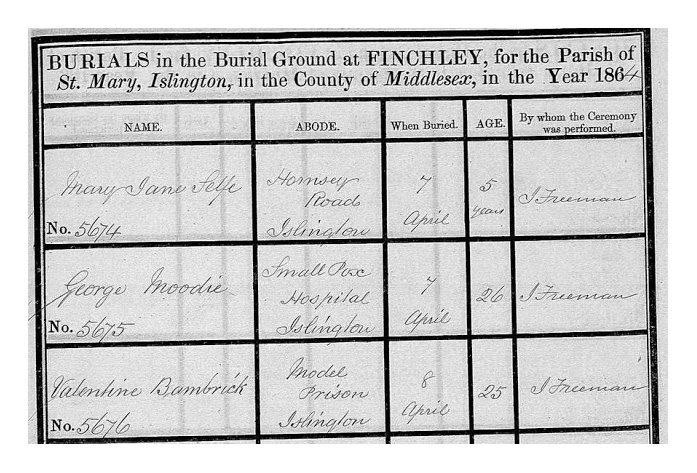
Valentine Bambrick committed suicide, by hanging, in Pentonville Prison on April Fool's Day 1864.
Extract from the Prison Book of Pentonville Jail:
"Number. 2009.
Name: Valentine Bambrick.
Age: 28 years.
Marital status: Single.
Read and Write: Well.
Charge: Robbery and Beating.
Sentence: Three years penal servitude.
Received from: Hants. County Prison, 22nd January 1864. No previous convictions.
Length of Separate Confinement: To serve 1 year 23 days.
To be visited by: Father, John. Barrack Master, Hyde Park Cavalry Barracks. London.
Conduct: Good.
Religion: C. of E.
Remarks: Committed suicide by hanging. 1st of April 1864."
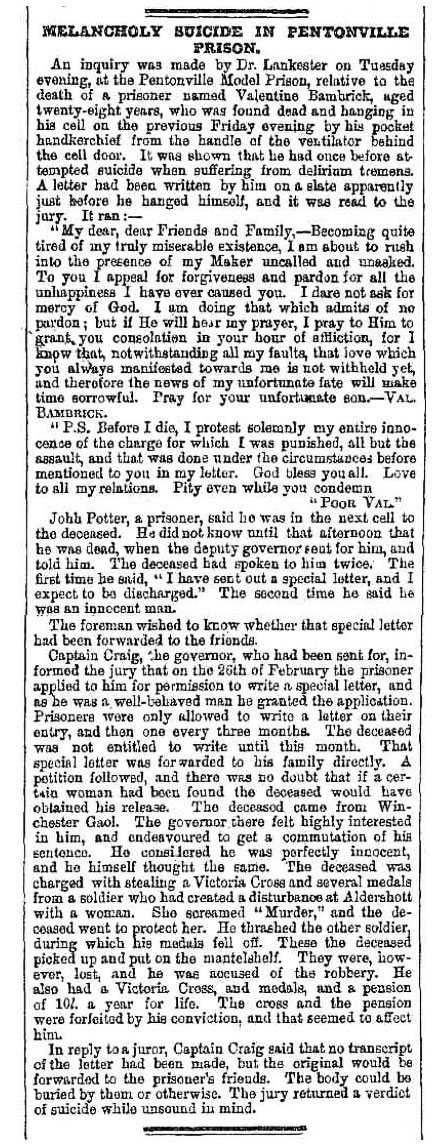
Account of Valentine Bambrick's suicide, on the front page of Reynolds's Newspaper, Sunday 10th April 1864.
(Click on image to enlarge)
Report of the inquest,from the "Islington Gazette" of the 9th of April 1864:
"Suicide at Pentonville Prison"
"Dr. Lankester held an inquest on Tuesday evening at Pentonville Prison relating to the death of a prisoner, Valentine Bambrick, aged 28 years, who was found dead and hanging in his cell on Friday evening last. Dr. Charles Lawrence Bradley, chief medical officer at the prison said that he had been told that the prisoner fretted, as he was being unjustly punished for a crime of which he was not guilty. His mind was no doubt impaired and he had suffered from 'delirium tremens'.
A letter was written on a slate which might be worth the attention of the jury. On the production of the slate the Governor read the following letter.
My dear, dear Friends and Family,
Becoming quite tired of my miserable existence I am about to rush into the presence of my Maker uncalled and unasked. To you I appeal for forgiveness and pardon for all the unhappiness I have ever caused you. I dare not ask for mercy of God. I am doing that which admits of no pardon; but if He will hear my prayer, I pray to Him to grant you consolation in your hour of affliction, for I know that, notwithstanding all my faults, that love which you have always manifested towards me is not withheld yet, and therefore the news of my unfortunate fate will make time sorrowful.
Pray for your unfortunate son - Val. Bambrick.
P.S. Before I die, I protest solemnly my entire innocence of the charge for which I was punished, all but the assault - and that was done under the circumstances before mentioned to you in my letter. God bless you all.
Love to all my relations. Pity even while you condemn
Poor Val
Captain Craig, the Governor of the goal, informed the jury that on the 24th of February the prisoner applied to him for permission to write a 'Special letter' and as he was a well-behaved prisoner he granted the application. That special letter was forwarded to his family directly. A petition followed, and there was no doubt that if a certain woman had been found the prisoner would have been released. He came from Winchester Gaol, and the Governor there, feeling highly interested in the prisoner endeavoured to get him a commutation of the sentence. He considered him perfectly innocent, as did he, (Captain Craig).
The deceased had been charged with stealing a Victoria Cross and several other medals from a soldier who had created a disturbance in a brothel in Aldershott with a prostitute. (There is no record of a man named Henry Milner Russell as being awarded the Victoria Cross.) The deceased also had the Victoria Cross and another medal and a pension of £10 a year for life. The latter however, was forfeited by the conviction and whilst the deceased was in prison an order from the Secretary of State for War arrived, directing that the Victoria Cross which had been obtained by the deceased should also be forfeited and this had affected the prisoner.
The jury returned a verdict of 'Suicide, while he being of unsound mind.'"
"To Lt. Col. Henderson, 9th April 1864.
Letter No. 59473.
I am directed by Sir George Grey to acknowledge the receipt of your letter reporting that Valentine Bambrick has committed suicide at Pentonville Prison and to state that Sir George Grey hopes that measures can be taken to prevent the possibility of further suicides occurring in any cells in this, or any other Government Prison by placing the means of this happening out of reach of prisoners.
Sir George Grey's attention has also been called to the report in the newspapers of the inquest held in this case in which, if the report is correct, it appears that the Governor of Pentonville Prison expressed a very confident opinion that the prisoner was innocent of the crime of which he had been convicted.
Sir George Grey does not know by what means, if any, the Governor had of forming an opinion, except from the statements of the prisoner himself, and it appears to him very inexpedient that Governors and Officers of Prisons should show and give opinions as to the guilt or innocence of prisoners without knowing fully all the facts of the case.
In this instance there has been a reference by the Judge before whom the prisoner was tried and who entertained no doubts of his guilt and a further enquiry was made at his suggestion, both of the Prosecutor and the Prisoner, the result of which was to confirm the opinion of the Judge.
H. Waddington."
Commemoration of Valentine Bambrick, 2002
PB / 22.12.12:
In September 2002 a plaque was unveiled to Valentine Bambrick in a chapel in St Pancras and Islington Cemetery. A number of articles, copied here, explain the history of the event:
Rifleman Valentine Bambrick
In March 2001 an official of the Finchley Society attended a lecture by the Barnet Borough Archivist. In the lecture mention was made of Rifleman V Bambrick, KRRC, who had been awarded the Victoria Cross for gallantry at Bareilly in 1858 and had in 1864 committed suicide in Pentonville Prison. He was buried in an unknown and unmarked grave in the St Pancras and Islington Cemetery.
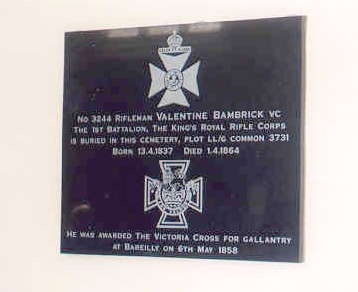
This information was passed on to the 60th regimental secretary, who suggested to the Chairman of the Celer et Audax Club that a plaque in memory of Rifleman Bambrick should be put up in the chapel of the cemetery. This was agreed, and the RGJ Trustees kindly agreed that the RGJ War Memorial Fund would pay for the black marble plaque, with silver lettering.
Research disclosed that Bambrick had transferred to the 87th Foot (The Royal Irish Fusiliers) in 1860, when the 60th left India, and that he left the Army in 1863. Born in Cawnpore in 1837, he came from an Army family - his father was a Troop Sergeant-Major in the 11th Light Dragoons, who had served at Waterloo and the capture of Paris. His uncle, after whom he took his Christian name, was also a Troop Sergeant-Major in the 11th Light Dragoons, while his younger brother John rode with the 11th Hussars in the Famous charge of the Light Cavalry Brigade at Balaclava in 1854.
The 1st 60th, after its gallant involvement in the siege and capture of Delhi in 1857 under command of Lt Col J Jones, in May 1858 was part of the Roorkhee Field Force, under command of Jones, now a Brigadier. The battalion on 6 May 1858 took part in the hard-fought capture of Bareilly, during which Bambrick showed "conspicuous bravery when in a serai he was attacked by three Ghazees, one of whom he cut down. He was wounded twice on this occasion". He was subsequently awarded the Victoria Cross.
Discharged at Aldershot on 16th November 1863, he became involved in a fracas on that very day when he saw a Private Russell beating a woman. After the ensuing fight, before which Russell had removed his medals, Bambrick was accused of stealing them. Tried on 3rd December 1863, the only prosecution witness was Russell, whose story was accepted without question, resulting in Bambrick's conviction and sentence to 3 years' penal servitude in Pentonville Prison. As a convicted felon he had to forfeit his Victoria Cross.
(Footnote: The harsh interpretation of these rules about forfeiture became less so in 1908, and in 1920, on the intervention of George V, were abolished)
As a result of which he committed suicide on 4 April 1864, leaving a note that he did so in remorse for losing his VC.
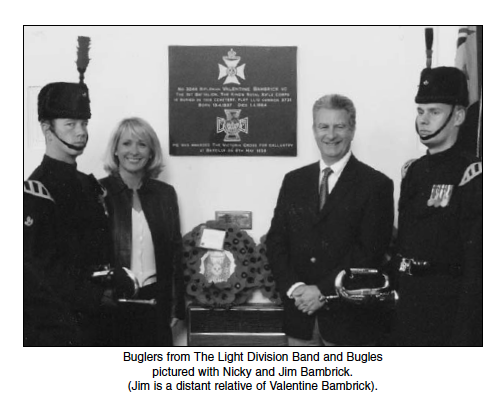
The plaque was unveiled at a short ceremony on 10th September by Lieutenant-General Sir Christopher Wallace, the Chairman of the Celer et Audax Club, followed by some appropriate prayers by the Reverend Colin Fox, the Regimental Chaplain, and the sounding of "Last Post" and "Reveille" by Buglers Jolle and Topp. Wreaths were laid on behalf of the Celer et Audax Club, the KRRC Association, and Islington Borough Council, and those present then moved off to the local community centre for a simple, but excellent lunch.
Representing the Celer et Audax Club were Lieutenant-General Sir Christopher and Lady Wallace, Brigadier Vere Hayes and Colonels Ian McCausland and Mike Robertson, supported by Lt Col Jan Dirk von Merveldt and Major Tim Matthews of the Royal Green Jackets and Mr Richard Frost and 11 members of the KRRC Association.
Guests included the Major of Islington, the Deputy Mayor of Barnet, the cemetery manager, the Borough archivist, nine officials of the Finchey Society, Mrs Didy Grahame, secretary of the VC & GC Association, and Mr & Mrs Jim Bambrick, the great grand-son of Valentine Bambrick's brother.
The ceremony and lunch afterwards, at which General Wallace and the Mayor of Islington made short speeches, was much appreciated by both hosts and guests, one of whom wrote "it was an extremely moving ceremony and so beautifully and fittingly done". Certainly the 60th contingent felt that the record had been somewhat set straight after the tragic circumstances of Bambrick's death.
AN INJUSTICE RECTIFIED
By Brian A Harrison
Former Sergeant 1st Bn KRRC & 2nd Green Jackets (KRRC)
and QMSI, SASC
FOR SOME CONSIDERABLE time now, the inside back cover of the KRRCA Journal has featured a listing of all members of the 60th who have bravely earned the Victoria Cross; but, to my knowledge, no one has ever compiled such an absorbing and academic article about them than that submitted last year by Major Ron Cassidy MBE. It will serve as a work of reference for many years to come and I would like to thank him, on behalf of all readers of the Journal, for his efforts in bringing everything together.
In reading through Major Ron's listing, it came as something of a shock for me to learn that one of our Riflemen - Valentine Bambrick VC - had not only been compelled to return his medal to the Queen but had taken his own life while a prisoner in Pentonville prison. In my detailed studies of prisoners in the Tower of London (and other prisons), I knew, probably more than anyone else, that inmates' lives had been very harsh and severe in olden times, even through to the Victorian age; but, in the back of my mind, I seemed to recall that someone had once said, `Even were a holder of the VC be sentenced to be hanged for murder, he should be allowed to wear the VC on the scaffold...'
As it so happened, on 10 September 2002, I was proved right on both issues. Yes! Private Bambrick VC (The rank of `Rifleman' was not formally approved until 0 had been sentenced to three years' penal servitude in Pentonville prison after his trial on 3 December 1863 on a trumped-up charge of stealing the medals belonging to one Private Russell of the Commissariat Corps (later to become the R.A.O.C.). On the same day, he had forfeited his VC under Royal Warrant. Only four months into his heavy sentence, he had hanged himself on 1 April 1864, leaving behind a letter expressing his remorse at losing his country's highest award for valour.
And Yes! I was correct in my opinion about wearing the award on the scaffold; but the decision dated from a much kinder and less severe period of history. The wording was actually written in a letter from Lord Stamfordham, private secretary to King George V, as late as 1920. Far too late to have any influence on Bambrick's paltry charge of felony in the bleak Victorian era. It has been said that a memorial was erected in Pentonville prison in his honour, but it is also claimed that no such memorial may now be found...
It was therefore with considerable excitement that, on the said 10 September, I was one of the select few allowed to witness a short and sweet ceremony in which the Victorian injustice meted out to Bambrick was overturned and finally put to rights.
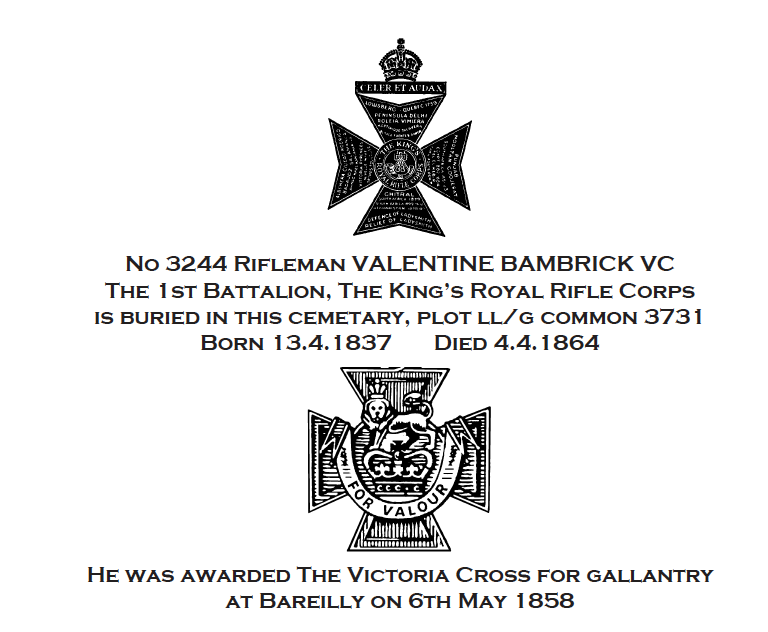
Buglers from The Light Division Band and Bugles pictured with Nicky and Jim Bambrick. (Jim is a distant relative of Valentine Bambrick). No 3244 Rifleman VALENTINE BAMBRICK VC The 1st Battalion, The King's Royal Rifle Corps is buried in this cemetery, plot ll/g common 3731 Born 04.1837 Died 4.4.1864 He was awarded The Victoria Cross for gallantry at Bareilly on 6th May 1858.
On that day, a small party, including direct descendants, Jim and Nicky Bambrick, and representatives from the VC and GC Society, gathered in St Pancras and Islington cemetery chapel to hear Lt-Gen. Sir Christopher Wallace deliver an inspiring speech explaining how, after 1st Bn 60th Rifles had earned eight VCs at the defence of Delhi in 1857, the regiment had marched 140 miles eastwards to Bareilly to deal with the Indian mutineers under Mohamed Bakht Khan. In the fierce hand-to-hand fighting on 6 May 1858, Valentine Bambrick had so distinguished himself in front of his officers and colleagues that he was nominated for the VC. Hostilities were concluded eight weeks afterwards and Bambrick, the so-called "unruly soldier", was awarded his medal later in 1859.
General Sir Christopher then went into the tragic details that resulted in Bambrick's death and burial in an unmarked grave in this cemetery. Through the efforts and interest of the Borough Archivist, Mr A. Mussell, and Mr Derek Warren and his fellow members of the Finchley Society, under the presidency of Mr W. Tyler, a suitable plaque had been mounted on the wall of the Chapel.
The General then approached the Regimental Flag hanging from the wall and drew it aside to reveal the memorial plaque which reads:
Following the laying of wreaths and prayers conducted by the Revd C.G. Fox TD, two buglers in Regimental Greens sounded the Last Post and Reveille. The assembled party then filed outside and made their way to the appropriately-named Green Man Community Centre, where a splendid finger buffet and drinks were served to all. Members of the Celer et Audax Club, under command of Colonel Ian McCausland, and members of the KRRCA, under Richard Frost, then acted as hosts for the Regiment's most welcome guests. If the speeches delivered by Councillor Margot Dunn, Mayor of Islington, and Councillor Andreas Tanbourides, Deputy Mayor of Barnet, serve as any form of yardstick, the Regiment certainly made a great impression and a good time was had by all.
Contrary to arguments raised in the past by other writers to this Journal, I have to hold my hand up and confess to the fact that I am one of the many generations of instructors who have proudly stood on the drill square in Upper Barracks, Winchester teaching young Regulars and National Servicemen the intricacies of how to `March at Ease', ending up with rifles on the left shoulder with butts upwards. It was inherent with the lesson to advise the squad that this privilege was earned by the 60th Rifles as an honour for their conduct at the Battle of Delhi. Whether this style of marching with the rifle-butt uppermost (or if it might have been the butt leading when marching as a sentry), there is no denying that the `unruly soldiers' of the 60th played a major role in crushing the Indian Mutiny at Delhi and Bareilly by using their rifle-butts during fierce fighting at close quarters.
I do not know if recruits passing through Winchester are still taught how to march at ease or how to march `as on sentry' with the SA80 rifle (although I was delighted to see Gurkha sentries marching this way at the Tower). All I do know is that the Royal Green Jackets still proudly wear a cap badge bearing the battle honour Delhi. It would be even more pleasing if they re-adopted the tradition of wearing a suitably-cut piece of scarlet material behind their badges to denote they are a `Royal Regiment' (when the Light Infantry does wear red material behind its badge without a `Royal' entitlement).
[Source for both articles above: http://www.krrcassociation.com/archives/rfn_v_bambrick_vc.pdf (accessed 22.12.12)]
On 19th January 2003, Iain Stewart posted the following:
The unveiling of a memorial plaque took place to the memory of Rifleman Valentine Bambrick Vc, 60th Rifles, at St Pancras and Islington Cemetery, where he lies in an unmarked grave
Islington, North London, 10th September 2002
A plaque in memory of Rifleman Valentine Bambrick VC was unveiled on Tuesday, 10th September 2002, in St Pancras and Islington Cemetery where Bambrick lies in an unmarked grave, of which the exact location cannot be pinpointed. The memorial plaque was unveiled by Lieutenant-General Sir Christopher Wallace, chairman of the 60th Rifles Officers' Club, attended by the Mayor of Islington, Councellor Margot Dunn, members of the Finchley Society and The King's Royal Rifle Corps Old Comrades Association.
Valentine Bambrick was awarded the Victoria Cross during the Indian Mutiny at Bareilly on 6th May 1858 "For conspicuous bravery at Bareilly, when in a Serai, he was attacked by three Ghazees, one of whom he cut down. He was wounded twice on this occasion".
Bareilly lies 140 miles east of Delhi and in the Sepoy Mutiny of 1857 the native troops stationed there rose on May 31 and left to join the rebels in Delhi in June 1857. The rebels returned to Bareilly in September after Delhi had been relieved by British Forces and were joined by several insurgent leaders with their supporters.
The British Army were despatched to Bareilly under General Sir Colin Campbell which included the Roorkee Field Force, incorporating, among other units, 1st Battalion the 60th Rifles, with whom marched Private Valentine Bambrick. General Campbell arrived at Bareilly on 6th May 1858, with the Roorkee Field Force under the command of Brigadier-General John Jones who had commanded the 1st/60th Rifles during the siege of Delhi.
The whole of the 1st Battalion took part in the assault on Bareilly. Confused fighting followed the entry of British troops into the warren of streets and alleyways. A party posted on a roof-top by Lieutenant Cromer Ashburnham, commanding D Company, gave warning of a large body of "Ghazees" towards the serai or group of buildings within which Bambrick fought his personal engagement with three of them.
(It might be considered that Bambrick's action was simply one of self-defence, but it was not unusual for the VC to be awarded to an individual who in the eyes of his comrades had most distinguished himself in a decisive action in which they had all taken part).
Valentine Bambrick was born in Cawnpore on 13 April 1837 and came of fine military stock, his father, uncle and younger brother all serving with the 11th Light Dragoons. Bambrick's own military record shows he was an "unruly soldier" but as every commanding officer knows, soldiers who are unruly in the guardroom tend to come up trumps in action.
After the action at Bareilly, Bambrick continued to serve with the 1st/60th Rifles at Seetapore, but when the battalion left for England in August 1860 he elected to stay in India and transferred to the 87th Foot, later the Royal Irish Fusiliers. He served with the 87th at the Curragh, Ireland and was discharged at Aldershot on 16th November 1863, when his luck changed.
Shortly after his discharge from the army Valentine Bambrick was involved in an incident where as he was proceeding to a room with a woman, he was approached by another female who asked him for protection from a beating by one Henry Russell. A fight ensued and later Russell accused Bambrick, and the woman he was with, Charlotte Johnson, of violent assault and of stealing his medals.
[The report from The Hampshire Chronicle, dated 5th December 1863, on the trial of Valentine Bambrick VC, is quoted in full here.]
Bambrick had placed the woman he'd saved from a beating in a hotel to present her as his only defence witness at his trial. However, owing to the length of time to bring the case to court, he lost touch with her. As a result of his conviction, Valentine Bambrick had his Victoria Cross forfeited by Royal Warrant on 3rd December 1863. Bambrick fell into a state of deep depression, and after writing a letter protesting his innocence of theft, while the fight with the other man was in defence of a woman whom the latter was murdering, he hanged himself in Pentonville Model Prison on 1st April 1864.
Although Bambrick did not seem to be aware of it, the Governor of the Prison had expected Bambrick to be released on the strength of his recommendation for a commutation of sentence. Both he and the Governor of Winchester Gaol considered Bambrick to be innocent.
The influence of King George V came into play over the forfeiture of the Victoria Cross from eight men who had been convicted of theft, bigamy and desertion. In 1920 the King wrote a letter to his private secretary, Lord Stamfordham, in which he wrote "The King feels so strongly that, no matter the crime committed by anyone on whom the VC has been conferred, the decoration should not be forfeited. Even were a VC to be sentenced to be hanged for murder, he should be allowed to wear the VC on the scaffold".
The names of all eight men, including Valentine Bambrick, were eventually added to the Register of Victoria Cross recipients.
Following King George V's decision to reinstate the Victoria Cross to those eight men who had had their medal forfeited, it is unclear if the War Office ever presented the VC awarded to Valentine Bambrick to one of his relatives. The Bambrick VC has never been sold or put up for auction and its whereabouts is unknown to this day.
Medal entitlement of Rifleman Valentine Bambrick - 1st Bn, 60th Rifles
- Victoria Cross
- Indian Mutiny Medal (1857-58)
[Source: http:/www2.prestel.co.uk/stewart/bbbambri.htm (accessed 22.12.12)]