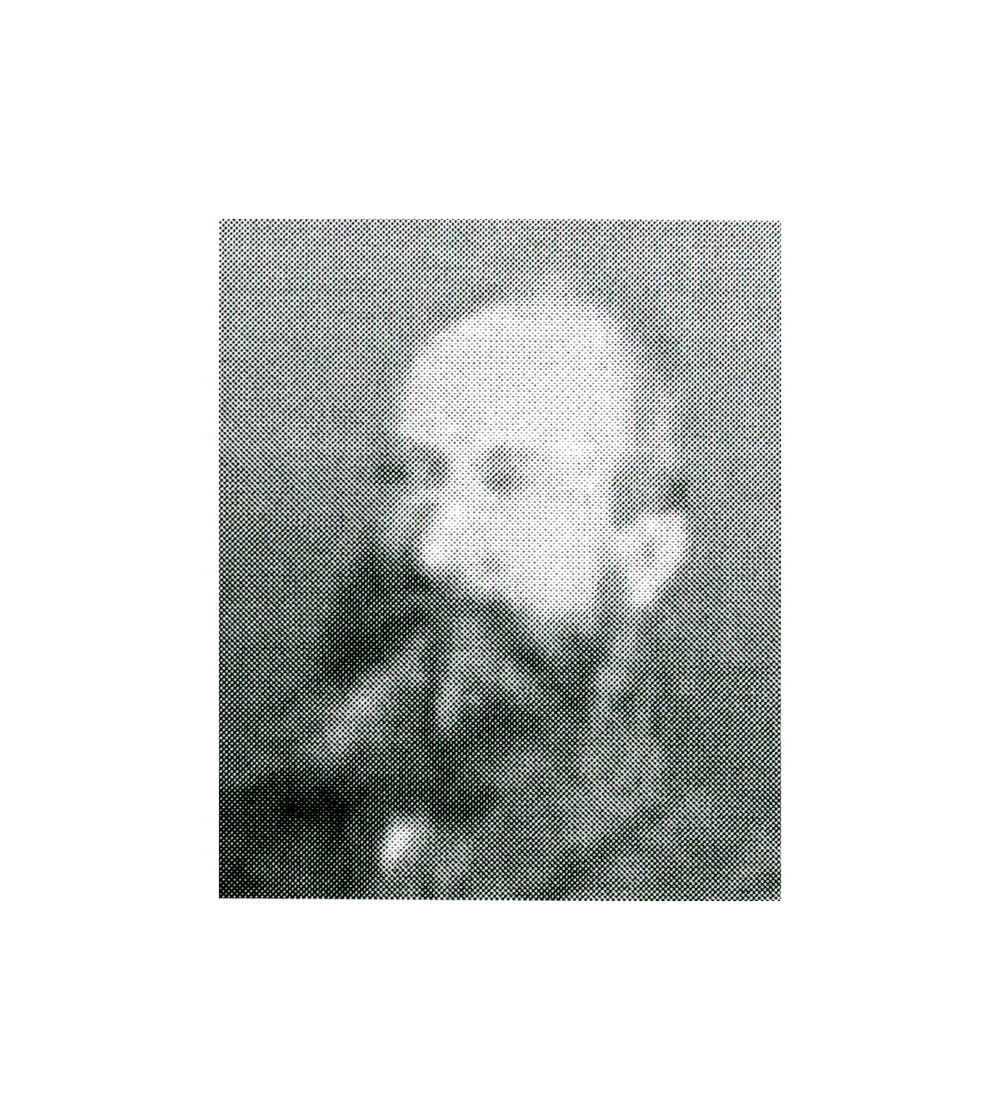
1535, Private Thomas Frederick ARMES, 4th Light Dragoons
&
Major Frederick Stewart Probyn, Royal Army Veterinary Corps [nephew?]
Birth & early life
Born in 1831 in the parish of St. Peter's Norwich, one of six sons of Thomas Armes, a Leather Cutter, of Dove Lane.
Enlistment
Enlisted at Norwich by 1215 Sergeant William Waterson on the 26th of May 1852.
Age: 21 years 11 months.
Height: 5' 8".
Trade: Clerk.
Appearance: Pale complexion. Hazel eyes. Brown hair.
Service
Both he and his horse were wounded in action in the Charge at Balaclava.
Lummis and Wynn state that he was left for dead on the field at Balaclava after a Cossack ran a lance through his leg. However, there is nothing in the medical report to substantiate this claim nor on his documents that "he was promoted to Corporal on the eve of Balaclava but rode in the Charge as a Private."
Sent to Scutari General Hospital on the 26th of October 1854, where he is said to have been nursed by Miss Florence Nightingale and Miss Stanley, the daughter of the Bishop of Norwich, before being invalided to England on the 17th of February 1855.
While in the service he had been presented with a copy of the New Testament by some of the ladies of Totnes in Devon. This was on the 14th of July 1852, soon after he had joined the army. Losing it on the battlefield of the Alma it was returned to him many years later by a soldier who had found it there.
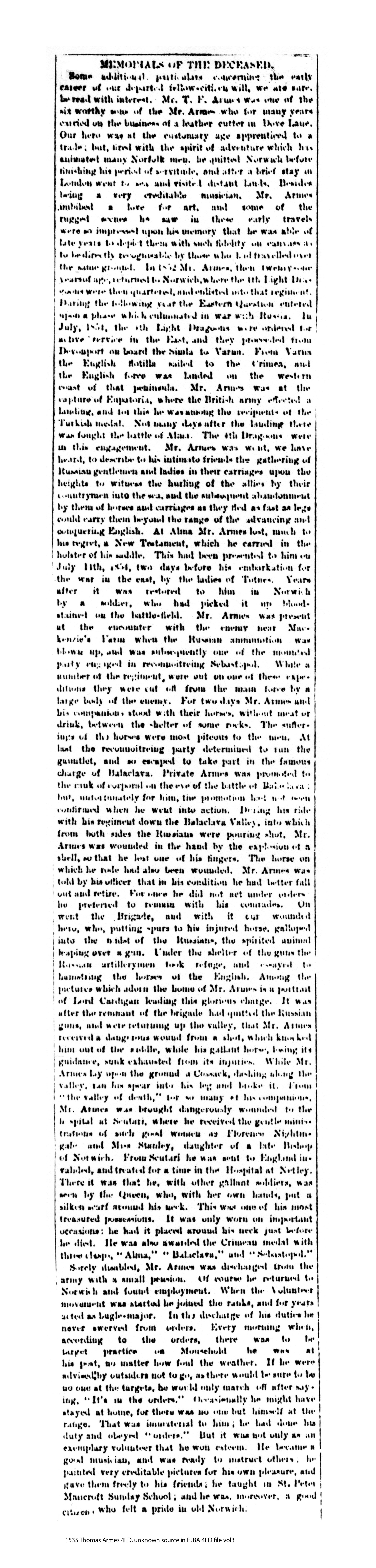
Thomas Armes's account of the Charge, unknown source, in EJBA 4LD file vol.3. TO BE TRANSCRIBED.
(Click on image to enlarge)
MEMORIALS OF THE DECEASED
Some particular details concerning the early career of our departed fellow citizens will, we are sure, be read with interest. Mr. T.F. Armes was one of the six worthy sons of the Mr. Armes who for many years carried on the business of a leather cutter in Dove Lane.
Our hero was at the customary age apprenticed to a trade, but, fired with the spirit of adventure which has animated many Norfolk men, he quitted Norwich before finishing his period of servitude, and after a brief stay in London went to sea and visited distant lands.
Besides being a very creditable musician, Mr. Armes imbibed a love for art, and some of the rugged [scenes?] he saw in those early travels were so impressed upon his memory that he was able of late years to depict them with such fidelity on canvas as to be directly recognisable by those who had travelled over the same ground.
In 1852[?] Mr Armes, then twenty-one years of age, returned to Norwich, where the 4th Light Dragoons were then quartered, and enlisted into that regiment.
During the following year the Eastern Question entered upon a phase which culminated in war with Russia. In July, 1854, the 4th Light Dragoons were ordered for active service in the East, and they progressed from Devonport on board the Simla to Varna. From Varna the English flotilla sailed to the Crimea, and the English force was landed on the western coast of that peninsula. Mr. Armes...
[FINISH OFF]
Discharge & pension
Discharged from Chatham Invalid Depot on the 16th of October 1855:
"Unfit for further service — Disabled by loss of fifth phalange of middle finger and injury to index finger of left hand by fragment of shell at Balaclava. Ring and little finger also contracted."
Served 3 years 120 days. Conduct: "a very good soldier."
Awarded a pension of 9d. per day on discharge.
Medals
Entitled to the Crimean medal with clasps for Alma, Balaclava and Sebastopol.
A note on his documents signed for, and on behalf of, the Adjutant General of Recruiting Services shows him to be entitled to the Crimean medal with clasps, as the medal roll credits him. Dated the 11th of July 1910, it would appear to have been added following an application by his relatives concerning his entitlement.
Further detailed medal information archived.
Commemorations
Attended the first Balaclava Banquet in 1875.
Member of the Balaclava Commemoration Society in 1877 and 1879.
Life after service
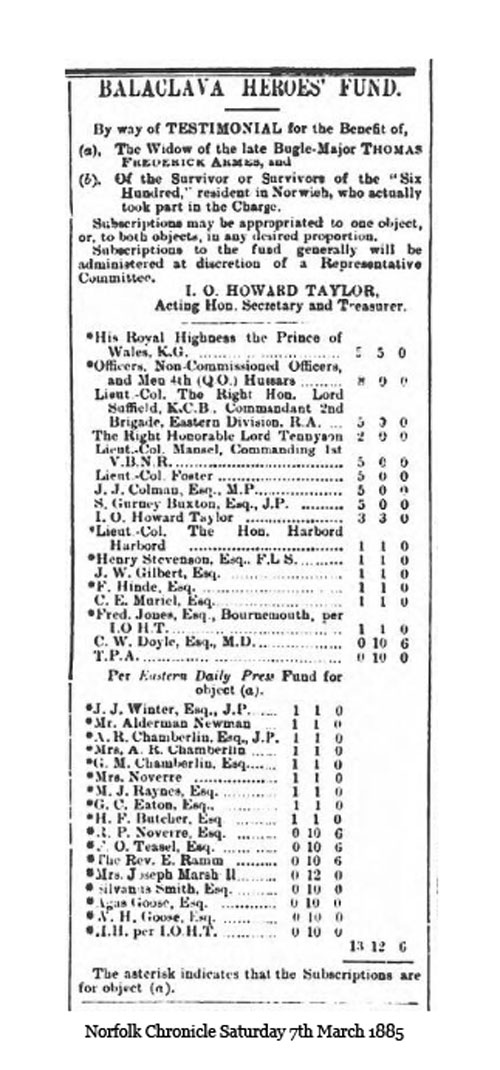
After his discharge he returned to Norwich where he became Bugle Major of the 1st Volunteer Battalion of the Norfolk Regiment.
1861 Census
Chestnut Court, St Gregory, Norwich.
Frederick T. Armes, aged 34, unmarried, Chelsea Pensioner, 4th Dragoons, born Norwich.
__________
Bethel Street, St Peters Mancroft, Norwich.
Emily Mary Ann Probyn [future wife of Thomas Armes], 26, Milliner and Dress Maker, born Kennington, Surrey.
Marriage registered
Thomas Frederick Armes married Emily Mary Ann Probyn, June Quarter 1865, Norwich.
1881 Census
, QUERY PHILIP ???.
sentence states, The 1881 Census shows him living in, ???, should this be connected to line above, namely Theatre Street ?.
1881 Census
Theatre Street, St Peter Mancroft, Norwich.
Frederick [sic] Armes, 50, Chelsea Pensioner Bugle Major of 1st NVR Corp, born Mancroft, Norwich.
Emily Mary Ann Armes, 46, born St Marks, Kennington, Suffolk [In fact, she was born in Kennington, south London. Presumably the Census enumerator added "Suffolk".]
Death & burial
Died at All Saint's Green, Norwich, on the 21st of January 1885.
Death registered
Thomas Frederick Armes, aged 57, March Quarter 1885, Norwich.
Extract from Norfolk Annals, 31st of January 1885:
"Died at All Saint's Green, Norwich, Thomas Frederick Armes, Bugle Major of the 1st Volunteer Battalion of the Norfolk Regiment. Formerly in the 4th Light Dragoons, he took part in the famous light cavalry charge at Balaclava, in which he was wounded and left for dead on the field."
In recording his death, the United Services Gazette of the 31st of January 1885 added:
"Towards the close of the famous engagement at Balaclava Armes was struck by a round shot in the ribs, which sent him flying out of the saddle.
He was at first supposed to have been killed, but through careful nursing at Scutari he, to a great extent, recovered his health, although he always suffered more or less from his wounds, especially at certain seasons. Two fingers of his right hand were cut off by a Russian cavalry soldier.
Armes lay so long at Scutari that when he was finally discharged from the hospital there, the Crimean war had terminated."
The funeral service was held in the church of St. Peter Mancroft at Norwich on the 27th of January 1885.
A full report of his life, death, and funeral, appeared in the "Eastern Daily Press" for the 28th of January 1885. (There is a copy of this newspaper report in the 4th Hussar file.)
[PB: INSERT TEXT REPORT HERE]
(Click on image to enlarge)
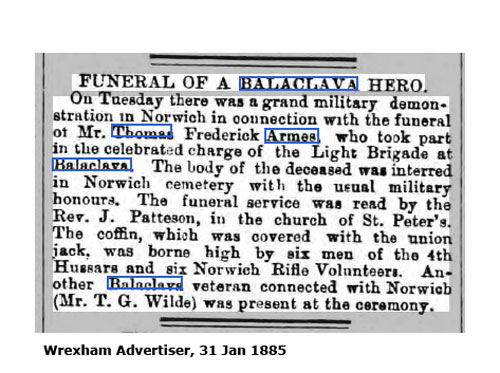
His funeral was widely reported in regional newspapers, for example this from the Wrexham Advertiser, Saturday 31 January 1885:
FUNERAL OF A BALACLAVA HERO
On Tuesday there was a grand military demostration in Norwich in oonnection with the funeral of Mr. Thomas Frederick Armes, who took part in the celebrated charge of the Light Brigade at Balaclava.
The body of the deceased was interred in Norwich cemetery witb the usual military honours. The funeral service was read by the Rev. J. Patteson, in the church of St. Peter's. The coffin, which was covered with the union jack, was borne high by six men of the 4th Hussars and six Norwich Rifle Volunteers. Another Balaclava veteran connected with Norwich (Mr. T. G. Wilde *) was present at the ceremony.
* presumably 1119 George Wilde, 13th Light Dragoons.
[PB: Some sources say a silk scarf was buried with him that he received from Queen Victoria at Netley.]
He was buried in Grave No, 100 Section 7, in the City Cemetery, Norwich, aged 54 years. His trade was given as that of a hair-dresser. His wife, Sally Mary Ann, died in March of 1919 and is buried in the same grave space.
Thomas Armes was buried in Grave No.100 Section 7, in the City Cemetery, Norwich, aged 54 years. His trade was given as Hair-dresser. His wife, Sally Mary Ann, died in March 1919 and is buried in the same grave space.
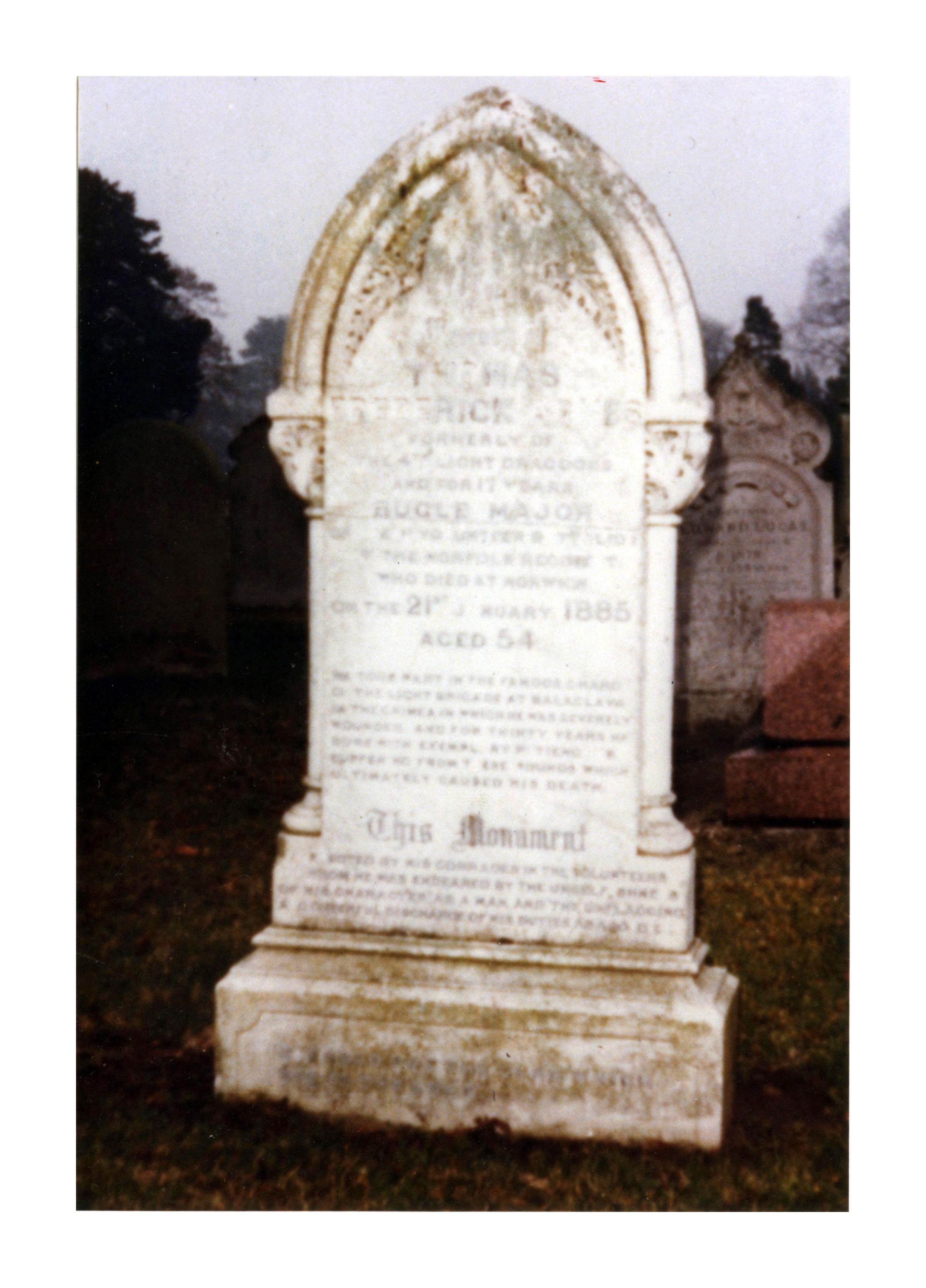
(Click on image to enlarge)
"In memory of Thomas Frederick Armes, formerly of the 4th Light Dragoons and for 17 years Bugle Major of the 1st Volunteer Battalion of the Norfolk Regiment, who died at Norwich on the 21st of January 1885, aged 54 years.
He took part in the famous Charge of the Light Brigade at Balaclava in the Crimea in which he was severely wounded and for 30 years he bore with exemplary patience the suffering from these wounds, which subsequently caused his death.
This monument was erected by his comrades in the Volunteers to whom he was endeared by the unselfishness of his character as a man, and by the unflagging discharge of his duties as a soldier."
At the base of the stone are the words: 'Blessed are the dead which lie in the Lord.'"
There is no mention of his wife on the stone, possibly owing to the length of time that elapsed before her death and there is little or no room for any other inscription on the stone.
There is a photograph of the stone in the 4th Hussar file.
(Click on image to enlarge)
1891 Census
23, Alfred Place, St Giles, Holborn.
Emily M Armes [wife], visitor, widow, 56, living on own means, born S Kennington.
1901 Census
1, Caernarvon Road, Norwich.
Emily Armes, aged 63, widow, boarder, living on own means, born Kennington, Surrey [sic].
Death registered
Emily M A Armes, aged 83, March Quarter 1919, Norwich.
Further information
In a collection along with Thomas Armes's medals are those to a relative, Major Frederick Stewart Probyn.
These medals comprise the Queen's South Africa medal with clasps for Transvaal, Cape Colony and South Africa 1901-02, when he was a Veterinary Surgeon (Civilian) attached to the A.V.D. and three World War One medals to the same man when a Major in the Veterinary Corps.
A number of "Probyns" were at the funeral of Thomas Armes, apparently as relatives, and the medals could well have been to one of these.
Thomas Armes had married Emily Mary Ann Probyn in the Church of St. Peter Mancroft at Norwich on the 11th of April 1865, so from this F.S. Probyn could have been a nephew.
Frederick Stewart Probyn
Frederick Stewart Probyn was born in London on the 26th of August 1876.
It was believed that he was born at Norwich, but his birth registration has been located by Chris Poole in the Pancras district:
He is shown in the Army Lists as a civilian veterinary surgeon in the Army Veterinary Department (A.V.D.) for a period of one year 252 days.Birth registered
Vincentia Adelaide Probyn [sister of Frederick], September Quarter 1863, Pancras.
Frederick Stewart Probyn, September Quarter 1876, Pancras.
Veterinary surgeons for South Africa
Some 100 civilian veterinary surgeons volunteered for service in South Africa. The incentive was described in a letter to the RCVS Council from a Colonel Duck, then in command of the Army Veterinary Department:
"We are in great need of first class veterinary surgeons, particularly for our transport ships. We are sending 10,000 horses a month to South Africa and we occasionally have severe losses. My object is to ask you gentlemen to make it known throughout the profession.
We give a bonus of £50 and 3s. per head on every horse landed in South Africa, presuming the loss to be 2 and a half %, a bonus of 2s for every horse landed, assuming the loss to be under 5% and a bonus of 1s presuming the loss to be under 7%.
Assuming you have a cargo of 1000 horses, a veterinary surgeon could make £200 for a month's work."
He became a Lieutenant in the A.V.D. on the 15th of April 1902; Captain, A.V.D., 15th of April 1907; Major in the R.A.V.C., 10th of July 1915.
He served in the operations in the Transvaal, March-June 1901, operations on the Zululand Frontier with Natal, September-October 1901, including the Defence of the Forts Italia and Prospect.
He was awarded the Queen's medal with four clasps, 1914 Star, British War Medal and the Victory Medal.
Major Probyn retired from the Army on the 2nd of October 1920.
1891 Census
80 Patshull Road, Pancras.
George S Probyn, 58, Brewers Collector, born Newington.
Ann Probyn, 46, born London.
Vincentia Probyn, 27, born Pancras.
Frederick S Probyn, 14, scholar, born Pancras.
One servant also shown.
1911 Census
Artillery Barracks, Chapeltown Road, Leeds.
Frederick Stewart Probyn, Captain, 34, single, Army Veterinary Corps, born Kensington.
Marriage registered
Frederick S Probyn married Daisy M.B. Manning, September Quarter 1914, Reading.
Death registered
Frederick S Probyn, aged 79, September 1956, Exeter.
Links
- Wendy Leahy, Shadows of Time website: 4th Light Dragoons Personal Records A.
- Findagrave.com states that he was buried in St Peter Mancroft Church, Norwich. No photograph is shown (accessed 28.8.16).
References & acknowledgements
Additional information about membership of the Balaclava Commemoration Society and a newspaper cutting fro 1885 kindly provided by Chris Poole.