Birth & early life
Born in Manchester c.1837.
A descendant believes he was born in Every Street, Ancoats, Manchester, and left with his parents at the age of seven to live at Glossop. [Glossop, about 15 miles west of Manchester on the edge of the Peak district, specialised in cotton spinning and calico production.] See Further information, below.
[PB, April 2014: The birth of a John Ainsworth is recorded in the October Quarter of 1837 in Manchester. But the name Ainsworth is not uncommon in the region and there are at least four children of the right age named "John Ainsworth" living in the Manchester area in 1841 (though none that I could find, after an admittedly brief inspection, in Every Street).
A 1914 obituary, quoted below, describes him as a "native of Ancoats", which also helps to explain the fact that he worked in cotton manufacturing both before and after discharge.
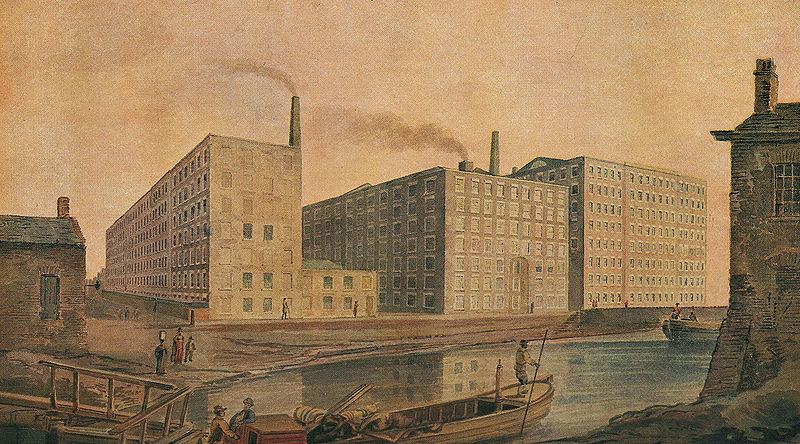
The first steam powered mills were built in Ancoats from around 1790 and proliferated after the opening of the Rochdale Canal in 1804 and Liverpool-Manchester Railway in 1830. Mills in Ancoats included Victoria Mills, Wellington Mill, Brunswick Mill, India Mills, Dolton Mills, Lonsdale Mills, Phoenix Mill, Lloydsfield Mill, Sedgewick Mill, Decker Mill, New Mill, Beehive Mill, Little Mill, Paragon Mill, Royal Mill and Pin Mill. This in turn encouraged the growth of local industries needed for the mills such as iron and brass foundries, and engineering, glass and chemical works.
McConnel and Company Mill c.1820, one of many cotton mills and factories in Ancoats. John Ainsworth had been a weaver before enlistment, and returned to it as an overlooker after discharge. Several of his children were also cotton weavers.
(Click on image to enlarge)
By 1815 Ancoats was the most populous district in Manchester. Streets of back-to-back houses and court dwellings were rapidly built. For the poorest members of the community, houses were split and cellars let separately. Public health was a concern, a survey motivated by the fear of a cholera outbreak [PB: there were major epidemics in 1832, 1848-9, and 1854] showed that over half of homes in Ancoats had no private plumbing, and over half of streets were not cleaned.
By the middle of the 19th century Ancoats was densely developed. In 1851 Ancoats' total population was 53,737, larger than towns such as Bury and Blackburn. However, despite this large population, Ancoats lacked public buildings and spaces. There were no parks and the only public buildings were a few churches and a dispensary. As late as 1821 there had been no churches.
[Source: http://en.wikipedia.org/wiki/Ancoats (accessed 18.4.2014).]
The great famine years in Ireland (1845-52) led to a great exodus of men, women and children. Many sought work in Manchester. In the 1851 Census, about half of the population of Ancoats are shown as born in Ireland.]
Service
Joined the regiment in the Crimea on the 25th of May 1855.
Tried and imprisoned from the 3rd of October — 6th of November 1857, for "breaking out of barracks when a defaulter."
In Barrack Cells, for "Absence", 28th — 30th of May 1861.
Tried and imprisoned, 11th of August — 7th of September 1861, "for insubordination".
In Barrack Cells, 14th—17th of February 1862, "by order of the Commanding Officer".
In Barrack Cells, 16th—22nd of December 1862, "by order of the Commanding Officer".
Sent to the Depot at Canterbury when the regiment went to India, 26th of July 1866.
From Private to Corporal: 1st of September 1866.
Discharge & pension
Discharged, "time expired, his having claimed it on the expiration of his limited engagement", from Canterbury Depot on the 26th of April 1867.
Served 11 years 358 days.
In Turkey and the Crimea: 6 months.
Conduct and character: "good". In possession of one Good Conduct badge.
17 times entered in the Regimental Defaulter's book and twice tried by Court-martial.
To live at No. 49 Blackfriars Street, Manchester.
Awarded a "Special Campaign Pension" of 9d. per day from the 1st of January 1897.
Life after service
[PB, April 2014:: It would seem he married twice, but it is not known who his first wife was, when she died, and whether there were any children.]
1871 Census
28, Sheffield Road, Glossop, Derbyshire.
The 1871 Census shows John Ainsworth as a Widower, aged 34, occupation "Warehouse Cotton", lodging at this address. [RM]
Marriage registered [presumably his second]
John Ainsworth and Leah Rowbottom, June 1873 Quarter, Hayfield.
Judging by the birthplaces of their children, the couple appear to have moved from Glossop to Tintwistle, about 3 miles north of Glossop, around 1876.
1881 Census
Salterbrook Road, Tintwistle.
[PB: I have not located Salterbrook Road, though there is a Salter's Brook some miles west of Tintwistle, in the Peak District.]
John Ainsworth, 44, Overlooker Cotton Weaver, born Manchester.
Leah, 34, born Glossop.
Four children shown:
Annie, 7, born Glossop
Arthur H., 5, born Glossop
Alice E., 3, born Tintwistle
Emily, 1, born Tintwistle.
1891 Census
19, Old Road, Tintwistle, Ashton Under Lyne, Cheshire.
[sic? Check Census. Old Rd, Ashton-Under-Lyne, appears to be about 6 miles north-east of Tintwistle.]
John Ainsworth, 54, Cotton Loom Overlooker, born Manchester.
Leah, 44, born Glossop.
Six children are shown:
Annie, 17, Cotton Weaver, born Glossop
Arthur, 15 Cotton Weaver, born Glossop
Alice A., 13, Cotton Weaver, born Tintwistle
Emily, 11, Cotton Weaver, born Tintwistle
May H., 7, born Tintwistle
Amy, 2, born Tintwistle.
Death registered
Leah Ainsworth, 45, September Quarter 1891, Ashton.
1901 Census
2, Ramsbottom View, Ramsbottom.
The 1901 Census records John Ainsworth as aged 64, a widower, living with his son Arthur, aged 25, born Glossop, and daughters Florence, 17, and Amy, 12, born in Cheshire [?]. [RM]
1911 Census
1, Plantation View, Summerseat, near Manchester.
John Ainsworth, 74, widower, boarder, retired Cotton Cloth Weaver, Army Pensioner, born Manchester
Amy, 20, daughter. Also a boarder.
Living with James & Florence White.
[PB: 1881 Census conflict: CP suggests the above, which seems to fit.]
Death & burial
John Ainsworth died on the 22nd of March 1914 and was buried in the Ramsbottom Cemetery on the 25th of March.
(There is a photograph of him in the 11th Hussar file.)
Extract from the Ramsbottom Observer, 27th of March 1914:
"Death of a Crimean Veteran — The interment took place at Ramsbottom Cemetery on Wednesday afternoon of Mr. John Ainsworth, of No. 5 Plantation View, Summerseat, who passed away on Sunday last at the age of 76 years. The deceased was at one time attached to the 11th Hussars (Prince Albert's Own) and saw active service, having taken part in the Crimean War. He enlisted when he was 19 years of age and was immediately sent to Sebastopol, where he remained almost two years. He was awarded a Turkish and English Crimean medal, the latter bearing the inscription, "Sebastopol."
On his return to England he was stationed for some time in London as a guard of honour to the late Queen Victoria, subsequently rising to the rank of Corporal. After 12 years service he was granted a pension on account of the hardships undergone in the Crimea. Since then he has been engaged in the cotton industry and then, after coming to Summerseat some 13 years ago, and prior to his retirement at the age of 70, was employed as a weaver and overlooker at Messrs Hoyle's, Brooksbottom Mill.
Although a native of Ancoats, Manchester, he took a deep interest in local affairs, and was President of the local Ratepayers Association. His hobby was gardening, and he was said to have had one of the prettiest gardens in the district. He was also a staunch Liberal and a church-goer. He leaves a son and four daughters to mourn his loss.
The funeral, which was of a military character, was attended by a firing party from the Bury Depot of the Lancashire Fusiliers, who walked in front of the hearse from the late residence of the deceased to the Cemetery. On arrival at the cemetery they stood with arms reversed as the cortege passed through the gates. The coffin was draped in the Union Jack, and four corporals acted as bearers. The obsequies were conducted by the Revd. G.L. Marchant, Rector of Holcombe, and as the coffin was being lowered into the grave three volleys were fired and the 'Last Post' was sounded."
[A list of family mourners and wreath-senders follows.]
According to a great-great-grand-daughter, who corresponded with EJB, no stone was erected and the grave is unmarked except for a number.
View a Map of Ramsbottom Cemetery.
Additional information about Ramsbottom Cemetery, with photographs, see e.g. genuki.org.uk/big/eng/LAN/Ramsbottom/CemeteryRdCemetery
Further information
His great-great-grand-daughter, a Mrs Hodgkinson, still [unknown date] lives at Ramsbottom. She possesses only a copy of the photograph previously known of him and the newspaper obituary and funeral report. According to her JA was born in Every Street, Ancoats, Manchester, and when seven years of age left with his parents to live at Glossop. She also confirms that he has no stone in the cemetery and the grave is unmarked except for a number.
Following family enquiries, Mrs. Hodgkinson provided a photograph of his wife, Leah, nee Rowbottom, whom he had married at Glossop in 1873, and photographs of his (and also that of his only son, Henry Harrison Ainsworth), grave-plots in Ramsbottom Cemetery. (There are copies in the 11th Hussar file.)
At the time of his marriage, John Ainsworth was described as a "Photographic artist" (and possibly responsible for the painting of himself in uniform, a photograph of which was sold with his medals), an ability also possessed by his son.
Henry Harrison Ainsworth (1876—1943) [son]
According to Mrs Hodkinson, Henry Ainsworth also apparently served in the Army, being at some point in time welcomed home from India (active service) [sic] by the local population. He later become a local publican.
A photograph of Henry (in uniform, and on horseback) is said to exist (or have existed) but the regiment in which he had served is not known.
There is also a family story that he had married a Roman Catholic — and for that, his father had struck out his name from the family bible. Other members of John Ainsworth's greater family had served in World Wars One and Two.
(There is a difference here in the statement by Mrs Hodgkinson that Henry Harrison Ainsworth, born in 1876, was his only son because two sons are mentioned in the 1881 Census Return — indeed, were either of these HHA?)